• Following Us

  • Categories

  • Check out the Archives


  • Awards & Nominations

Final Crisis: Rogues’ Revenge (Review/Retrospective)

This January, I’m going to take a look at some of DC’s biggest “events.” I’ll be starting with the most recent one, Flashpoint, but – in the spirit of the character – we’re going to have a marathon run through Flash stories before we get there. Check back daily this week for more Flash-ified goodness…

Rumours on the street are that Jesse James bought it. I thought you might be dead, too. Tar pit said Zoom buried you under the Flash Museum. Computron swore you were banished to some kinda war planet. And Double Down bet me a grand the Titans had you locked up in their tower.

But you’re here. You escaped!

– The Trickster just about sums up everything that happened since Geoff Johns left

It was a touch period for the Flash after Geoff Johns finished his rather tremendous run on the character. Although Mark Waid’s first run with Wally West was a celebrated comic book run, his brief tenure on the title following Johns’ departure was not nearly as well received. Wally West was shipped off to an alternate dimension, and then brought back. The teenage Bart Allen was turned into the Flash, and then unceremoniously killed. The Rogues were sent to another planet, and the supporting cast suffered the indignity of Countdown to Final Crisis. All of this happened in a few years, and transformed DC’s Flash comic books from some of the best on the market to something of a joke.

However, Geoff Johns’ Final Crisis tie-in miniseries seems intended to assure the faithful that everything is going to be okay. Even Captain Cold dismisses everything that’s happened as “one %%@#$@-up year.”Let’s just put it behind us.
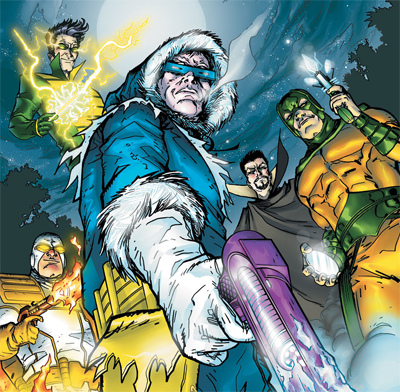
Cold warriors...

Continue reading

Mark Millar’s Run on Ultimate Fantastic Four – Vol. 3 (Hardcover) (Review/Retrospective)

Celebrating the 50th anniversary of the Fantastic Four, I’m taking a look at some of the stories featuring the characters over the past half-century.

Mark Millar isn’t quite the tough guy he makes himself out to be. Asked a few years ago about whether the birth of his child might tame some of his more sensationalist tendencies, Millar replied that – if anything – he would be even more motivated to push the envelope in order to demonstrate he hadn’t mellowed. And, in fairness, the years since have seen ideas like Kick-Ass or Wanted or Nemesis, all excessively and ridiculously cynical, graphic and violent. However, I maintain that Millar is a stronger writer when he channels his inner softer romantic – for example, demonstrating the respect he showed Superman in Red Son. Taking over Ultimate Fantastic Four for a year (perhaps on a trial run before writing for regular Fantastic Four), you get a sense that Millar has a genuine affection for these characters and their world – too much to try to make them “darker and edgier”, for example. While his run on Ultimate Fantastic Four isn’t the best thing he’s written, it is sharp and entertaining – and delivered with enough energy that it can’t help but warm the reader’s heart.

Never a drag...

Continue reading

Ultimate Galactus Trilogy (Review/Retrospective)

After spending the tail end of last year looking at the tangled inter-continuity crossovers at Marvel, I thought I’d spend January looking at some of the looser “out of continuity” tales at the major companies.

What does a continuity-lite crossover look like? I mean, a relatively self-contained comic book event that isn’t based upon years and years of events? Marvel famously launched their Ultimate line a decade ago to offer a chance to “reimagine” their classic stories – the Avengers became The Ultimates, and monthly issues of Ultimate Spider-Man, Ultimate X-Men and Ultimate Fantastic Four were available on the stands. The goal was to offer tales that would allow new readers to jump on board without having to worry about the weight of half-a-century (or more) worth of back story for the characters. Despite some minor crossover between the books – Mark Millar writing the Ultimates into his Ultimate X-Men run or Ultimate Spider-Man occasionally paying a short visit to the Baxter building – the line largely steered clear of the sort of bombastic big events that Marvel seems to love churning out month-on-month. So, what does an actual “big crossover event” look like when written for these characters? A bit like the Ultimate Galactus Trilogy, I suppose.

He's got the world in the palm of his hand...

Continue reading

Flashpoint

After spending the tail end of last year looking at the tangled inter-continuity crossovers at Marvel, I thought I’d spend January looking at some of the looser “out of continuity” tales at the major companies.

Flashpoint is the first big event of Geoff Johns’ relaunched run on The Flash. If Flash: Rebirth was intended to echo Green Lantern: Rebirth, fan anticipation and speculation suggest that his Flashpoint – a five-part miniseries – will serve as a counterpart to Sinestro Corps War on his Green Lantern run. However, the title Flashpoint has connotations for the character – it was the title of a relatively recent story featuring the character, one of DC Comic’s Elseworlds. I figured, with the big event coming it up, it might be worth a bit of a retroactive review of the title which perhaps inspired the event.

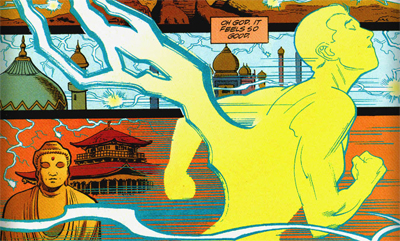
He moves like lightening...

Continue reading

Realm of Kings (Review/Retrospective)

This is the fifteenth in a series of comic book reviews that will look at the direction of Marvel’s shared universe (particularly their “Avengers” franchise) over the past five or so years, as they’ve been attempting to position the property at the heart of their fictional universe. With The Avengers planned for a cinematic release in 2012, I thought I’d bring myself up to speed by taking a look at Marvel’s tangled web of continuity.

Realm of Kings is a strange little chapter in the cosmic saga that Dan Abnett and Andy Lanning have been drafting. It seems to exist not really as a story in its own terms (although it does contain some interesting narratives) but rather as a bridge between War of Kings and The Thanos Imperative. It’s essentially the story of an attempt to find stability in a radically warped universe, one turned upside down by recent events. It feels somewhat smaller in scope than the other events that the pair have produced, not that there’s anything wrong with that. In fact, it’s nice to see a series exploring the consequences and aftermath of what has occurred, rather than simply pushing on right into the next big thing. While Realm of Kings does focus on “the Fault” opened at the climax of War of Kings that will become a galactic threat in The Thanos Imperative, the three miniseries are at their best when they explore the consequences of the political instability that the intergalactic war has produced.

That's gonna be Thor tomorrow...

Continue reading

X-Men/Dark Avengers: Utopia (Review/Retrospective)

This is the fourteenth in a series of comic book reviews that will look at the direction of Marvel’s shared universe (and, in particular, their “Avengers” franchise) over the past five or so years, as they’ve been attempting to position the property at the heart of their fictional universe. With The Avengers planned for a cinematic release in 2012, I thought I’d bring myself up to speed by taking a look at Marvel’s tangled web of continuity. Get an overview of what I’m trying to take a look at here.

There’s an essay to be written about how Marvel has so carefully and meticulously replaced the X-Men with The Avengers as their biggest A-list franchise book (in fact, there’s a quite wonderful essay written here about that). During the nineties, the big event crossovers at Marvel seemed to exist at the leisure of their mutants – Age of Apocalypse and Onslaught being two of the more obvious examples. However, since House of M, the mutants have been consciously sidelined. They continue to have their own internal events and crossovers – Messiah Complex and Second Coming the most obvious examples – but they remain largely insular and detached from the regular goings on in the Marvel Universe. Except for Wolverine, because he’s everywhere.

Marvel announces Dark Avengers on Ice!

Continue reading

Superman: The Animated Series – World’s Finest (Parts I, II & III)

This post is part of the DCAU fortnight, a series of articles looking at the Warner Brothers animations featuring DC’s iconic selection of characters. What with reviewing Superman/Batman: Public Enemies earlier, I figured it might be worth our time to take a look at the original Superman/Batman animated team-up. 

Thank you. I couldn’t have saved Lois without your help. 

I’m aware of that. 

– Superman and Batman share a moment of mutual Batman appreciation 

Superman: The Animated Series meets Batman: The Animated Series. How is that a tough sell? 

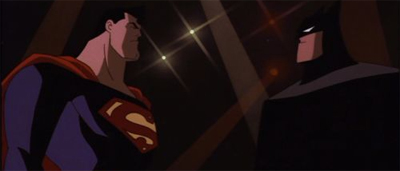
You can't outglower me, boy... in one of these animated movies I was played by Billy Baldwin...

Continue reading

War of Kings (Review/Retrospective)

This is the twelfth in a series of comic book reviews that will look at the direction of Marvel’s shared universe (particularly their “Avengers” franchise) over the past five or so years, as they’ve been attempting to position the property at the heart of their fictional universe. With The Avengers planned for a cinematic release in 2012, I thought I’d bring myself up to speed by taking a look at Marvel’s tangled web of continuity.

War of Kings is perhaps the best thing to come out of Secret Invasion. In fact, the miniseries went out of its way to highlight its links to the Marvel comics mega-event, with the story even kicking off in a Secret Invasion: War of Kings special (note the order there, it isn’t War of Kings: Secret Invasion). However, not withstanding the attempts to tie the series back to the high-selling mainstream events that Marvel was consistently churning out, War of Kings is essentially an epic space opera, the story of an interstellar war and alien politics, told with the wit and charm that writer Dan Abnett and Andy Lanning have made the cosmic line famous for. Tying it into Secret Invasion only serves to highlight the deficiencies with that event, as the writers here attempt the same sort of story with the same sort of themes, but with more skill and grace than the bigger event could off.

Now is the time...

Continue reading

Secret Invasion (Review/Retrospective)

This is the twelfth in a series of comic book reviews that will look at the direction of Marvel’s shared universe (particularly their “Avengers” franchise) over the past five or so years, as they’ve been attempting to position the property at the heart of their fictional universe. With The Avengers planned for a cinematic release in 2012, I thought I’d bring myself up to speed by taking a look at Marvel’s tangled web of continuity.

Well… that was anti-climactic.

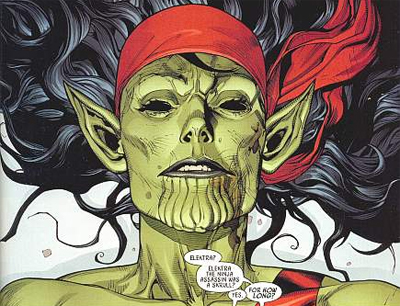
Well, at least green and red go together...

Continue reading

Brian Michael Bendis’ Avengers – Mighty Avengers: Assemble & Secret Invasion (Hardcover) (Review/Retrospective)

This is the ninth in a series of comic book reviews that will look at the direction of Marvel’s core continuity (and in particular their “Avengers” franchise) over the past five or so years, as they’ve been attempting to position the property at the heart of their fictional universe. With The Avengers planned for a cinematic release in 2012, I thought I’d bring myself up to speed by taking a look at Marvel’s tangled web of continuity. Get an overview of what I’m trying to take a look at here.

After the schism of Civil War, a title like Mighty Avengers makes sense on some level. If you’ve pitted heroes against heroes in a contest that you’ve deemed to be allegedly subjective (Marvel’s editorial policy was that there was no right or wrong side to the conflict), then it makes sense to follow the winners as well as the losers. The post-Civil War issues of Bendis’ New Avengers followed those heroes who had fought against registration of superheroes and lost, and Mighty Avengers was launched to offer us an on-going narrative featuring the winning side. It also seems to be a conscious nostalgic effort on the part of author Bendis, perhaps a response to the criticism that his early work on New Avengers steered clear of conventional Avengers storylines – occupied as they were with Japanese ganglands, prison breakouts and Sentry’s inter-personal issues. Here, Bendis seems to be consciously focusing on classic Silver Age devices – in the first run of issues, the State-sanctioned Avengers team faces classic foes like Ultron, the Symbiotes and even Doctor Doom. The problem is that Bendis isn’t necessarily comfortable drafting conventional superheroic fare.

Ultron puts Tony in touch with his feminine side…

Continue reading