• Following Us

  • Categories

  • Check out the Archives


  • Awards & Nominations

Tintin: The Calculus Affair (Review)

In the lead-up to the release of The Adventures of Tintin: The Secret of the Unicorn, I’m going to be taking a look at Hergé’s celebrated comic book character, from his humble beginnings through to the incomplete post-modern finale. I hope you enjoy the ride.

The Calculus Affair is an interesting little story that is one part suspense thriller, and another part mystery. In short, it’s almost the perfect cocktail to brew up a Cold War espionage thriller, which was exactly what Hergé was going for. It wouldn’t be too difficult to rework the adventure as a James Bond movie (in fact, it even features a sequence with our lead piloting a tank), but Hergé does a lot of work to ensure that the story never gets too heavily bogged down. Much like King Ottokar’s Sceptre, the story stands quite well as an examination of the time when it was written.
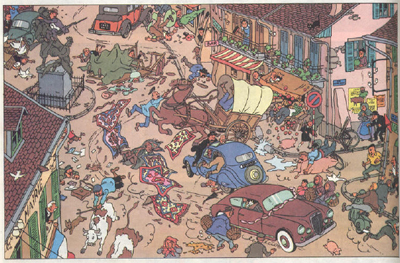
Another fine mess!

Continue reading

Tintin: Explorers on the Moon (Review)

In the lead-up to the release of The Adventures of Tintin: The Secret of the Unicorn, I’m going to be taking a look at Hergé’s celebrated comic book character, from his humble beginnings through to the incomplete post-modern finale. I hope you enjoy the ride.

The one thing I really admire about Explorers on the Moon is the fact that – for an adventure that takes the iconic boy reporter off te surface of the planet and launches him into outer space – it’s a remarkably low key affair. In fact, most of the book is devoted to nice character moments for the ensemble, and to explore some of the wonderful research Hergé did to put his story together. There’s no great mystery on the moon, none of the aliens that would later appear in Flight 714. Instead, Hergé seems to accept that launching his cast out of the planet’s atmosphere was enough of a radical deviation from the norm as it was. So what we get is a strange situation where Explorers on the Moon feels like one of the more grounded adventures in the series.

"Can you hear me, Major Tom?"

Continue reading

Non-Review Review: The Spy Who Came In From The Cold

Spying is a damn dirty business. Don’t let James Bond and his fancy Union Jack parachutes or underwater cars fool you. According to The Spy Who Came In From The Cold, it’s an empty and depressing little existence where the players are all confined to the role of pawns on a chessboard. I can’t help but feel that there’s something symbolic about the scene where Alec Leamas, played by Richard Burton, assaults an elderly shopkeeper, played by Bernard Lee – the actor who was playing Bond’s paymaster, M. Given the character’s growing sense of disillusionment, it can’t help but feel strangely potent to see him lash out a symbol of the other – far more romanticised – series of adventures built around British Intelligence.

"I, I can remember... standing by the wall... and the guns, the guns shot above our heads..."

Continue reading

Ex Machina: The Deluxe Edition – Volume III (Review)

In an effort to prove that comic books aren’t just about men in spandex hitting each other really hard, this month I’m reviewing all of Brian K. Vaughan’s superb Ex Machina. And in June, I’ll be reviewing his Y: The Last Man.

We’re at the half-way point in this saga of the superhero mayor of New York City, so that means that Vaughan and Harris are turning things up a few notches. The three central threads of the series – Mayor Hundred’s time in office, his history as a superhero and the conspiracy surrounding his origin – are beginning to intertwine and collide in a variety of interesting ways. Being entirely honest, I’ve always been a bit skeptical about how the series hopes to balance all these different elements, particularly with a relatively short run of fifty issues. As things begin to move to a head, it becomes clear which of these particular threads that Vaughan is going to focus on.

Talk about catching the bus...

Continue reading

Non-Review Review: GoldenEye

This post is part of James Bond January, being organised by the wonderful Paragraph Films. I will have reviews of all twenty-two official Bond films going on-line over the next month, and a treat or two every once in a while.

GoldenEye saved James Bond. Bond had wallowed in obscurity for six years by the time that Pierce Brosnan’s first appearance in the role was released. As a kid, James Bond was something that was dead to me. Sure, it came on television from time to time (mostly on holidays) and they filled up a shelf at the videostore, but I always felt like they were something that had happened in the past – like the original Star Wars movies, or any Star Trek films featuring Captain Kirk. Even though I lacked the sophistication to articulate it at the time, I think I felt that the entire James Bond franchise would be reruns for me. There was nothing new happening.

And then GoldenEye was released.

Brosnan is Bond...

And it meant business.

Continue reading

Non-Review Review: The Bourne Supremacy

I have to admit that The Bourne Supremacy is the strongest of the Bourne films for me, even though fans of the series tend to forget it, snuggled as it is between The Bourne Identity and The Bourne Ultimatum. The middle part of the trilogy is undoubtedly the most straight-forward, but that isn’t a weakness – it contains a well-motivated character arc for the character of Bourne while handling the themes of the series remarkably well, and still paying homage to all the plot devices that one associates with the espionage thriller. It isn’t preoccupied with setting anything in motion, nor in wrapping anything up, but that gives the movie much more freedom than the two that surround it.

Nobody said it would be a walk in the car park...

Continue reading

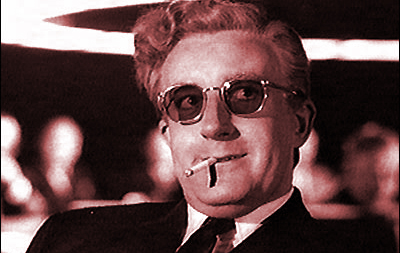
Non-Review Review: Dr. Strangelove (Or: How I Learnt to Stop Worrying and Love the Bomb)

What I’m about to say is grounds for excommunication from the church of film geekdom, but I am not a huge Stanley Kubrick fan. I admire and appreciate his work from a technical level and there are a few of his films I would credit as genuine classics – and yet there are others that I am markedly indifferent to. Cinematic purists will balk when I suggest The Shining – that most commercially Hollywood production – is my favourite of Kubrick’s film. Dr. Strangelove (Or: How I Learnt to Stop Worrying and Love the Bomb) is widely regarded as a classic of Cold War cinema, but I must concede that I can’t help but feel a little disconnected from it. Of course quite a large portion of the film (particularly the broader comedy) is still hilarious, but the film refers to a world that I never really knew – I was born in the twilight of the Soviet Union, disconnected from this heated level of nuclear paranoia.    

There's nothing strange about the love for this film...

Continue reading