• Following Us

  • Categories

  • Check out the Archives


  • Awards & Nominations

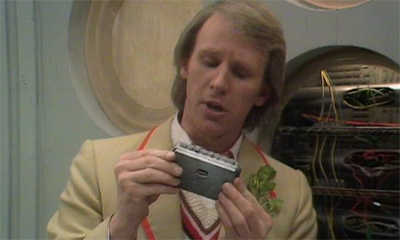
Doctor Who: The King’s Demons (Review)

To celebrate the fiftieth anniversary of the longest-running science-fiction show in the world, I’ll be taking weekly looks at some of my own personal favourite stories and arcs, from the old and new series, with a view to encapsulating the sublime, the clever and the fiendishly odd of the BBC’s Doctor Who.

The King’s Demons originally aired in 1983.

Do our demons come to visit us? Bid them attend us.

Demons? Very odd indeed.

Makes a nice change for you not to take everything in your stride, I must say.

– King John, the Doctor and Tegan set the mood

The show’s twentieth anniversary deserved better than this. Okay, there are a number of qualifications that can made, excuses that can be offered. The King’s Demons was never intended to close out the season, and was instead intended as a two-part episode to bridge into the triumphant return of the Daleks, a return that ended up postponed a year and reworked into Resurrection of the Daleks. There’s also the fact that The King’s Demons wasn’t the last piece of Doctor Who to air as part of the show’s twentieth anniversary year, even if it was the season finalé. The Five Doctors would be broadcast later in the year to celebrate the anniversary.

However, none of these excuses take away from the fact that The King’s Demons is an exceptionally weak piece of television, and a demonstration of everything wrong about how John Nathan Turner and the Doctor Who production staff approached the show’s twentieth season.
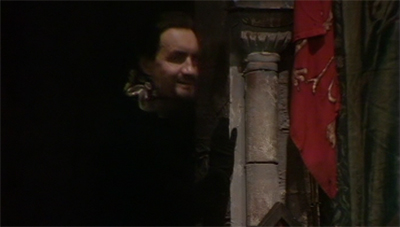
Hardly a Master piece...

Hardly a Master piece…

Continue reading

The Death & Return of Superman Omnibus (Review/Retrospective)

To celebrate the release of The Man of Steel this month, we’re going Superman mad. Check back daily for Superman-related reviews.

The Death & Return of Superman stands as one of the most influential and iconic Superman stories ever told. It was certainly the best-selling, even if that doesn’t necessarily make it the most-read, due to the nature of the nineties comic book speculation market. Read today, separate from all the hype and publicity and novelty items, it’s a very interesting part of the character’s lore. It’s certainly an ambitious tale, epic in scope. However, it’s very clearly disjointed and oddly paced and often demonstrates a strange disconnect with its own subject. A story with the title The Death & Return of Superman should probably offer some profound insight into its lead character. This just feels like a series of plot twists peppered with some casual observations.

Death of a hero...

Death of a hero…

Continue reading

Watch Out! The James Cult Film Club is Doing Intermission, 18th June 2013, Dublin!

I’m a big fan of the Jameson Cult Film Club. It exists as an ode to classic movies, finding a way to stage beloved classics in a way which encourages audiences to re-engage with them. Transforming a piece of Dublin into a set from the film, hiring actors to bring certain key sequences to life, even serving appropriate snack food, these events are a joyous celebration of pop cinema.

Their next film will be interMission, which is one of my favourite Irish films of the past decade. It feels appropriate to celebrate the movie’s tenth birthday with a celebratory showing at a secret location in the cinema. It’s a great choice, and it’s always a good excuse to celebrate a quality piece of Irish cinema.

intermission1

Anyway, we’ll hopefully have some tickets to give away in the next week or so to the showing on the 18th June. As with all the Jameson Cult Film Club screenings, the event is free of charge – which is quite nice, I have to say. Tickets are randomly raffled off, and you can sign up as a member at the Jameson Cult Film Club website. If you want some examples of their good work, we’ve got some photos from their screenings of The Blues Brothers, Silence of the Lambs and L.A. Confidential, among other things.

I’m normally quite wary of offering whole-hearted unqualified endorsements on the blog, but it’s really something I’d recommend that every cinephile should try at least once. And, if you’re reading this from outside of Ireland, feel free to check out interMission for a decidedly Irish piece of cinema. Only In Bruges really comes close to it – and that really falls into the quasi-ambiguous “Father Ted” category of “is it an Irish piece of entertainment?”

intermission

In the meantime, I’m off to make myself some tea. Maybe even with brown sauce.

Doctor Who: Arc of Infinity (Review)

To celebrate the fiftieth anniversary of the longest-running science-fiction show in the world, I’ll be taking weekly looks at some of my own personal favourite stories and arcs, from the old and new series, with a view to encapsulating the sublime, the clever and the fiendishly odd of the BBC’s Doctor Who.

Arc of Infinity originally aired in 1983.

We know who you are.

That changes nothing.

– the Doctor and Omega set one thing straight

There really should be a bare minimum threshold of enjoyment for a Doctor Who story set on Gallifrey. I mean, these are beings who claim to control the whole of time and space. Their guards look like they modelled themselves on Adam Strange, replacing his jetpack with a cape, and there’s always an excuse for some good old-fashioned science-fiction ray-gun-related fun. How hard can it be to entertain an audience for four episodes in that particular setting?

Unfortunately, Arc of Infinity answers that question. Quite boring indeed, it seems.

Going around in circuits...

Going around in circuits…

Continue reading

Non-Review Review: This is the End

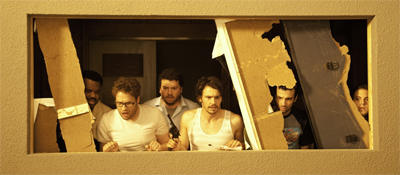
There’s a moment about half-way through This is the End when our bunch of celebrities are starting go stir-crazy, as they brave the apocalypse inside James Franco’s surprisingly fortified house. In the strange combination of idle boredom and growing madness, the group decide to improvise a trailer for the non-existent sequel to Pineapple Express. It is complete nonsense, but there’s a strange energy and a warm sense of humour to their “sweded” version of a Hollywood comedy, complete with remote-control car chases and homemade props.

It feels like something that only these actors would get – it’s just a bunch of people hanging out, fooling around, making the most of the materials available to them do something which feels incredibly niche. It’s a weird balance of something so experimental and so niche that it’s almost definitely a piece of post-modern art. (The movie even features an early scene of pretentious James Franco gleefully arguing that everything is art – even Jay Baruchel.) On the other hand, it’s accessible and fun, managing to seem – simultaneously – like an incredibly niche and charmingly broad piece of film.

It’s also pretty damn funny.

... and I feel fine...

… and I feel fine…

Continue reading

Non-Review Review: The Fast & The Furious 6

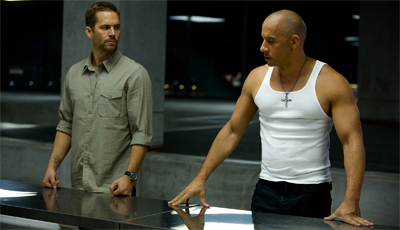
The ideal The Fast & The Furious film could only properly be summated with hand gestures and poorly improvised sound effects. “Rrrrrrr….” and then (wavy hand movement) and then “smack!” and then (index finger jams into opposite palm), followed a “bb’tccccch…” and (outward gesture of hand indicating explosion). Fast Five came close to being that perfect macho car chase film, one less concerned with plot and performance than a riveting high-octane spectacle treating its human cast as much like props as the vehicles they drive.

The Fast & The Furious 6 backs away a great deal from the charm of the previous film. There’s the same dumb action set pieces delivered in a charmingly intense manner by Justin Lin, but the script feels over-plotted. There are lots of big emotional moments between an ensemble that really wasn’t built to give those sorts of performances. There are lots of shocking revelations from events several films earlier. There are lots of personal conversations where Lin has no idea what to do with the camera but circle around his actors and hope that the audience doesn’t get too bored.

Not so fast...

Not so fast…

Continue reading

Non-Review Review: Epic

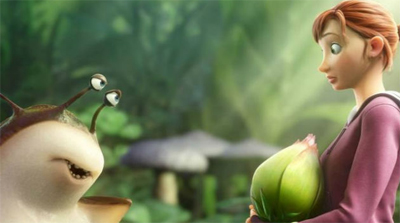
Epic looks stunning. While it doesn’t necessarily push the envelope in terms of 3D rendering or animation, it’s often quite beautiful to watch. Even in 3D, the vibrant greens radiate off the screen, with the characters having a pleasant elasticity to them. The action sequences are well-staged and the choreography is generally impressive. However, despite this, Epic winds up feeling rather shallow. Perhaps it’s a result of the decision to develop the world as a priority, rather than the characters inhabiting it.

The story is more a collection of familiar tropes and set-pieces than a compelling narrative, and none of the lead characters are ever developed beyond basic archetypes. There’s the plucky heroine, the roguish hero, the gruff mentor, the free-spirited wise oracle, the drôle accented bad guy, the comic relief and even the kooky dad. None feel of any real substance, which is a problem when you’re executing a plot as straight-forward as this.

It's a slug's life...

It’s a slug’s life…

Continue reading

Doctor Who: Earthshock (Review)

To celebrate the fiftieth anniversary of the longest-running science-fiction show in the world, I’ll be taking weekly looks at some of my own personal favourite stories and arcs, from the old and new series, with a view to encapsulating the sublime, the clever and the fiendishly odd of the BBC’s Doctor Who.

Earthshock originally aired in 1982.

I would suggest you get your people well back. The hatch may be booby-trapped.

What about you?

Well, my arms are only this long. I can’t get any further away.

– the Doctor and Scott

Earthshock is regarded as one of the stronger stories of Peter Davison’s tenure on Doctor Who. It’s easy enough to see why. After all, it features not one but two memorable twists. It also harks back to the classic “base under siege” stories of the Patrick Troughton era. While it’s still very clearly a piece of early eighties Doctor Who, its production values hold up rather well compared to adventures from that era of the show. It’s written by Eric Saward and, like The Visitation, it has that same sense of tension and pace, building towards a truly massive final twist.

And yet, despite that, I find it very difficult to love Earthshock. I suspect a lot of that is down to how it seems like Doctor Who learned all the wrong lessons from Earthshock, retroactively tainting an otherwise very solid serial.

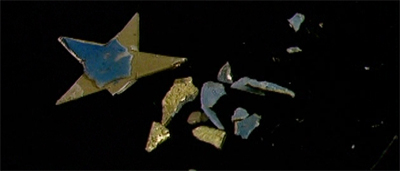
Shattered...

Shattered…

Continue reading

Doctor Who: Black Orchid (Review)

To celebrate the fiftieth anniversary of the longest-running science-fiction show in the world, I’ll be taking weekly looks at some of my own personal favourite stories and arcs, from the old and new series, with a view to encapsulating the sublime, the clever and the fiendishly odd of the BBC’s Doctor Who.

Black Orchid originally aired in 1982.

Why would I attack you? Have you done me any harm?

No!

No, then I’ve no reason to harm you. And besides…

Besides what?

Well, it wouldn’t be cricket.

– the Doctor, Ann Talbot and Muir

Black Orchid is pretty damn frustrating. There’s a lot of interest here, but sadly it’s mostly from a technical point of view. This is the first two-part adventure since The Sontaran Experiment. It’s also the first historical story told with no science-fiction elements excluding the TARDIS crew since The Highlanders. It’s also the penultimate adventure starring this version of the TARDIS crew, and the last Fifth Doctor serial before his world is turned upside down in Earthshock. So there’s a lot that should be interesting here.

Unfortunately, the writing is at best generic and at worst actively crap. Black Orchid feels exactly like the sort of thing that the BBC was doing without countless television shows other than Doctor Who, so Black Orchid needs to be able to do it to a reasonable standard. Instead, it feels like a murder mystery written by somebody writing with an Agatha Christie adaptation on in the background. It’s frustrating, because there’s a lot of potential here, but the end result is just disappointing.

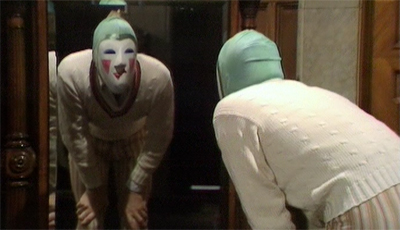
Clowning around...

Clowning around…

Continue reading

Doctor Who: The Visitation (Review)

To celebrate the fiftieth anniversary of the longest-running science-fiction show in the world, I’ll be taking weekly looks at some of my own personal favourite stories and arcs, from the old and new series, with a view to encapsulating the sublime, the clever and the fiendishly odd of the BBC’s Doctor Who.

The Visitation originally aired in 1982.

It’s survival, Doctor. Just as these primitives kill lesser species to protect themselves, so I kill them.

That’s hardly an argument.

It’s not supposed to be an argument. It’s a statement!

– the Terileptil is in no mood for debate with the Doctor

As far as writing débuts go, The Visitation is not a bad first script. Writer Eric Saward had experience writing for radio, but The Visitation was his first live action script to be produced. It’s a pretty solid piece of Doctor Who, even if it’s not anything exceptional. Then again, Robert Holmes’ first script was the perfectly average The Krotons. So there’s room for improvement, and The Visitation is not a bad place to start from.

Of course, Holmes feels like the appropriate comparison here. Not only was Saward a massive fan of Robert Holmes, with the treatment of the ailing Holmes during The Trial of a Time Lord serving as one of the reasons for his departure from the show, but it also seems that The Visitation was very clear attempt to emulate Holmes’ approach to Doctor Who. In fact, it feels like an attempt to update Holmes’ Third Doctor story, The Time Warrior.

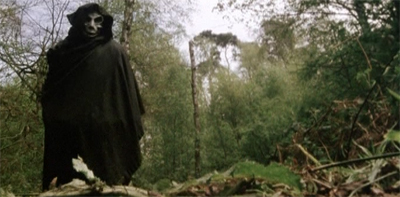
Death stalks the countryside...

Death stalks the countryside…

Continue reading