• Following Us

  • Categories

  • Check out the Archives


  • Awards & Nominations

The X-Files (Topps) #3 – A Little Dream of Me/The Return (Review)

This August (and a little of September), we’re taking a trip back in time to review the second season of The X-Files. In November, we’ll be looking at the third season. And maybe more.

There are inevitable challenges in working on a licensed property. You are effectively playing with somebody else’s toys. Since these tie-ins cannot drive a narrative currently unfolding in another medium, it’s often a challenge to maintain the illusion of forward momentum while existing at the behest of a story that can change from week-to-week. While The X-Files was a massive coup for Topps comics, and while Stefan Petrucha and Charles Adlard did a wonderful job, the comic had to face these constraints.

A Dismembrance of Things Past had brushed up against those limitations in trying to tell a U.F.O. story without meddling in the television show’s continuity. Petrucha used some fiendishly clever sleight of hand there, suggesting that the story would be about an alien visitation and possible cover-up, only to reveal that the story was actually an intimate meditation on the ideas of truth and memory. It was a rather ingenious bait-and-switch, resulting in a wonderful little story.
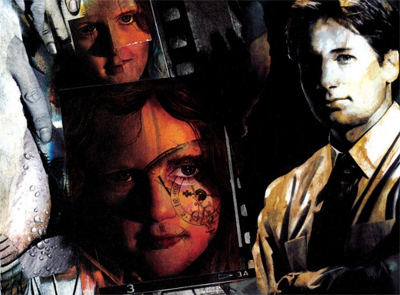
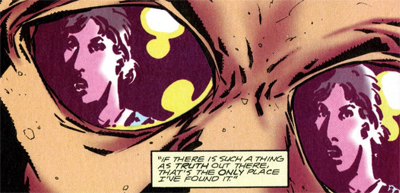
Pictures in his head...

Pictures in his head…

A Little Dream of Me is not quite as efficient in dealing with the external limitations imposed on a tie-in comic book. The unfortunate realities of comic book scheduling meant that A Little Dream of Me had the misfortune to hit the stands very shortly after the broadcast of Colony and End Game. Of course, the script for A Little Dream of Me would have been written long before the episodes aired (about six months), but the scheduling causes the comic to suffer.

After all, Colony and End Game had made it abundantly clear that Samantha Mulder was unlikely to be returning to her family any time soon. And that was in the television show. The third issue of the comic book teasing the return of Samantha Mulder seems like a rather cynical cheat.

The "X" file...

The “X” file…

Continue reading

The X-Files – Fearful Symmetry (Review)

This August (and a little of September), we’re taking a trip back in time to review the second season of The X-Files. In November, we’ll be looking at the third season. And maybe more.

Fearful Symmetry is an embarrassing mess of an episode. It’s ambitious, but it’s clumsy and over-wrought. It aspires to great things, but is instead completely banal. For a show featuring an invisible elephant, that’s no small accomplishment.

Tyger, Tyger...

Tyger, Tyger…

Continue reading

The X-Files – Colony (Review)

This August (and a little of September), we’re taking a trip back in time to review the second season of The X-Files. In November, we’ll be looking at the third season. And maybe more.

Colony is another second season game changer. As with other episodes in the second season, there’s a sense that the production team are really getting to grips with what works with the show – laying groundwork and defining a template that they can work with into the show’s third season. While the Duane Barry and Ascension two-parter had been an act of desperation to work around Gillian Anderson’s pregnancy, Colony and End Game is a two-parter that the show embraced entirely of its own volition.

These two two-part episodes really set the template for the show going forward. There’s a sense that Chris Carter and his team were really defining what a season of The X-Files should look like, giving them a blueprint that they might build on in the years ahead. From the second season through to the sixth, the show would stick quite rigidly to the idea of two big two-parters in the middle of the season, quite apart from any multi-part stories bridging the seasons.

Lights in the sky...

Lights in the sky…

These two parters were typically broadcast as part of the “sweeps”, and inevitably focused on the show’s alien conspiracy mythology. Even the more stand-alone two-parters like A Christmas Carol and Emily or Dreamland Part I and Dreamland Part II still build off the series’ central mythology. Given those were the points at which the show got the highest exposure, and the point where the show worked hardest to draw in an audience, it’s no surprise that the mythology arc rose to such prominence.

Duane Barry and Ascension undoubtedly set a precedent, but those episodes were prompted by factors outside the control of the creative team. However, Colony and End Game really solidified that precedent into a guiding principle for the show. This two-parter comes to codify and cement a lot of the things that the show’s mythology comes to take for granted. For better and worse.

Quite pointed...

Quite pointed…

Continue reading

The X-Files (Topps) #2 – A Dismembrance of Things Past (Review)

This August (and a little of September), we’re taking a trip back in time to review the second season of The X-Files. In November, we’ll be looking at the third season. And maybe more.

A Dismembrance of Things Past is an absolute delight, and a nice demonstration of how well writer Stefan Petrucha and Charles Adlard could tell stories set within The X-Files universe.

There are many interesting things about A Dismembrance of Things Past. It’s a fine piece of work, deftly balancing the demands on a new comic book set within the world of The X-Files with an urge to tell a story that fits very clearly and very comfortably within the show’s basic structure. It is easy to imagine A Dismembrance of Things Past receiving a live-action adaptation. Indeed, Petrucha’s script feels like something of a tribute to writer Darin Morgan before Darin Morgan had even written for the show, half-way between Blood and Jose Chung’s “From Outer Space.”

Something to remember them by...

Something to remember them by…

A Dismembrance of Things Past confronts the difficulties of writing a tie-in comic book to The X-Files, while using those constraints to tell an interesting story in its own right. After all, the comic book would have to tell an alien or U.F.O. story eventually. The words “The X-Files” are written on the cover, and that comes with the territory. At the same time, Petrucha and Adlard have to acknowledge the fact that the tie-in comic book cannot advance the on-screen mythology arc. Indeed, it seems unlikely Carter had shared too much of that arc with Petrucha or Adlard.

It takes a lot of skill to balance these competing demands of a tie-in comic book – to remain connected to the source material, but never pulling too far away or ahead, while remaining interesting. A Dismembrance of Things Past manages to satisfy all of its obligations and then some.

Through alien eyes...

Through alien eyes…

Continue reading

The X-Files – Little Green Men (Review)

This August (and a little of September), we’re taking a trip back in time to review the second season of The X-Files. In November, we’ll be looking at the third season. And maybe more.

“We wanted to believe,” Mulder’s opening monologue explains. In a way, The X-Files works best as a profound meditation on faith. Not just Scully’s traditional religious faith, but Mulder’s belief that the world must make sense – even a crazy conspiratorial sort of sense. While Scully is a practising Roman Catholic, Mulder’s officer poster proclaims “I want to believe.” It’s a show about faith in humanity. A show about two people with unshakeable faith in each other.

“Trust no one,” a dying Deep Throat advised Scully in The Erlenmeyer Flask, words impossible to live by. Unsurprisingly, while treated as a mantra and motto for the show, the agents seem to freely ignore that last warning. Mulder and Scully trust each other. Mulder trusts the Lone Gunmen, and Senator Matheson, along with just about everything he reads or is told that reinforces his faith. It’s telling that – despite his cynicism about the government and her religious faith – the show casts Scully (rather than Mulder) in the role of skeptic.

His darkest hour...

His darkest hour…

Little Green Men is effectively a second pilot for the show. While set in the new status quo established during the closing scene of The Erlenmeyer Flask, the episode is very much structured as a “jumping on” point for those who might want to start watching the series. After all, the first season had been a cult hit, but hadn’t quite set the world on fire. Offering an introduction to those attracted by the growing buzz surrounding the show over the summer hiatus makes sense.

And so Little Green Men is built around Mulder’s crisis of faith and his attempts to vindicate that faith, offering a thoughtful examination of a man who wants to believe. While Little Green Men doesn’t offer any large steps forward in the show’s mythology or story arcs, it is a moving and introspective piece.

Samantha gets carried away...

Samantha gets carried away…

Continue reading

X-Men: The End – Book Two: Heroes and Martyrs (Review/Retrospective)

This May, to celebrate the release of X-Men: Days of Future Past, we’re taking a look at some classic and modern X-Men (and X-Men-related) comics. Check back daily for the latest review.

To describe Chris Claremont’s three six-part miniseries that comprise X-Men: The End as “convoluted” is to miss the point. Of course they are convoluted. Claremont is essentially writing a gigantic epilogue to his work on Uncanny X-Men. He is tidying away decades of continuity and offering a sense of closure to his work on these characters and their world. Claremont is an exceptional storyteller when it comes to long-form serialised storytelling.

As a writer, Claremont tends to layer interesting twists on top of interesting twists, with every resolution opening up more avenues for future stories to explore. He has demonstrated an ability to string along plots for decades, revisiting characters and situations years after most readers had forgotten about them. These are the qualities that make his Uncanny X-Men run so deeply fascinating, but they are also the qualities that make him a bit of an awkward fit for a concept like The End, an epic miniseries built around the idea of wrapping up the entire X-Men mythos.

Some things never go into fashion...

Some things never go into fashion…

However, what is so fascinating about X-Men: The End is that all of the elements that Claremont uses are the same elements that he has been playing with since he took over Uncanny X-Men. The story beats have a familiar pattern to them, the themes are familiar, the characters speak as they did in the years that Claremont wrote them. What is fascinating about X-Men: The End is the way that it serves to really set Claremont’s take on the X-Men in stone, treating the elements associated with Claremont as a truly inexorable part of the comic’s mythology.

X-Men: The End is very much a Chris Claremont comic, through-and-through. That’s what makes it feel like such a perfect fit.

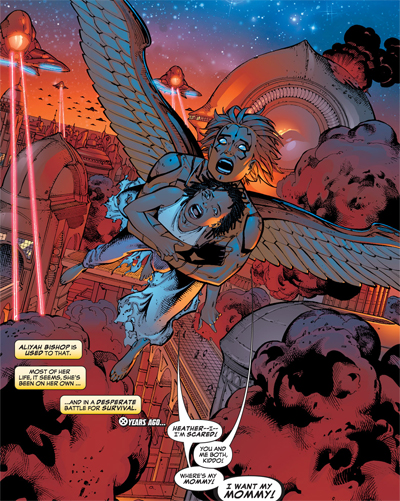
A wing and a prayer...

A wing and a prayer…

Continue reading

Non-Review Review: Under the Skin

This film was seen as part of the Jameson Dublin International Film Festival 2014.

Under the Skin exists as a gigantic flash backwards to the atmospheric and moody science-fiction horrors of the seventies. Despite a verbal reference to 2014 and some quick glimpses of posters for movies released in 2012, director Jonathan Glazer has constructed the movie as a throwback. Indeed, Under the Skin feels very much like an even lower key spiritual successor to Nicholas Roeg’s The Man Who Fell to Earth, except this time it’s the Scarlett Johansson who fell to Scotland.

undertheskin3

Continue reading

Non-Review Review: Predator

Predator is an absolutely brilliant piece of work. It’s elegantly constructed, beautifully directed and cleverly written. Perhaps the smartest thing about Predator is the way that it so fantastically plays on audience expectations, offering the perfect bait-and-switch, teasing a jungle adventure in the style of Schwarzenegger’s Commando before morphing into something else entirely. It’s so well handled that the film’s reputation and prestige has done little to dampen its thrills.

A predator stalks...

A predator stalks…

Continue reading

Non-Review Review: Alien vs. Predator

To celebrate the release of Prometheus in the United States this week, we’ll be taking a look at the other movies in the Alien franchise.

I like cheesy movies. I have a fondness for those old fashioned mix-and-match creature features from back in the day. I have a remarkable tolerance for some of those incredibly awkward B-movie adventures featuring relatively bland characters trapped in a strange and slightly illogical situations. As such, I’m probably a bit fonder of Paul W.S. Anderson’s creature-feature fight-night beat-’em-up schlock-fest Alien vs. Predator. I’m not so fond that I’d argue it’s a good movie – in fact, I’d readily concede that it’s a disappointing lifeless husk of a movie. However, I will concede that there are some interesting concepts and ideas buried quite deeply in the middle of that film.

Natural born predators…

Continue reading

Non-Review Review: Aliens (Theatrical Cut)

To celebrate the release of Prometheus this week, we’ll be taking a look at the other movies in the Alien franchise.

I think Aliens might be my favourite James Cameron movie. Of course, the guy has any number of iconic movies vying for that position – The Terminator and Terminator 2 both come to mind, for example – but I can’t help but admire how efficiently the director constructed his first big budget motion picture. Regardless of its place within an iconic science-fiction franchise, Aliens is practically a guidebook on how to effectively construct a movie, from writing the script to directing the action and absolutely everything in between. It’s hard to look at Aliens as anything less than a complete triumph, no matter which angle you examine the film from.

Queen bee…

Continue reading