I’m thrilled to be launching 3-Minute Reviews on Escapist Movies. Over the coming weeks and months, I will be joining a set of contributors in adding these reviews to the channel. For the moment, I’m honoured to contribute a three-minute feature film review to the channel, discussing Soul, the Pixar film that is now streaming on Disney+.
The Escapist have launched a movie podcast, and I was thrilled to join Jack Packard for a special Christmas episode, and our last episode of the year. The idea developed once it became clear that Jack and I were separately looking at this concept from two very different angles. So we decided to tackle the big question: is Die Hard a Christmas movie?
I published a new piece at The Escapist today. As ever, there are rumours in Star Wars fandom about the possibility that the sequel trilogy will be removed from canon.
As ever, these rumours are most likely nonsense designed to generate clicks in an economy that has monetised outrage clicks by stoking and feeding fan resentment and anger. However, they also reveal something very interesting about the nature of canon in modern fandom. The idea of “canon” has nothing to do with continuity. It is instead a way of asserting power and ownership over media, of asserting that a franchise “belongs” to one particular group and not for others.
You can read the piece here, or click the picture below.
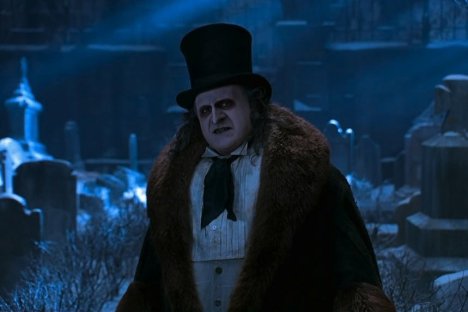
I published a new In the Frame piece at The Escapist this evening. It’s Christmas, so it seemed like a good time to take a look back at one of the most underappreciated Christmas movies ever: Batman Returns.
Batman Returns is a decidedly unconventional Christmas movie, packed with weirdos and freaks, commercialism run amok and climaxing with the aborted mass murder of an entire city’s firstborn sons. However, it is this weirdness that makes Batman Returns such a delightful Christmas movie, and one that is arguably perfectly suited to this most strange and surreal Christmas. At its core, Batman Returns is a mood piece built around what it feels like to be lonely at Christmas.
You can read the piece here, or click the picture below.
Hosted by Andrew Quinn and Darren Mooney, and this week with special guest Niall Murphy, The 250 is a weekly trip through some of the best (and worst) movies ever made, as voted for by Internet Movie Database Users. New episodes are released Saturdays at 6pm GMT.
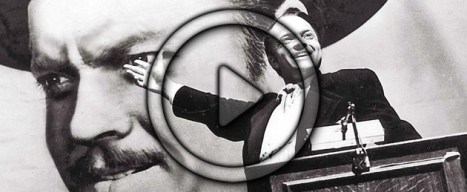
So this week, Orson Welles’ Citizen Kane.
Following the death of Charles Foster Kane, reports of the magnate’s final word slip out to the press. Trying to parse a portrait of the public figure’s life and times, a reporter attempts to discern the meaning of the word, “Rosebud.”
At time of recording, it was ranked 97th on the list of the best movies of all time on the Internet Movie Database.
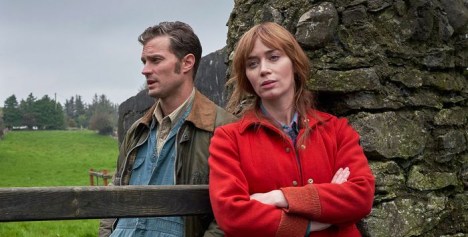
“Welcome,” narrates Christopher Walken in the opening moments of Wild Mountain Thyme. “Welcome to Ireland. My name’s Tony Reilly. And I’m dead.”
Even before it as released, Wild Mountain Thyme had positioned itself as a viable candidate for the “best bad movie of 2020”, a title that merits some distinction from actually and actively bad movies like Artemis Fowl or Songbird. There is something inherently performative about the idea of “best bad movies”, which requires them to be inherently entertaining in decidedly unconventional ways. Of course, Cats is perhaps the great example of this is recent memory, a terrible movie that has been swiftly reclaimed as a cult classic.
Fifty shade of green.
The premiere of the trailer for Wild Mountain Thyme immediately grabbed the internet’s attention, as did news about the plot of the play from which writer and director John Patrick Shanley was drawing. There was something about the combination of factors at play: the terrible accents, the twee portrayal of rural Ireland obviously written from an outsider’s perspective, Shanley’s interview comments about the Irish, and rumours about an insane third act twist. There was some anticipation that this could be an equivalent to something like Steven Knight’s Serenity.
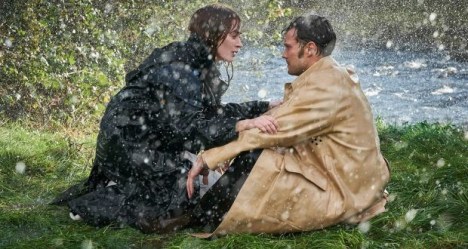
Of course, the truth is that competing at this level, drawing that sort of interest and fascination, requires a certain spark. For all the problems with Serenity, it was not a film that lacked for ambition. Knight followed his impulses unwaiveringly and unquestioningly, and there’s something intoxicating in watching a film steer itself so confidently towards a premise so completely insane, with no real idea of how to execute the twists that it wants to employ. Sadly, Wild Mountain Thyme lacks that energy and vigour. Indeed, the worst thing about it is how dull it is.
Nomadland is essentially two competing and irreconcilable films.
The first, and more successful film, is a character study of its protagonist. Frances McDormand plays Fern, a widow who has embarked on a life on the road following the death of her husband and the destruction of the community in which she lived. Fern is a wanderer, a restless soul who finds herself trapped between the harsh demands of life on the road and the freedom that such a lifestyle affords her. She is a restless soul wandering across the vast open plains of the United States of the America.
Fern From Home.
The second, and irreconcilable, film is a snapshot of a particular class of people that developed in the aftermath of the Great Recession. As jobs were destroyed and houses were repossessed, large numbers of people found themselves dispossessed and force to live an itinerant existence largely dependent upon the gig economy to keep their heads above the ever-rising tide. There is something almost documentarian about this film, drawing as it does from Jessica Bruder’s non-fiction book and featuring many actual “nomads” in supporting roles.
Nomadland quite rightly refuses to condescend to the people who have found a way to survive on the margins. However, the decision to focus on a character like Fern robs the movie of a lot of its potential sting and insight. Watching Nomadland, there’s something almost empowering about the way that Fern’s existence plays out, a sense in which Fern is living the way that she always wanted to on some level. This feels rather cynical and calculated in the context of the very real and devastating trauma of the financial crisis and the destruction that it wrought.
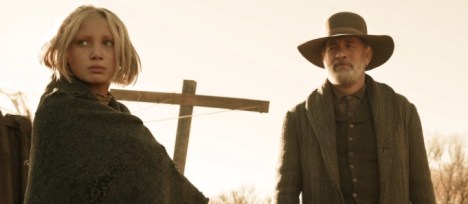
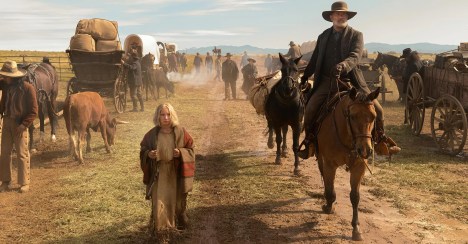
News of the World is a gentle and sweet modern western, albeit more than a little disjointed.
Adapted from Paulette Jiles’ novel of the same name, News of the World is essentially an update on the classic western template exemplified by The Searchers. Captain Jefferson Kyle Kidd is a veteran of the Civil War who makes his living travelling through the Southern United States, reading the news to assembled crowds. On one journey, Kidd comes across a carriage that has been destroyed. Its driver has been killed, and its sole occupant – a young girl – abandoned.
“Jo, hanna! Time to go!”
Kidd determines that the young girl is named Johanna. She was taken from her parents when she was very young and raised by the Kiowa tribe. She was recently recovered, and the army is attempting to send her back to her last surviving relatives. Of course, with her escort killed and the Union forces scattered trying to manage Reconstruction, Kidd finds himself tasked with caring for the young woman and ferrying her across the nation to reunite her with her mother’s extended family.
There’s a surprising and endearing warmth to News of the World, which largely comes from casting Tom Hanks in the lead role. In some ways, this feels like the movie’s most telling update to that classic western formula, replacing John Wayne’s true grit with Tom Hanks’ hanksian decency. News of the World is perhaps a little too episodic and too uneven for its own good, occasionally feeling like a more mainstream counterpart to something like The Sisters Brothers, but it works largely thanks to the central performances of Tom Hanks and his co-star Helena Zengel.
If Onward had been positioned as the populist Pixar film this year, then Soul is a counterproint. It is a prestige piece for the company, something similar to Inside Out or Wall-E. After all, Soul is the latest project from Pete Docter. Docter has been part of the Pixar brain trust since its earliest days, even working on the stories for Toy Story and Toy Story 2. However, Docter’s most recent high-profile work has been his scripting and directing duties on Up and Inside Out, two Pixar films to have been nominated for Best Picture and to win Best Animated Feature.
The afterlife and all that jazz.
The premise of Soul is suitably abstract. Joe Gardner is a music teacher who always dreamed of being a successful stage musician. One day, a former student gets in contact with him, offering a gig with jazz legend Dorethea Williams. Joe manages to land the gig, and is convinced that his fortunes are about to change for good. Naturally, dramatic irony strikes, and Joe finds himself sent to the afterlife. Refusing to accept that his life is over, Joe commits to doing whatever it takes to get back to Earth and live his dream. “I’m not dying today,” he vows. “Not when my life just started.”
Soul deals with very big ideas in a remarkably clever way. The film creates a compelling and fascinating imaginary world that recalls both Riley’s internal life from Inside Out and even the afterlife depicted in Coco. Docter also uses the story as a meditation on weighty subject matter like death, dreams and disillusionment. It’s bold and striking, and the film largely works as a showcase for the company’s imagination. However, Soul does stumble slightly in its final act, pulling its punches ever so slightly as the film reaches its denouement.
So, as I have mentioned before, I am launching a new video series as a companion piece to In the Frame at The Escapist. The video will typically launch with the Monday article, and be released on the magazine’s YouTube channel the following week. This is kinda cool, because we’re helping relaunch the magazine’s film channel – so if you can throw a subscription our way, it would mean a lot.
Given that Godzilla vs. Kong is going straight to HBO Max, we thought it might be looking back at Kong: Skull Island. In particular, what made the movie such a delight in contrast to Godzillaand Godzilla: King of the Monsters. Indeed, part of the genius of Skull Island is the way in which it positions its monster as a metaphor similar to that of the Japanese Godzilla, but from a distinctly American perspective.


















 the m0vie blog