• Following Us

  • Categories

  • Check out the Archives


  • Awards & Nominations

Roger Ebert

I’ve been away for a while, with personal stuff, so this is quite late. Which is probably for the best, as I don’t think I can really say too much about Ebert that hasn’t already been said by so many more eloquent individuals all around the internet.

Roger Ebert meant a lot to me. It’s no real exaggeration to suggest that he was the first real American film critic that I noticed. Obviously, I grew up with British and Irish film critics on television and radio. I was fond of (and am still fond of) Barry Norman, Jonathan Ross, Mark Kermode and Dave Fanning among others. However, Ebert was the first American film critic who really resonated with me.

rogerebert2

Continue reading

Avengers vs. X-Men (Review/Retrospective)

To get ready for Iron Man 3, we’ll be taking a look at some Iron Man and Avengers stories, both modern and classic. We hope to do two or three a week throughout the month, so check back regularly for the latest update.

I’ll admit, I’ve always been broadly curious about how the Avengers and the X-Men franchises fit together. I’m not normally a massive fan of over-thinking the whole “shared universe” aspect of superhero comics. After all, how can Spider-Man continue to have it so tough when there’s a bunch of wealthy and well-loved superheroes who could vouch for him? Why wouldn’t Batman use Superman or Green Lantern for back-up all the time? It’s best not to dwell on the implication that all these comic books are unfolding at the same time, despite how fun the occasional crossover might be.

Still, I’ve always found it interesting that the X-Men books apparently share a continuity with Marvel’s publishing line. After all, the merry mutants are frequent victims of persecution and attempted genocide, the subjects of institutionalised racism and seem to spend the majority of their time as pariahs or outlaws. You’d assume that at least Captain America – the Sentinel of Liberty and all that – would probably want to take an interest in mutant affairs, or try to help them out a little.

Avengers vs. X-Men is a massive line-wide crossover between Marvel’s two largest and most iconic franchises. It is – as you might expect – mostly an excuse to throw the two sets of toys against each other, but it still has its fair share of interesting ideas. It doesn’t necessarily develop those interesting ideas in the most satisfactory direction, but it is surprisingly coherent for a twelve-issue series from five of Marvel’s highest profile writers and three of the company’s most respected artists.
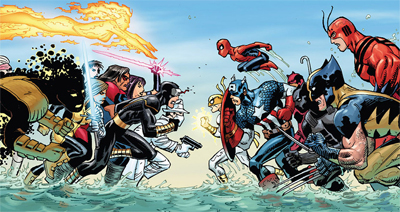
Exactly what it says on the tin...

Exactly what it says on the tin…

Continue reading

Doctor Who: The Chase (Review)

To celebrate the fiftieth anniversary of the longest-running science-fiction show in the world, I’ll be taking weekly looks at some of my own personal favourite stories and arcs, from the old and new series, with a view to encapsulating the sublime, the clever and the fiendishly odd of the BBC’s Doctor Who.

The Chase originally aired in 1965.

You’re from Earth?

No, no, Ma’am. No, I’m from Alabama.

– Barbara and Morton set things straight

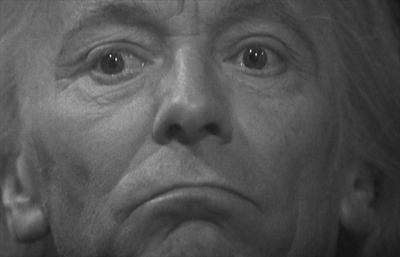
There are times when Doctor Who seems to straddle the line between genius and insanity, when the viewer is left completely unsure whether they’ve witnessed something profoundly clever, or infuriatingly stupid. The Chase is one of those stories, one of those rare cases where I’m honestly not sure if I’m reading too much into a piece of television or simply scratching the surface of a whole wealth of complex meaning and symbolism. The Chase is, as near as I can make out, either a desperate attempt to cash-in on the then-current Dalek craze, or one of the craziest attacks the show ever made on the fourth wall. It’s either completely terrible or breathlessly brilliant, and I refuse to rule out the possibility that it is both, possibly at the same time.

Cutting to the chase...

Cutting to the chase…

Continue reading

Doctor Who: The Rings Of Akhaten (Review)

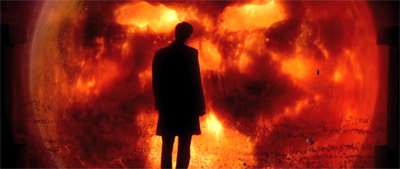
The Rings of Akhaten is a visual feast. Both the Mill and Millennium FX deserve a tremendous amount for realising the eponymous environment, which stands out as the perhaps the most impressively alien landscape to appear on Doctor Who since the show began broadcasting in high definition. It’s a solid demonstration that Doctor Who has come a long way since the eighties, and that the show is well able to keep pace with its American competitors. However, it also makes the news that the Mill has been forced to shut down all the more depressing – especially since that shut-down was partially due to the reduced number of Doctor Who episodes being produced each year.

In fact, a lot of the bigger problems with The Rings of Akhaten can be traced back to the decision to structure this seventh season of the revived show, split over two different years instead of across a single year. Most obviously, there’s the fact that we are half-way through this season of Doctor Who, and The Rings of Akhaten feels like the second or third episode of a given season. So much time is taken up with matters and concerns associated with the first half of a given season that The Rings of Akhaten ultimately feels quite light and almost insubstantial.

Burn with me...

Burn with me…

Continue reading

Doctor Who: The Seeds of Doom (Review)

To celebrate the fiftieth anniversary of the longest-running science-fiction show in the world, I’ll be taking weekly looks at some of my own personal favourite stories and arcs, from the old and new series, with a view to encapsulating the sublime, the clever and the fiendishly odd of the BBC’s Doctor Who.

The Seeds of Doom originally aired in 1976.

Very impressive. What do you do for an encore, Doctor?

I win.

– Chase and the Doctor

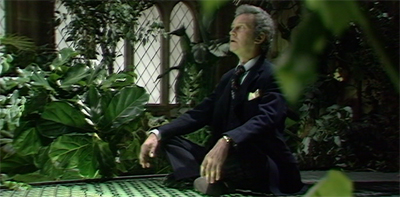
“The mixture of styles is charming,” Miss Ducat notes of Harrison Chase’s impression mansion, and it’s also true of the story itself. I think that part of the reason that The Seeds of Doom works so well is because it’s actually a rather wonderful blend of any number of pulp subgenres, mixing a spy adventure, a trashy sci-fi adventure, an end-of-the-world catastrophe story, a gothic horror tale and an alien invasion saga, all within one six-part story. The story’s meglomaniac, Harrison Chase, might believe hybrids are “a crime against nature” (which opens up all sorts of avenues of plant racism), but I think this works quite well.

Hamilton Chase goes green…

Continue reading

Brian Michael Bendis’ Avengers – Avengers Assemble (Review/Retrospective)

To get ready for Iron Man 3, we’ll be taking a look at some Iron Man and Avengers stories, both modern and classic. We hope to do two or three a week throughout the month, so check back regularly for the latest update.

How do you cash in on the success of a big-budget blockbuster comic movie? Especially a film that has gone on to be the most successful film of 2012, and one of the most successful films of all time? It’s a tough question, and I’d like to imagine that Marvel thought long and hard about how to capitalise off the success of The Avengers. After all, comics are a medium that have been trying any number of desperate ploys to maintain sales and to attract fans over the past decade, so it would be stupid not to try to turn some of the cinema-goers into comic book fans. I made the transition, so it can’t be that tough.

Avengers Assemble, an eight-issue miniseries, seems to have been created as an answer to that question. Not only does it carry the name used by the film in several international markets, it uses the iconic roster from the film, tries to tell what appears to be a continuity-light tale and comes from a high-profile creative team. Unfortunately, these factors all feel rather cynical, rather than a genuine attempt to court new readers.

Hey, it's that guy, from that thing!

Hey, it’s that guy, from that thing!

Continue reading

Doctor Who: The Brain of Morbius (Review)

To celebrate the fiftieth anniversary of the longest-running science-fiction show in the world, I’ll be taking weekly looks at some of my own personal favourite stories and arcs, from the old and new series, with a view to encapsulating the sublime, the clever and the fiendishly odd of the BBC’s Doctor Who.

The Brain of Morbius originally aired in 1976.

How did you get her here, by the way?

The power of the Sisterhood.

Really? What, you mean you still practise teleportation? How quaint. Now, if you got yourself a decent forklift truck–

Doctor, you have but a little time left. Will you waste it prattling nonsense or confess your guilt.

What do you mean, I have but a little time left?

Before you die.

But I’m only seven hundred and forty nine. Life doesn’t begin until seven hundred and —

At the next sun. That is agreed.

Not by me, it isn’t. I haven’t even been consulted.

– The Doctor, Ohica and Maren are clear on a few things

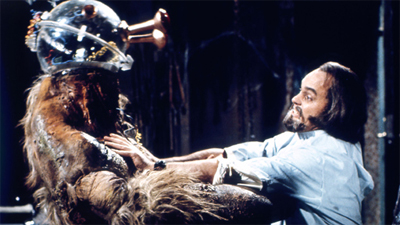
The Brain of Morbius continues the trend of phenomenally strong episodes in Baker’s sophomore season. Barring The Android Invasion, it’s a fairly stellar run of adventures, and I think that it’s these stories that a lot of people (casual follower and hardened fanatic alike) think of when they remember Tom Baker’s celebrated tenure in the role. Producer Philip Hinchcliffe continues his “gothic adventures… in space!” trend from Planet of Evil, this time offering a futuristic take on a Hammer-Horror-style Frankenstein. And the results are as fun, as wonderful and as grotesque as you might have imagined.

They did the monster mash…

Continue reading

Doctor Who: The Android Invasion (Review)

To celebrate the fiftieth anniversary of the longest-running science-fiction show in the world, I’ll be taking weekly looks at some of my own personal favourite stories and arcs, from the old and new series, with a view to encapsulating the sublime, the clever and the fiendishly odd of the BBC’s Doctor Who.

The Android Invasion originally aired in 1975.

Is that finger loaded?

– the Doctor

We’re in the middle of one hell of a season here, aren’t we? Indeed, The Android Invasion is sandwiched between two stories that could legitimately vie for the title of “best Doctor Who story ever.” Perhaps that’s why it feels like such a let-down. The Android Invasion isn’t the worst Doctor Who story ever. Indeed, it isn’t the worst Tom Baker Doctor Who story ever, nor is it the worst Philip Hinchcliffe Doctor Who story ever. It is just sort of… there. It’s a very dull and mundane piece of television, one that feels all the more dull and mundane for the fact that it’s positioned in one of the strongest seasons that the show ever produced.

He needs a Doctor...

He needs a Doctor…

Continue reading

Iron Man by David Michelinie & Bob Layton (& John Romita Jr.) Omnibus, Vol 1 (Review/Retrospective)

To get ready for Iron Man 3, we’ll be taking a look at some Iron Man and Avengers stories, both modern and classic. We hope to do two or three a week throughout the month, so check back regularly for the latest update.

It’s hard to believe, given the high profile the character has attained since Robert Downey Jr. first played Tony Stark in Iron Man back in 2008, but Iron Man used to be one of Marvel’s second-tier characters. Of course, like any other comic book character, Iron Man has had his ups and downs. There have been solid runs by great creative teams, and disappointing stories told by writers and artists unsuited to the character. However, Iron Man never really had one of those iconic comic book runs of the seventies and eighties, the kind of high-profile character-defining run like Walt Simonson’s tenure on Thor or Frank Miller’s work on Daredevil or Chris Clarement’s extended run on the X-Men franchise.

Perhaps the closest to such a run from the Bronze Age is the work by David Michelinie and Bob Layton, who actually enjoyed two extended runs writing for the character at the end of the seventies and into the eighties. This gigantic omnibus collection includes the first of those two runs, which were bisected (mostly) by Denny O’Neil’s extended time on the title. While it’s not as cohesive and solid a run as any of the aforementioned examples, it still demonstrates a solid understanding of Iron Man, and features two of the character’s most iconic stories.

You have to whip it...

You have to whip it…

Continue reading

Doctor Who: Pyramids of Mars (Review)

To celebrate the fiftieth anniversary of the longest-running science-fiction show in the world, I’ll be taking weekly looks at some of my own personal favourite stories and arcs, from the old and new series, with a view to encapsulating the sublime, the clever and the fiendishly odd of the BBC’s Doctor Who.

Pyramids of Mars originally aired in 1975.

Yes, that’s resonating tuner. Part of an anti-gravity drive. Oh! They must be building a rocket.

Egyptian mummies building rockets? That’s crazy.

– the Doctor and Sarah Jane demonstrate how arbitrary “crazy” is on this show

Pyramids of Mars is a classic slice of Doctor Who. It’s a piece of television that I dearly love, even if it is quite clear watching it that Robert Holmes was re-writing it by the seat of his pants. It’s got all the right ingredients for the Philip Hinchcliffe era of the show. Tom Baker is on phenomenal form. Sarah Jane has full adapted to being the only companion again. There’s one of those nice period settings that the BBC does so well. There’s an ancient evil arising to destroy the planet, and maybe the universe. Said evil is deliciously hammy, yet somehow quite intimidating.

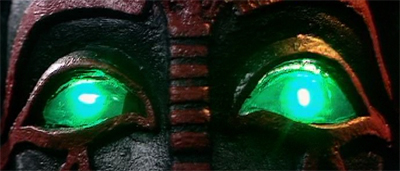
Pyramids of Mars is the perfect storm, a carefully mixed cocktail of Doctor Who in the Hinchcliffe era. Given that the Hinchcliffe era is generally regarded as one of the best periods in the show’s history, that should give an idea of just how impressive it is.

Because "Sutekh the Benign" doesn't sound quite so threatening...

Because “Sutekh the Benign” doesn’t sound quite so threatening…

Continue reading