• Following Us

  • Categories

  • Check out the Archives


  • Awards & Nominations

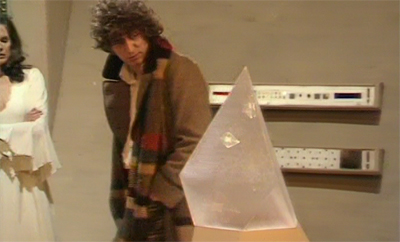
Doctor Who: The Leisure Hive (Review)

To celebrate the fiftieth anniversary of the longest-running science-fiction show in the world, I’ll be taking weekly looks at some of my own personal favourite stories and arcs, from the old and new series, with a view to encapsulating the sublime, the clever and the fiendishly odd of the BBC’s Doctor Who.

The Leisure Hive originally aired in 1980.

Look what you’ve done.

What have I done?

You’ve got the century wrong, you’ve got the season wrong and you’ve got K9’s sea-water defences wrong.

Well, I can’t get everything right.

Just something would be a help.

– Romana and the Doctor really do seem like an old married couple, don’t they?

The Leisure Hive represented a bold new beginning for the show, as it saw John Nathan-Turner move into the role of producer, very quickly putting his mark on the show with a new theme tune and opening sequence, a stronger emphasis on science-fiction and arguably a very “gimmick-y” approach to the show itself. Nathan-Turner would go on to be the longest-serving – and most controversial – producer of the show, serving in the role until the series’ untimely cancellation in 1989. It really is quite tough to discuss The Leisure Hive without getting side-tracked on to any number of tangents, isn’t it?

Is Baker getting to old for the role?

Continue reading

Doctor Who: Journey to the Centre of the TARDIS (Review)

“Good guys do not have zombie creatures. Rule one, basic storytelling.”

– Clara understands the way the universe works

And here our big theory that this anniversary season is a “greatest hits” collection runs into a bit of bother. Okay, Cold War was definitely a Troughton-era throwback. And Hide had a definite Hinchcliffe-and-Holmes feeling to it. (“The Baker Street irregulars” in 1974.) Maybe you could stretch it a little bit and argue that The Bells of St. John is a tribute to the Pertwee era by way of Russell T. Davies; and The Rings of Akhaten definitely feels a little like a classic bit of Hartnell-era world-building.

Making the case for The Journey to the Centre of the TARDIS is just a little bit harder. After all, The Crimson Horror is another throwback to Hinchcliffe and Holmes, while Nightmare in Silver is another “base under siege by classic monster” tribute to Troughton. So there’s only one missing piece here. If that “greatest hits” argument holds, then Journey to the Centre of the TARDIS must be one gigantic shout out to the John Nathan Turner era.

Hear me out.

A shining beacon of light...

A shining beacon of light…

Continue reading

Doctor Who: The Armageddon Factor (Review)

To celebrate the fiftieth anniversary of the longest-running science-fiction show in the world, I’ll be taking weekly looks at some of my own personal favourite stories and arcs, from the old and new series, with a view to encapsulating the sublime, the clever and the fiendishly odd of the BBC’s Doctor Who.

The Armageddon Factor originally aired in 1979. It was the sixth and final part of The Key to Time saga.

The Key to Time was perhaps the first conscious attempt to tell a season-long story in Doctor Who. Sure, we’ve had elements of an arc before. The first season, for example, gave the Doctor himself a character arc where he evolved from cowardly curmudgeon into an unlikely heroic figure. Jon Pertwee’s second season was given the Master as a linking element. Tom Baker’s Doctor embarked in a pretty much unbroken series of adventures from Robot through to Terror of the Zygons, with the ending of one serial seemingly leading directly into the next. None of these were necessarily that ambitious and you could argue they evolved more by chance than by design.

So, The Key to Time represented a bit of a learning curve, an attempt to tie a season’s stories together using an over-arching concept. As I’ve discussed quite a bit in my reviews of the season, the result was a little clunky, with those concepts seemingly clumsily shoe-horned into a separate bunch of adventures. That leaves the finalé, The Armageddon Factor to do the heavy-lifting with regards to The Key to Time saga. Unfortunately, the pay-off feels a bit jumbled, over-wrought, disorganised and non-sensical, as it juggles a wealth of elements that never add up to more than the sum of their parts.

While a great many Doctor Who six-parters suffer from being too long, too padded, too stretched for their story and concepts, The Armageddon Game feels curiously over-stuffed, lacking a tight focus on the interesting elements and too many distractions clogging up the story.

The problems are crystal clear...

The problems are crystal clear…

Continue reading

Doctor Who: The Power of Kroll (Review)

To celebrate the fiftieth anniversary of the longest-running science-fiction show in the world, I’ll be taking weekly looks at some of my own personal favourite stories and arcs, from the old and new series, with a view to encapsulating the sublime, the clever and the fiendishly odd of the BBC’s Doctor Who.

The Power of Kroll originally aired in 1978 and 1979. It was the fifth part of The Key to Time saga.

What? Well, you’d better introduce me.

As what?

Oh, I don’t know. As a wise and wonderful person who wants to help. Don’t exaggerate.

– the Doctor and Romana meet the locals

The Power of Kroll is a strange little serial, apparently the result of Robert Holmes being told to create the largest monster even on Doctor Who. Holmes wasn’t necessarily convinced that this was the best idea (and one can sense that from the story), but the adventure isn’t quite the mess that most people would have you believe. At the very least, it serves as a dry run (see what I did there) for the much stronger Caves of Androzani, but it also has an interesting idea or three along the way.

The power of CSO, more like...

Continue reading

Archie Goodwin’s (& George Tuska’s) Run on The Invincible Iron Man – The Invincible Iron Man Omnibus, Vol. 2 (Review/Retrospective)

To get ready for Iron Man 3, we’ll be taking a look at some Iron Man and Avengers stories, both modern and classic. We hope to do two or three a week throughout the month, so check back regularly for the latest update.

The second omnibus contains both the tail end of Stan Lee run on Tales of Suspense and the Archie Goodwin run on The Invincible Iron Man. To make matters easier, I’ve split the review in half. This half covers Archie Goodwin’s Iron Man.

Archie Goodwin is one of the best editors to work in comic books. During his time working at DC, the editor was responsible for The Long Halloween and also James Robinson’s long-running Starman. While Goodwin was an exceptional editor, he was arguably a weaker writer. As his run on The Invincible Iron Man demonstrates, Goodwin has a very clear idea of what concepts work and won’t work with the character, and how to start “fixing” some of the more obvious flaws present in the character from his inception during Stan Lee’s Tales of Suspense run. However, Goodwin isn’t quite as deft when it comes to story construction or plot mechanics. He lacks Lee’s flair for soap opera angst and interpersonal drama.

However, his run on The Invincible Iron Man remains quite impressive, and just as influential and formative as anything written by Stan Lee. I’d argue that Goodwin’s conceptual model of the character is a lot closer to the modern version of Iron Man, and that his version of Tony Stark bleeds through the work of later writers and also into the massive billion-dollar film franchise as well. So Goodwin’s work on The Invincible Iron Man is quite iconic. It’s just some of the nuts-and-bolts scripting that seems to catch him, from time to time.

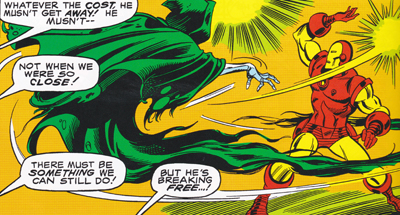
That's why they call him the Invincible Iron Man...

That’s why they call him the Invincible Iron Man…

Continue reading

Doctor Who: The Androids of Tara (Review)

To celebrate the fiftieth anniversary of the longest-running science-fiction show in the world, I’ll be taking weekly looks at some of my own personal favourite stories and arcs, from the old and new series, with a view to encapsulating the sublime, the clever and the fiendishly odd of the BBC’s Doctor Who.

The Androids of Tara originally aired in 1978. It was the fourth part of The Key to Time saga.

Ah! That takes me back… or forward… that’s the trouble with time travel, you can never remember…

– The Doctor

There are some things that I know I should probably feel guilty about – cases where my opinion is so clearly distinct from the general consensus that I feels some sense of obligation to apologise for my radical and far-out ideas. While it falls just short of that mark, I honestly enjoy The Androids of Tara as the best story of The Key to Time. I’ll concede it isn’t as masterfully written as The Ribos Operation, nor as full of wonderfully clever constructs as The Pirate Planet, but The Androids of Tarais a refreshingly small-scale adventure that manages to accommodate the awkward humour that this era of the show is accustomed to, while remaining an excellent adventure in its own right.

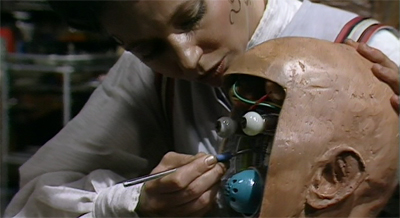
Eyes without a face...

Continue reading

Non-Review Review: Dead Man Down

This is intriguing. Dead Man Down feels like a blend of a European revenge thriller with a more straight-forward American crime film. Director  Niels Arden Oplev has established his credibility with his work on the original version of The Girl With the Dragon Tattoo, even it I am less fond of the film than most. His first America film is an interesting experiment, even if Oplev can’t quite pull it off as seamlessly as the material requires.

Dead Man Down buckles a bit under the weight of two sets of genre requirements. It is by turns quiet, withdrawn and introspective, but also loud, overwhelming and exposition-filled. These two facets of the film – feeling like the demands of a European film against an American mainstream release – seem to be at war with one another. The result is something that is more interesting than entirely satisfying.

They do make a bloody mess...

They do make a bloody mess…

Continue reading

Doctor Who: Stones of Blood (Review)

To celebrate the fiftieth anniversary of the longest-running science-fiction show in the world, I’ll be taking weekly looks at some of my own personal favourite stories and arcs, from the old and new series, with a view to encapsulating the sublime, the clever and the fiendishly odd of the BBC’s Doctor Who.

Stones of Blood originally aired in 1978. It was the third part of The Key to Time saga.

Doctor, might I ask you  a personal question?

Well, I don’t see how I could stop you from asking.

Are you from outer space?

No.

Oh.

I’m more from you’d call inner time.

Ah.

– Professor Rumford and the Doctor clarify things

Stones of Blood was a bit of a landmark for the television show. Not only was it the 100th Doctor Who story broadcast, but it also aired remarkably close to the show’s fifteenth anniversary. The Three Doctorshad demonstrated that the show could celebrate its anniversaries in style, but producer Graham Williams seemed to want a more restrained celebration of the show’s run – vetoing an early scene in the TARDIS where Romana and K-9 give the Doctor a birthday cake and a present (a new scarf). Instead, it was decided that the show would celebrate its time on the air by returning to two of its more defining genres, blending those two distinct types of story into one four-part adventure. So we end up with a story that is half gothic horror and half outer space adventure.

A celebration, out of the blue!

Continue reading

Non-Review Review: Iron Man 3

Where do you go after The Avengers? Marvel brought together four separate superhero franchises to produce one mega-blockbuster last summer, producing the most successful film of 2012 and one of the most lucrative films in the history of the medium. It’s a tough act to follow. If Iron Man 3 is any indication, it seems like Disney and Marvel understand how they want to progress from here. Shrewdly deciding not to compete with The Avengers on scale, Iron Man 3 is instead a character-driven action thriller specifically tailored for the character of Tony Stark, with writer and director Shane Black very clearly having his own idea for the hero who first launched Marvel’s shared universe.

While Iron Man 3 isn’t quite perfect, it’s a solid superhero blockbuster, and perhaps second only to Kenneth Brannagh’s Thor as the best superhero film produced by Marvel Studios.

Who da Iron Man?

Who da Iron Man?

Continue reading

Earth X (Review/Retrospective)

To get ready for Iron Man 3, we’ll be taking a look at some Iron Man and Avengers stories, both modern and classic. We hope to do two or three a week throughout the month, so check back regularly for the latest update.

“Your kind does love to rewrite history, Richards,” the Watcher observes towards the end of Earth X, after we get an introduction and brief recap of the life of Tony Stark. Almost every issue of the collection opens with a review of an iconic Marvel character’s back story, as writer Jim Krueger and plotter Alex Ross attempt to tie the tapestry of the Marvel universe together in some way. It turns out that everything a character underwent wasn’t just their own personal development, but part of a broader tapestry of history within the Marvel universe. No character evolution, it seems, happens in isolation. Everything is interconnected, even if we (or the writers or the characters) never realised it at the time.

Earth X is really just an attempt to tie most of the Marvel universe up in one gigantic knot, to connect everything to everything else. In a way, published in 1999, it seems to foreshadow the current era of Marvel publishing, where absolutely everything within in the shared universe must somehow be connected to something else. Avengers vs. X-Men, for example, would connect the Phoenix from the X-Men to the Iron Fist mythology. Grant Morrison’s New X-Men connected the Weapon X project to the development of Captain America. The X-Men and the Avengers must be united as part of Uncanny Avengers.

In many ways, Earth X reads more interestingly as a treatise than as a comic story. It’s far stronger as a thought-experiment than an actual narrative. It’s more fun on purely technical level, watching Jim Krueger and Alex Cross connect all those dots, than it is as an adventure in its own right.

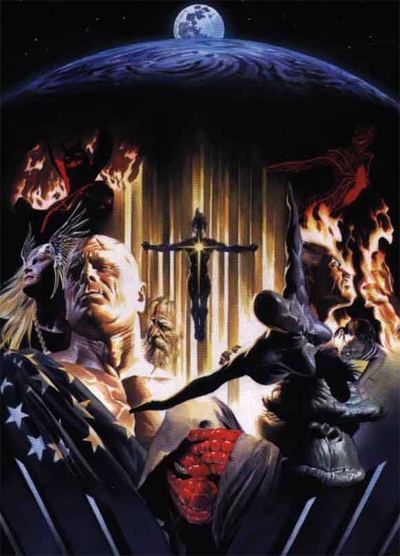
Stellar...

Stellar…

Continue reading