• Following Us

  • Categories

  • Check out the Archives


  • Awards & Nominations

Doctor Who: The Two Doctors (Review)

To celebrate the fiftieth anniversary of the longest-running science-fiction show in the world, I’ll be taking weekly looks at some of my own personal favourite stories and arcs, from the old and new series, with a view to encapsulating the sublime, the clever and the fiendishly odd of the BBC’s Doctor Who.

The Two Doctors originally aired in 1985.

That is the smell of death, Peri. Ancient musk, heavy in the air.

– welcome to the Colin Baker era

The Two Doctors is an oddity. It’s the only story of the Nathan Turner era that runs over two hours, unless you choose to count The Trial of a Time Lord as a single story. It’s also the only “multi Doctor” story that wasn’t filmed on one of the show’s significant anniversaries. (Time Crash was, after all, filmed in the show’s forty-fifth year.) It’s also notable for the fact that it completely eschews the charmingly impish portrayal of the Second Doctor that fans have come to know and love over the course of reunion stories like The Three Doctors or The Five Doctors.

Indeed, The Two Doctors is almost the exact opposite of the show that you would expect it to be. The low opinion in which fans seem to hold the serial confirms that writer Robert Holmes has delivered a story that is markedly different from what those waiting for a team-up between Colin Baker and Patrick Troughton would have been expecting. Far from a nostalgia-packed love-in, The Two Doctors is written with Holmes’ trademark cynicism. This time the writer is directing that cynicism towards the show itself.
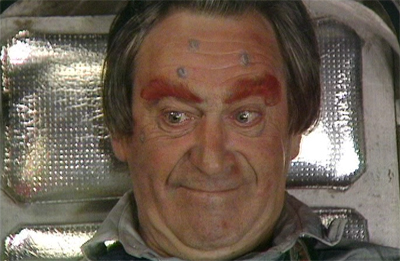
Patrick Troughton! In colour!

Patrick Troughton! In colour!

Continue reading

Non-Review Review: The Hunger Games – Catching Fire

The Hunger Games: Catching Fire suffers from a problem comic to the second story in planned trilogies. It lacks its own clear arc or structure, instead serving as a little more (or perhaps a little less) than half a film. There’s no conclusion or resolution here, just a lot dangling plot threads and insinuations – the suggestion of a larger and grander conflict looming on the horizon that might offer some measure of closure.

While it improves on quite a few flaws from the first film, it ultimately feels rather hollow; like an extended trailer for The Hunger Games: Mockingjay.

Hungry for more?

Hungry for more?

Continue reading

Doctor Who: Time Crash (Review)

To celebrate the fiftieth anniversary of the longest-running science-fiction show in the world, I’ll be taking weekly looks at some of my own personal favourite stories and arcs, from the old and new series, with a view to encapsulating the sublime, the clever and the fiendishly odd of the BBC’s Doctor Who.

Time Crash originally aired in 2007.

To days to come.

All my love to long ago.

– the Fifth and Tenth Doctors look backwards and forwards

There is a strange school of thought about the revived Doctor Who, populated by a very vocal minority of fans, who insist that the new series hasn’t been paying nearly enough attention to what came before – that it’s really the show “in name only” or whatever extremist rhetoric you want to use. These are the fans who refuse to be satisfied with The Day of the Doctor because it’s not “The Eleven Doctors”, without having actually seen the anniversary special.

These are fans who are heartbroken that the show hasn’t found time to show Paul McGann regenerating into Christopher Eccleston, or who object to the destruction of Gallifrey or the re-working of monsters with messy back stories like the Cybermen in order to make them more accessible to modern audiences. It’s worth stressing that this viewpoint is very much in the minority, but it exists. Any journey into on-line forums or discussions about the show will inevitably trip across this particular viewpoint.

Of course, that’s complete nonsense. Even if it was ambiguous beforehand, Time Crash exists as nothing short a love letter to a very particular past era of the show.

More than just a tip of the hat...

More than just a tip of the hat…

Continue reading

Non-Review Review: The Family

I can’t tell you what The Family is. Not because of omerta or anything as cliché as that, but because it seems like The Family itself doesn’t know. I can describe what happens in the film, taking you through the events as they unfold on screen. I can describe the set-up. I can talk about its obvious influences. But I can’t tell you what exactly Luc Besson’s latest film actually is, because it seems like Besson himself can’t make up his mind.

Is it an action film with a quirky and unconventional set-up? Is it a gangster comedy about a former crook trying to go straight? Is it a fish-out-of-water comedy of manners about Americans arriving in northern France? Is it a pitch black comedy about a self-justifying sociopath attempting to carve out his own place in the world? Is it a high-stakes thriller about a family putting their lives on the line? Is it a weird coming-of-age drama? The Family is all of these things at various points, but it never commits to any of them.

Instead, it uses these elements to just keep circling until the running time is over.

Family values...

Family values…

Continue reading

Doctor Who: Blood of the Daleks (Review)

To celebrate the fiftieth anniversary of the longest-running science-fiction show in the world, I’ll be taking weekly looks at some of my own personal favourite stories and arcs, from the old and new series, with a view to encapsulating the sublime, the clever and the fiendishly odd of the BBC’s Doctor Who.

Blood of the Daleks originally broadcast in 2006-2007.

Blood of the Daleks is an interesting piece of Doctor Who lore. It isn’t the first of Paul McGann’s audio adventures in the role of the Doctor. While McGann wasn’t the first of the performers to work with Big Finish, he recorded his first performance in 2001, half a decade before he recorded Blood of the Daleks. He’d gone through years of audio adventures and even a couple of companions before Blood of the Daleks.

Paul McGann been working on the character since before Russell T. Davies had had a chance to structure and plan the revival, and he has been a fixture of the line throughout the tenures of Christopher Eccleston, David Tennant and Matt Smith in the role. However, Blood of the Daleks marks something of a big moment for the character, a definite step forward for his version of the character, and a bold endorsement of his interpretation by the BBC.

Blood of the Daleks didn’t debut on audio CDs in collectible shops. It broadcast on BBC7, less than a week following the broadcast of The Runaway Bride.

doctorwho-bloodofthedaleks

Continue reading

Doctor Who: The Five Doctors (Review)

To celebrate the fiftieth anniversary of the longest-running science-fiction show in the world, I’ll be taking weekly looks at some of my own personal favourite stories and arcs, from the old and new series, with a view to encapsulating the sublime, the clever and the fiendishly odd of the BBC’s Doctor Who.

The Five Doctors originally aired in 1983.

There was one chap we tried to get hold of. What was his name? Used to be your scientific advisor.

Oh, the Doctor.

Yes that’s right.

Wonderful chap. All of them.

– Crichton and the Brigadier get into the spirit of things

The Five Doctors is a big anniversary celebration for the franchise, reuniting all five… er, four… er, three of the actors to play the lead role and one guy in a dodgy wig. Written by Terrance Dicks, The Five Doctors is 100 minutes of pure celebration, without too much in the way of depth or drama or development. It’s a beautifully packaged “greatest hits” collection for the franchise, to the point where the generally nostalgic atmosphere of the rest of the twentieth season (pairing up the Doctor with foes from his twenty-year history) can’t help but feel a little a little shallow in comparison.

Producer John Nathan Turner and script editor Eric Saward tended to fixate a bit too heavily on the show’s history and its continuity, with stories often becoming oppressively burdened with in-jokes and references to events that took place decades ago. In contrast, Dicks is able to craft a healthy slice of nostalgia that remains accessible and enjoyable, giving everybody their moment in the sun.

Well, everybody but the Cybermen.

Terrance Dicks does not care for the Cybermen...

Terrance Dicks does not care for the Cybermen…

Continue reading

Non-Review Review: Predator

Predator is an absolutely brilliant piece of work. It’s elegantly constructed, beautifully directed and cleverly written. Perhaps the smartest thing about Predator is the way that it so fantastically plays on audience expectations, offering the perfect bait-and-switch, teasing a jungle adventure in the style of Schwarzenegger’s Commando before morphing into something else entirely. It’s so well handled that the film’s reputation and prestige has done little to dampen its thrills.

A predator stalks...

A predator stalks…

Continue reading

Doctor Who: Terror of the Zygons (Review)

To celebrate the fiftieth anniversary of the longest-running science-fiction show in the world, I’ll be taking weekly looks at some of my own personal favourite stories and arcs, from the old and new series, with a view to encapsulating the sublime, the clever and the fiendishly odd of the BBC’s Doctor Who.

Terror of the Zygons originally aired in 1975.

Right, let’s see what other damage we can do. Anybody know what this is?

I haven’t the faintest idea.

You tell us.

I will. It’s a self-destructor, and it works like this.

– the Doctor demonstrates to the Duke and Lamont that you don’t ask a question without knowing the answer

Terror of the Zygons is a strange beast. Tom Baker’s first season was bookended by two relics from the Jon Pertwee era. Robot was essentially a Pertwee-era invasion story where the only real difference was Tom Baker’s larger-than-life performance; Revenge of the Cybermen had been commissioned by Barry Letts and felt more like a Pertwee-era space story than anything Hinchcliffe and Holmes would produce.

In contrast, Terror of the Zygons is very definitely an episode of Doctor Who produced by Philip Hinchcliffe and script edited by Robert Holmes. It kicks off one of the show’s strongest seasons, and plays into many of the recurring themes of the era. There are fallen gods and body horror and a sense of the Doctor as a bohemian who won’t be bound by society’s rule. And yet, at the same time, there’s also a sense that Terror of the Zygons is derived from the same basic structure of Pertwee-era invasion story.

In short, Terror of the Zygons feels like it straddles two very different eras of the show, and provides an opportunity for the show to very definitely transform from one form into another.

Let Zygons be Zygons...

Let Zygons be Zygons…

Continue reading

Doctor Who: Night of the Doctor (Review)

To celebrate the fiftieth anniversary of the longest-running science-fiction show in the world, I’ll be taking weekly looks at some of my own personal favourite stories and arcs, from the old and new series, with a view to encapsulating the sublime, the clever and the fiendishly odd of the BBC’s Doctor Who.

Night of the Doctor originally aired in 2013.

I’m a Doctor. But probably not the one you’re expecting.

– isn’t that the truth?

Paul McGann. The “sort of” Doctor; the version of the character that is highly contested by fan and casual viewer alike. With only a single televised story to his credit, produced and filmed in America, McGann was always a controversial part of Doctor Who lore. Before his face appeared in a notebook in Human Nature, there was even debate about whether or not the movie “counted” in the grand pantheon of Doctor Who.

Ironically, McGann’s Doctor has gone on to have one of the most prolific lives of any Doctor. He has appeared in Big Finish audios, webcasts and even a series of audio plays broadcast on BBC radio. McGann has had an impressive volume of output, even without counting the tie-in novels and comics featuring his character, made without his input. The state of limbo in which the character seemed to hover seemed monumentally unfair, a quirk of fate that was the result of powers far beyond those of McGann himself.

So The Night of the Doctor is a pleasant surprise, conferring the ultimate legitimacy upon Paul McGann’s interpretation of the character, effectively confirming the Eighth Doctor as the version who held the flame for the classic series, and whose regeneration marks a turning point for the show.

He really eights himself...

He really eights himself…

Continue reading

Doctor Who: The Three Doctors (Review)

To celebrate the fiftieth anniversary of the longest-running science-fiction show in the world, I’ll be taking weekly looks at some of my own personal favourite stories and arcs, from the old and new series, with a view to encapsulating the sublime, the clever and the fiendishly odd of the BBC’s Doctor Who.

The Three Doctors originally aired in 1973.

Well, Sergeant, aren’t you going to say it that it’s bigger on the inside than it is on the outside. Everybody else does.

It’s pretty obvious, isn’t it?

– the Doctor and Benton

The Three Doctors never seems entirely sure what it’s supposed to be. It knows what it has to accomplish. This was the first serial of the tenth season of Doctor Who, so it has to feature the three versions of the character to date. It also wants to radically shake-up the status quo of the series and to allow Jon Pertwee’s Doctor to take to the cosmos. Those are really the two primary objectives of The Three Doctors, and writers Bob Baker and Dave Martin accomplish them quite well.

The problem is that the story itself isn’t sure what it wants to be. Pertwee-era script editor Terrance Dicks would be a lot more confident when juggling The Five Doctors, conceding that the whole thing was a gigantic nonsensical spectacle. The Three Doctors seems almost like a regular story with the tenth anniversary grafted on to it – it’s easy enough to imagine a rough outline of this story that could work with only Jon Pertwee and without the end of his exile.

As a result, the two strongest beats in The Three Doctors feel almost like afterthoughts, grafted on to the outline of a generic and somewhat bland Doctor Who adventure.

Why does the Doctor hate himself...?

Why does the Doctor hate himself…?

Continue reading