• Following Us

  • Categories

  • Check out the Archives


  • Awards & Nominations

Star Trek: Deep Space Nine – Rejoined (Review)

This February and March, we’re taking a look at the 1995 to 1996 season of Star Trek, including Star Trek: Deep Space Nine and Star Trek: Voyager. Check back daily Tuesday through Friday for the latest review.

For a show that is supposedly about an enlightened and utopian future, Star Trek really doesn’t have the best record when it comes to gay rights.

Many fans laud the work that the franchise did in popularising the Civil Rights anxieties of the sixties, offering memorable and distinctive parables and the futility of racism while offering one of the first interracial kisses to air on national television. Fans of the franchise are quick to celebrate these triumphs as an example of Star Trek holding up a mirror to contemporary society and championing the causes of equality and social justice. It is part of the mythmaking that Gene Roddenberry baked into the foundation of the Star Trek legend.
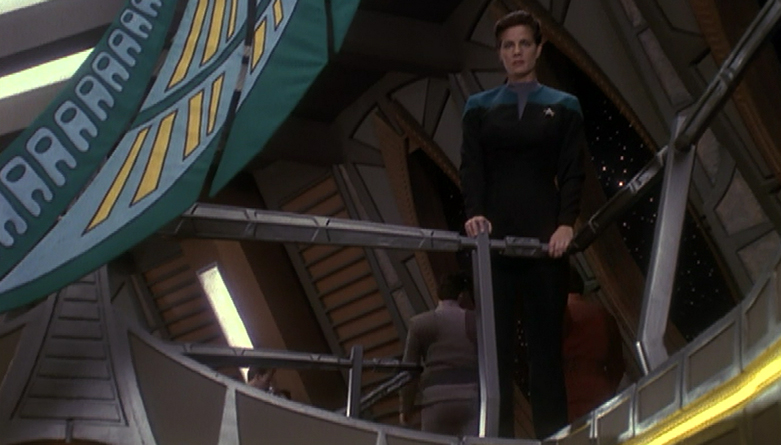
A Trill alone...

A Trill alone…

Of course, the reality is more complicated. As important as it was to have a racially diverse crew on the bridge of the classic Enterprise, that idea came from the studio rather than Roddenberry. The show defended and vindicated the Vietnam War just as often as it criticised and opposed it. The interracial kiss in Plato’s Stepchildren might had more meaning if it weren’t an example of telepathic mindrape by sadistic aliens, or if it had aired before I, Spy had broadcast its own interracial kiss.

As much as fans like to believe Star Trek is progressive and enlightened, the franchise does not have as strong a track record as its advocates would contest. This is particularly true of the depiction of homosexuality in Star Trek. In the first season of Star Trek: The Next Generation, David Gerrold’s script for Blood and Fire was scrapped. Richard Arnold claimed that it was because the script was terrible; but this was the same season that produced The Last Outpost, Angel One and The Neutral Zone. It seems “terrible” is a relative term.
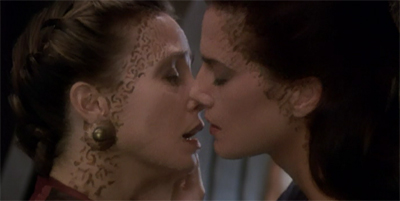
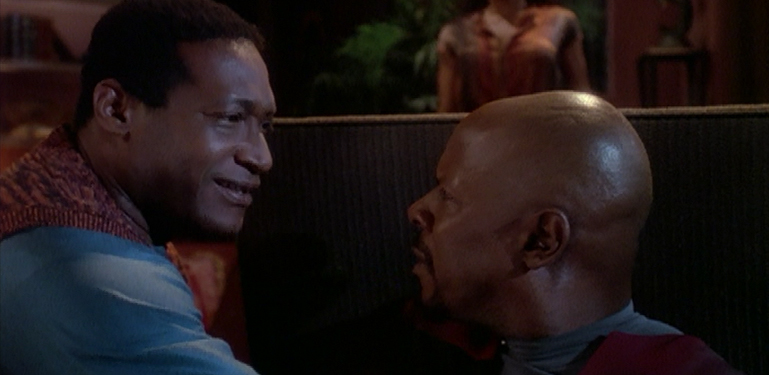
Kiss me.

Kiss me.

There were other examples. During production of The Offspring, there are accounts of David Livingston sprinting down to the sets to stop a shot of a same-sex couple holding hands making it into the episode. When the show finally decided to do an allegory for homosexuality, it was careful to cast a female performer in the role of Riker’s love interest to be sure that the audience did not get the wrong idea. The mirror universe episodes of Star Trek: Deep Space Nine are populated with gay stereotypes and clichés.

No matter how alien the creatures in Star Trek might get, sexuality tends towards heterosexual. In Metamorphosis, Kirk and Spock only realise that the Companion is attracted to Cochrane once they deduce the creature’s gender. Odo’s pseudo-sexual relationship with other Founders is typically expressed in relation to the character known as the Female Changeling. (Chimera does try to fix this.) Although there have been allusions to Andorian marriages featuring four partners, Star Trek: Enterprise presents the relationships as decidedly normative.
Take a bow!

Take a bow!

What little queer content exists seems to have slipped in under the radar. There is a decidedly homoerotic undertone to Amok Time. In The Offspring, Data allows Lal to assign her own gender and Whoopi Goldberg defined kissing as something that happens when “two people” (rather than “a man and a woman”) fall in love. In Rules of Acquisition, Jadzia Dax suspected that Quark’s newest employee had a crush on the rogue trader; Dax was just surprised to discover that the waiter in question was a woman in disguise who was trying to subvert the Ferengi patriarchy.

All of this serves to make Rejoined the most successful Star Trek episode to deal with the topic of homosexuality. This is not to argue that Rejoined is perfect or flawless. It is a science fiction show that aired in 1995, and there are some uncomfortable subtexts to the whole story. At the same time, its heart is in the right place. Rejoined is a beautiful piece of work, because it represents a rare example of the franchise trying to live up to its own publicity. In doing so, it serves to emphasise how frequently (and easily) the property has allowed itself to fall short.

Just Trilled to be there...

Just Trilled to be there…

Continue reading →

Star Trek: Voyager – Persistence of Vision (Review)

This February and March, we’re taking a look at the 1995 to 1996 season of Star Trek, including Star Trek: Deep Space Nine and Star Trek: Voyager. Check back daily Tuesday through Friday for the latest review.

In some respects, the second season of Star Trek: Voyager can be seen as a conflict over the future of the show.

On the one hand, Michael Piller had returned to the franchise following the failure of the television show Legend. With Ira Steven Behr overseeing Star Trek: Deep Space Nine, Piller returned to focus his attention on the second season of the younger Star Trek show. After all, the second season was a disorganised mess, with the production team struggling to get the necessary scripts together on time. Having a safe pair of hands on board to help guide the show might come in handy.

"It's a bridge AND a tanning salon, simultaneously..."

“It’s a bridge AND a tanning salon, simultaneously…”

On the other hand, Jeri Taylor had been around the show since Caretaker. She had taken over the reins after Piller’s departure and had supervised the tail end of the first season. Taylor had arrived on the Star Trek franchise just a year after Piller, and had been a vital part giving Star Trek: The Next Generation its unique voice and mood. Over the course of the second season, it became increasingly clear that Michael Piller and Jeri Taylor had very different visions for the future of Star Trek: Voyager, and those visions were coming into conflict.

History ultimately vindicated Jeri Taylor. The second season of Voyager was the last television season of Star Trek to be directly overseen by Piller, while Jeri Taylor become the guiding light of the third and fourth seasons of the show. Whatever problems might exist with those two seasons television, they are at least more stable and consistent than the first and second years of the show. It is, of course, arguable that Piller never got his own change to exercise his own vision of the show unimpeded – and so that is not a fair measure.

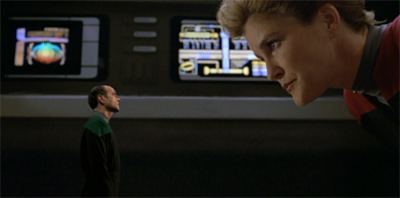
Cutting the Doctor down to size...

Cutting the Doctor down to size…

In a way, the conflict between Piller and Taylor’s versions of Voyager is quite clearly typified in this early run of episodes. The show had breezed through the four episodes left over from the first season production block, and desperately needed ideas to keep afloat. The senior producers rolled up their sleeves and got involved. Piller was largely responsible for Parturition and Tattoo, while Taylor oversaw Persistence of Vision. None of these episodes are perfect, but it is quite clear that Taylor is increasingly the show’s safest bet going forward.

Persistence of Vision is a very flawed episode of television, playing to some of Taylor’s more uncomfortable recurring motifs. However, it is much more interested in actually moving Voyager along than either of Piller’s contributions.

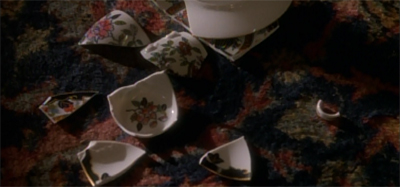
"The teacup that I shattered did come together."

“The teacup that I shattered did come together.”

Continue reading →

Star Trek: Deep Space Nine – Indiscretion (Review)

This February and March, we’re taking a look at the 1995 to 1996 season of Star Trek, including Star Trek: Deep Space Nine and Star Trek: Voyager. Check back daily Tuesday through Friday for the latest review.

Much like Hippocratic Oath before it, Indiscretion serves to set the baseline of quality for the fourth season of Star Trek: Deep Space Nine. While The Way of the Warrior and The Visitor were ambitious deviations from form, Hippocratic Oath and Indiscretion offer a much clearer vision of what the show will look like from this point forward. As with Hippocratic Oath, a heavy two-hander a-plot is paired with a lighter b-plot that explores the day-to-day life on the eponymous space station, a structure that allows for world-building with sacrificing momentum.

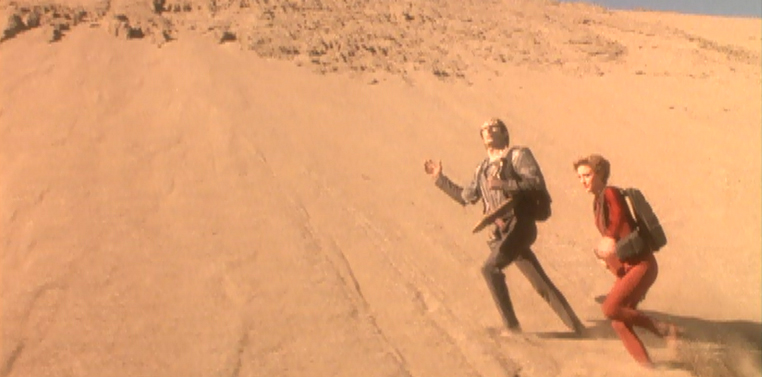
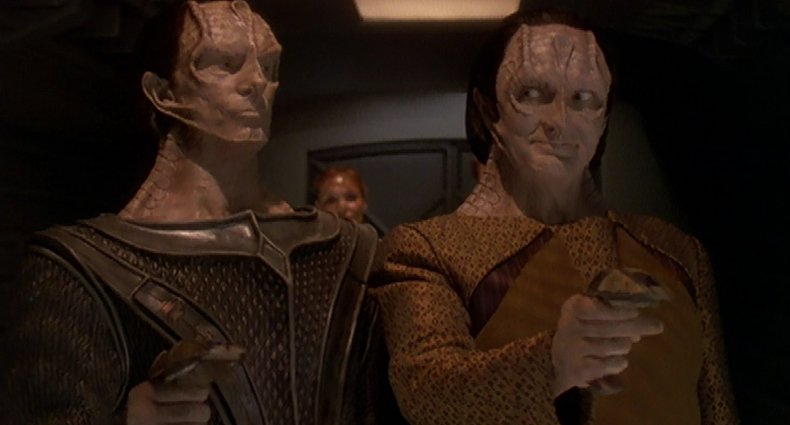
Indiscretion works very well on its own terms. It throws together two of the show’s more fascinating a well-defined characters, putting Major Kira and Gul Dukat on a road trip from hell that inevitably throws them headfirst into conflict with one another. Watching Nana Visitor and Marc Alaimo interact is worth the price of admission alone, and Indiscretion throws a fairly heated personal conflict into the mix to create some tense and compelling drama. Indiscretion works very well as forty-five minutes of television.

Road trip!

Road trip!

However, it also works quite well as an exercise in setting up a longer game. As with most of the episodes that end up rippling through the continuity of Deep Space Nine, it is hard to be sure if the writers knew exactly where they wanted to go with the plot threads stemming from this instalment. Some of the difficulties dealing with the episode’s biggest legacy suggest that more thought might have gone into it. Nevertheless, Indiscretion is an episode that is clearly written with one eye on the future of the show.

As much as it stands on its own two feet, the episode is clearly written with a view to drama that it might enable further down the line. It is a story that seems to be written so that its consequences might fuel further storytelling opportunity. Deep Space Nine had toyed with the idea of serialised storytelling before, but this marks the point where the show just rolls up its sleeves and jumps right on in.

"You know, I think she likes me."

“You know, I think she likes me.”

Continue reading →

Non-Review Review: Deadpool

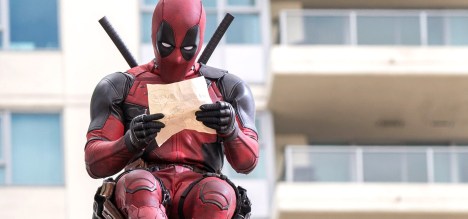
Deadpool is an incredibly juvenile self-aware R-rated superhero action comedy.

And there is nothing wrong with that.

Drawing on the character's rich history...

Drawing on the character’s rich history…

Continue reading →

Non-Review Review: Zoolander II (aka 2oolander)

Zoolander II arrives a decade and half after Ben Stiller’s original male model comedy, perhaps tapping into the same rich vein of nostalgia that led to the release of Jurassic World and the relaunched X-Files.

Zoolander is a fascinating (and beloved) film. It is (along with Anchorman) one of the defining comedies of the early twenty-first century, to the point that it (allegedly) counts among Terrence Malick’s favourite films. The film offers one of Ben Stiller’s most iconic performances and is filled with memetic lines and catchphrases. Tellingly, the teaser trailer to Zoolander II offered hints to its identity through visual shout-outs to some of the gags that had soaked into the popular imagination. It is a surprise that the sequel took this long to produce.

Model investigators...

Model investigators…

Zoolander sits awkwardly between the end of the twentieth century and the start of the twenty-first. It was among the more high-profile films to digitally erase the World Trade Centre following the 9/11 attacks. Roger Ebert famously argued that Zoolander was one reason “why the United States is so hated in some parts of the world.” Mirroring its protagonist, the disconnect between the world in which the film was produced and the world in which is was released suggested an engaging innocence.

It is perhaps too much to expect Zoolander II to measure up to the original film, to offer that same surprising (and perhaps unintentional) innocence. Zoolander II is reasonably diverting, if solidly unspectacular. The film lacks the same sparkle that made the original such a hit, falling back a little bit too far on in-jokes and familiar characters without offering much new or exciting of its own.

A familiar ring to it...

A familiar ring to it…

Continue reading →

Star Trek: Deep Space Nine – Hippocratic Oath (Review)

This February and March, we’re taking a look at the 1995 to 1996 season of Star Trek, including Star Trek: Deep Space Nine and Star Trek: Voyager. Check back daily Tuesday through Friday for the latest review.

Hippocratic Oath represents a return to normality for Star Trek: Deep Space Nine. The Way of the Warrior was a feature-length war epic tasked with introducing a new regular character and a new status quo, while The Visitor was an intimate character study that stood quite apart from the show around it. With Hippocratic Oath, the show gets back to business as usual. It even has a classic a-story/b-story split with Bashir and O’Brien’s Gamma Quadrant hijinx juxtaposed with Worf learning his place on the station (and the show).

This is not to suggest that Hippocratic Oath is a bland hour of Star Trek. Indeed, it is a tightly-constructed story that hits on some of the show’s core themes and most interesting dynamics. One of the problems with the third season of Deep Space Nine was the fact that it had a strong start but no idea on how to build from that. Hippocratic Oath seems to serve very much as a “business as usual” episode of the fourth season, helping to set a baseline of quality of the show going forward.

Awkward bromantic moment...

Awkward bromantic moment…

Continue reading →

Star Trek: Deep Space Nine – The Visitor (Review)

This February and March, we’re taking a look at the 1995 to 1996 season of Star Trek, including Star Trek: Deep Space Nine and Star Trek: Voyager. Check back daily Tuesday through Friday for the latest review.

To my father, who is coming home.

Daddy's home...

Daddy’s home…

Continue reading →

Star Trek: Voyager – Parturition (Review)

This February and March, we’re taking a look at the 1995 to 1996 season of Star Trek, including Star Trek: Deep Space Nine and Star Trek: Voyager. Check back daily Tuesday through Friday for the latest review.

One of the more interesting aspects of the second season of Star Trek: Voyager is its stubborn refusal to give up on elements that simply do not work.

Time and again, and often at the behest of producer Michael Piller, the second season returns to concepts that were problematic and troublesome in the first season. The obvious goal is to fix those problems so that those elements can be successfully reintegrated into the surrounding show. This is why the second season returns to concepts like the Kazon as a threat and Tom Paris as a rebel and Neelix as a character with a useful function on the ship. This is not a bad approach. If the first season of a show is about experimentation, then the second season is about calibration.

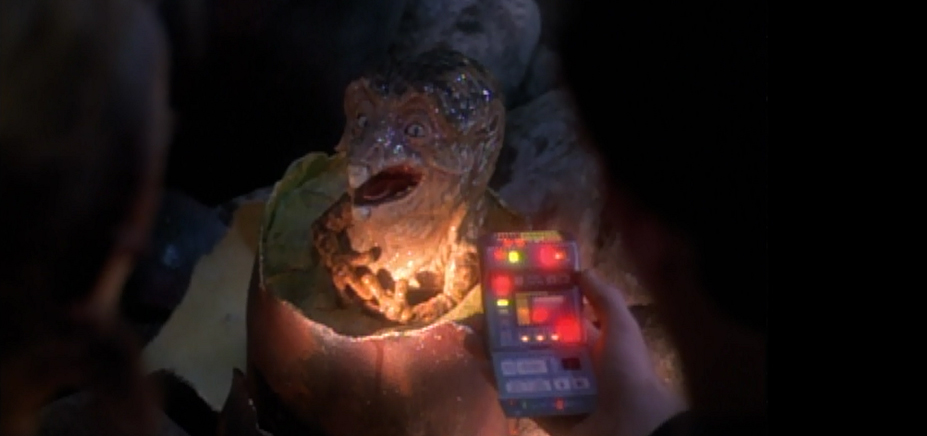
Two men and a lizard lady...

Two men and a lizard lady…

It is hard to begrudge Michael Piller this approach. After all, it had worked quite well on Star Trek: The Next Generation and Star Trek: Deep Space Nine. In particular, it took Deep Space Nine about three years before it figured out how to make characters like Bashir, Dax and Quark capable of carrying their own episodes without making the audience want to bash their heads against a large blunt surface. It is not unreasonable to take the same approach to dealing with the elements of Voyager that are not working.

There is a very significant difference, though. The problematic elements of Voyager have little to do with execution; they are fundamental problems with the concepts. The Kazon do not work as a threat because they are one of worst alien species that Star Trek ever produced, rooted in some rather unpleasant racial stereotypes tied to contemporary Los Angeles gang culture. Tom Paris does not work as a rebel and womaniser because Robert Duncan McNeill works better as a charming goof. Neelix’s romance with Kes is toxic because she is a child and he’s possessive.

Cooking up a storm...

Cooking up a storm…

As such, it feels like the second season of Voyager spends a lot of time fixing problems that are fundamentally unfixable. One of the great aspects of the premise of Voyager is the fact that the show is in a constant state of movement. Unlike the cast of Deep Space Nine who are fixed in a single place, the cast of Voyager are constantly moving forward. It is possible for Voyager to jettison the parts that are simply not working. (Cue lazy joke about the size of Kazon space.)

Parturition is an example of this phenomenon, as Voyager tries to “fix” the toxic relationship between Neelix and Kes, while offering Tom Paris some small semblance of character growth. Unfortunately, it seems very attached to the idea of Neelix and Kes as a romantic couple and Tom Paris as a playful romantic rogue, which means that the best that it can hope to do is to not make the underlying problems any more obvious. While Parturition is nowhere near as bad as Elogium or Twisted, it still feels like a series treading water.

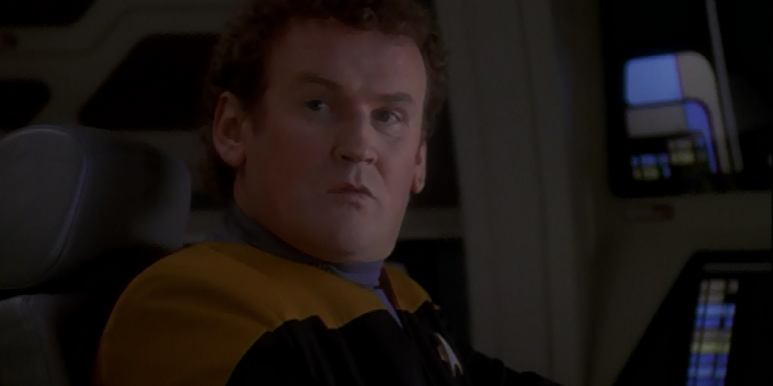
It's time for the Delta Quadrant's favourite fifties sitcom, "Last Tango With Paris."

It’s time for the Delta Quadrant’s favourite fifties sitcom, “Last Tango With Paris.”

Continue reading →

The X-Files/30 Days of Night (Review)

This January, to prepare for the release of the new six-part season of The X-Files, we’re wrapping up our coverage of the show, particularly handling the various odds and ends between the show’s last episode and the launch of the revival.

The X-Files/30 Days of Night is the most satisfying X-Files story of the interregnum between The Truth and My Struggle I.

The comic book miniseries is notable for a number of reasons. It is the simultaneously the last X-Files comic to be published by Wildstorm and the first X-Files comic to be published by IDW. It is the first comic book crossover between X-Files characters and another established comic book franchise, and it crosses over directly through Mulder and Scully rather than using the Lone Gunmen to insulate the franchise. It is also the first X-Files comic to be illustrated by Tom Mandrake, who would later work with Joe Harris.

Darkness falls...

Darkness falls…

There are other reasons that The X-Files/30 Days of Night stands out. The comic is the work of a creative team (much) more strongly associated with 30 Days of Night than The X-Files, and there is a sense the comic services that franchise more than The X-Files. Barring the first twelve-issues of Stefan Petrucha and Charles Adlard’s Topps run, which was really more of a series of shorter interlocking stories, The X-Files/30 Days of Night is also the longest single X-Files comic book story published to this point in the franchise’s history.

It is also just really good.

Due North...

Due North…

Continue reading →

Star Trek: Deep Space Nine – The Way of the Warrior (Review)

This February and March, we’re taking a look at the 1995 to 1996 season of Star Trek, including Star Trek: Deep Space Nine and Star Trek: Voyager. Check back daily Tuesday through Friday for the latest review.

The third season of Star Trek: Deep Space Nine was really just a dress rehearsal for what lay ahead.

The third season had been a tumultuous time for the show, with Michael Piller departing the franchise to pursue opportunities outside Star Trek. It was the year directly after the end of Star Trek: The Next Generation, and all attention was focused on the pending release of Star Trek: Generations and the launch of Star Trek: Voyager. On top of that, the third season suffered from a great deal of confusion and disorganisation throughout the year, making it very hard for the production team to set an end goal for themselves.

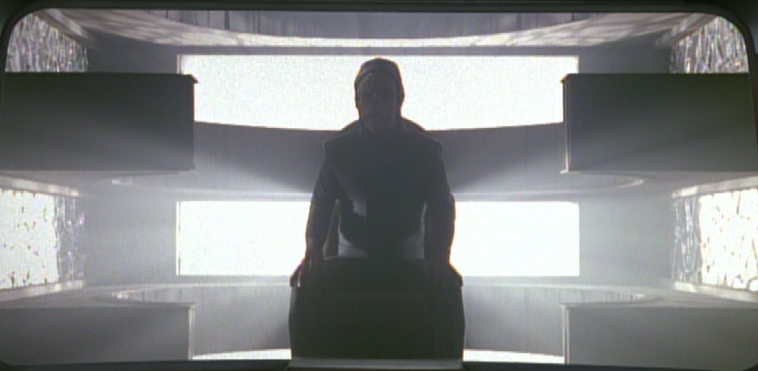
"This could be the start of a beautiful friendship..."

“This could be the start of a beautiful friendship…”

In fact, the third season of Deep Space Nine was such a mess that the production team had not even managed to hit the end of season cliffhanger that they wanted. The Adversary had been drafted at the last possible minute when the studio vetoed the idea of ending the year with a Vulcan withdrawal from the Federation. This is not to discount the long list of impressive episodes produced during the season, but it does illustrate that the third season of Deep Space Nine had not progressed according to plan.

At the same time, it was a vital learning experience for the show. It provided a clear framework for what followed, providing producer Ira Steven Behr with a foundation from which he would build the rest of the run. The work put in during the third season would pay dividends in the fourth and fifth seasons, as the show began to play with and pay off ideas that had been carefully and meticulously established during that most chaotic of seasons. In fact, the show begins paying off those dividends with The Way of the Warrior, the first episode of the fourth season.

Klingons woz 'ere...

Klingons woz ‘ere…

Continue reading →