• Following Us

  • Categories

  • Check out the Archives


  • Awards & Nominations

Doctor Who: The Doctor Falls (Review)

In many ways, World Enough and Time felt like a nostalgic return to classic Doctor Who.

The first part of the season premiere luxuriated in its relaxed pacing, as Bill watched grainy black-and-white footage that moved at a glacial pace. When the Cybermen appeared, they were explicitly classified as “the Mondasian Cybermen” and designed to evoke their earliest appearance in The Tenth Planet. When John Simm revealed himself, he was wearing a “rubbish beard” under an overly-elaborate disguise. There was a sense that Steven Moffat was bidding farewell to Doctor Who with a celebration of the classic series’ eccentricities.
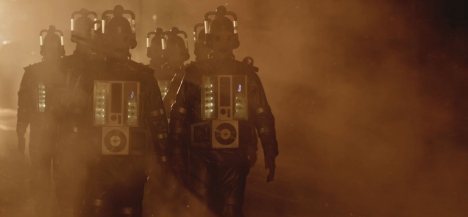
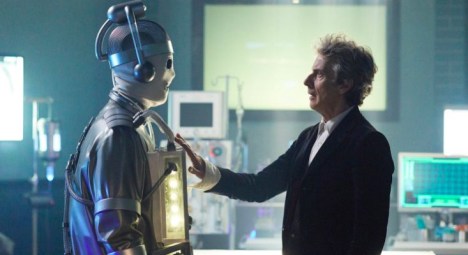
March of the Cybermen.

In contrast, The Doctor Falls is much more of an encapsulation of Moffat’s themes and ideas during his time on the show. Even the title of The Doctor Falls evokes the Moffat era; The Doctor Dances was the first episode to include the words “the Doctor” since Holiday for the Doctor, the first part of the First Doctor serial The Gunfighters. Moffat’s fascination with the Doctor as a character and concept is born out with his repeated reference to the character in the titles of his era; Vincent and the Doctor, The Doctor’s Wife, The Doctor, The Widow and the Wardrobe.

More to the point, The Doctor Falls returns to the idea of Moffat’s “Doctor trilogy” as the heart of his tenure as executive producer, the narrative running through The Name of the Doctor, The Night of the Doctor, The Day of the Doctor and The Time of the Doctor. Positioned roughly half-way through his run in terms of seasons and episodes, those stories encapsulated a lot of what Moffat felt about the character and the concept. It makes sense that The Doctor Falls should return to those ideas.
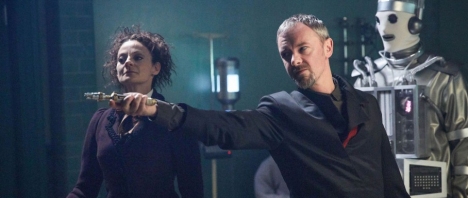
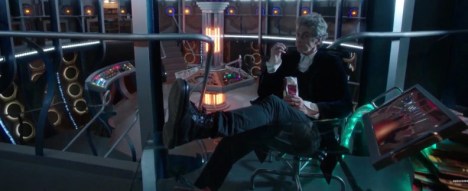
Masters of the Universe.

Continue reading

34. Terminator 2: Judgment Day (#43)

Hosted by Andrew Quinn and Darren Mooney, The 250 is a fortnightly trip through some of the best (and worst) movies ever made, as voted for by Internet Movie Database Users. New episodes are released every second Saturday at 6pm GMT, with the occasional bonus episode between them.

This time, James Cameron’s Terminator 2: Judgment Day.

Prophecised to lead mankind against the evil artificial intelligence Skynet in a post-apocalyptic battle for survival, young John Connor finds himself caught in a battle between two time-travelling assassins; one sworn to kill him, the other to protect him.

At time of recording, it was ranked the 43rd best movie of all time on the Internet Movie Database.

Continue reading

Star Trek: Deep Space Nine – Once More Unto the Breach (Review)

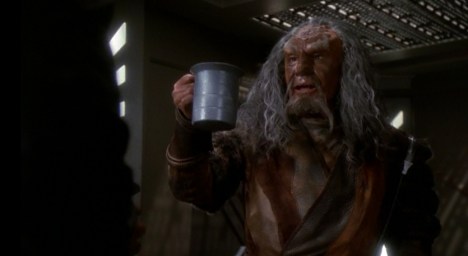
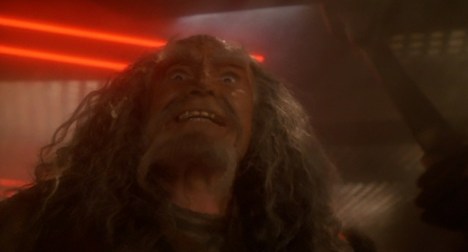
Once More Unto the Breach bids a fond farewell to Kor, the Star Trek franchise’s original Klingon.

To be fair, Star Trek: Deep Space Nine had never been particularly shy about killing off recurring characters, with Enabran Tain dying in In Purgatory’s Shadow, Michael Eddington expiring in Blaze of Glory, and Tora Ziyal being murdered in Sacrifice of Angels. Contractual negotiations had guaranteed the death of Jadzia Dax in Tears of the Prophets. Certainly, Kor was not a major player in the larger fabric of the show when compared to these figures, having only previously appeared in Blood Oath and The Sword of Kahless.

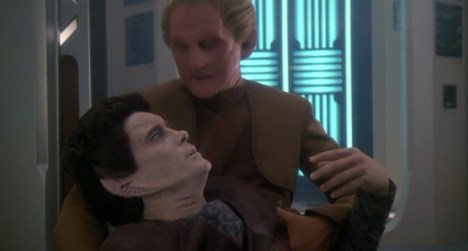
The return of a Kor character.

However, there is a certain gravity to the character owing to the fact that he could trace his appearance all the way back to Errand of Mercy in the very first season of the franchise. Kor was very much the first Klingon, even if he was neither the first Klingon to appear on screen nor the first Klingon to truly resemble the modern template. Kor was a part of the franchise’s history, part of its context. John Colicos had a fairly significant impact on popular culture, but has particularly important to Star Trek.

There would be bigger deaths over the course of the seventh season. Actors who had been with the franchise for years would go out in a blaze of glory. Recurring guest stars would see their stories come to an end. Some of those endings would be happy, whereas others would be more ignoble. Nevertheless, there is a something powerful about the passing of Kor in Once More Unto the Breach. It feels very much like an ending.

No Country for Old Klingons.

Continue reading

Non-Review Review: The House

The House comes from the writing duo Brendan O’Brien and Andrew Jay Cohen, representing Cohen’s directorial debut.

O’Brien and Cohen are perhaps best known for their work on Neighbours and Neighbours II: Sorority Rising, two of the more successful “overgrown manchildren” movies of the past few years. (They also worked on the somewhat underrated Mike and Dave Need Wedding Dates.) While these sorts of movies about grown-ups behaving badly are a dime-a-dozen in the modern comedy landscape, Neighbours and Neighbours II were elevated by a number of factors: attention to their female leads, very canny casting, clever shifts in the film’s moral weight at key moments.

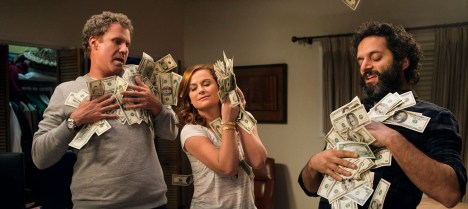
They are so money.

The House is perhaps a more modest proposal than Neighbours and Neighbours II. It is certainly a lot more straightforward in its plotting and character arcs, a simplicity reflected in the relatively abridged run-time of eighty-eight minutes. (To be fair, both Neighbours and Neighbours II kept their runtime just over the hour-and-a-half mark, which seems about right for a broad comedy.) However, it shares one key strength. It is a movie that very skilfully captures the feeling of a mid-life crisis, and the yearn to return to into a belated adolescence.

The House is a little uneven in places, prone to the structural problems that haunt a lot of contemporary blockbuster comedy from the jokey asides that jar with the narrative to the oh-so-tidy resolution, but it has a solid core. It is a movie that understands the middle-class middle-aged urge to break bad in the most banal of fashions, just a hint of sadness lurking beneath its more absurd twists. The House doesn’t always win, and maybe it hedges just a little too much, but it knows the game that it is playing.

A dicey proposition.

Continue reading

Star Trek: Voyager – In the Flesh (Review)

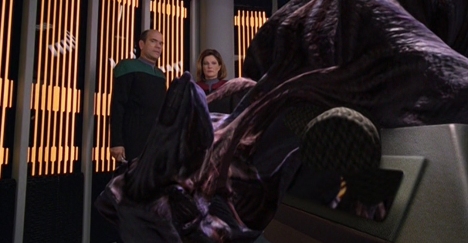
In the Flesh is a curiously nostalgic episode of Star Trek: Voyager.

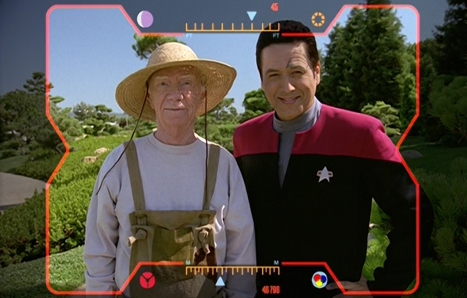
Nostalgic in a number of different ways. Most obviously, it opens on what appears to be Earth, bringing the Voyager crew to something resembling home. The campus recalls visits to Starfleet Command in earlier episodes of Star Trek: The Next Generation and Star Trek: Deep Space Nine like The First Duty, Homefront and Paradise Lost. There is even a prominent guest appearance from Boothby, the groundskeeper who was referenced as early as Final Mission. When it is eventually revealed to be a ruse, it is explained as a ruse orchestrated by old villains Species 8472.

Picture imperfect.

However, In the Flesh feels nostalgic in a deeper sense, extending even beyond the Star Trek canon. There is something very retro about the threat presented here, about a top secret facsimile of a distant world being used to train infiltrators in a deep space cold war. In the Flesh feels like a piece of fifties paranoia, with specific creative choices evoking film noir storytelling and even the aesthetic of Invasion of the Body Snatchers or Night of the Living Dead. The most prominent guest star is Ray Walston, a veteran of cult sixties sci-fi show My Favourite Martian.

To be fair, Voyager has always had a strong nostalgic streak for pulpy fifties and sixties science-fiction, but it is strange to see it so pronounced. In its own weird way, it fits with the general nostalgic tone of the fifth season as a whole.

Look at the “8” in their eyes.

Continue reading

Non-Review Review: Halal Daddy

Halal Daddy is a pleasant enough culture clash comedy, perhaps most notable for how conventional it is.

The premise of Halal Daddy is immediately striking, based on a true story about the halal meat factory in Sligo. It is a compelling set up, one with a lot of potential to explore the collision of differing perspectives and outlooks against the backdrop of the West of Ireland. Certainly, director Conor McDermottroe does an excellent job capturing a sense of place and texture in this Sligo-set comedy.

Meat cute.

However, what is most surprising about Halal Daddy is how conventional it feels. In many ways, it plays like the extended pilot for a BBC sitcom. Indeed, there is a sense that Halal Daddy might easily have been broken down into a series of six relatively interconnected episodes built around a variety of miscommunications and errors in judgment featuring the core cast. At certain point, Halal Daddy feels like a compressed set of stories, with each new set of complications summarised as “the one where…”

This is not a huge problem. Halal Daddy has a lot of charm. Some of that charm comes from a winning central performance from Nikesh Patel, while some of it comes from the casual ease with which it navigates from sitcom beat to sitcom beat without ever letting any of these potential problems overwhelm its characters or the audience. Halal Daddy is an enjoyable feel-good comedy, one that only occasionally feels a little light of touch.

There’ll be halal to pay.

Continue reading

Star Trek: Deep Space Nine – Treachery, Faith and the Great River (Review)

Treachery, Faith and the Great River is a beautiful piece of Star Trek: Deep Space Nine.

It is a meditation on everything suggested by the title, recurring themes across the seven-season run of Deep Space Nine. Indeed, it is a reflection on how each of those three concepts all tie back to the same notion of belief. Treachery is what happens when belief is betrayed, faith is what happens when belief is held without validation, and the great river reflects a more generic belief in the balance and distribution of the wider universe. Treachery, Faith and the Great River is a story about belief and the various forms that it takes, and the rewards that it offers.

“And how can man die better than facing fearful odds, for the ashes of his fathers, and the temples of his Gods?”

In many ways, Treachery, Faith and the Great River marks a return to the sort of softer religious belief that defined the early seasons of Deep Space Nine. It is an episode that engages with the challenges of faith, rather than taking it at face value. It is no small irony that an episode as nuanced as Treachery, Faith and the Great River should be credited to the writers responsible for The Reckoning. In many ways, Treachery, Faith and the Great River asks what it means to truly believe in something, even knowing that this belief might never be rewarded.

Treachery, Faith and the Great River is a story about looking for the divine, and the answers that are offered in return.

Weyoun Six, Weyoun Seven…
All good clones go to heaven…

Continue reading

Non-Review Review: Baby Driver

Baby Driver is largely about keeping the wheels spinning.

Circular imagery recurs throughout the film. At various points, long-take sequences begin and end in the same location, following characters as they move in a literal circle. At other points, the camera remains static while characters leave the frame to one side and enter from the other, creating the impression that they have just lapped their environment. Baby Driver is populated with objects that go all the way around to end up where they started; the clicker on an iPod, the drum of a washing machine, the wheels on a car, the subwoofer on a stereo, the record on a turntable.

Tune in, and cop out.

Even the dialogue and story move in something approaching a circle; recurring patterns of bad behaviour and errors in judgement, repeated lines offering a sense of symmetry to the story. In one of the nicer smaller examples, both the extended opening and closing sequences make a point to place the eponymous getaway driver behind the wheel of a striking red Subaru. Calls and response, echoes and refrains, patterns and sequences. It all comes around, Baby Driver suggests.

There is very little novel or innovative in Baby Driver, which feels very much like an attempt by writer and director Edgar Wright to construct a more conventional crowd-pleasing film than cult hits that defined his earlier efforts. A lot of Baby Driver feels conventional and archetypal, a conscious choice on the part of the director. While the supporting cast features any number of interesting players breathing life into familiar criminal archetypes, Baby Driver suffers from the fact that its two leads are its least satisfying element.

Drive baby.

Continue reading

Doctor Who: World Enough and Time (Review)

The Moffat era will likely be remembered for its “wibbly wobbly, timey wimey” plotting, so perhaps World Enough and Time is an appropriate end point.

World Enough and Time begins what will be Steven Moffat’s last season finale, and what will be his last run as both writer and showrunner on Doctor Who. It is the beginning of the end. It is in some ways a less dramatic farewell than that overseen by his predecessor, with a year of specials meaning that Russell T. Davies was credited on the last nine episodes of his tenure. Instead, World Enough and Time is the first of Steven Moffat’s last three scripts for Doctor Who.

Heart-to-heart-implant.

World Enough and Time is bookended by these references, reminding the audience that time is running out for the Doctor. The teaser suggests an inevitable regeneration, as the Doctor stumbles out of the TARDIS burning with energy. The closing shot of the “Next Time” trailer at the end of the episode is the Doctor digging his hand into the soil as the energy flows through his body. There is a definite sense that the Twelfth Doctor is (a lot) closer to his end than two his beginning.

Indeed, even the inclusion of the Cybermen in World Enough and Time plays into this idea. The Daleks have arguably always functioned as the death drive within Doctor Who, the Last Great Time War serving as a metaphor for the traumatic cancellation. The Cybermen provide an interesting inversion. They represent the continuation of life through grotesque means. The Cybermen are monsters that sacrificed their humanity to survive. While the only answer to the Daleks is life, the only answer to the Cybermen is death. Death comes to time.

No time for Missy-ing.

There are several interesting aspects of World Enough and Time, from the decision to build the two-parter around the Cybermen rather than the Daleks through to the decision to include two versions of the Master. However, the most strikingly “Moffat-y” aspect of the episode is how it approaches the question of time itself. The central hook of World Enough and Time is a colony ship where time has been dialated by a black hole, but that is not the most interesting “timey wimey” element of the series.

Instead, World Enough and Time is notable as a surprisingly nostalgic indulgence. It is an episode seems to bring the show back to its earliest days, from the Master’s campy disguise to his rubbish beard to the quite pointedly “Mondasian Cybermen” to the time spent watching a black-and-white show waiting a week to see what would happen next. World Enough and Time is a surreal curiousity, rather than a bombastic event. There is something very surreal in that.

Doctor Who watches Doctor Who.

Continue reading

33. Braveheart – w/ When Irish Eyes Are Watching (#75)

Hosted by Andrew Quinn and Darren Mooney, The 250 is a fortnightly trip through some of the best (and worst) movies ever made, as voted for by Internet Movie Database Users. New episodes are released every second Saturday at 6pm GMT, with the occasional bonus episode between them.

This week, a special crossover episode with When Irish Eyes Are Watching, an Irish film podcast wherein Alex, Clíona and Séan take at a look at films connected to the Emerald Isle.

Together, they are covering Mel Gibson’s Braveheart.

A pseudo-historical epic, Braveheart follows William Wallace as he prepares to lead Scotland to its independence from the British crown.

At time of recording, it was ranked the 75th best movie of all time on the Internet Movie Database.

Continue reading