• Following Us

  • Categories

  • Check out the Archives


  • Awards & Nominations

Star Trek: Voyager – Resistance (Review)

This February and March, we’re taking a look at the 1995 to 1996 season of Star Trek, including Star Trek: Deep Space Nine and Star Trek: Voyager. Check back daily Tuesday through Friday for the latest review.

Resistance is a very episodic instalment of Star Trek: Voyager.

It begins with the ship facing a convenient plot-generating fuel-shortage, the type of problem that the ship had encountered near the start of Phage or The Cloud or Tattoo. It is the kind of problem that was not mentioned in previous episodes, and which will never be presented as a potentially recurring problem. In fact, Resistance is the only episode of Voyager (or Star Trek) where the word “Tellerium” is mentioned. Many of the stock criticisms of Voyager apply here.

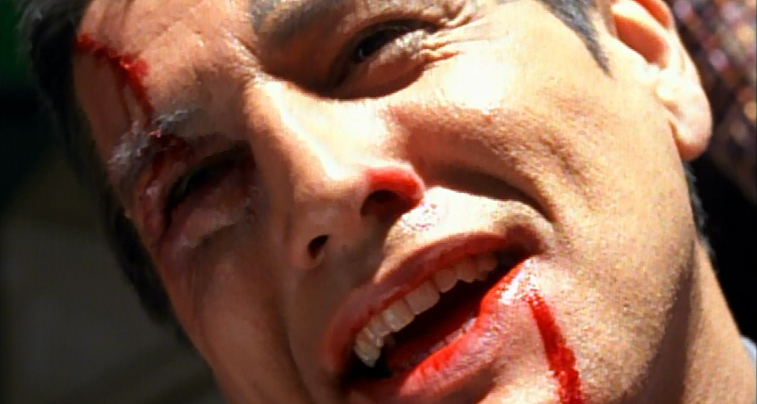
Fifty shades of Joel Grey...

Fifty shades of Joel Grey…

At the same time, Resistance is proof that the episodic model is not entirely without merit. For all that modern television has tended towards serialisation and arcs and long-form storytelling, there is nothing inherently wrong with a good old-fashioned done-in-one adventure. On a purely cosmetic level, Resistance is the typical Voyager episode; it relies on contrivance, it features a host of guest characters who will never appear (or be mentioned) again, it has no lasting impact. And yet it works better than any episode to this point in the second season.

As easy as it is to get distracted by arguments about serialised and episodic storytelling, or about arcs and standalones, the truth is that Voyager‘s problems are at once more simple and more complex than that. The grand irony of the second season is that it is the only season of Voyager to attempt a storytelling arc, but that storytelling arc is pretty universally derided as one of the worst things that the show ever did. (It isn’t really, but it’s still pretty bad.) The truth is that it doesn’t matter how Voyager chose to tell its stories, as long as it told them well.

Mellon head...

Mellon head…

Resistance is a fairly standard episode of Voyager, but it is elevated in the telling. The story seems unlikely to rank among anybody’s favourite Voyager episodes, but it is an efficient and effective character study with a solid script and a great central performance. The production team were able to recruit Oscar-winning actor Joel Grey as the primary guest star, lending the story an incredible level of pathos. Lisa Klink also makes quite an impression with her debut teleplay, providing a story that is careful to give most of the cast something to do.

The result is proof that there’s nothing inherently wrong with a largely episodic approach to Star Trek storytelling, as long as the material is up to scratch.

"This is knife reunion, no?"

“This is knife reunion, no?”

Continue reading

Star Trek: Voyager – Manoeuvres (Review)

This February and March, we’re taking a look at the 1995 to 1996 season of Star Trek, including Star Trek: Deep Space Nine and Star Trek: Voyager. Check back daily Tuesday through Friday for the latest review.

It is weird to think that the much-maligned Kazon provided perhaps the closest thing that Star Trek: Voyager had to a long-form story arc.

That probably says more about Voyager than it does about the Kazon. In storytelling terms, Voyager was firmly episodic. There were some loose threads that would span and connect multiple episodes, but the bulk of the show was comprised of very traditional “done in one” adventures. It seems fair to observe that Voyager represented something of a backslide for the franchise. It was much more episodic than Star Trek: Deep Space Nine, but also less interested in long-form storytelling than the later years of Star Trek: The Next Generation.

"This is still more enjoyable than Tattoo!"

“This is still more enjoyable than Tattoo!”

One suspects that the Kazon arc running through the second season had something to do with this storytelling choice. Michael Piller pushed really hard to make the Kazon a recurring threat to Voyager and to place them at the centre of the second season. As a result, they become a loose thread that runs through several of the season’s “big” episodes. They place a traitor on board Voyager in Alliances. They provided Tom Paris with a character arc culminating in Investigations. They provided the season-ending cliffhanger in Basics, Part I.

The arc was not well-received, whether by the fans or by the staff. It is not too difficult to understand why. Even before considering the quality of the arc itself – or the storytelling involved – the Kazon are hardly the most compelling Star Trek villains. Allowing for that, it seemed like the writing staff had no real idea how to serialise a story arc across a season, making all manner of clumsy mistakes along the way. The arc never gathered momentum and it never paid off, which are very real problems when trying something that ambitious.

Either you Kazon... or you be gone...

Either you Kazon… or you be gone…

Manoeuvres effectively kicks off the arc. Although the Kazon had appeared in Initiations earlier in the second season, Manoeuvres features the first reappearance of Seska and Cullah since State of Flux midway through the first season. The episode is perhaps the strongest of the “Kazon” shows, with a sense of momentum driving the first half of the script. However, things rather quickly come off the rails in the second half of the story. Already, the production team’s inexperience with serialised storytelling is showing.

Manoeuvres is perhaps as good as the Kazon ever got. It is nowhere near good enough.

So that's why they call them raiders...

So that’s why they call them raiders…

Continue reading

Star Trek: Voyager – Cold Fire (Review)

This February and March, we’re taking a look at the 1995 to 1996 season of Star Trek, including Star Trek: Deep Space Nine and Star Trek: Voyager. Check back daily Tuesday through Friday for the latest review.

Cold Fire is an episode that exemplifies the feeling that second season’s treading water.

Cold Fire opens with a somewhat unconventional recap of Caretaker. Unlike most “previously on…” sections of Star Trek: Voyager (or the Star Trek franchise as a whole), this block is narrated by Majel Barrett in-character as the ship’s computer. It becomes clear that Cold Fire is interested in following up on the dangling threads left by Caretaker, with the crew of Voyager encountering the female mate alluded to in Janeway’s conversations with the eponymous Nacene character from Caretaker.

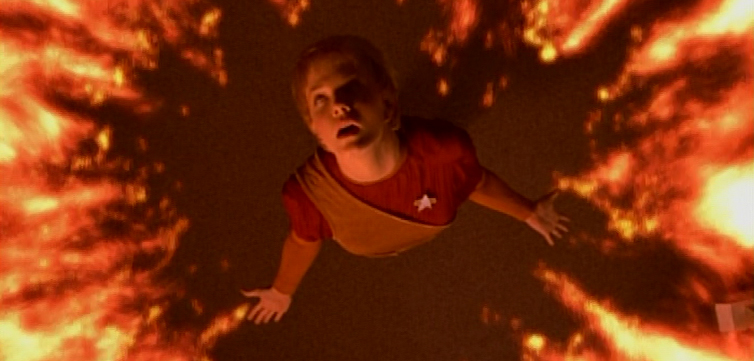
Everything burns...

Everything burns…

This should be a big deal. After all, the Caretaker is the character responsible for plucking Voyager and the Val Jean out of the Alpha Quadrant and depositing them on the other side of the galaxy. Finding another being with a similar amount of power presents a very real and tangible opportunity for Janeway to get her crew home. If the Caretaker could pull them all the way across the Milky Way, then it stands to reason that Suspiria could send them all the way back. Cold Fire presents a potential end to Voyager’s journey.

Unfortunately, Cold Fire never really does anything with that storytelling angle. Even when Janeway comes face-to-face with Suspiria at the climax of the episode, she never asks the powerful entity to send her crew home. So Cold Fire feels like an episode that spends forty-five minutes walking in circles, accomplishing little of note.

"It's probably just the inertial dampeners acting up..."

“It’s probably just the inertial dampeners acting up…”

Continue reading

Star Trek: Voyager – Tattoo (Review)

This February and March, we’re taking a look at the 1995 to 1996 season of Star Trek, including Star Trek: Deep Space Nine and Star Trek: Voyager. Check back daily Tuesday through Friday for the latest review.

Tattoo is another example of the second season Star Trek: Voyager doubling down on elements that did not work in the first season.

Episodes like The Cloud and Cathexis had suggested that Chakotay might be a problematic character for the show. After all, Chakotay was the first Native American lead character to appear in the franchise, but he was played by a Mexican-American actor. More than that, the first season seemed to draw from an awkward collection of tropes and clichés in its depiction of Chakotay’s culture. The show declined to anchor Chakotay in a single specific Native American cultural tradition, instead drawing from a rake of familiar shallow iconography.

"Oh, here we go again..."

“Oh, here we go again…”

Chakotay didn’t really work in the first season. The problem is that Michael Piller seemed reluctant to accept that Chakotay’s Native American spirituality was borderline racist and offensive. So Tattoo returns to that particular well, with a much greater commitment to patronising and exploiting Native American culture. Exploring the Delta Quadrant, Chakotay comes across a seemingly abandoned moon that turns out to be the home of an ancient alien culture that made contact with Chakotay’s ancestors forty-five thousand years ago.

These aliens were responsible for shaping and molding Native American culture, for putting those groups in closer communion with the land and for fostering a purer spirituality. Not only is the main alien played by white actor Richard Fancy, the make-up design on these “Sky Spirits” emphasises their whiteness. So Tattoo becomes a story about how Native American culture essentially came from a bunch of super-advanced white people. It is astounding that nobody seemed to stop and think about the episode on the way to the screen.

"Oh, hey. That's a new level of offensiveness."

“Oh, hey. That’s a new level of offensiveness.”

Continue reading

Star Trek: Voyager – Persistence of Vision (Review)

This February and March, we’re taking a look at the 1995 to 1996 season of Star Trek, including Star Trek: Deep Space Nine and Star Trek: Voyager. Check back daily Tuesday through Friday for the latest review.

In some respects, the second season of Star Trek: Voyager can be seen as a conflict over the future of the show.

On the one hand, Michael Piller had returned to the franchise following the failure of the television show Legend. With Ira Steven Behr overseeing Star Trek: Deep Space Nine, Piller returned to focus his attention on the second season of the younger Star Trek show. After all, the second season was a disorganised mess, with the production team struggling to get the necessary scripts together on time. Having a safe pair of hands on board to help guide the show might come in handy.

"It's a bridge AND a tanning salon, simultaneously..."

“It’s a bridge AND a tanning salon, simultaneously…”

On the other hand, Jeri Taylor had been around the show since Caretaker. She had taken over the reins after Piller’s departure and had supervised the tail end of the first season. Taylor had arrived on the Star Trek franchise just a year after Piller, and had been a vital part giving Star Trek: The Next Generation its unique voice and mood. Over the course of the second season, it became increasingly clear that Michael Piller and Jeri Taylor had very different visions for the future of Star Trek: Voyager, and those visions were coming into conflict.

History ultimately vindicated Jeri Taylor. The second season of Voyager was the last television season of Star Trek to be directly overseen by Piller, while Jeri Taylor become the guiding light of the third and fourth seasons of the show. Whatever problems might exist with those two seasons television, they are at least more stable and consistent than the first and second years of the show. It is, of course, arguable that Piller never got his own change to exercise his own vision of the show unimpeded – and so that is not a fair measure.

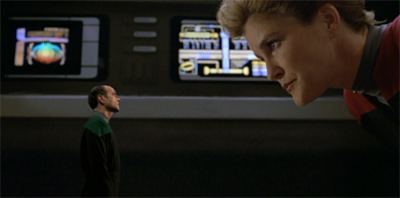
Cutting the Doctor down to size...

Cutting the Doctor down to size…

In a way, the conflict between Piller and Taylor’s versions of Voyager is quite clearly typified in this early run of episodes. The show had breezed through the four episodes left over from the first season production block, and desperately needed ideas to keep afloat. The senior producers rolled up their sleeves and got involved. Piller was largely responsible for Parturition and Tattoo, while Taylor oversaw Persistence of Vision. None of these episodes are perfect, but it is quite clear that Taylor is increasingly the show’s safest bet going forward.

Persistence of Vision is a very flawed episode of television, playing to some of Taylor’s more uncomfortable recurring motifs. However, it is much more interested in actually moving Voyager along than either of Piller’s contributions.

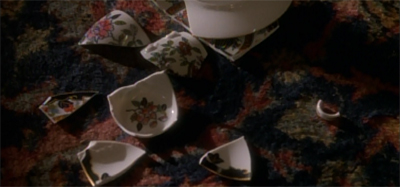
"The teacup that I shattered did come together."

“The teacup that I shattered did come together.”

Continue reading

Star Trek: Voyager – Parturition (Review)

This February and March, we’re taking a look at the 1995 to 1996 season of Star Trek, including Star Trek: Deep Space Nine and Star Trek: Voyager. Check back daily Tuesday through Friday for the latest review.

One of the more interesting aspects of the second season of Star Trek: Voyager is its stubborn refusal to give up on elements that simply do not work.

Time and again, and often at the behest of producer Michael Piller, the second season returns to concepts that were problematic and troublesome in the first season. The obvious goal is to fix those problems so that those elements can be successfully reintegrated into the surrounding show. This is why the second season returns to concepts like the Kazon as a threat and Tom Paris as a rebel and Neelix as a character with a useful function on the ship. This is not a bad approach. If the first season of a show is about experimentation, then the second season is about calibration.

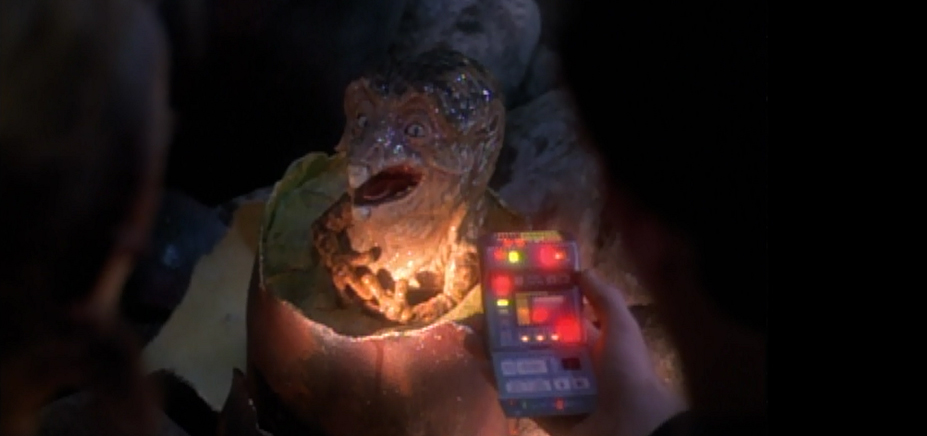
Two men and a lizard lady...

Two men and a lizard lady…

It is hard to begrudge Michael Piller this approach. After all, it had worked quite well on Star Trek: The Next Generation and Star Trek: Deep Space Nine. In particular, it took Deep Space Nine about three years before it figured out how to make characters like Bashir, Dax and Quark capable of carrying their own episodes without making the audience want to bash their heads against a large blunt surface. It is not unreasonable to take the same approach to dealing with the elements of Voyager that are not working.

There is a very significant difference, though. The problematic elements of Voyager have little to do with execution; they are fundamental problems with the concepts. The Kazon do not work as a threat because they are one of worst alien species that Star Trek ever produced, rooted in some rather unpleasant racial stereotypes tied to contemporary Los Angeles gang culture. Tom Paris does not work as a rebel and womaniser because Robert Duncan McNeill works better as a charming goof. Neelix’s romance with Kes is toxic because she is a child and he’s possessive.

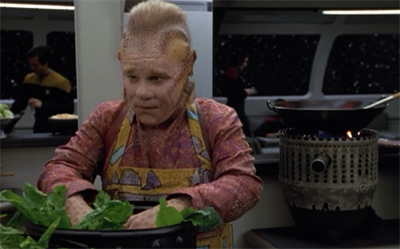
Cooking up a storm...

Cooking up a storm…

As such, it feels like the second season of Voyager spends a lot of time fixing problems that are fundamentally unfixable. One of the great aspects of the premise of Voyager is the fact that the show is in a constant state of movement. Unlike the cast of Deep Space Nine who are fixed in a single place, the cast of Voyager are constantly moving forward. It is possible for Voyager to jettison the parts that are simply not working. (Cue lazy joke about the size of Kazon space.)

Parturition is an example of this phenomenon, as Voyager tries to “fix” the toxic relationship between Neelix and Kes, while offering Tom Paris some small semblance of character growth. Unfortunately, it seems very attached to the idea of Neelix and Kes as a romantic couple and Tom Paris as a playful romantic rogue, which means that the best that it can hope to do is to not make the underlying problems any more obvious. While Parturition is nowhere near as bad as Elogium or Twisted, it still feels like a series treading water.

It's time for the Delta Quadrant's favourite fifties sitcom, "Last Tango With Paris."

It’s time for the Delta Quadrant’s favourite fifties sitcom, “Last Tango With Paris.”

Continue reading

Star Trek: Voyager – Season 1 (Review)

This September and October, we’re taking a look at the jam-packed 1994 to 1995 season of Star Trek, including Star Trek: Deep Space Nine and Star Trek: Voyager. Check back daily for the latest review.

The best thing that can be said about the first season of Star Trek: Voyager is that it avoids being actively terrible.

This might sound like damning with the faintest of praise, but it’s worth looking at the show in the context of its siblings. None of the Star Trek spin-offs have had illustrious first seasons, often struggling to find their feet. It’s worth noting that Voyager‘s first season doesn’t contain any episodes that are as flat-out bad as something like Code of Honour, Angel One or The Passenger. While the show has more than its fair share of problems, it’s hard to look at the concept behind any episode in Voyager‘s first season and think “this is truly bad idea.”

voy-caretaker2

Of course, the logical counterpoint to that argument is the observation that the show hasn’t produced anything of equivalent quality to Heart of Glory, Conspiracy, Duet or In the Hands of the Prophets. This is perfectly legitimate criticism, and it really explains the problem with the first season of Voyager. While the show has avoided any spectacularly embarrassing decisions, it did this by completely avoiding any real risk.

The first season of Star Trek: Voyager is almost perfectly calibrated to land in the Star Trek comfort zone.

voy-learningcurve18

Continue reading

Star Trek: Voyager – Twisted (Review)

This September and October, we’re taking a look at the jam-packed 1994 to 1995 season of Star Trek, including Star Trek: Deep Space Nine and Star Trek: Voyager. Check back daily for the latest review.

It’s easy to see why the decision was made to bury Twisted as deep into the second season of Star Trek: Voyager as possible. The third of four episodes carried over from the end of the show’s first production year, it was the sixth episode of the show’s second broadcast season. Not only did it air behind the last episode produced as part of that first year, it also aired behind the first two episodes produced during the second season.

To be fair, Twisted isn’t a bad episode. It has a whole host of problems, but the most fundamental issue with Twisted is that it is incredibly dull. It’s the most pointless sort of story imaginable, where a bunch of weird stuff happens to our characters and there’s no way to save the day so they just sit around and wait patiently until it stops. While the script to Twisted is comprised of irritating moments, they don’t add up to anything substantial.

Twisted is very much the equivalent of forty-five minutes of Star Trek themed dead air.

"Why, hello there..."

“Why, hello there…”

Continue reading

Star Trek: Voyager – Non Sequitur (Review)

This September and October, we’re taking a look at the jam-packed 1994 to 1995 season of Star Trek, including Star Trek: Deep Space Nine and Star Trek: Voyager. Check back daily for the latest review.

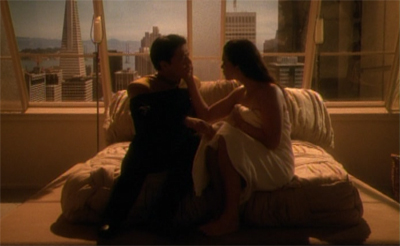
Non Sequitur is a Brannon Braga script touching on familiar Brannon Braga concepts – big ideas like time and space and reality and existence. Harry Kim wakes up to find himself in bed with his girlfriend, Libby. The two are living in San Francisco on Earth. Ensign Harry Kim never served on Voyager, instead working in Starfleet Engineering on Earth. Unable to explain what has happened, Kim finds himself struggling to cope with the situation.

Luckily, in true Star Trek: Voyager fashion, everything is conveniently reset at the end of the episode.

Feels like going home...

Feels like going home…

Continue reading

Star Trek: Voyager – Elogium (Review)

This September and October, we’re taking a look at the jam-packed 1994 to 1995 season of Star Trek, including Star Trek: Deep Space Nine and Star Trek: Voyager. Check back daily for the latest review.

Elogium is the first script from writer Kenneth Biller, even if it was his second script produced and his third script to air. Adapted from a script by Jeri Taylor from a freelance pitch from Jimmy Diggs, Elogium has gone through quite a few sets of hands before reaching the screen. In many respects, Biller’s script went through the opposite approach of many writers working on Star Trek for the first time.

Ronald D. Moore’s script for The Bonding and René Echevarria’s teleplay for The Offspring both went through story editor Melinda Snodgrass and executive producer Michael Piller for varying amounts of re-writes before their ideas reached the screen. In contrast, Biller’s début assignment is re-writing a script written by an executive producer from a freelance pitch. It’s no wonder that Elogium turned into such a mess.

Love in a turbolift...

Love in a turbolift…

The episode was produced towards the tail end of the first season of Star Trek: Voyager, and it’s almost a shame that it was held back into the second season. While hardly an episode deserving of repeat airing over the summer, it was also a pretty poor way of welcoming viewers into the show’s second season. It’s a problem with all of the hold-overs, except for Projections. The other three episodes carried over are among the weakest episodes of a troubled season. Elogium might not be quite as dull as Twisted or as unfocused as The 37’s, but it is a deeply creepy episode of television.

The two episodes produced during the second season to air in the first six weeks – Initiations and Non Sequitor – might not represent franchise high-points, but they are well-produced hours of television that suggest Voyager might be finding its feet. The hold-overs from the first season undermine that sense of progress.

Neelix was shocked to discover that Ocampan children were not found under cabbage patches...

Neelix was shocked to discover that Ocampan children were not found under cabbage patches…

Continue reading