• Following Us

  • Categories

  • Check out the Archives


  • Awards & Nominations

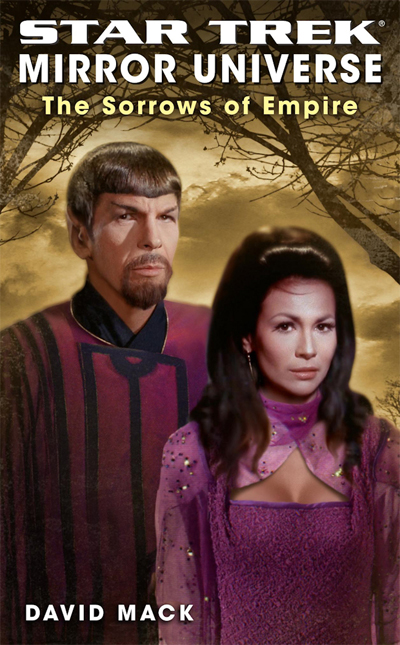
Star Trek: Mirror Universe – The Sorrows of Empire by David Mack (Review)

The first Star Trek pilot, The Cage, was produced in 1964. To celebrate its fiftieth anniversary, this December we are reviewing the second season of the original Star Trek show. You can check out our first season reviews here. Check back daily for the latest review.

There is a fairly significant lacuna in the internal chronology of the Star Trek universe, between the opening scene of Star Trek: Generations and Encounter at Farpoint. It is a fairly significant void that has only fleetingly been explored in various novels and comic books – most notably in Pocket Books’ intriguing Lost Era series. However, the lack of interest in this period is understandable. Not too much had changed between the end of Star Trek VI: The Undiscovered Country and the start of Star Trek: The Next Generation. Starfleet was still Starfleet, the Enterprise was still a ship of exploration.

In contrast, much more happened between the last act of Mirror, Mirror and the teaser of Crossover. The Terran Empire had collapsed in on itself, replaced by a hostile alliance of Klingons and Cardassians. Humans were no longer masters of their domain, instead forced to exist as slaves or mercenaries or rebels. The universe of Mirror, Mirror had been brutal, but ordered; the world of Crossover was brutal and chaotic. Everything had changed in a rather fundamental way. An empire had died, the enemy had stormed the gates. Everything was wrong.

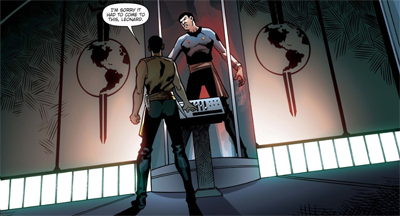
With The Sorrows of Empire, author David Mack begins a project to impose a clear structure on the mirror universe. Mack’s objective is essentially to stitch together a host of divergent (and perhaps even contradictory) continuity into a singular unifying narrative. The Sorrows of Empire was first published as a novella in the Glass Empires collection. However, his attempt to knit together the mirror universe as featured on the original show, Star Trek: Deep Space Nine and Star Trek: Enterprise was quickly expanded into its own full-length novel.

Indeed, having tied those various threads together, Mack would then try to resolve them all, writing Rise Like Lions to help stitch The Soul Key into his tapestry while resolving a long-dangling piece of Star Trek continuity. The Sorrows of Empire is a fascinating read, and Herculean effort. Mack shares the same knack for blending continuity with narrative as writers like Keith R.A. DeCandido or Christopher L. Bennett. However, The Sorrow of Empires struggles to get around the fact that it is trying desperately to put together a jigsaw from mismatched pieces that were never meant to be combined.
tos-thesorrowsofempire

Continue reading

Star Trek – The Trouble With Tribbles (Review)

The first Star Trek pilot, The Cage, was produced in 1964. To celebrate its fiftieth anniversary, this December we are reviewing the second season of the original Star Trek show. You can check out our first season reviews here. Check back daily for the latest review.

This is a classic.

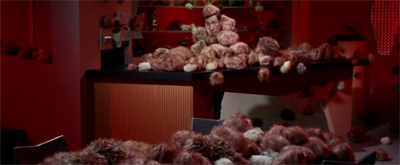
The Trouble With Tribbles is an episode that can make a legitimate claim to being the best episode of Star Trek, if not the best episode of the entire franchise. It is a genuine classic in countless ways, perfectly embodying so much of what makes Star Trek classic and iconic and loved. David Gerrold’s script, polished by Gene Coon, is easily the best comedy episode that the franchise has ever produced, but never at the expense of the show’s credibility. The Trouble With Tribbles may be silly, but it is also very clever and insightful.

Nobody knows the Tribbles I've seen...

Nobody knows the Tribbles I’ve seen…

Continue reading

Star Trek – Mirror Images (Review)

The first Star Trek pilot, The Cage, was produced in 1964. To celebrate its fiftieth anniversary, this December we are reviewing the second season of the original Star Trek show. You can check out our first season reviews here. Check back daily for the latest review.

There has always been something rather strange about IDW’s Star Trek publishing line. How does the company decide what ideas got to print? What indicators do they look at in order to determine that one concept is worth exploration, but another is not? Basing the monthly on-going comic series around JJ Abrams’ rebooted Star Trek universe makes a great deal of sense, as does commissioning D.C. Fontana to write Year Four – The Enterprise Experiment. However, there is a sense that a lot of their output comes from throwing darts at boards.

For example, comics based on Star Trek: The Next Generation and Star Trek: Deep Space Nine have been confined to miniseries or arcs of the on-going monthly series; this seems odd, given that the market buying comics books would have been at the perfect age to feel nostalgia for them. However, miniseries like Intelligence Gathering or Assimilation2 are given as much prominence as strange alternate universe stories as The Last Generation or Mirror Images.

Pained leadership...

Pained leadership…

It isn’t that The Last Generation or Mirror Images aren’t interesting, at least on paper. While the execution in both cases might leave a little to be desired, there are interesting stories to be told in the classic “what if…” comic book style. However, it is hard to believe that there is as much demand for the four-issue story of mirror!Kirk taking command of the I.S.S. Enterprise and killing mirror!Pike as there is to see Data or Odo or Picard again. Given the success that IDW has enjoyed resurrecting The X-Files, it would seem nineties nostalgia is out there.

There is an argument to be made that the classic crew is currently more popular and iconic than any of the spin-offs, largely thanks to the recent cinematic reboot. However, is there really so much demand for a story based around Christopher Pike that four issues of mirror!Pike scheming demand to published?

Only logical...

Only logical…

Continue reading

Star Trek – I, Mudd (Review)

The first Star Trek pilot, The Cage, was produced in 1964. To celebrate its fiftieth anniversary, this December we are reviewing the second season of the original Star Trek show. You can check out our first season reviews here. Check back daily for the latest review.

I, Mudd is delightfully silly.

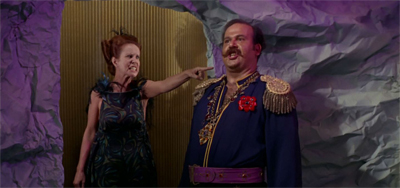
This is probably the broadest Star Trek comedy episode ever produced. It is very difficult to imagine any Star Trek ensemble outside the original cast pulling off an episode like this. While The Trouble With Tribbles is easily the show’s most iconic comedy episode (and the franchise’s, to boot), there is something rather plucky and endearing about I, Mudd. One of features of the later Star Trek spin-offs was a tendency to take themselves quite seriously. This isn’t a problem of itself, but it does make it impossible to do a show like I, Mudd.

Mudd in yer eye...

Mudd in yer eye…

As with other second-season episodes, there is a sense that the show is stretching its wings a bit. Catspaw was a clear attempt to do a horror story, and Wolf in the Fold was a slasher or occult film in Star Trek form. Episodes like Amok Time and Journey to Babel are very consciously building out the Star Trek universe. Episodes like I, Mudd and The Trouble With Tribbles demonstrate that Star Trek can do comedy.

To be fair, it is perfectly reasonably to argue that shows like I, Mudd led the show to think that Spock’s Brain was a good idea. Still, I, Mudd is just so much fun – demonstrating the sense of goofy and theatrical fun that ran through so much of classic Star Trek.

"Stella, Stella... You're putting me through hell-a!"

“Stella, Stella… You’re putting me through hell-a!”

Continue reading

Star Trek (DC Comics, 1984) #9-16 – New Frontiers (aka The Mirror Universe Saga) (Review)

The first Star Trek pilot, The Cage, was produced in 1964. To celebrate its fiftieth anniversary, this December we are reviewing the second season of the original Star Trek show. You can check out our first season reviews here. Check back daily for the latest review.

Eight issues is a long time in the world of comic books, even by the standards of modern storytelling. Committing to the same story arc for two-thirds of a calendar year is a big decision, even moreso in December 1984. Nevertheless, DC comics committed to an eight-issue Star Trek story arc in the wake of Star Trek III: The Search for Spock, on throwing Kirk and the crew into a truly epic adventure with the fate of the Federation hanging on the line. It is no wonder that The Mirror Universe Saga remains the gold standard for Star Trek comic books, reprinted and repackaged repeatedly over the years.

The Mirror Universe Saga is an epic in just about every sense of the word, spanning two universes and eight issues. Not only do writer Mike Barr and artist Tom Sutton find themselves handling the fallout from the last feature film, but they also dabble in an iconic piece of Star Trek history. The Mirror Universe Saga takes full advantage of its format to offer a spectacular and impressive adventure that would have been impossible to realise on film in 1984 – indeed, it is hard to imagine television or cinema doing justice to the scale of the adventure now.

Meeting of minds...

Meeting of minds…

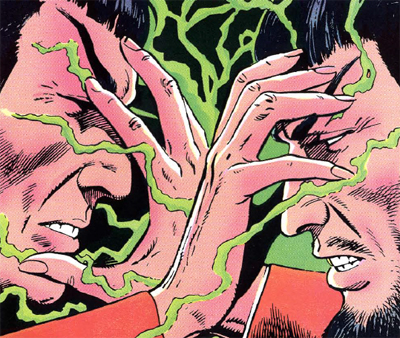
However, The Mirror Universe Saga succeeds on more than simply epic scale and meticulous attention to detail – although Barr and Sutton provide those with gusto. Despite everything going on around it, The Mirror Universe Saga largely works because it never loses track of the characters at the heart of the story. While the Terran Empire might be plotting an invasion in the midst of an internal revolution, the more powerful moments of The Mirror Universe Saga come from throwing the characters into contact with their alternate selves.

In 1984, it seems like The Mirror Universe Saga had figured out what would be the core ingredients for the most successful follow-ups to Mirror, Mirror. It deduced that the mirror universe could not just be playground where everything is gloriously and campily evil; it had to retain some level of emotional reality or connection. What good is a mirror if it is not reflecting anything?

Set course... for eeeevil!

Set course… for eeeevil!

Continue reading

Star Trek – The Deadly Years (Review)

The first Star Trek pilot, The Cage, was produced in 1964. To celebrate its fiftieth anniversary, this December we are reviewing the second season of the original Star Trek show. You can check out our first season reviews here. Check back daily for the latest review.

“Accelerated ageing” is one of those classic science-fiction tropes. It’s one of those stock element that can be easily baked into an episode – like “evil duplicate” or “body theft.” It instantly adds drama, gives the actors something to do, and offers a chance for the make-up team to work on something that might be considered a bit more prestigious than aliens. It pops up on shows as diverse as Stargate SG-1 and The X-Files.

Within the Star Trek franchise, the trope shows up a couple of times. The Deadly Years is the most obvious example, but it also shows up during the first two years of Star Trek: The Next Generation, when that show was trying hardest to channel its direct predecessor. Too Short a Season inverted the trope to give us “accelerated de-ageing”, while Unnatural Selection played it entirely straight.

A wrinkle in the timeline...

A wrinkle in the timeline…

The Deadly Years is an episode that doesn’t quite work as a cohesive whole, although if its populated with some intriguing moving parts. There is a sense that the writing staff are trying to plug perceived gaps in the story by throwing everything they have into the mix. Some of these are good ideas, some of these are already so familiar that they feel like Star Trek clichés at what marks the halfway point of the original production run.

There are several elements here that would arguably support their own episodes. On top of the idea of the crew ageing rapidly, we get the wonderful dramatic hook of Spock trying to prove Kirk unfit for command – a plot point that never feels like it gets enough focus. However, we also get another “incompetent/crazy/stupid senior official” plot heaped on top to provide a suitably dramatic climax to the episode. And the Romulans return, albeit as generic heavies. The Deadly Years is a mixed bag at best.

"She's... well, you get the idea..."

“She’s… well, you get the idea…”

Continue reading

Star Trek – New Visions #1: The Mirror, Cracked (Review)

The first Star Trek pilot, The Cage, was produced in 1964. To celebrate its fiftieth anniversary, this December we are reviewing the second season of the original Star Trek show. You can check out our first season reviews here. Check back daily for the latest review.

It is interesting the ideas that wind up becoming the focal points for fans and tie-in fiction.

For example, there is a wealth of tie-in material based around individual episodes of the Star Trek franchise. Despite the fact that Gary Seven only appeared in Assignment: Earth, the character has inspired tie-in novels and comic books about his exploits from a wealth of different writers. Similarly, the history of Khan Noonien Singh has been thorough explored (and re-explored) in various novels and comic books as well, despite the fact that he only appeared in one episode of the classic television show and one of the theatrical films – his popularity grew to the point where he reappeared in the rebooted series.

Boom, boom, boom, shake the bridge!

Boom, boom, boom, shake the bridge!

There is a lot of fixation on the perceived “missing” adventures from Kirk’s five-year mission, a revisionism that occasionally seems intended to downplay the two seasons of Star Trek: The Animated Series. Michael Jan Friedman wrote a series of novels exploring Captain Picard’s tenure commanding the Stargazer. There is a wealth of material filling the gaps between The Turnabout Intruder and Star Trek: The Motion Picture; and from there to Star Trek II: The Wrath of Khan.

In contrast, there is less material filling the gap between the opening sequences of Star Trek: Generations and Encounter at Farpoint; particularly if you exclude material focusing on Captain Sulu or Captain Picard. The Lost Era novel series was short-lived, and the comics have little interest in it. Similarly, the tie-in novels may have expanded continuity past Endgame, but there is an incredible “safeness” to it all. Sure, Deep Space Nine might be destroyed; but it will be rebuilt with most of the same craft. Voyager may be home, but it’ll be sent out again. Janeway may die, but she’ll be back.

A transporter, darkly...

A transporter, darkly…

Continue reading

Star Trek – Mirror, Mirror (Review)

The first Star Trek pilot, The Cage, was produced in 1964. To celebrate its fiftieth anniversary, this December we are reviewing the second season of the original Star Trek show. You can check out our first season reviews here. Check back daily for the latest review.

Mirror, Mirror is rightfully iconic.

It is a Star Trek episode that spawned sequels on Star Trek: Deep Space Nine and a prequel on Star Trek: Enterprise. It codified the whole idea of a “mirror universe” in popular culture, to the point where audiences readily accept the idea of an entire world populated with evil (and possibly sexy) counterparts to our characters. Shows as diverse as Doctor Who and South Park have played with the concept. Indeed, “evil alternate universe doppelganger has a goatee” is a recognisable trope.

... And that was the last time Koenig tried to upstage Shatner...

… And that was the last time Koenig tried to upstage Shatner…

There is a strange irony to all this. The mirror universe is an absurd concept for a number of reasons, and that absurdity is only heightened when it becomes more and more iconic. Turning the idea into a recognisable television cliché inevitably simplifies it. Although Mirror, Mirror is very camp – in the same way that a lot of classic Star Trek is camp – it is a story that has a lot of interesting and clever things to say. These tend to get sanded off through imitation and repetition. (For example, despite wearing the “evil goatee”, mirror!Spock is “a man of integrity.”)

And yet, behind the striking iconic production design and the admittedly absurd premise, Mirror, Mirror ranks as one of the best and most insightful scripts of classic Star Trek. It represents a cautionary tale and critical examination of some of the show’s core tendencies.

Bringing the pain...

Bringing the pain…

Continue reading

Star Trek (IDW, 2009) #13 – The Red Shirt’s Tale (Review)

The first Star Trek pilot, The Cage, was produced in 1964. To celebrate its fiftieth anniversary, this December we are reviewing the second season of the original Star Trek show. You can check out our first season reviews here. Check back daily for the latest review.

The IDW monthly comic series that launched after the release of Star Trek is an interesting beast.

Writer Mike Johnson has been on board since the title launched in September 2011, lending the comic a sense of creative consistency. Much has been made of the involvement of Roberto Orci as “creative consultant” on the title, as if to imply that the comic might somehow be legitimised in relation to the blockbuster franchise that spawned it. Certainly, the series does not enjoy the same loose attitude towards contemporary continuity that characterised the DC comics series published during the mid-eighties.

Suit up!

Suit up!

At the same time, it is not as if IDW’s on-going Star Trek comic series can claim a closer relation to canon. After all, the events of the comic’s first arc were rendered explicitly non-canonical by a casual conversation between Pike and Kirk in the first twenty minutes of Star Trek Into Darkness. This is not a problem of course – any more than continuity issues were a problem for the mid-eighties DC series – but they do suggest that the series’ fixation on continuity is perhaps misplaced.

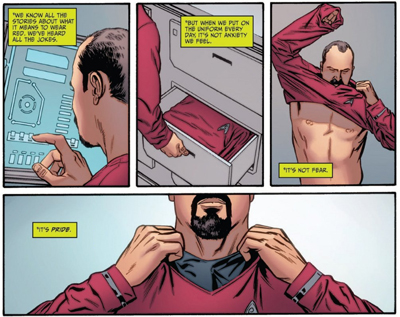
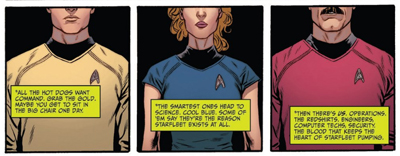
This weird fetishisation of “continuity” defined the first year or so of the title’s existence, with issues dedicated to essentially re-telling classic Star Trek stories using the new cast and crew. (Indeed, only one story from that year – Vulcan’s Vengeance – was not based on a classic episode.) The Red Shirt’s Tale serves as something of a half-way marker as the comic began to transition away from these sorts of continuity-heavy retellings, focusing a bit more on the new characters and the new world. The issue is a retelling of The Apple, but in a way that is more thoughtful and playful than a lot of what came before.

Colour-coded...

Colour-coded…

Continue reading

Star Trek – The Apple (Review)

The first Star Trek pilot, The Cage, was produced in 1964. To celebrate its fiftieth anniversary, this December we are reviewing the second season of the original Star Trek show. You can check out our first season reviews here. Check back daily for the latest review.

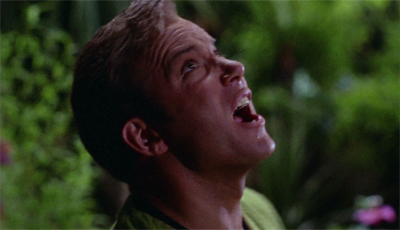
It’s amazing how iconic Star Trek could be, even when it was terrible. There’s something quite ironic about how much of the franchise’s truly memorable iconography is rooted in some of the show’s weakest episodes. The Apple is one of the most iconic and memorable Star Trek episodes, featuring a giant evil dragon head sculpture, David Soul in orange body paint, lots of speechifying from Kirk, and a strong atheistic message with Kirk casting himself as Satan in the Garden of Eden.

It is also just terrible.

"VAAAAAAAL!!!"

“VAAAAAAAL!!!”

Continue reading