• Following Us

  • Categories

  • Check out the Archives


  • Awards & Nominations

Star Trek: Deep Space Nine – One Little Ship (Review)

“It was the sixth season, so why not do it?” observes Ira Behr, providing all the rationale the writing staff needed. “How many series can do a salute to Land of the Giants, to The Incredible Shrinking Man?” he demands. “We had to do this show! We owed it to all the schlock science fiction that had come before us. If we hadn’t done it, it would have been a crime – a creative crime, and, dare I say, a crime against humanity itself. And it just became clear to me, you know? Maybe the tumour moved a silly centimeter in my brain. But we just had to do it. And that was that.”

The Star Trek: Deep Space Nine Companion

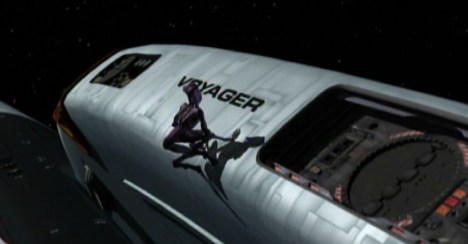
Isolinear jungle.

Continue reading

Star Trek: Voyager – Prey (Review)

Prey is a fantastic piece of television, and stands as one of the best standalone episodes of the fourth season of Star Trek: Voyager.

It is an episode built around a very simple premise, pitting two of Voyager‘s more memorable alien creations against one another and throwing a nice character arc into the midst of this epic conflict. Prey is an exciting thriller built around the established characteristics of both the Hirogen and Species 8472, using two very distinctive cultures to tell a compelling and engaging story with the regular cast thrown into the fray. “Lone Hirogen hunter pursues lost member of Species 8472” is a great hook for an episode.

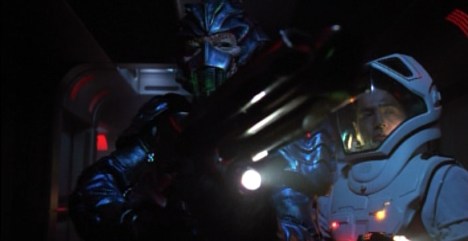
Here come the big guns.

However, Prey goes even further than that. The basic plot is intriguing on its own terms, but Prey cleverly grounds the story in what we know about these characters and their dynamic. As much as Voyager is caught in the crossfire of this horrific situation, the crew are also forced to make tough decisions. How will Janeway react to a wounded member of a hostile (and nigh-invulnerable) species? How will Seven of Nine respond when asked to save the life of a creature that participated in a brutal war with the Borg Collective?

This is intriguing stuff, largely anchored in what the audience already knows of the characters and delivered with top-notch production values and a great sense of pacing. Prey is an episode that plays to all the strengths of the fourth season, from the appeal of the Hirogen and Species 8472 through to the chemistry between Kate Mulgrew and Jeri Ryan.

There’ll be hull to pay.

Continue reading

Star Trek: Deep Space Nine – Far Beyond the Stars (Review)

I am black, I have spent time in a mental hospital, and much of my adult life, for both sexual and social reasons, has been passed on society’s margins. My attraction to them as subject matter for fiction, however, is not so much the desire to write autobiography, but the far more parochial desire to set matters straight where, if only one takes the evidence of the written word, all would seem confusion.

– Samuel Delany, The Straits of Messina

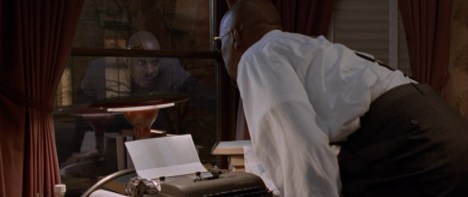
Keep dreaming.

Continue reading

Star Trek: Voyager – Hunters (Review)

Hunters is a weird episode of Star Trek:Voyager, perhaps most notable for the manner in which it flirts with serialisation.

More than any other episode of the fourth season, with the possible exception of The Gift, this mid-season episode seems to exist primarily in relation to the episodes around it. The script is very consciously a sequel to Message in a Bottle, with the crew discovering the ancient network of space stations is a two-way radio back to the Alpha Quadrant. It also introduces the Hirogen, an alien species that will recur in Prey, The Killing Game, Part I and The Killing Game, Part II. The story also sets up a narrative thread that will pay off in Hope and Fear, the season finale.

“Prey, tell.”

More than that, Hunters is an episode that is very consciously engaged with dangling threads of continuity. It resolves the relationship between Janeway and Mark that has haunted the lead character since Caretaker, offers Tom Paris some hint of reconciliation with the father who seemed so disappointed in Persistence of Vision, and even resolves the Maquis plot thread by tying back to Blaze of Glory. This is an episode that exists as something of a storytelling nexus point, a variety of intersecting threads all tied together as part of a single narrative.

Voyager had largely eschewed any attempt at long-form storytelling, perhaps in response to the trauma of the troublesome Kazon arc in the second season that led to ill-judged misfires like Alliances and Investigations. However, those early attempts at serialisation were heavily plot-driven, a series of stories building towards a number predetermined plot points. In contrast, the serialisation suggested by Hunters is looser; a collection of character beats, some earlier details that had largely been forgotten, some elements that might be useful in the future.

The farthest woman from home.

That said, Hunters seems just as cautious about long-form storytelling as The Gift was. As much as Hunters revives old story lines and character beats, it also makes a conscious effort to close many of them. Hunters makes it very clear that this level of serialisation will not be the default for the series going forward. The episode tidies away more loose threads than it unravels. The relationship between Kathryn Janeway and Mark Johnson is brought back purely so it can be ended. The Maquis are mentioned only to confirm they have been destroyed.

Still, there is something oddly intriguing about Hunters, a mostly quiet episode that exists primarily as both prelude and coda rather than a narrative in its own right. It is a quieter, stranger Voyager episode, even while introducing a race of giant space!hunters.
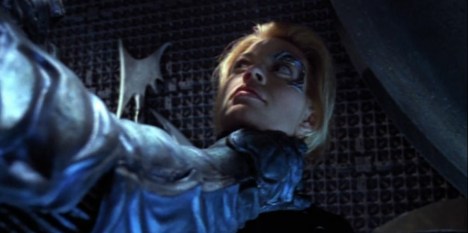
Gripping stuff.

Continue reading

Star Trek: Deep Space Nine – Who Mourns for Morn? (Review)

Who Mourns for Morn? suffers a great deal from its place in the sixth season.

Who Mourns for Morn? is the second broad comedy in the last three episodes. It is the third light-hearted episode of the last six. That would be a lot of comedy for any season of Star Trek, but it is particularly apparent in the context of the sixth season of Star Trek: Deep Space Nine. After all, there is supposed to be a war raging in the background. The cathartic release of You Are Cordially Invited made a great deal of sense after the opening six-episode arc, and The Magnificent Ferengi was a brilliant comedy episode. However, this is just too much.

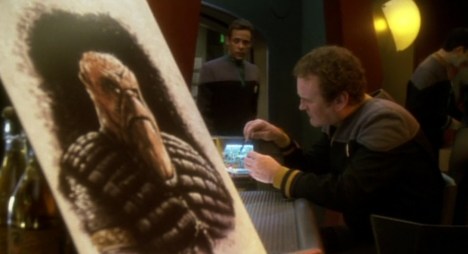
Painting a picture of a life...

Painting a picture of a life…

To be fair, the structure of the season contributes to this sense of humour fatigue. The decision to open the sixth season with a six-episode arc focusing on the retaking of Deep Space Nine was bold and ambitious, but it left little room for comedy or humour. As a result, the comedy episodes were concentrated in the aftermath of that sprawling war story, making for a particularly jarring contrast. The first half of the sixth season of Deep Space Nine only has three comedy episode, which is not too much by any measure. However, they arrive in rapid succession.

Taken on its own terms, Who Mourns for Morn? is a solid and enjoyable episode. It is not as funny as House of Quark or Little Green Men, but it moves quickly and works from a clever premise. It is populated with quirky supporting characters, none of whom outstay their welcome. Who Mourns for Morn? is a fun little runaround. Unfortunately, it arrives at a point in the season where the audience is exhausted from all those runarounds.

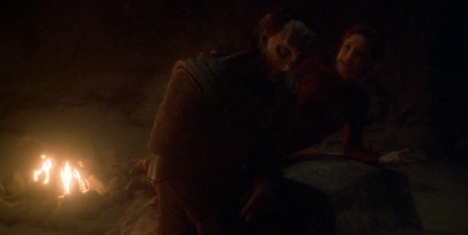
A very messy, very dirty business.

A very messy, very dirty business.

Continue reading

Star Trek: Voyager – Message in a Bottle (Review)

Message in a Bottle is an intriguing episode, although not necessarily for the most obvious of reasons.

Working with Andy Dick can be tough.

Working with Andy Dick can be tough.

Message in a Bottle is notable for its stunt casting, featuring controversial comedian Andy Dick as the Emergency Medical Hologram, Mark II. Given his background and his interests, Andy Dick is a very strange choice for a Star Trek guest role. Then again, it takes all sorts; Star Trek: Deep Space Nine cast Iggy Pop in The Magnificent Ferengi and Star Trek: Voyager finds room for the Rock in Tsunkatse. However, the last time the franchise attempted to cast a famous comedian, Star Trek: The Next Generation ended up with The Outrageous Okona.

Understand, Andy Dick tends to be the focal point for discussion around Message in a Bottle. However, the episode is notable for other reasons. In a weird way, Message in a Bottle kicks off a very loose serialised arc that plays through the next handful of episodes. It introduces the communications grid that plays a major role in Hunters, and features the first glimpse of the Hirogen. The Hirogen go on to play a major role in episodes like Prey, The Killing Game, Part I and The Killing Game, Part II.

"What the hell are YOU doing in my Star Trek show?"

“What the hell are YOU doing in my Star Trek show?”

Message in a Bottle also comes at the half-way point in Voyager‘s run, speaking in terms of structure rather than episode count. Message in a Bottle is positioned mid-way through the middle season of Voyager‘s seven year run. Although the count is skewed somewhat by the series’ abridged first season, it feels like the last point at which Voyager is closer to its beginning than to its end. As such, there is something strangely appropriate in the fact that Message in a Bottle allows Voyager to reconnect with Starfleet and the Alpha Quadrant.

This is perhaps the point where the end of the journey “seems a little closer.”

"This never would have happened if they'd just gone with the Bashir model!"

“This never would have happened if they’d just gone with the Bashir model!”

Continue reading

Star Trek: Voyager – Waking Moments (Review)

Waking Moments feels very much like a first or second season episode of Star Trek: Voyager that somehow entered production in the middle of the fourth season.

A lot of this is down to the simple texture of the episode. Waking Moments centres around a decidedly “weird” alien species, a touch that recalls the early mysteries of Delta Quadrant life suggested by episodes like Phage, The Cloud, Heroes and Demons, Cathexis and even Emanations. These are aliens that do not conform to standard Star Trek logic, stalking their prey through dreams rather than with advanced technology. In fact, the emphasis on dreams in Waking Moments harks back to the vague New Age sentiment of Michael Piller’s time on Voyager.

No, Chakotay. Hunters and Prey are next week.

No, Chakotay. Hunters and Prey are next week.

In fact, Waking Moments returns to a very New Age cliché version of Chakotay. Following on directly from Mortal Coil, Chakotay is once again repeating “ah-koo-chee-moya” and talking about “vision quests.” He mentions his father as a connection to his Native American heritage for the first time since Basics, Part I, and even evoked Tattoo in discussing his rejection of shared activities in his youth. Waking Moments feels like an episode that was originally written while Michael Piller was overseeing the show, but has finally made it to air.

Of course, Waking Moments feels rather retrograde in other ways. It is a very clumsy ensemble piece that treats tired old plot twists as innovative and exciting, moving along at a leaden pace without any sense of what makes this story interesting or compelling in its own right. Waking Moments is a surprisingly tiring piece of television.

An artist's impression of the audience watching Waking Moments.

An artist’s impression of the audience watching Waking Moments.

Continue reading

Star Trek: Deep Space Nine – Waltz (Review)

One of the more common observations about Star Trek: Deep Space Nine is that it is the most “morally ambiguous” Star Trek series, with characters engaging in actions that Picard never would have considered on Star Trek: The Next Generation.

In some ways, this observation makes sense. After all, Deep Space Nine was the first Star Trek show to feature an extended interstellar conflict. Its primary cast is comprised of unapologetic terrorists and untrustworthy wheeler-dealers. The Federation were no longer the unambiguous good guys of the larger Star Trek universe, monolithic humanity giving way to factions like the Maquis or Section 31. Deep Space Nine never took Gene Roddenberry’s utopia for granted, daring to ask what it might look like when paradise found itself under threat.

Eat, pray, hate.

Eat, pray, hate.

However, Deep Space Nine also a very strong moral compass. While there are episodes that flirt with the idea of the end justifying the means, like In the Pale Moonlight or Inter Arma Enim Silent Leges, they are very much the exception rather than the rule. Section 31 are unequivocally monsters, and never proven to be a necessary evil. The Federation wins the Dominion War without the help of their attempted genocide in Extreme Measures. Even the Maquis are treated as ineffective in Defiant, and only romanticised through eulogy in Blaze of Glory.

More than that, Deep Space Nine clearly has a very strong social conscience. This is particularly true in episodes written by executive producer and showrunner Ira Steven Behr. Past Tense, Part I and Past Tense, Part II rage against the treatment of the homeless in contemporary society, sending three regular characters back in time to protest a nineties Los Angeles ordinance. Bar Association insists upon the right to collective bargaining. Far Beyond the Stars is a poignant ode to the power of science-fiction as a window to a better future.

Psycho Sisko!

Psycho Sisko!

Even in the context of the show’s more controversial elements, that moral compass shines through. While the Dominion War might lead to murky compromises, the show goes out of its way to cast the Founders as monstrous; the enslavement of the Jem’Hadar as explored in The Abandoned or of the Vorta as touched upon in Treachery, Faith and the Great River, the use of biological weapons in The Quickening, the disregard for soldiers’ lives in Rocks and Shoals. The Dominion is monstrous, as unequivocally evil as Nazi Germany.

As such, Waltz really serves to confirm something that has always been true of the series. Despite the familiar refrain that Deep Space Nine embraces “moral ambiguity”, the truth is that Deep Space Nine has always believed “that there is really such a thing as truly evil.”

Rocky road to recovery.

Rocky road to recovery.

Continue reading

Star Trek: Deep Space Nine – The Magnificent Ferengi (Review)

In some ways, The Magnificent Ferengi serves as a logical end point for the Ferengi.

It is, after all, the last good Ferengi episode of the Berman era as a whole. The Dogs of War is not terrible, but it has serious problems. It looks much better following on from the double-header of Profit and Lace and The Emperor’s New Cloak, which rank among the worst episodes of Star Trek: Deep Space Nine ever produced. Then again, it is not like the other Star Trek series had much better luck, with Inside Man on Star Trek: Voyager and Acquisition on Star Trek: Enterprise also falling flat. However, there is more to it than that.

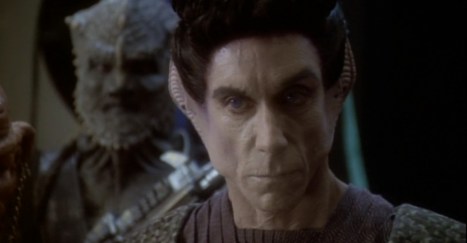
The comedy really Pops here.

The comedy really Pops here.

The Magnificent Ferengi is an episode that revels in one of the franchise’s most reviled recurring alien species, serving as a grand celebration of the work that Ira Steven Behr has done with the Ferengi since The Nagus during the first season of Deep Space Nine. This is reflected within and without the text. The Magnificent Ferengi is  about a band of Ferengi who finally get to be the heroes of their own weird little war story. However, it’s also a celebration of how well-developed the species is that the episode has seven distinct major Ferengi characters.

Indeed, it could reasonably be argued that the best thing about The Magnificent Ferengi is that it puts a cap on the Ferengi as a concept, rendering any further Ferengi episodes completely superfluous to requirement.

Sharp wit.

Sharp wit.

Continue reading

Star Trek: Voyager – Mortal Coil (Review)

In its own weird way, Mortal Coil effectively amounts to a Star Trek: Voyager Christmas Special.

It unfolds in the lead up to the Talaxian festival of Prixin, which Neelix describes as “the Talaxian celebration of family. We observe it every year on Voyager.” Bringing friends and family together on an annual basis with ritualised food preparation and salutations, it serves as analogous to Thanksgiving or Christmas. Indeed, this sort of thinly-disguised Christmas celebration is a science-fiction stable. Perhaps “Life Day” from Star Wars Holiday Special is the most obvious example. To solidify this Yuletide sensibility, Mortal Coil aired the week before Christmas.

Choking on his Borgophobia.

They just keep killing Neelix.

There is something decidedly wry about the one and only Star Trek Christmas Special. (And no, the Christmas Party in Dagger of the Mind doesn’t really count.) This is after all an episode in which a regular character loses his faith in the existence of an afterlife and attempts to commit suicide in a transporter room. It is a strange choice for a seasonal story. In some ways, it feels very much like a Bryan Fuller script, a subversion of the traditional Christmas narrative. After all, Fuller has talked about Hannibal as an exploration of heterosexual male friendship. Just one with murder and cannibalism thrown in.

Mortal Coil is a fascinating episode, albeit one that feels decidedly clumsy in its execution. The episode hesitates and wavers on what it wants to say, offering a wishy-washy conclusion to a very powerful premise. Still, Mortal Coil is intriguing for its oddness.

I met a man who wasn't there.

I met a man who wasn’t there.

Continue reading