• Following Us

  • Categories

  • Check out the Archives


  • Awards & Nominations

Star Trek: Voyager – Season 4 (Review)

The fourth season is probably the show’s best season.

Of course, that is arguably damning with faint praise. By any measure, the fourth is probably weaker than at least four seasons of Star Trek: The Next Generation and four seasons of Star Trek: Deep Space Nine. It is also weaker than the first two seasons of Star Trek or the final two seasons of Star Trek: Enterprise. In the grand scheme of things, that places the best season of Star Trek: Voyager around the franchise median. Somehow, this feels entirely appropriate.
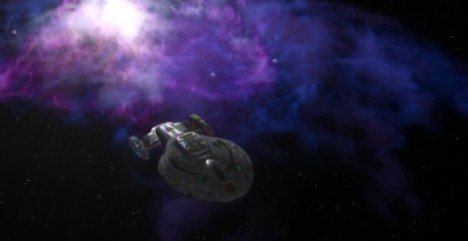
The fourth season of Voyager has some of the show’s best episodes. As such, it also has some of the franchise’s best episodes. Scorpion, Part I and Scorpion, Part II are spectacular television, while Year of Hell, Part I and Year of Hell, Part II offer a glimpse of the show that Voyager could have been while also developing some of the series’ core themes. There are also truly great standalone episodes like Nemesis, Prey, and Living Witness. More than that, there is a lot of really fun storytelling as well, with lighter episodes like Concerning Flight and Message in a Bottle.

However, there is also an unevenness to the season. While there are arguably fewer truly terrible episodes than in the earlier seasons, there are a couple of true stinkers like Retrospect or Vis á Vis. More than that, there are quite a few disposable and dull episodes, stories quickly forgotten after the end credits. Stories like Scientific Method, Random Thoughts, Waking Moments, Unforgettable and Demon fail to make a lasting impression. They just fill up the season order adding very little beyond a familiar Star Trek beat sheet.
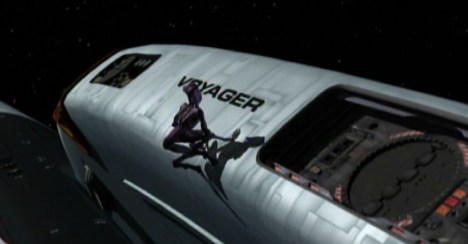
In some ways, this is the central tension of the fourth season, one reflected in the addition of Seven of Nine and the focus on Borg culture. The fourth season of Voyager is caught between mediocrity and brilliance, between being a perfectly serviceable mid-tier Star Trek show and being something a little more ambitious. The fourth season is a weird synthesis of generic Star Trek and something unique, reflecting the fusion of organic and mechanical that defines the Borg Collective.

The fourth season of Voyager ultimately retreats back to the comfort and safety offered by familiarity, but there are moments when it looks like the show might finally be ready to take flight. Unfortunately, it never really gets off the ground, but there is something heartwarming in the effort.

Continue reading

Star Trek: Voyager – Hope and Fear (Review)

Hope and Fear is a reasonably solid conclusion to the fourth season of Star Trek: Voyager.

To be fair, the episode has a number of very clever ideas. There are a number of creative choices in Hope and Fear that feel entirely appropriate for the final episode of what has been a relatively strong season. Various concepts and ideas are brought back into play, from Janeway’s alliance with the Borg in Scorpion, Part II through to her conversion of Seven of Nine in The Gift and up to the secret coded message from Starfleet suggested in Hunters. It makes sense to bring all of these ideas back into play for the grand finale.

The fourth season comes to a head.

More than that, it makes sense to build the episode around the dynamic between Janeway and Seven. One of the recurring tensions in the fourth season, both behind the scenes and in front of the camera, has been the debate about the prominence of Seven of Nine. In the year since she was introduced, Seven has effectively become one of the three most important members of the cast. There is a credible argument to be made that she is the most important member of the cast, an anxiety played out in One. As such, it is logical to build Hope and Fear around Janeway and Seven.

At the same time, there is a certain clumsiness to the plotting of the episode. There is a very rushed quality to the story, which never really takes the time to develop or explore these big revelations and twists. Hope and Fear races towards its conclusion as if it has been sucked into quantum slipstream, a very disorienting and disjointed effect. Certain character arcs feel under-explored, and certain gaps in the plot logic are brushed aside. Hope and Fear feels like a story that deserved a bigger canvas.

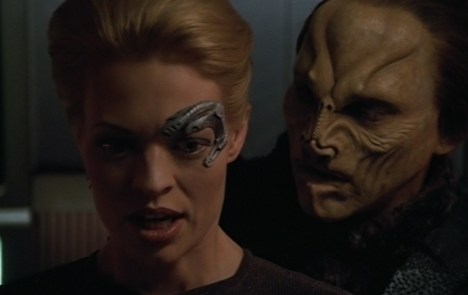
The hard cell.

Continue reading

Star Trek: Deep Space Nine – Profit and Lace (Review)

Profit and Lace is a disastrous misfire, a late-season catastrophe that many would consider to be the absolute nadir of Star Trek: Deep Space Nine. At best, it is an episode that belongs in conversation with Meridian, Prophet Motive, Let He Who Is Without Sin… and The Emperor’s New Cloak. It is a very bad piece of television. It could reasonably be argued that the toxicity of Profit and Lace is not even quarantined. The episode is so bad that it becomes a retroactive taint upon Deep Space Nine‘s attempts to develop and flesh out the Ferengi.

Some of the show’s best episodes focus on the Ferengi characters, like House of Quark or Family Business or Little Green Men or The Magnificent Ferengi, not to mention all manner of very solid stories like The Nagus or Bar Association or Body Parts. The writers on Deep Space Nine did a tremendous job developing and humanising the Ferengi, but the late one-two punch of Profit and Lace and The Emperor’s New Cloak erases all of that good will. Suddenly, the Ferengi are appearing in episodes as tone-deaf and ill-advised as The Last Outpost.

How Ishka got her groove back.

There are any number of reasons why Profit and Lace is so horrible. On a very basic level, it is a comedy episode that is simply not funny. The script is built around jokes that were already tired by the standards of fifties Hollywood, but refuses to do anything interesting or compelling with them. It is uncomfortably backwards-looking and regressive, its sexual politics feeling horribly outdated. The direction veers wildly between something approaching earnest world-building and broad slapstick, resulting a tonal mismatch that is toxic to the touch.

Profit and Lace is a stinker, by just about any measure.

A Quarky installment.

Continue reading

Star Trek: Voyager – One (Review)

One is a solid episode.

Indeed, One is so solid that it is the rare episode of Star Trek: Voyager to be repurposed for Star Trek: Enterprise. The prequel series tended to borrow stock Star Trek plots, but it tended to borrow most heavily from Star Trek: The Next Generation and even Star Trek: Deep Space Nine; Oasis was Shadowplay, Vanishing Point was Realm of Fear, Dawn was Darmok. However, One would be reworked as Doctor’s Orders, another pseudo-horror bottle episode in which a member of the cast finds themselves driven insane by isolation.

Everything’s gone askew…

However, One has an in-built advantage over Doctor’s Orders, in that it is centred on a character who practically begs for this sort of treatment. Seven of Nine is effectively a reformed Borg drone. While Jean-Luc Picard was assimilated in The Best of Both Worlds, Part I and recovered in The Best of Both Worlds, Part II, and while Chakotay brushed up against a pseudo-collective in Unity, Seven of Nine is the first franchise regular to have spent the bulk of her life inside the Borg Collective. The nature of the Borg means that Seven is perfectly suited to a story about isolation.

One is a messy and clumsy episode in a number of ways, particularly in its drive for big action set pieces and tangible threats. In particular, the penultimate act of One feels awkward, as if the production team do not trust the audience to engage with a purer breed of psychological thriller. However, One leans very heavily on the character of Seven of Nine and on the performance of Jeri Ryan. Luckily, both character and actor are up to the task.

Voices in her head.

Continue reading

Star Trek: Deep Space Nine – Valiant (Review)

Valiant is a very bitter and mean-spirited little episode of Star Trek: Deep Space Nine, and all the more effective for that fact.

Some of that bitterness is baked into the basic premise. Valiant is an episode about a bunch of plucky young cadets who get brutally murdered for daring to believe in themselves. The final act of Valiant is a brutal piece of television, the camera lingering over the death and destruction on familiar sets, panning across the dead bodies of these promising young recruits. No matter how arrogant or inexperienced Red Squad might be, no matter how eager their participation in an attempted fascist coup in Homefront and Paradise Lost, it is still an unsettling image.

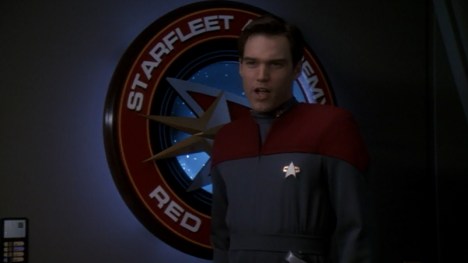
A legend in his own mind.

However, there is something even nastier lurking beneath the surface of this episode. On a superficial level, Valiant suggests that the guest characters fail in their daring mission because they lack the self-awareness to recognise the folly of their plan, but this is disingenuous. Countless Star Trek episodes have been built around far more reckless and audacious schemes, generally paying off the heroes. Valiant does not punish these young cadets for doing something that the main characters would never have attempted, it punishes them for not being the main characters.

Valiant is in some ways a brutal deconstruction of the typical Star Trek storytelling framework, an episode built around a selection of guest characters whose biggest mistake is assuming that they are the stars of the show rather than simply bit players. Valiant comes down hard on these would-be heroes, a reminder that life does not always operate according to familiar storytelling structures.

Hard to pin it on just one person.

Continue reading

Star Trek: Voyager – Demon (Review)

Demon is an episode with some interesting ides that cannot make up for a lackluster execution.

The writing staff on Star Trek: Voyager had been playing with the idea at the heart of Demon for quite some time. It had been a candidate for the third season finale, before Brannon Braga settled upon the story that would become Scorpion, Part I. It was considered for a mid-season two-parter, but the writing staff could never come up with a way to make the story work; Year of Hell, Part I, Year of Hell, Part II, The Killing Game, Part I and The Killing Game, Part II were all written to fill gaps left by a story that refused to materialise.

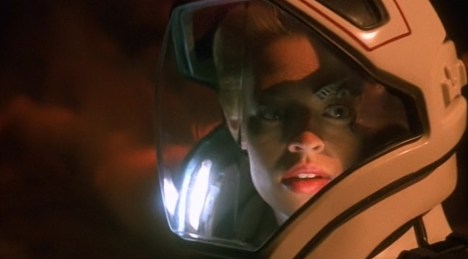
Spaced out…

As such, there is a faint scent of desperation to Demon. The episode arrives in the final stretch the fourth season, at a point when the production team is very clearly fatigued and where writers are generally desperately grasping for anything resembling a workable story. The harsh production cycle of television means that the start of a twenty-six episode season can be planned over the summer hiatus, but that the tail end of the season is typically assembled on the fly. This is the stretch of the season where even Star Trek: Deep Space Nine produces Profit and Lace or Time’s Orphan.

The problems with Demons are compounded by the fact that it is very obviously a budget-conscious show. While it features a number of elaborate computer-animated sequences, it also films primary on standing sets and features no credited guest stars. The result is a curiously plodding show, one full of extended dialogue scenes that inform neither plot nor character, and which feel like a conscious attempt to sideline the more ambitious elements of the story. The result is the waste of an interesting idea on a forgettable episode.

Something’s wrong here, though Torres can’t quite put her finger on it.

Continue reading

Star Trek: Voyager – Living Witness (Review)

Living Witness is a fantastic piece of television, and a great example of what Star Trek: Voyager does best.

Living Witness is in many ways archetypal Star Trek, a story that uses the franchise framework to construct a powerful allegorical story that comments upon contemporary anxiety. It is a story that could easily have been told on any of the other franchise series, especially Star Trek: The Next Generation or Star Trek: Enterprise, but it is a story told well. Living Witness is one of the highlights of the fourth season, and one of the strongest episodes from the seven-season run.

Command and conquer.

In many ways, Living Witness is the culmination of themes and ideas that have been bubbling through Voyager from the outset. Some of these elements are less than flattering, with the episode’s racial politics evoking the clumsiness with which the Kazon were handled. However, there is also a fascination with idea of history and how history functions in a world rooted in postmodernism and recnstruction. At the end of history, is the past up for grabs? Are facts anything more than pieces to be manoeuvred on a political chessboard?

Given this archetypal quality of Living Witness, how it reflects the themes and pet interests of Voyager, there is some irony in the fact that the episode does not actually feature a single regular character from Voyager. The regular cast appear as holographic representations of themselves, exaggerations and distortions. When the EMH appears almost half-way through the episode, he is explicitly identified as “a back-up programme”, and thus distinct from the version of the EMH who will appear in Demon or One.

Core principles.

In some ways, Living Witness confirms one of the more interesting aspects of Voyager, the fact that the characters are themselves largely irrelevant to the show and that the series is much more compelling as a framework to explore archetypal ideas. Living Witness is just one of several episodes that treat the regular characters as a secondary aspect of the show, almost as guest stars who have crossed over into a completely different series. Living Witness is very much of a piece with stories like Distant Origin or Course: Oblivion, or even Muse or Live Fast and Prosper.

Living Witness is a story about the thin line between history and mythology. In doing so, it consciously reframes Voyager as a story within a story, as concept more powerful as an archetype than as a material object. Living Witness images the ship and its crew as history elevated to mythology.

Any which Janeway but loose.

Continue reading

Star Trek: Deep Space Nine – The Reckoning (Review)

The end is nigh.

As the sixth season of Star Trek: Deep Space Nine draws to a close, the production team are increasingly aware that things will be wrapping up shortly. Star Trek: The Next Generation ran for seven seasons, setting a nice target for the spin-offs. Indeed, most of the sixth season had been spent discussing contract extensions with the cast for a final season. The writers (and the cast) knew that the seventh season would be the last. As the sixth season wound down, that massive deadline loomed large.

That’s gonna leave a stain.

The long-term storytelling on Deep Space Nine was largely improvised on the fly, with the writers adding new and interesting twists to the mythology as they went; this led to strange-in-hindsight tangents like Dukat’s time as a space pirate between Return to Grace and By Inferno’s Light. There had never really been a long-term plan, explaining why seemingly important plot points like Bajor’s admittance to the Federation seemed to just drop off the table after Rapture.

At best, the writers on Deep Space Nine knew the direction in which they were moving, but had not charted the course that they would follow. Still, a looming deadline tends to focus the mind. In the final third of the sixth season, the production team begin aligning plot points and character arcs towards the end of the story. Ira Steven Behr wrote His Way in large part because he wanted to introduce Vic Fontaine and pair off Kira and Odo, realising that time was working against him.

Who Prophets?

The Reckoning is a story about the end of days, in more ways than one. Broadcast in April 1998, it perfectly taps into the millennial eschatology that had taken root in the popular consciousness in the lead up to the twenty-first century. The Reckoning posits an epic battle between good and evil that will mark the end of an epoch, tapping into an anxiety simmering through popular culture in television shows like Millennium and films like End of Days. As the nineties came to a close, there was a clear anxiety about what the future might hold, if it existed at all.

However, The Reckoning also feels like a conscious effort to align various characters and plot beats in service of the final season ahead. The Reckoning properly seeds an entire subplot that will play through the remainder for the show, from Tears of the Prophets through to What You Leave Behind. Character motivations are made clear, stakes are heightened, mythology is explained. All of this is very much in service of where the writers plan for Deep Space Nine to go.

The wormhole in things…

Continue reading

Star Trek: Deep Space Nine – His Way (Review)

His Way doesn’t so much straddle the line between sweet and creepy as play hopscotch across it.

There is a lot to like about His Way. There is a palpable enthusiasm to the episode, a charm and energy that excuses the indulgence. After all, His Way uses the holosuite to create facsimile of sixties Las Vegas populated by a self-aware crooner who spends a solid chunk of the episode hitting swing band classics. It is a ridiculous set-up, yet one entirely in keeping with the interests of Star Trek: Deep Space Nine.

Suited to the task…

Deep Space Nine never felt like it belonged in the nineties. It felt a much stronger connection to Star Trek than to Star Trek: The Next Generation, as evidenced by episodes like Crossover and Blood Oath. It built entire episodes around a classic Hollywood aesthetic, from the broad noir pastiche of Necessary Evil to the more specific plot references of Profit and Loss or Meridian. This is a television show that made repeated and extended references to Julian Bashir’s affection for James Bond in episodes like Our Man Bashir or A Simple Investigation.

There is a genuine warmth and affection that shines through His Way, something at radiates through the episode from Jay Chattaway’s lounge-tinged ambient soundtrack through to James Darren’s giddy performance. There is a sense that everybody involved in the episode is having such a good time that it would be churlish to begrudge them this small diversion. After all, Deep Space Nine is much closer to the end than to the beginning, and the production team have accomplished so much that they deserve an indulgence.

The hands-on approach.

At the same time, His Way has not aged particularly well. It is the episode that eventually gets Odo and Kira together, but it suffers from the problem affecting many of the episodes leading into the relationship. His Way is told almost exclusively from Odo’s perspective, reducing Kira to an object of fascination or desire. His Way invests a lot of energy in the idea that Odo can “win” Kira, but it never affords Kira any agency. This was okay in Crossfire, an episode explicitly about how unhealthy Odo’s unrequited and unexpressed obsession was. It works less well in His Way.

His Way plays almost like an episode about a pick-up artist, about that creepy subculture in which insecure and nerdy men effectively try to trick women into sleeping with them through a complicated series of performance pieces and psychological warfare. Rene Auberjonois and James Darren make a charming enough duo that the episode doesn’t tank outright, but His Way still feels decidedly creepy in its approach to the question of courtship.

Vic’s story is life.

Continue reading

Star Trek: Voyager – Unforgettable (Review)

Unforgettable has perhaps the most ironic title in the Star Trek canon.

The episode is very generic in nature, very much in keeping with the style of Star Trek: Voyager. It is a love story centring on the character Chakotay, although he seems to have been selected as the focus of the episode by chance. There is nothing about Unforgettable that would not work as well as an episode built around Harry Kim or Neelix or even Tuvok. It is an episode with an alien of the week, with a strange society that leads to a dilemma that can be neatly resolved within the forty-five minutes allotted to the episode, leaving no lasting mark on the series.

Forget me not…

Unforgettable has any number of interesting ideas. The Ramuran are an interesting high concept, an alien race with the power to erase themselves from the memories of those they encounter. That should be an interesting story hook, particularly given Voyager‘s recurring fascination with memory and identity. This is also an episode built around a guest appearance from cult icon Virginia Madsen. Madsen is a fantastic guest star for Voyager, an actor who really deserves a meaty and memorable role, like Andy Dick was afforded with Message in a Bottle.

Unfortunately, none of these ideas coalesce. Unforgettable is a bland romantic episode that moves a glacial pace towards an inevitable outcome, either unable or unwilling to exploit either its clever concept or its top-tier guest star to tell a memorable story. Unforgettable is ultimately anything but.

Memories are made of these.

Continue reading