• Following Us

  • Categories

  • Check out the Archives


  • Awards & Nominations

Jessica Jones – AKA Smile (Review)

So Jessica Jones comes to an end.

AKA Smile accomplishes quite a lot, ably assisted by the narrative streamlining that took place from AKA 1,000 Cuts, AKA I’ve Got the Blues and AKA Take a Bloody Number. Indeed, many of the character’s find resolutions unfold in those episodes, leaving AKA Smile free to concentrate on wrapping up the arc. Jeri Hogarth’s arc is complete. Will Simpson has been handled. Robyn has found some measure of peace. Although Jessica and Luke spend a considerable portion of AKA Smile together, they do not actually have a conversation.

jessicajones-smile22a

As a result, AKA Smile has room to breath. There is time to focus on the conflict between Jessica and Kilgrave, to ruminate on the bond between Jessica and Trish. There is even time for a minor crossover from Daredevil, with Rosario Dawson dropping by in the character of Claire Temple. Oddly enough, there is even a slight sense of padding to all this. Kilgrave’s confrontation with Jessica in the hospital feels somewhat unnecessary, given their confrontation by proxy at the climax of AKA Take a Bloody Number and in person at the climax of AKA Smile.

At the same time, there is an endearing confidence to AKA Smile that ensure the finalé is never tied down or overwhelmed by the narrative weight that Jessica Jones has amassed over its thirteen episode season.

jessicajones-smile23a Continue reading

The X-Files – Season 8 (Review)

This October/November, we’re taking a trip back in time to review the eighth season of The X-Files and the first (and only) season of The Lone Gunmen.

The eighth season of The X-Files would be the perfect last season of the show, and a pretty solid first season of a new show born from the ashes.

In many ways, television is a conservative medium – more in an artistic sense than a political one. Network television is largely built around churn, a conveyor belt model that is designed to generate product according to tight schedules and oppressive deadlines. Routine and familiarity make the production schedule easier to manage, particularly for shows with large season orders. More than that, if a show has figured out an approach that has worked, it makes no sense to deviate from that pattern.
xfiles-deadalive33a

Why risk changing something that has been proven to work and to which the audience has responded? For all the (deserved) praise The X-Files gets for popularising (or repopularising) serialised storytelling in prime-time television, it was just as conservative as any other show. The production team were working under incredible pressure, so it makes sense they would not want to change a formula that made sense. As such, the really big changes to the show were largely driven by external factors.

The mythology largely developed from Scully’s abduction in Duane Barry and Ascension, an attempt by the writers to work around Scully’s abduction. The decision to film The X-Files: Fight the Future between the fourth and fifth seasons was at the behest of Fox rather than the production team. David Duchovny forces the move to Los Angeles in the sixth season. The eighth season represents the most seismic shift in the creative life of The X-Files, and – as with those other big decisions – it was largely driven by choices outside the production team.

xfiles-thisisnothappening13a

In hindsight, it seems obvious that the show could not continue forever. Duchovny and Anderson were headlining a show that filmed twenty-odd episodes a season. The show had begun diffusing its focus in the fourth and fifth seasons by focusing on members of the supporting cast, but it was still effectively a two-lead show. That is a tremendous strain. Something had to give. It turned out that something was Duchovny. At the end of the seventh season, with everything coming down to the wire, Duchovny made it clear he would not appear in a full eighth season.

This forced the show to change, but in a way that afforded some measure of stability. The idea of doing The X-Files without either Mulder or Scully was horrifying to the production team and horrifying to certain sections of fandom, but Duchovny’s willingness to stick around for half of the eighth season afforded some measure of compromise. The change did not need to be jarring. Easing David Duchovny out of the show would allow for a smoother transition. It would allow the show to say a proper (and extended) farewell to Mulder.

xfiles-empedocles23a

This is perhaps the strongest aspect of the eighth season, the sense that it has a certainty and finality that the seventh season lacked. Even during the post-production of Requiem, the production team had no idea whether the seventh season would be the final season of the show. As a result, the seventh season is decidedly non-committal on the issue of closure. The eighth season is a lot more enthusiastic about the prospect of wrapping things up, once and for all. There is a sense that this is the final season of a version of the show, at the very least.

The eighth season finds itself in the impossible position of having to imagine The X-Files without Mulder. The only real issue is that it succeeds all too well. The biggest problem with the eighth season is that it is followed by a ninth season.

xfiles-without2a Continue reading

Jessica Jones – AKA Take a Bloody Number (Review)

AKA Take a Bloody Number is the penultimate episode of the season, and continues the process of narrowing the focus.

There is a sense that Jessica Jones is largely clearing away the clutter as it moves towards its final episodes. AKA Sin Bin found the show building to critical mass, and subsequent episodes have shrewdly decided to begin letting the air out slowly rather than bursting the balloon. AKA 1,000 Cuts resolved Jeri’s divorce subplot and killed off Hope Slottman. AKA I’ve Got the Blues disbanded the survivors’ group and took care of Will Simpson’s supersoldier plot. AKA Take a Bloody Number brings back Luke Cage, allowing the show to focus on the relationship between Luke and Jessica for the first time since AKA You’re a Winner! Luke seems to have missed the show’s climax, but he is still a matter than needs addressing.

jessicajones-takeabloodynumber29a

One of the strengths of Jessica Jones is a willingness to let its cast drift into and out of focus as the plot demands. Characters like Luke Cage and Jeri Hogarth are absent from consecutive episodes, and stretches of the season. This is likely due to actor availability issues, with Mike Colter soon to be headlining Luke Cage and Carrie-Anne Moss arguably the biggest star (and certainly the most recognisable “film” star) in the cast. Nevertheless, it does allow Jessica Jones a narrative expedience. Instead of having to constantly check in on various characters with a drip-feed of character development, the show can decide only to use them as is strictly necessary. It is a technique that works out quite well for the show. (Indeed, the show might have done better to adopt it with Kilgrave.)

AKA Take a Bloody Number works as a fairly streamlined piece of television, resisting the urge to escalate the scales (and the scope) of the story as it approaches its endgame. The climactic confrontation between Luke and Jessica is arguably just as effective as the climax of AKA Sin Bin, despite the smaller number of intersecting plot threads and involved characters.

jessicajones-takeabloodynumber10a

Continue reading

The Lone Gunmen (Review)

This October/November, we’re taking a trip back in time to review the eighth season of The X-Files and the first (and only) season of The Lone Gunmen.

The Lone Gunmen seemed destined to be an oddity.

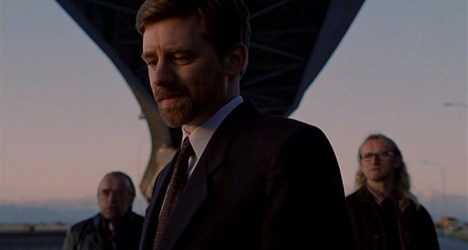
When it arrived in March 2001, it must have felt like a throwback. The production team had consciously modelled the series on the classic episodic spy and adventure shows of the sixties, seventies and eighties. Mission: Impossible and The A-Team served as cultural touchstones, with both The Pilot and Eine Kleine Frohike making visual references to Brian dePalma’s cinematic adaptation of Mission: Impossible while Maximum Byers featured an extended discussion of the pros and cons of Pros and Cons, an early first season episode of The A-Team.

lonegunmen-pilot14a

In terms of structure and tone, The Lone Gunmen seemed to hark back to the golden age of two-knuckled action adventure television shows like The Man From U.N.C.L.E. or MacGyver. Threads rarely carried over from episode to episode. Only one actor who didn’t appear in the opening credits would appear in more than a single episode of the show. There was no hint of a “mythology” and no clear structure from week-to-week beyond “the Lone Gunmen get into wacky adventures and hijinks ensue.”

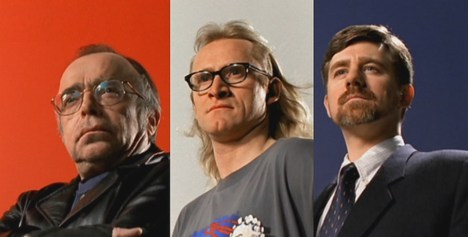
In many ways, The Lone Gunmen was the kind of show that had quietly shuffled off the air in the early nineties. It felt like it belonged to a generation of television predating The X-Files rather than succeeding it. Even the opening credits to the show were much less abstract and much more traditional than those of The X-Files, playing as something of a highlight reel of the early first season. There is something very aggressively old-school about the aesthetic of The Lone Gunmen.

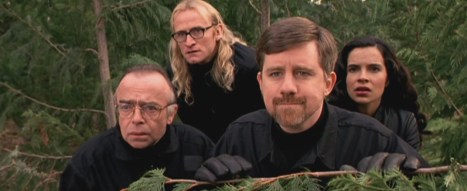
lonegunmen-likewaterforoctane2

The Lone Gunmen would have seemed somewhat outdated had it aired before Homicide: Life on the Streets during the late nineties; it was doubly out of place in the emerging era of reality television. However, there are elements of The Lone Gunmen that feel like they might have played better had the show arrived a few years later. Byers, Langly and Frohike were too eccentric to anchor an hour-long show on a major network, as Fox had already become. They might have fared better on another network after the cable television explosion.

It is easy enough to imagine The Lone Gunmen as an oddity airing on a smaller cable network like HBO or Showtime or AMC. Indeed, the perfect pitch for The Lone Gunmen would seem to land somewhere between Bored to Death and The X-Files. The audience for The Lone Gunmen might have been small in terms of major television networks, but it was devoted. Smaller providers – even on-line providers like Amazon or Netflix – would love to court that sort of fanbase. Had The Lone Gunmen arrived a few years later, it may have had a chance.

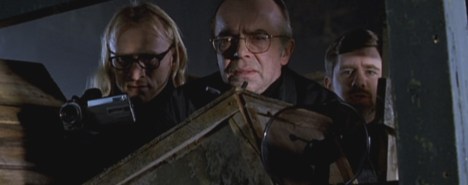
lonegunmen-planetofthefrohikes13

As such, The Lone Gunmen feels like a television show out of time. It is a series that landed at the wrong moment on the wrong channel, and which likely never had a chance. The animators on King of the Hill were incorporating jokes about the inevitable cancellation of The Lone Gunmen before the episode even aired. The viewing figures were far from spectacular, but they were better than the shows that had aired in the same slot in the season prior and the season following. March 2001 was just not the right moment for The Lone Gunmen.

Then again, it feels appropriate that The Lone Gunmen should so perfectly mirror its central character. Heroic, endearing, charming, but also undeniably odd.

lonegunmen-diagnosisjimmy19

Continue reading

Jessica Jones – AKA I’ve Got the Blues (Review)

Jessica Jones loses a little steam when it gets out of the adrenaline rush that was the AKA WWJD?, AKA Sin Bin and AKA 1,000 Cuts triptych.

There is a sense that the show is not entirely sure about how exactly it wants to end; like its eponymous lead, there is an anxiety about sticking the landing. It is a problem similar to the one that faced Daredevil, which had its own issues when it come to offering a satisfactory conclusion to a season-long arc. (Indeed, Daredevil feels more like a checklist of matters that require closure rather than a story of itself.) More than that, the show has built towards a sustained climax in its eighth through tenth episodes, but there are still three hours left to fill.

jessicajones-ivegotthebluesa

Jessica Jones has always felt a little over-extended. AKA Crush Syndrome and AKA It’s Called Whiskey essentially introduced Kilgrave twice. AKA The Sandwich Saved Me, AKA Sin Bin and AKA 1,000 Cuts each feature Kilgrave captured by our heroes only to escape through various convenient means. The Will Simpson subplot fits with the themes of the season, but does feel like a stalling tactic. Malcolm provides the heart of the show, but the writers never find a convincing voice for Robyn and so their subplot also feels like padding.

So there are some basic structural issues going into the final few episodes of the season, just as there were some structural issues with the opening few episodes of the season. Nevertheless, Jessica Jones does make a number of clever decisions as it builds towards its conclusion. Instead of ramping up and outwards, as would be the natural impulse, the show begins narrowing its focus and winding down. AKA I’ve Got the Blues and AKA Take a Bloody Number are surprisingly intimate in their scope following the scale of the show’s climax.

jessicajones-ivegottheblues32a

Continue reading

The Lone Gunmen – The “Cap’n Toby” Show (Review)

This October/November, we’re taking a trip back in time to review the eighth season of The X-Files and the first (and only) season of The Lone Gunmen.

In its own way, The “Cap’n Toby” Show feels like an appropriate farewell to The Lone Gunmen.

The “Cap’n Toby” Show was not the last episode of The Lone Gunmen to be produced, but it was the last episode to air. It was broadcast three weeks after All About Yves closed out the first season of the show and more than a fortnight after news of the cancellation first broke. It aired with very little fan fare, avoiding even the modicum of publicity that FX earned as it burnt off the last six episodes of Harsh Realm only a year earlier. Just in case there had been any doubt, or any hope held out, The Lone Gunmen was definitely dead.

No need to get crabby...

No need to get crabby…

There is a melancholy to The “Cap’n Toby” Show that fits quite comfortably with The Lone Gunmen. The episode had clearly been held back in the hops of airing it during a hypothetical second season. Ideally, it would have given the production team a little lee-way at the start of the next season, perhaps even allowing the three title characters to pop over to The X-Files. The ninth season of The X-Files would be launching without Mulder, so some friendly faces would not be amiss. Airing The “Cap’n Toby” Show in mid-June puts paid to that optimism.

However, even allowing for all these issues, there is an endearing pluckiness and romance to The “Cap’n Toby” Show that feels at once entirely in keeping with the show and the characters. What better way to make a cancellation than with a forty-five minute ode to the nostalgic joys of television?

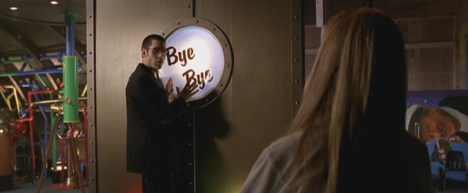
"Bye bye."

“Bye bye.”

Continue reading

Jessica Jones – AKA 1,000 Cuts (Review)

AKA 1,000 Cuts continues to toy with the conventions of the superhero genre.

The revelations about Kilgrave’s past in AKA Sin Bin represented a rejection of the psychology traditionally applied to comic book villains, creating a villain who could not blame his sociopathic tendencies on a convenient childhood trauma. AKA 1,000 Cuts plays upon another standard genre convention, the idea of the superhero who doesn’t kill. In terms of superhero storytelling, the old “thou shalt not kill” rule is always a reliable source of existential angst for a suitably ambiguous hero.

image

As with many of the conventions toyed with on Jessica Jones, the trope is played relatively straight on Daredevil. Again, there is a sense of Jessica Jones as something of a playful twisted response to Daredevil, often subverting or undermining many of the genre conventions that Daredevil so skilfully embodied. At this point in the first season of Daredevil, Matt Murdock was wrestling with the question of whether or not to murder Wilson Fisk. Much hand-wringing and angst resulted, playing into the show’s masculine Catholic aesthetic.

While Daredevil seemed anchored in moral absolutes, Jessica Jones opts for a much more pragmatic and relativist solution. The question posed by Jessica Jones is not whether killing Kilgrave can be justified; the show embraces that reality quite skilfully in AKA 1,000 Cuts. The question is what it takes to justify it. AKA 1,000 Cuts offers a fairly harrowing answer.

jessicajones-1000cuts18a Continue reading

The X-Files – Existence (Review)

This October/November, we’re taking a trip back in time to review the eighth season of The X-Files and the first (and only) season of The Lone Gunmen.

This is not the end.

But it really should be. At least for Mulder and Scully.

There was no season nine. What are you talking about?

There was no season nine.
What are you talking about?

Continue reading

Jessica Jones – AKA Sin Bin (Review)

Kilgrave lies.

To be fair, that much should be obvious. Kilgrave is a character whose power hinges upon his ability to manipulate people using words. Of course he lies. Even his name is a lie. He lied to Jessica about the effectiveness of his powers, revealing that his decision not to control Jessica against her will wasn’t really a decision. He lies to everyone about his past, painting his concerned parents as cliché monsters. He lies to himself about his motivations, genuinely believing he is a victim in all of this.

jessicajones-sinbin19a

He also lies to the audience about his character, as AKA Sin Bin reveals Kilgrave is not a tragic and sympathetic antagonist with an explanatory childhood trauma after all. He is not the archetypal sympathetic bad guy whose actions can be explained away as the result of the horrible things that happened to him when he was a child. He is not the version of Wilson Fisk presented in Shadows in the Glass, a man who might have been a hero under other circumstances. Kilgrave is an unrepentant self-serving sociopath.

One of the joys of Jessica Jones is that the revelation that Kilgrave is unquestioning evil does not in any way make him a less complicated or compelling character.

jessicajones-sinbin3a

Continue reading

The X-Files – Essence (Review)

This October/November, we’re taking a trip back in time to review the eighth season of The X-Files and the first (and only) season of The Lone Gunmen.

The mythology of The X-Files is a strange beast.

In the show’s declining years, it frequently became a stick with which the show might be beaten by critics and fans who had grown exhausted of ambiguity and labyrinthine plotting. Steven King lamented the fact that the show “blundered off into a swamp of black oil, and in that swamp it died.” In assessing the impact of the series, Joyce Millman described the mythology as a “sadistically convoluted plot line.” Juliette Harrisson complained that the entire mythology ended up “so twisted and incomprehensible by the end.”

Oh, baby.

Oh, baby.

In hindsight, it seems like history has not been kind to the mythology. In the years since the show went off the air, it seems that fans have come to value the episodic “monster of the week” stories ahead of the central story arc about aliens plotting to colonise the planet. This is ironic, given the attention devoted to the mythology while the show was on the air. The mythology dominated season premieres and finalés, taking the limelight during Sweeps and commanding impressive production values.

This assessment of the mythology is at once fair and unfair. Examined from far enough away, the mythology was linear and logical: alien colonists were coming back to reclaim the planet and enslave (or exterminate) mankind. Everything else was just window-dressing, with the mythology exploring the compromise and collaboration that facilitated this plan. The mythology was, at its best, an exploration of human weakness and the corruption of authority; a timeless (and almost Shakespearean) tragedy. From a sufficient distance, it was not hard to follow.

Oh, alien baby.

Oh, alien baby.

However, the details tend to create confusion, with everything getting a little muddled as The X-Files piles compelling and memorable visuals on top of one another. Are the bees intended to spread smallpox to thin the population as Zero Sum suggests, or to spread the black oil to aid in repopulation as The X-Files: Fight the Future implies? Is the black oil a sinister body-hopping parasite as suggested in Piper Maru and Vienen, or is it an organism that turns the body into a host for a gestating alien organism like in Fight the Future or The Beginning?

The eighth season does a lot to simplify the mythology by stripping out the conspirators and the vaccine and the rebels and the hybrids, replacing them with a more blunt central narrative about “alien replicants” mounting a stealth invasion. That said, things begin to get a bit cluttered and crowded as the season reaches its conclusion. Essence and Existence have a very clear structure and clear objectives, but there is a sense that that the narrative could still be streamlined a bit.

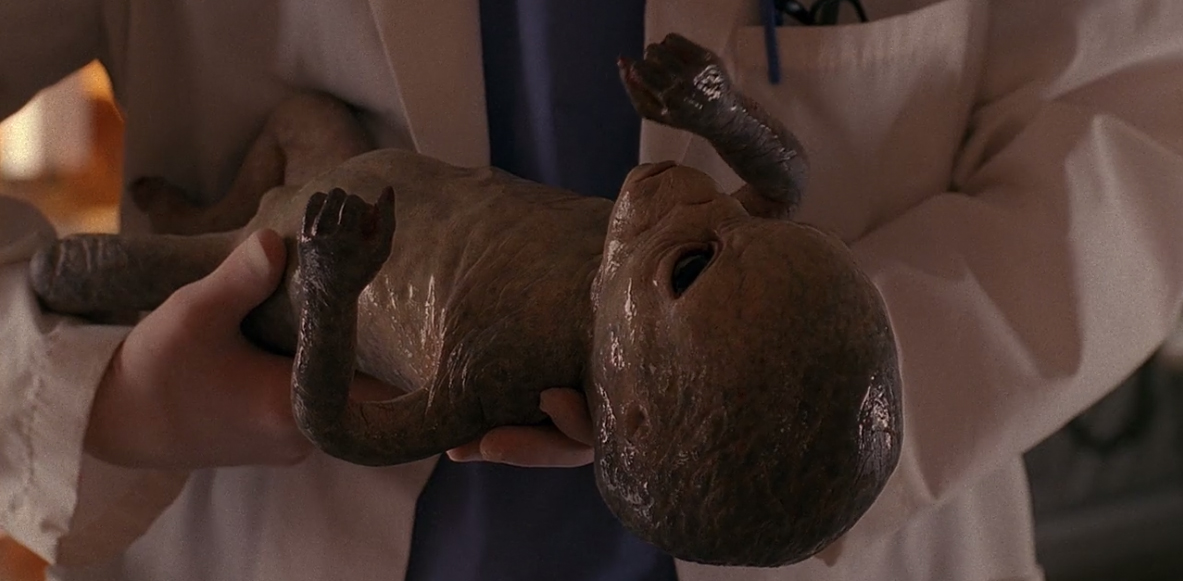
Oh, blood-splattered alien babies...

Oh, blood-splattered alien babies…

Continue reading