• Following Us

  • Categories

  • Check out the Archives


  • Awards & Nominations

“The 250 Live: Twin Peaks – The Return”, 23rd March 2019 in Support of the Irish Cancer Society

As a fundraiser for the Irish Cancer Society’s annual Daffodil Day, the Irish popular film podcast The 250 is hosting a live eighteen-hour podcast covering David Lynch’s groundbreaking television series Twin Peaks: The Return from 2pm GMT (8am EST/5am PST) on Saturday 23rd March.

Twin Peaks: The Return is considered a landmark in modern popular culture. Originally broadcast on Showtime in May 2017, The Return has been described as “one of the most groundbreaking TV series ever” by Sean T. Collins at Rolling Stone. Matt Zoller Seitz argued that it was “the most original and disturbing to hit TV drama since The Sopranos.”
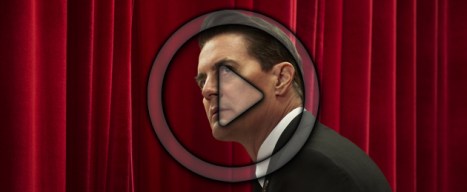
However, there is also an argument that it transcends television, and is in fact an eighteen-hour film. Those who worked on the show have suggested that director David Lynch (who directed all eighteen episodes) saw it as a single eighteen-hour movie. Film magazines like Cahiers du Cinéma and Sight and Sound ranked Twin Peaks: The Return among the very best films of the year.

What better way to hash out this debate over whether Twin Peaks: The Return is an eighteen-hour film than with an eighteen-hour podcast?
Over the course of those eighteen hours, guests will wrestle with everything from the question of whether these eighteen hours are film, television or something else entirely, take a broader look at David Lynch’s filmography, explore the themes of the series/film, and even try to make sense of the wealth of imagery within. “We’re hoping to create an experience that will appeal to both casual fan and eager enthusiast,” explained co-host Darren Mooney. “The eighteen-hour podcast should offer something for everybody. I’m very excited. And maybe a little terrified. But it’s for a good cause.”

The event will be broadcast live on The 250’s Mixlr, and an edited version of the entire podcast will be released for public consumption on The 250’s Soundcloud after the fact. Donations can be made to the Irish Cancer Society through The 250’s Just Giving in both the lead-up to and during the event itself.

The live broadcast will begin at 2pm GMT on Saturday 23rd March and run through until 8am GMT on Sunday 24th March, bringing the podcast up until midnight in Washington State. Darren and Andrew will need some damn fine coffee and cherry pie to get them through the night, which is being thoughtfully provided by the Camerino Bakery.

Although the schedule is subject to change, due to the nature of live broadcasting, at the moment it looks like:

  • 2pm: “Home.” Nostalgia and Twin Peaks: The Return, with guests Niall Glynn and Richard Drumm (HeadStuff, Quantum of Friendship)
  • 3pm: “It’s Happening Again.” Fire Walk With Me as a prelude to Twin Peaks: The Return, with guest Niall Glynn
  • 4pm: “Damn Good Coffee.” Food in Twin Peaks as a slice of Lynch’s American, with guest Caryna Camerino
  • 5pm: “We’re in the version layer.” Actor Amy Shiels (Candie) talks about working with David Lynch and her career.
  • 6pm: “This is the man I told you about.” Discussing Cooper, masculinity (and apparently Wally Brando) with guest Charlene Lydon (Element Pictures, The Lighthouse)
  • 7pm: “Not where it counts, buddy!” Discussing David Lynch’s filmography, and The Return‘s place in it with guest Donald Clarke (The Irish Times)
  • 8pm: “What is that thing?” “A glass box.” Discussing whether The Return is an eighteen hour film, an eighteen part series, or something else entirely, with guests Brian Lloyd (Entertainment.ie) and Jenn Gannon
  • 9pm: “Gotta light?” Dissecting Part 8 with Phillip Bagnall and Jason Coyle (Scannain)
  • 10pm: “Next on the Roadhouse playlist…” Analysing the musical choices of The Return with guest Cian (Selected)
  • 11pm: “What’s going on around here?” Does The Return make literal sense? Does it have a single correct meaning? Does it have to? With guest Phillip Bagnall
  • Midnight: “… is that one of the Marx Brothers?” Balancing genre, tone and pacing in The Return. With guest Phillip Bagnall.
  • 1am: “… drink deep and descend.” Alone at last, Darren and Andrew discuss Andrew’s first binge through the series, from The Pilot to the end.
  • 2am: “We’re not anywhere near Mount Rushmore.” The Return as a portrait of America, particularly modern America, and as an extension of Lynch’s vision of the country.
  • 4am: “… the evil that men do.” Andy Hazel (Twin Peaks Season 3) stops by to talk about evil as it exists in Twin Peaks.
  • 5am: “Wrapped in plastic”; Laura Palmer and the trope of the dead girl, and the engagement of The Return with that.
  • 6am: “… a long way from the world.” Darren and Andrew discuss some of their favourite moments and characters from the series, especially those neglected in earlier hours.
  • 7am: “What year is this?” Is Twin Peaks finished? Could it come back? Do we really want it to? Will it take another twenty-five years? Is the ending the best place to leave it?

Important/useful links:

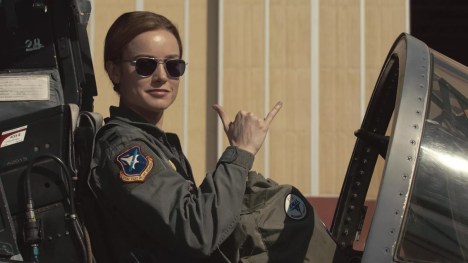
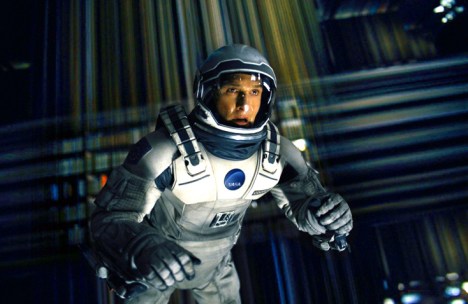
“Too Emotional”: “Interstellar”, “Star Trek: Discovery”, “Captain Marvel” and the Re-Gendering of Science-Fiction…

Women have very obviously had a huge impact on shaping and defining science-fiction as a genre.

Many of the key figures in the genre’s history have been female, across all forms of media. Ursula Le Guin is one of the defining science-fiction authors. The first showrunner of Doctor Who was a young woman by the name of Verity Lambert. Among many of the key figures overshadowed by Gene Roddenberry in developing Star Trek was Dorothy “D.C.” Fontana, who was responsible for defining and shaping a lot of what fans know about the iconic character of Spock and of Vulcan. Indeed, modern science-fiction fandom owes a lot to early female enthusiasts. Spockanalia was one of the earliest professional-quality fanzines, dedicated to the idea of Spock as a cultural icon and sex symbol. The “Save Star Trek” campaign was organised by Bjo Trimble.

However, this aspect of the genre’s history and development is largely ignored and overlooked. Modern science-fiction is largely defined as a masculine genre. MIT Technology Review’s Top Ten Hard Science Fiction Books of All Time includes one female author, while Forbidden Planet’s 50 Science Fiction Books You Must Read includes only three women. The recent forays of directors like Ava DuVernay, Patty Jenkins and Claire Denis into big-screen science-fiction only underscored the degree to which the genre has historically been dominated by male directors. Even the public perception of science-fiction fandom is gendered. Despite the formative role that women played in defining fandom, the stereotypical image of a fan is white, middle-class, male, heterosexual.

As with many issues in fandom, this has been pushed to the fore in recent years, a long-simmering culture war over ownership of these conceptual spaces has spilled over into the mainstream. Fandoms traditionally considered as white, heterosexual and masculine have begun lashing out at what they perceive to be invaders who do not conform to their expectations. These attacks are gendered. GamerGate was an organised attack on women within the gaming community, beginning with a smear campaign from a jilted boyfriend. In terms of science-fiction, the Sad Puppies and Rabid Puppies attempted to game the Hugo nominations to target women and minorities. This is to say nothing of organised vote-brigading of female- and minority-led films.

Against this context, one of the more interesting pushes in contemporary mainstream big-budget science-fiction is a firm attempt to recontextualise and re-gender science-fiction storytelling, to push the genre away from these more reactionary elements and these more conventional definitions of masculine interest. Some of these examples are generated no shortage of attention and blowback, most obviously through the casting of more diverse leads in projects like Star Wars: Episode VII – The Force Awakens and Star Wars: Episode VIII – The Last Jedi, which led to an online explosion of targeted misogyny and vitriol at the female actors involved.

However, some of this reinvention has been more subtle and nuanced, such as the conscious rejection of hard science-fiction in big-budget mass-audience science-fiction projects as high-profile and diverse as Interstellar, Star Trek: Discovery and Captain Marvel.

Continue reading

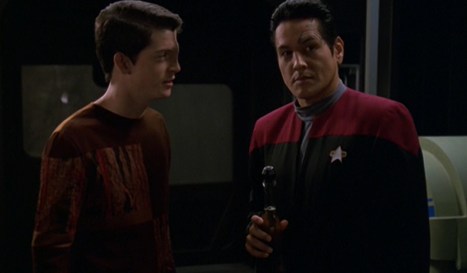
Star Trek: Voyager – Repentance (Review)

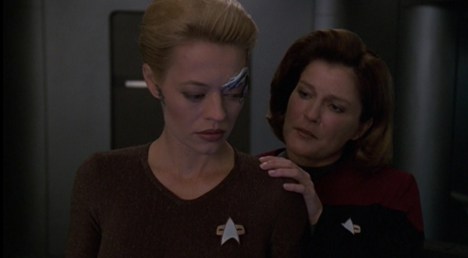
Repentance marks another example of the seventh season of Star Trek: Voyager groping clumsily and awkwardly towards an archetypal Star Trek plot.

The Star Trek franchise has cultivated a reputation for being a vehicle for progressive social commentary, largely on the back of episodes like Let That Be Your Last Battlefield or Plato’s Stepchildren. Of course, those episodes were decidedly less progressive and more complicated than the popular memory would allow, but there is an argument to be made that the idea of Star Trek as a voice for social progress is worth something even if the franchise did not always live up to those ideals. After all, the franchise also gave audiences The Omega Glory and Turnabout Intruder.

In the neck of time.

The seventh season of Voyager seems to recognise this social commentary as something essential to Star Trek‘s cultural identity, something that essentially defines Star Trek as Star Trek and distinguishes it from other popular science-fiction. This explains why the seventh season of Voyager is so preoccupied with the Prime Directive, which even gets name-dropped within Repentance; it is a major element in stories like Flesh and Blood, Part I, Flesh and Blood, Part II, Natural Law and Friendship One. It is seen as something identifiably Star-Trek-ian in nature.

The seventh season of Voyager builds a number of episodes around big social issues of the late nineties and the new millennium; Critical Care grappled with the healthcare crisis, while Lineage wrestled with anxieties about designer babies. Repentance is very much of a piece with those episodes, although it turns its gaze towards the issue of capital punishment. On paper, this is archetypal Star Trek storytelling, an allegorical exploration of a hot button issue through the prism of science-fiction. However, as with so many of these episodes, the archetypal Star Trek trappings feel superficial.

Hologram for a king’s ransom.

Repentance has very little to actually say about the death penalty. More than that, what it does have to say is deeply confused and unfocused. Voyager is perhaps the most consistently conservative of Star Trek shows in terms of political philosophy, which has led to a number of spectacularly poor decisions like the characterisation of the Kazon from Caretaker onwards or the false rape accusation paranoia underpinning Retrospect. It seems entirely predictable, if no less disappointing, that Voyager stumbles clumsily into an ill-judged take on the application of capital punishment in Repentance.

As with Critical Care and Lineage before it, Repentance is an episode that understands the importance of using a platform to say something important about one of the most pressing issues of the era while also extending a great deal of effort trying to avoid saying anything at all.

“Cue the women in prison fan-fic.”

Continue reading

New Podcast! The Pensky File – Star Trek: Deep Space Nine, Season 5, Episode 9 (“The Ascent”)

I was thrilled to be asked back to join The Pensky Podcast to discuss Star Trek: Deep Space Nine, particularly as they hit the fifth season, which may well be the best season of Star Trek ever produced. So, no pressure talking about The Ascent, then.

Wes had a family emergency to take care of, so I joined Clay to discuss this mid-season double-buddy comedy episode in which Odo and Quark find themselves stranded on a hostile alien world while Nog and Jake discover that life as roommates is less than ideal. It’s a fun, broad discussion. We cover everything from the writers’ tendency to use subplots lifted directly from sitcoms to flesh out supporting characters through to debates about stakes in modern mass media, as well as the shift away from the twenty-odd episode season that has squeezed out episodes like The Ascent. It was great fun, and I hope you enjoy listening. I’ll let you decide which one of us is Quark and which one of us is Odo.

You can find more from The Pensky Podcast here, and listen to the podcast by clicking the link or just listening below.

Continue reading

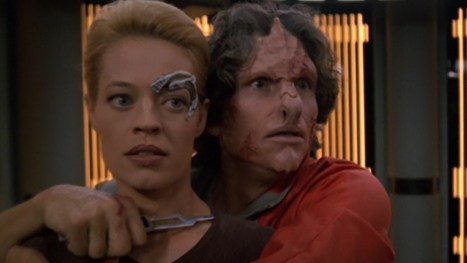
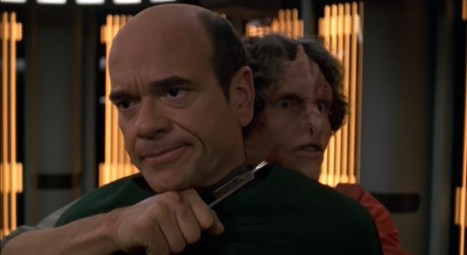
Star Trek: Voyager – Lineage (Review)

Lineage is an extremely odd piece of television.

On one hand, it continues the engagement with archetypal social-commentary-driven Star Trek that defines so much of the seventh season of Star Trek: Voyager. Of course, Voyager has always defined itself as archetypal Star Trek, but it is particularly pronounced during the final season. Producer Kenneth Biller seems eager to offer fans a series that superficially embraces the recognisable elements of Star Trek. There are a number of Prime Directive stories like Natural Law and Friendship One, for example. The idea of the Federation as an ideal comes up in stories like Drive and The Void, for example.

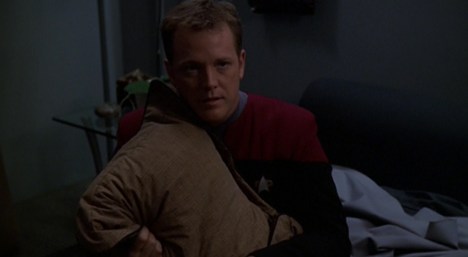
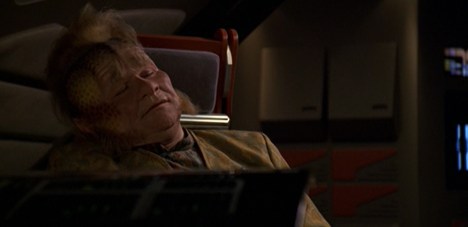
Tom has the talking pillow.

There are also a number of episodes that adopt the classic issue-driven format that fans and even casual audiences have long associated with Star Trek, the sort of “science-fiction as a mirror on society” stories that can trace their roots back to episodes like Let That Be Your Last Battlefield… The seventh season of Voyager wrestles with the healthcare system in Critical Care and the death penalty in Repentance. More than that, it explicitly calls back to one of the highlights of the form when Author, Author stages a late-season remake of The Measure of a Man.

On the surface, Lineage belongs as part of that tradition. It is a story about genetic engineering and designer babies, two hot-button issues at the turn of the millennium, a palpable anxiety rippling through the popular consciousness in projects as diverse as Space: Above and Beyond or Gattaca or The Sixth Day. There was a real and tangible fear about what this sort of genetic tampering would do to society, and the set-up of Lineage promises to explore the implications of an idea with which the franchise had been grappling since Space Seed in the late sixties.

Duvet really know how much you care?

However, as with Critical Care, there is a sense that the production team want the credit (and the attention) for dealing with a hot-button issue without the possible political back draft that would come from actually taking a strong stance on the point. Lineage pays lip-service to a broader cultural debate around things like genetic engineering and designer babies, but it consciously veers away from anything potentially contentious to focus on a really tonally surreal soap opera that involves the casual violation of the EMH’s programming and an absurd stand-off in Sickbay without any emotional reality.

The result is something of a surreal roller coaster that doesn’t work in any meaningful way, veering dramatically in terms of tone and theme while completely abandoning any sense of nuance or complexity in favour of heightened melodrama. The result is deeply unsatisfying, but fascinating as a hodge-podge of different ideas thrown together to structure an episode.

Baby on board.

Continue reading

Star Trek: Voyager – Shattered (Review)

Shattered was the first episode of Star Trek to be broadcast in the new millennium, premiering in January 2001.

Of course, there is some debate about when the new millennium actually began, even as Star Trek: Voyager mailed its colours to the mast with 11:59. However one might feel on the issue, Shattered seems more deserving of the claim than Fair Haven. This is an episode that captures a real sense of the moment that which the nineties technically gave way to the twenty-first century, a transition defined in very literal terms. It was a moment that was simultaneously about great cultural, social and technological change while also reflecting on how little had actually changed.

Say it, don’t hypospray it.

The nineties were (and remain) a paradox. They are easily defined by any chronological measure, with a neatly delineated start and end date. However, like any other decade, they are fuzzier when defined in a cultural sense. In some ways, the nineties began with the fall of the Berlin Wall and ended with the attack on the World Trade Centre. In another way, the nineties are still happening in terms of culture and fashion. They are at once present in the way that we make and consume art, but also something so absent that we long for the comfort of their trappings.

Shattered captures that weird fractured sense of time, the uncanny feeling that time is out of joint, that the past and the future are all overlapping in the same physical space without any sensation of linear progression. Shattered suggests that Voyager‘s past, present and future can all share the same physical space and that they can be navigated with relative ease. Despite the fact that this ship has been on a seven-year journey home, its past and its future are never distant.

“I am Commander Chakotay, and I endorse this cider.”

Continue reading

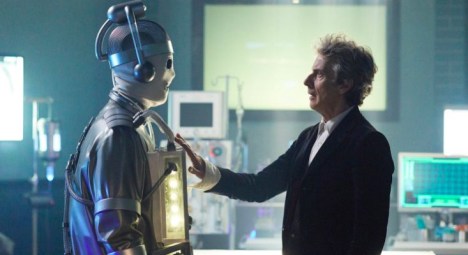
The Moffat Moment: The Lasting Legacy of Steven Moffat’s “Doctor Who” and “Sherlock”…

Hindsight is a powerful tool.

It’s hard to recognise patterns in the moment, to understand how a larger design is unfolding as it actually unspools. It’s a lot easier to process the larger context once the work is complete. Many important works only reveal themselves in retrospect, once they can be properly contextualised as part of broader cultural movements and placed within the larger popular consciousness. By this measure, Steven Moffat’s run on Doctor Who is a particularly fascinating piece of work.

Moffat’s Doctor Who is an interesting piece of work, in large part due to the sheer volume of venom that it generates online. This is to be expected with any writer working on a major geek-friendly property. Fandoms are inherently protective of what they deem to belong to them, and this can lead to excessive and aggressive campaigns of hatred against those writers and directors they believe to be betraying the object of their affection. This is most obvious in terms of the response to Star Wars: Episode VIII – The Last Jedi, with harassment campaigns against actors and insane petitions and misogynist edits.

Moffat was subject to that sort of online hatred to the point that he was chased off Twitter, but the most interesting thing about the hatred of his tenure was that it seeped into professional journalism. Professional websites like The Daily Dot were so aggressively critical of Steven Moffat that they even made a point to blame him for decisions made by his direct predecessor; even when issuing a correction of that simple fact-checking oversight, they made a point to leave his sarcastic commentary on that narrative choice within the article without any context so that it might look like an endorsement.

There was an interesting dishonesty in the criticism of Moffat’s tenure. The most obvious example might be Rebecca A. Moore’s infamous study that argued that women’s speaking roles actually decreased under Moffat’s tenure, which was circulated in mainstream media and press. While it’s possible to have subjective arguments about the content of such dialogue and characterisation, the study itself was easily demonstrably inaccurate and read very much as an attempt to manipulate the numbers in service of a predetermined editorial perspective.

It is, of course, perfectly reasonable to dislike the work of a particular writer or to dislike the direction of a particular show. Life would be boring if everybody liked the same things. However, a large part of the fan-press coverage of the Moffat era seemed dedicated to arguing that the series was objectively awful with little room for debate. This resulted in a very heightened tone in online discourse around it in which the producer had to give interviews to the mainstream press insisting that he was not a misogynist. This critical environment was less than healthy, and its spread to professional outlets was regrettable.

As with most things, including the tenure of Russell T. Davies and Andrew Cartmel, the reality of the Steven Moffat’s tenure as showrunner was complicated. It is, for example, true that the overnight ratings did drop during the final years of his tenure. It is also true that the manner in which people were consuming television changed as well, making overnights less important. It is similarly true that Moffat’s tenure saw the series breaking into America; synchronising broadcast on BBC America, record high ratings and shooting episodes like The Impossible Astronaut, Day of the Moon and The Angels Take Manhattan there.

More to the point, it was the Moffat era that saw the series’ impact on American popular culture increase dramatically. To be fair, at least some of this was a delayed reaction to the hard work done by Russell T. Davies who had made smaller-scale efforts at outreach such as second-unit shooting in Daleks in Manhattan and Evolution of the Daleks. Nevertheless, the impact was felt. For example, Christopher Eccleston showed up on The Sarah Silverman Program playing “Doctor Lazer Rage.” Similarly, Community featured “Inspector Spacetime”, with a superfan played by future Moffat-era co-star Matt Lucas.

Whatever the precise cause of this increasingly mainstream interest in the show in American popular culture, and it seems fair to credit at least some of that to the increased access that American audiences had to the show during Moffat’s tenure as showrunner, it gets at one of the larger and stranger overlaps between Moffat’s work on the series and broader cultural trends. Moffat’s Doctor Who often seems like a template for certain strands of contemporary popular culture, whether through coincidence or design.

Rewatching Moffat’s Doctor Who, removed from its original context, it often seems like Moffat had a much stronger understanding of the direction of contemporary culture than many of his critics would allow.

Continue reading

Star Trek: Voyager – Flesh and Blood, Part II (Review)

In its seventh season, Star Trek: Voyager gets nostalgic.

It happens naturally when long-running shows begin the process of wrapping up. It is inevitable that the production team will look back with affection and sincerity towards the early years of their shared adventures. The seventh season of Star Trek: Deep Space Nine even made a number of strange callbacks to the first season. Chimera offered a very late-in-the-game return to “the hundred”, the Founders that were sent out into the void like Odo had been. What You Leave Behind featured Sisko fulfilling the task for which he has been chosen in Emissary.

“Star Trek was never about shooting stuff with big guns,” argue a certain strand of modern Star Trek fans.

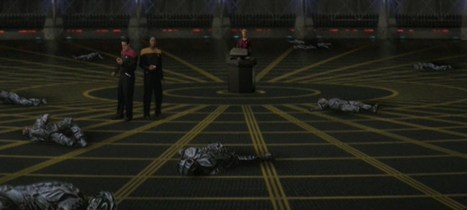
That nostalgia simmers and bubbles through Flesh and Blood, Part I and Flesh and Blood, Part II. However, there’s a sense that Flesh and Blood, Part I and Flesh and Blood, Part II don’t quite understand what they are evoking. Flesh and Blood, Part I and Flesh and Blood, Part II hark back to the earliest seasons of Voyager in a number of surprising ways, providing a neat bookend to some of the core anxieties that have been bubbling through the series since Caretaker.

Unfortunately, Flesh and Blood, Part I and Flesh and Blood, Part II seem to be doing this almost unconsciously. This is not an exorcism or an exploration, but an unexpected repetition. Voyager is still haunted by memories of the show’s turbulent early years, and it is clear that Voyager has no better understanding of itself now than it did then. The result is deeply unsatisfying and frustrating.

East of Iden.

Continue reading

Star Trek: Voyager – Flesh and Blood, Part I (Review)

In its seventh season, Star Trek: Voyager gets nostalgic.

It happens naturally when long-running shows begin the process of wrapping up. It is inevitable that the production team will look back with affection and sincerity towards the early years of their shared adventures. The seventh season of Star Trek: The Next Generation made a conscious effort to tie up loose ends and to handle long-dangling plot threats. Daimon Bok made a surprise return in Bloodlines, seven years after his first appearance in The Battle. In fact, All Good Things… even sent Picard back in time to relive the events of Encounter at Farpoint.

Going off the grid.

That nostalgia simmers and bubbles through Flesh and Blood, Part I and Flesh and Blood, Part II. The two-parter is openly nostalgic, consciously harking back to the middle seasons of the show. Both parts were aired in a single evening, recalling the broadcast of The Killing Game, Part I and The Killing Game, Part II or Dark Frontier, Part I and Dark Frontier, Part II. More to the point, the two-parter brought back the Hirogen for their first appearance since the fourth season, acknowledging that they were perhaps Voyager‘s most successful recurring alien menace.

Unfortunately, Flesh and Blood, Part I and Flesh and Blood, Part II are a flawed recreation of the past. They are a fake, a simulation, an illusion. They are crafted from a fading memory of the show’s short-lived glory years, and rooted in a number of fundamental misunderstandings about what exactly worked when Voyager was at its best. The result is deeply unsatisfying and frustrating.

They were never really here.

Continue reading

Star Trek: Voyager – Nightingale (Review)

During the production of the third season of Star Trek: The Next Generation, producer Michael Piller laid down a template for Star Trek storytelling that became a large (and underrated) part of the series’ successful. Following on from the unfocused and clumsy first two seasons, Piller advocated from a strong character-driven storytelling sensibility, advocating for a narrative structure whereby each episode would reveal or inform something interesting about a given character, quite apart from any phenomenon of the week or interesting alien species.

It was a template that was so sturdy that Piller himself could open the season by applying it to Wesley Crusher in Evolution. Ronald D. Moore was perhaps the first writer to really understand the appeal of the structure, applying it to Worf in The Bonding and Sins of the Father. Even when episodes weren’t about the main characters, they still offered some insight. Tin Man, Déjà Q and The Defector were both episodes focused on a guest star, but that guest star was largely seen through Data’s eyes.

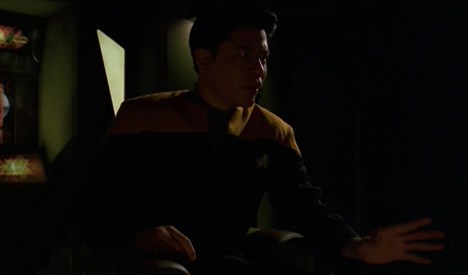
Captain Kim.

There were stories that didn’t adhere to this template. Often, like in Hollow Pursuits and Yesterday’s Enterprise, they focused on a guest star rather than the leads. However, these episodes were the exception that proved the rule. Even the less successful episodes of the season, like A Matter of Perspective or Ménage à Troi were still elevated above the troubled first and second seasons by this attention to character-driven storytelling. Piller set a template that lasted for the next four seasons, and beyond.

In the middle seasons of Star Trek: Voyager, there was a tension between this template and the demands of contemporary television. The writing staff on Voyager understood the basic rhythms and structure of the template that Piller established, and kept applying it after his departure following Basics, Part I and Basics, Part II. Stories like Nemesis and Timeless found a way to apply that template to even neglected characters like Chakotay and Kim. The only issue was that the template felt increasingly outdated.

He’s (Nee)lixed.

Modern television was moving on. The X-Files and Babylon 5 were embracing sprawling epic television storytelling. Television series like The Sopranos and Oz were adopting a more novelistic approach to the medium. Even Star Trek: Deep Space Nine was consciously moving away from self-contained episodes in favour of longer-form storytelling, most notably the six-parter that ran from A Time to Stand through to Sacrifice of Angels. There was a sense that, even applied skillfully and correctly, the Piller template reflected an older mode of television storytelling.

One of the big issues with the seventh season of Voyager is a palpable feeling that even this foundational block of Star Trek storytelling dating back to The Next Generation has begun to erode. The seventh season of Voyager is packed with stories that look and feel loosely that familiar Piller template, broad narratives focusing on individual characters and big ideas wherein the characters develop or discover something about themselves. However, these episodes also tend to look like they were constructed from a faded photocopy of that classic blueprint.

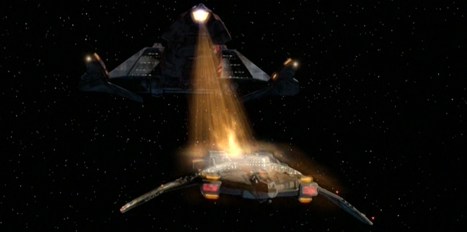
In-tractor-able.

This is reflected in the broad “Star-Trek-iness” of stories like Drive or Critical Care, episodes that gesture toward social commentary while working hard to avoid actually saying anything potentially engaging. It is also reflected in character-driven episodes like Imperfection or Body and Soul, which superficially resemble the template that Piller laid out for telling a good self-contained Star Trek story, but failing to connect all of the pieces in a way that makes any real sense.

Nightingale is perhaps the season’s best example of this, for so many reasons. It is the last Voyager episode to focus on the character of Harry Kim, but returns to what has been his standard character arc since Demon. It has a strong central throughline about the importance of taking command, and the responsibilities of being in authority, but it also never allows these elements to cohere into a strong central thesis. It contains stock Star Trek elements like an alien war and the challenge of non-interference, but doesn’t do anything with them. It is simply a mess.

Continue reading