• Following Us

  • Categories

  • Check out the Archives


  • Awards & Nominations

New Podcast! The Time is Now – Season 1, Episode 14 (“The Thin White Line”)

As ever, a delight to stop by The Time is Now to talk about Millennium, this week with the estimable Christopher Knowles.

This week, I got to show how deep my love was for The Thin White Line, the last episode of the first season to be penned by James Wong and Glen Morgan. As with Force Majeure, this is one of my favourite episodes of the first season. It is interesting, because it’s also one of the last “serial killer of the week” stories in the season. It is also among the very best of that subgenre, and deals thematically with ideas that the show will explore in the season ahead.

This was a fun, broad discussion. As ever, you can listen to the episode here, subscribe to the podcast here, or click the link below.

Continue reading

Star Trek: Voyager – Natural Law (Review)

Natural Law represents another vaguely nostalgic entry in the final season of Star Trek: Voyager.

Most superficially, Natural Law evokes the vague New Age sentiment that defined a lot of the early episodes focusing on Chakotay – episodes like The Cloud or Tattoo. It feels entirely appropriate that Chakotay should be part of the away team to encounter the Ventu, as the presentation of the Ventu evokes a lot of the early approach to Chakotay’s own Native American heritage; a romanticised ideal of a more primitive culture. In fact, it seems entirely plausible that the aliens who build the shield to protect the Ventu – the mysterious “Species 312” – might in fact be the same white-skinned aliens encountered in Tattoo.

“I can see what’s happening, and they don’t have a clue…”

More specifically, though, Natural Law represents a familiar archetypal Star Trek episodes. Although the words are not actually spoken within the episode itself, Natural Law is pretty much a textbook “Prime Directive” episode. It belongs to that familiar subset of stories about the crew encountering a group of primitive aliens affected by a piece of outside technology, and trying to weigh their obligation to help that society with their desire not to directly intervene. The Ventu are a familiar native archetype, albeit one handled with a little more grace and dignity than the inhabitants of Gamma Trianguli VI in The Apple.

There is something very interesting in Natural Law, particularly in the context of the seventh season’s recurring fascination with tying Voyager back to the roots of the Star Trek franchise with references to Kirk in episodes like Q2 and Friendship One. Ironically, Natural Law only underscores how far removed Voyager is from the original Star Trek. Kirk often struggled to justify bending the Prime Directive to liberate societies trapped in oppressive circumstances and kept in arrested development. In contrast, Natural Law strains to justify the washing of the crew’s hands. More than that, Natural Law reveals the true purpose of the Prime Directive has nothing to do with primitive cultures.

The rise and falls…

Continue reading

New Podcast! The Time is Now – Season 1, Episode 13 (“Force Majeure”)

It was a delight to stop by The Time is Now podcast again, particularly so soon after my last appearance on The X-Cast.

This week, I’m joining host and showrunner Kurt North to talk about one of my favourite episodes of the first season and a definite turning point in the evolution of Millennium. Force Majeure is one of the first times in the season that Millennium really lets its freak flag fly high. It is an episode that feels very different and distinct from what came before, eschewing the conventional “serial killer of the week” format in favour of something more abstract and eschatological.

This was a fun, broad discussion. As ever, you can listen to the episode here, subscribe to the podcast here, or click the link below.

Continue reading

Torchwood: Miracle Day – Rendition (Review)

Rendition serves as a demonstration of the flaws with Torchwood: Miracle Day. While some of those flaws – the flaws inherent to the production between the BBC and Starz, the difficulty with scale – were built into The New World, Rendition hits upon quite a few more. Most obviously, it’s an entire episode dedicated to filler. Pretty much the only plot line that advances in a meaningful way is that involving Oswald Danes. Otherwise, Rendition feels like a bit of a holding pattern, a time-wasting exercise designed to pad out the season to ten episodes.

Dead on arrival?

Dead on arrival?

Continue reading

New Podcast! The X-Cast – Season 4, Episode 13 (“Never Again”)

I had the pleasure of popping by The X-Cast again, this time to discuss Never Again with the wonderful Deana Ferrer.

Long-time readers of the blog will know (or at least suspect) that Never Again stands out as one of my favourite episodes of The X-Files. Most days, it’s a toss up between that and One Breath. There are a lot of reasons for that, but I think the most obvious is that – as I’ve gotten older – I’ve found myself identifying more with Scully than with Mulder. Scully’s anxieties and uncertainties here, her self-doubt and her insecurity, all resonate with me more and more as I get older. More than any other X-Files episode, I understand the feelings that drive Never Again.

Of course, there’s more to it than that. It is also a fantastically constructed episode of television, an interesting illustration of how continuity is an external construct in long-form narratives, and something that pushes very strongly at certain ideas of what The X-Files is and what The X-Files is about. So it was a pleasure to join Deana to discuss the episode, to break it down and to try to make sense of it all. I know it’s a controversial episode, so I simply hope that we make a relatively coherent argument for it.

As ever, you can listen to the episode here, or click the link below.

Continue reading

Star Trek: Voyager – Friendship One (Review)

Friendship One finds Star Trek: Voyager trapped between its own past and the future of the larger Star Trek franchise.

Of course, there’s no small irony that that future would take the form of Star Trek: Enterprise, a prequel set almost a century before the original series and (to date) the television series set at the earliest point in the larger continuity. This gets at something very strange about the seventh season of Voyager, where it seems to be looking both back at and forwards to the past. In some ways, it is the ultimately literalisation of the “end of history” ambiance that pervades the series, articulated in stories like Future’s End, Part I and Future’s End, Part II. There is no future. There is just the past.

What ship can cause antimatter annihilation and has room for two people?
A friendship?

So Friendship One seems caught between two different versions of the past. In its most obvious sense, it is trapped in Voyager‘s own idea of the past. It is an atomic-era creature feature about the horrors of radiation, a pulpy fifties schlock-fest that feels of a piece with everything from Jetrel to The 37’s to Cathexis to Macrocosm to In the Flesh to Bride of Chaotica! This is the future as it looked in the fifties, the atomic (rather than “post-atomic”) horror. However, it also gestures very strongly towards Enterprise, even accidentally encapsulating some of the core anxieties of the fourth Star Trek spin-off in an eerily prescient manner.

The result is an episode that feels like it is suffocating in its own past, with no idea of how to chart a course forward.

Does anything really (anti)matter?

Continue reading

Non-Review Review: What We Left Behind

Part of what is so remarkable about What We Left Behind is the way in which it feels more like a testament (and love letter) to how series producer and documentary co-directory Ira Steven Behr saw the Star Trek: Deep Space Nine than an exploration of the show itself.

This is not a surprise. Indeed, the poster for the documentary notably features Behr holding the eponymous space station in the palms of his hand, as much trying to figure it out for himself as offer it to the audience watching. Behr jokes that the documentary began production in 2012, but spent three years trying to figure out its identity and its angle. With its release in 2019, this puts Behr in the paradoxical position of having lived with What We Left Behind for almost as long as he lived with Deep Space Nine itself.

There isn’t too much in What We Left Behind that a dedicated fan won’t already know about the show’s production and history, but that’s not the point. An early sequence in the documentary exists largely in order to caution the viewer against interpreting the accounts offered in the documentary too literally. Repeatedly, actors and writers contradict themselves and each other. At one point, Robert Hewitt Wolfe casually recalls the finer details of Shadows and Symbols better than Hans Beimler, who actually wrote the episode. “I wasn’t even on the show at that point!” Wolfe jokes.

However, the documentary comes back time and again to the second season episode The Wire in order to explain these competing accounts and contradictory stories. They all hint at some greater truth.

Continue reading

Star Trek: Voyager – Author, Author (Review)

Author, Author is a deeply cynical piece of Star Trek.

Author, Author is arguably as bleak as anything that Star Trek: Deep Space Nine ever produced. It is a story about how shallow and how self-centred the primary cast of Star Trek: Voyager can be, but also a showcase of how little the Federation has actually evolved in the twelve years since Star Trek: The Next Generation tackled the same themes in The Measure of a Man. Indeed, with production wrapping up and the series winding down, Author, Author seems to acknowledge the flip side of the “end of history.” There is no sense of material progress. Things have not improved. Things have not changed.

Doctor Demented.

Author, Author literalises this within its own narrative. Author, Author suggests that little has changed in the Federation’s worldview since The Measure of a Man, while also insisting that nothing will change in the immediate future. Author, Author acknowledges that The Measure of a Man was a desperate punt of a thorny issue, but also frames its own narrative as exactly the same kind of punt. The closing scene of the episode places any long-term consequences of the story four months in the future. In doing so, it places them squarely outside the purview of Voyager in particular and Berman era Star Trek in general.

The only problem with all of this is that Author, Author often seems entirely unaware of how unrelentingly cynical and bleak it is.

Write on!

Continue reading

Star Trek: Voyager – Q2 (Review)

Q2 is an episode very much in keeping with the ethos of Star Trek: Voyager, particularly at this point in its run.

It isn’t just the strange nostalgia that permeates the episode, opening with an extended oral presentation from Icheb on the heroic exploits of James Tiberius Kirk from the original Star Trek and extending through to the unnecessary return of a beloved recurring guest character from Star Trek: The Next Generation. Nor is it the awkwardness with which Q2 affects a half-hearted compromise in its final act, with the series paying lip service to the fact that its omnipotent (and mostly friendly) guest star could get the crew home with a click of his fingers, while refusing to do that because it would break the series.

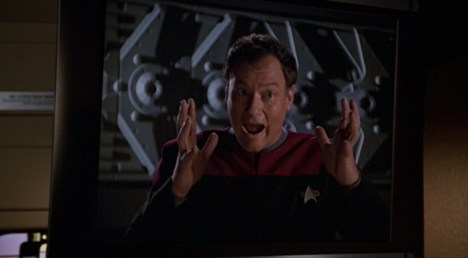
“Q2 ratings are way up!”

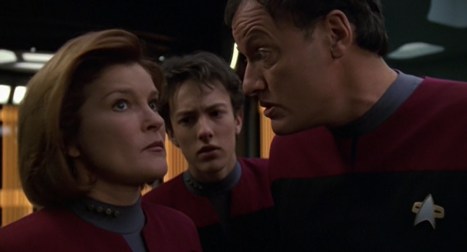
The essential Voyager-ness at the heart of Q2 is much more profound than all of that. It has to do with how the series treats is returning guest star. Q has been a part of the Star Trek universe dating back to Encounter at Farpoint. John de Lancie has been a recurring guest star on the franchise for thirteen-and-a-half years. Although de Lancie has aged relatively well, and although suspension of belief easily allows for it, even Q himself seems much older between his first and last appearances in the television franchise.

However, Q2 takes a character who was introduced as an immortal and all-powerful trickster god in The Next Generation, and transform him into a stressed middle-aged parent by the end of Voyager. This is a very Voyager approach to characterisation and development. It is how the series has approach many of its characters. In Caretaker, Chakotay was a rebel, Paris as a rogue, and Neelix was a free-wheeling trader; within the show’s first season, all of those rough edges have been filed off. The decision to do that with a character who is effectively a trickster god speaks a lot to the central philosophy of Voyager.

Not kidding around.

Continue reading

Star Trek: Voyager – Human Error (Review)

Human Error is a staggering act of creative cowardice.

Star Trek: Voyager is in the literal home stretch of its final season; only seven more episodes remain. By this point in its final season, Star Trek: Deep Space Nine was mapping out an impressive and ambitious epic tying together seven years of threads into something loosely resembling a single tapestry; the “final chapter” was kicking into high gear with Strange Bedfellows. While Star Trek: The Next Generation was less assuredly wrapping things up, as Star Trek: Generations loomed, there was an air of finality and closure to stories like Journey’s End or Firstborn.
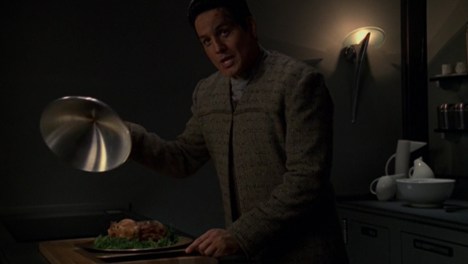
What a dish.

Voyager shows little real sign of progress in the final stretch. There is the occasional piece of housekeeping, such as the awkward decision to get Neelix off the ship in Homestead. There are occasional flashes of thematic reflection on the end of the journey, as in Workforce, Part I and Workforce, Part II. There are also episodes asserting the show’s place within the larger franchise, espousing hollow takes on familiar franchise storytelling in episodes like Critical Care or RepentanceVoyager even shows flashes of anxiety about the franchise iteration that will replace it, in episodes like Friendship One.

Watching the seventh season of Voyager, there is never any doubt that this will be the final season. There is a funereal atmosphere running through the season, that awkward sense of an exhausted athlete grasping desperately for the respite of the finish line. Watching the seventh season of Voyager, fatigue hangs in the air; it is abundantly clear that nobody involved expects an eighth season. However, it is equally obvious that nobody involved with the show has any idea what to do with the seventh season itself.
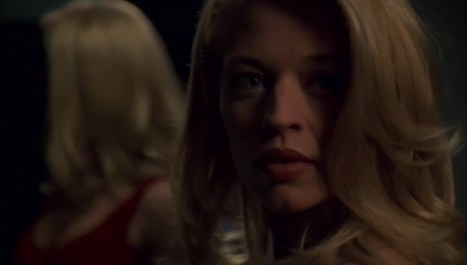
Not feeling herself.

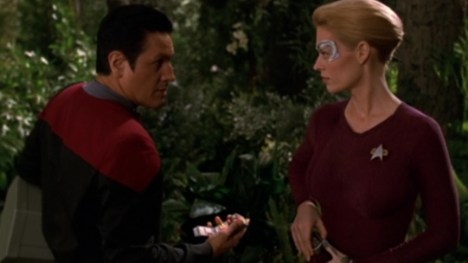
On its own terms, Human Error is a disappointment in a manner similar to a lot of late Voyager episodes. The premise is highly derivative of a number of relatively recent episodes. As with Imperfection, Seven of Nine experiences a technological malfunction that may kill her due to her Borg implants. As with Someone to Watch Over Me, Seven of Nine experiments with her humanity. As with Pathfinder (and much earlier Hollow Pursuits), a character finds themselves escaping from reality into holographic fantasy. As with Fair Haven, a lead character falls in love with a holographic partner.

Human Error is dull and drab in terms of plotting. Its structure is fairly conventional. It’s secondary plot is underdeveloped, unnecessary and distracting. Its resolution is trite, with Seven of Nine naturally redeeming her earlier failures by saving the crew at the last possible minute using techno-babble and hazily-defined stakes. All of this is pretty standard Voyager plotting. It is not an aberration. There is very little to be said about these elements of the episode. These have been problems with the show for years, and Human Error is not even the most egregious example of any of them.
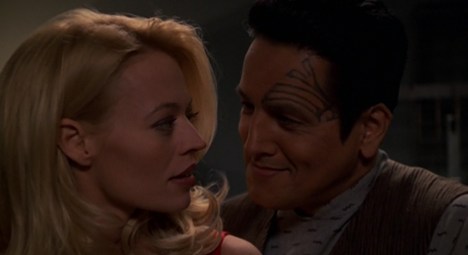
More like Chako-bae.

The big problem with Human Error is lack of conviction. Human Error is an episode with a premise that requires and demands proper development and exploration. It is an episode that lays down a marker, one that exists primarily so that it can be honoured over the final stretch of the season. Despite the problems within the episode itself, Human Error gambles in a big way on how the rest of the season builds off it. Naturally, Human Error loses this bet, its set-ups never honoured by the episodes that follow. This deals the episode a fatal blow, undercutting it brutally. Human Error is dull and drab, but also pointless.

To be clear, Human Error is not making an unreasonable request of the seven episodes that follow. The premise flowing from Human Error isn’t especially ambitious in the context of early twenty-first century television. Both The Next Generation and Deep Space Nine have built skilfully off individual episodes like Human Error, using these set-ups as stepping stones to build something more impressive. Even Voyager has employed that sort of storytelling before, albeit to mixed effect. There is no reason for Human Error to crash so spectacularly, beyond a complete disinterest from Voyager itself.
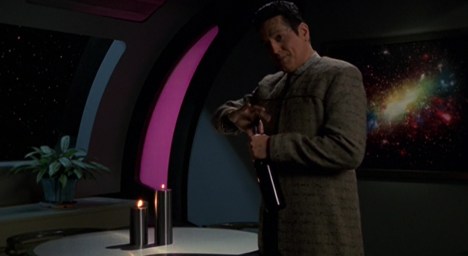
Don’t bottle it.

Continue reading