• Following Us

  • Categories

  • Check out the Archives


  • Awards & Nominations

New Podcast! Set the Tape Rewind – Episode 10

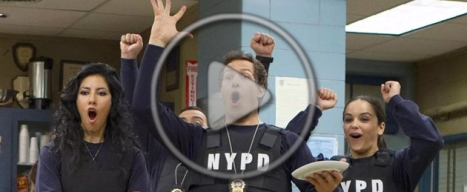
Thrilled to be invited to to guest on the latest episode of the new podcast from Set the Tape, discussing the week in popular culture with Owen Hughes and Steve Norman.

Set the Tape Rewind half-hour jump into the world of film, television and… well, everything else. This week, we’re discussing whether Avengers: Infinity War broke the Marvel Cinematic Universe, the mass cancellation of shows at Fox and NBC followed by the resurrection of Brooklyn 99, and our competing attitudes towards tie-in fiction. It was a huge pleasure to be invited on for a fun discussion.

You can listen to the episode here, or click the link below.

Non-Review Review: Solo – A Star Wars Story

Solo: A Star Wars Story is perhaps remarkable in how it is unremarkable.

That is not exactly fair. Most obviously, despite being the tenth theatrical release with a Star Wars brand, Solo: A Star Wars Story is still something relatively novel for a franchise; it is a big-screen outing that consciously and overtly marginalises a lot of what audiences have come to expect from the franchise. There are a host of familiar elements here, but often in minuscule amounts; either token gestures or sly continuity nods. Without confirming any of these elements are present, Solo certainly has fewer Jedi, Death Stars, representatives of the Empire, officially designated rebels, or lightsabers than most Star Wars films.

The Wookie and the Rookie.

More than that, the film’s production was notably troubled, which is striking for a production company as efficient as Disney and Lucasfilm. Original directors Phil Lord and Chris Miller finished shooting their version of the film, and were fired during the editing process. Reportedly, seventy percent of Solowas reshot by Ron Howard. Given the schedule demands of the actors involved, the complicated mechanics of the set pieces, and the budget of the film, this was no small undertaking. On paper, Solo would appear to have more in common with a film like Justice League or Suicide Squad than even the troubled Rogue One.

With all of that in mind, it is a credit to Howard that Solo turns out as well as it did. Howard is an efficient and often underrated director, one with a clean eye and with a clear storytelling style. Howard’s films tend to be unfussy and uncomplicated, a director who never gets in the way of the story being told. This is something of an underappreciated virtue, with Howard’s films often maintaining a firm grasp on the fundamentals of storytelling. Howard’s characters tend to have clear arcs and tangible motivations, with very little getting lost in the shuffle. Howard’s direction is unobtrusive, which likely made him such a good fit for this particular film in these particular circumstances.

On the cards…

Watching the film, there is little sense of competing tones or contrasting visions. There are moments over the course of the film when the cast are noticeably more playful, their banter a little more conversational and the comic rhythms a little more pronounced. However, Solo never misses a beat, never turns to sharply, never transitions too jarringly. There is a strange sense, watching Solo, that absolutely everything has ended up right where it was supposed to be with a minimum amount of fuss. There is absolutely nothing about the finished product screams “troubled production.”

At the same time, nothing about Solo screams anything at all.

Going Solo.

Continue reading

Non-Review Review: Deadpool 2

Like the original, Deadpool 2 is being talked about as a deconstruction or comedy. It’s not really. At least, not primarily.

Deadpool 2 is most effective as a very simple and straightforward superhero narrative with a shade more violence and a dash more awareness. There are laughs in Deadpool 2. And a few truly great jokes. There are even occasionally moments where Deadpool 2 will take a montage or a couple of scenes specifically to set up a later pay-off. However, these are the exception rather than the rule. And it’s no coincidence that this set-up leads to the biggest laugh in the film.

Not basic Cable.

More to the point, Deadpool 2 never opts for a joke over an efficient plot beat. Deadpool 2 never even distorts its plot in order to cram a few more laughs into the runtime. The gags are largely there to decorate the plot, not to direct it. They’re fun, but they aren’t especially brutal or pointed. There’s never a sense that Deadpool 2 exists as a deconstruction or critique of superhero movies, that it has anything especially insightful to say about the genre beyond accepting that modern audiences are genre-literate.

To be clear, this is not an issue with Deadpool 2. In fact, what’s most remarkable about Deadpool 2, particularly in the age of superhero bloat and franchising, is the relative efficiency with which it tells a simple story. For all the jokes about genitalia and all the pop culture references that crowd the narrative, there is more genuine emotion in Deadpool 2 than there is in Avengers: Infinity War. The characters are better defined, their arcs and motivations clearer, their agency repeatedly affirmed. There is an endearing and infectious earnestness beneath the dick jokes.

Just Joshing.

Continue reading

New Podcast! Scannain Podcast (2018) #17!

A busy Scannain podcast, covering the week in film and other news.

This week, I’m joined by Grace Duffy, Jason Coyle, Ronan Doyle, and Alex Towers to discuss the week in film – both Irish and international. The news includes coverage of Cannes, of Irish success at other international film festivals, and the upcoming release dates of notable Irish films. As usual, we also talk about what we watched, what is being released next week and what is currently in the top ten.

Check it out here, or give it a listen below.

Non-Review Review: On Chesil Beach

On Chesil Beach is a messy and awkward adaptation of Ian McEwan’s story, adapted by the writer from his own work.

McEwan’s source material might be better described as a “novella” than as a “novel”, with the writer describing it as such and the book generating some small controversy when shortlisted for the Booker Prize. Indeed, the film strains when it tries to extend the novella’s core idea out into a feature-length film, often struggling to find focus and to hold its attention. The result is a very uneven piece of work.

Love on the rocks.

However, On Chesil Beach provides an intriguing mess of interesting ideas and solid performances. Saoirse Ronan and Billy Howle cannot hold the film together, but provide a set of interesting characters that provide the closest thing that the film has to a throughline. The film works best when it is willing to focus on these two characters together, when it moves away from its free-association aesthetic towards something more concrete.

On Chesil Beach never quite coheres into a fully-formed film, often feeling more like a televison movie or a stage play than a theatrical release. Still, there is something interesting playing beneath the surface, often lost in heavy-handed writing or awkward segues.

It ain’t no picnic.

Continue reading

Non-Review Review: Entebbe

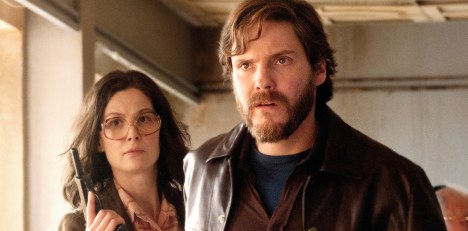
Entebbe is an ambitious, and very messy, hostage drama.

The events that took place in Entebbe Airport in Uganda during June and July 1976 are fascinating. The crisis been adapted for the screen on several occasions already. Anthony Hopkins, Elizabeth Taylor and Richard Dreyfuss starred in Victory at Entebbe later that same year. The following year, Irvin Kershner directed Raid on Entebbe with Charles Bronson and Yaphet Kotto. That same year, Israel produced its own take on the tale in Operation Thunderbolt, which earned an Academy Award nomination for Best Foreign Language Film.

A Brühl-tal experience…

The events leading up to the daring recovery mission are deeply fascinating, with any number of interesting angles on the larger story. It is tempting to look at the events in terms of the tenure of General Idi Amin, who made Uganda a base of operations for these terrorists, much like Last of King of Scotland did. It is possible to look at the Israeli soldiers who trained to mount the rescue mission, knowing the dangers into which they were venturing. It might be reasonable to treat the events as a formative experience for the (then) young state of Israel.

Entebbe attempts to tell the story through all these different prisms at the same time, to offer a holistic perspective on the events that captures the surreal nature of events and the absurd stakes for all of the players caught up in this perilous game. Entebbe bites off a lot more than it can chew, never quite managing to balance the competing demands of the objects of its focus. Entebbe is an intriguing film, but one that feels fractured and unfocused.

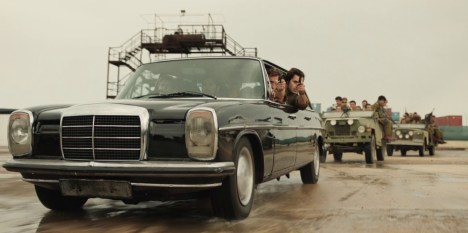
Merc task force.

Continue reading

To Infinity and Beyond: Of Life (and Death) Without Meaning in “Avengers: Age of Ultron” and “Avengers: Infinity War”

Avengers: Infinity War is a staggering accomplishment, from a purely logistical standpoint.

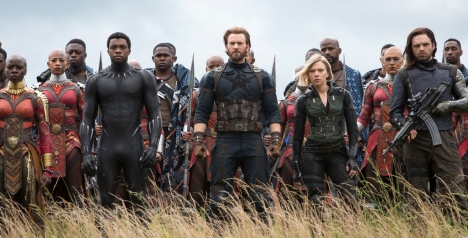
The film features approximately fifty major characters drawn from ten years of cinematic storytelling, all drawn together to face a major existential threat in a story that spans from a fictional African kingdom to the depths of outer space, all told within two-and-a-half hours, and all packaged in a neat and easy-to-follow delivery mechanism. Marvel Studios and the Russo brothers might make it look easy, but there’s no denying the level of skill and technique involved in shepherding a story like this to the big screen and making it work in a fundamental “this is entertaining” kind of way.

It’s important not to undersell this, not to dismiss the level of craft involved in stitching together a coherent narrative from the differing lengths of cloth. There is pleasure to be had in watching the various characters come together; in watching Peter Quill get insecure around Thor, in listening to Rocket joke about stealing the Winter Soldier’s arm, in the fact that Tony Stark and Stephen Strange spend the bulk of the movie attempting to out-Sherlock one another. Infinity War succeeds on these terms. It’s easy to be dismissive of this cinematic experiment, given how easy it looks, but that does not diminish the accomplishment.

However, there’s also something gnawing away in the background of Infinity War, an awkward question that the film never actually answers. “What is this actually about?” somebody might legitimately ask, and there are any number of possible answers. Infinity War is a film about a big purple dude with a magic glove. Infinity War is about paying off ten years of continuity. Infinity War is about proving that it is possible to make a movie like Infinity War. Infinity War is about ensuring that the next Disney shareholders’ meeting is a blowout party.

All of these are legitimate answers, but they dance around the truth. On its own terms, taken as a piece of popular culture projected on to a screen for two-and-a-half hours, Infinity War isn’t actually about anything. When people sit down to look at Infinity War in the years and decades ahead, to dissect and examine it, what will they come back with? What is it actually saying? What is it actually talking about? Not even in some grand “thesis statement about the universe” way, but in a more basic “this is the thematic arc of the film” manner?

Watching Infinity War, there is a deeply uncomfortable sense that Infinity War is about nothing beyond itself.

Continue reading

Non-Review Review: I Feel Pretty

I Feel Pretty has a very bold premise for an aspirational comedy.

Renee is a young woman wrestling with her insecurities, who dreams of being more beautiful. Inspired by a late-night viewing of Big, she is inspired to transform that dream into a wish, and pleads with some external power to physically transform her. Following an awkward accident (and a brain injury) at her “Soul Cycle” class, Renee wakes up and does not recognise her own body. The only catch is that the transformation is strictly internal. Renee is delusional. Her physical appearance has not changed, but the way that she sees herself has.

Reflective anxiety.

That is an ambitious premise, but also a loaded one. There are any number of potential misfires and miscalculations that could sabotage that premise, the skillful execution of the movie relying upon a pitch-perfect management of tone, a key understanding what the movie is trying to say at any given moment, and the sense that all of the production team are working from the same template towards the same goal.

Unfortunately, I Feel Pretty lacks that sense of cohesion, resulting in a mismatched tonal disaster, a film never entirely sure whether it is laughing with its protagonist or at her.

A tough premise to stomach.

Continue reading

Non-Review Review: The Delinquent Season

This film was seen as part of the Audi Dublin International Film Festival 2018.

“You’re a f&!king cliché!” one character screams at another during a particularly heated moment in The Delinquent Season.

That’s a dangerous line to put into a screenplay, particularly in what is supposed to be an intimate character-driven drama. The line skirts the boundaries of self-awareness, inviting the audience to consider it as a statement of authorial intent. It takes genuine courage to force the audience to assess whether the character in question really just “a f&!king cliché”? Obviously, the film believes that its central characters are more than just a collection of familiar tropes repackaged and reheated, but it takes confidence to stare the viewer right in the eye and broach the question.

“Look, it’s this or Infinity War.”

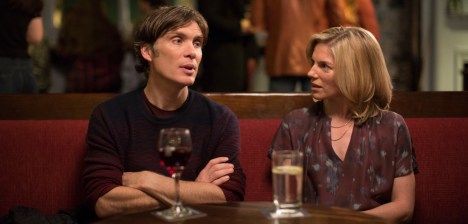
The Delinquent Season certainly has lofty goals. It aspires to be provocative and confrontational, to push the audience a little bit out of their comfort zone by asking them to empathise with characters who are abrasive and awkward. The Delinquent Season seems to genuinely hope that the audience might find its central characters to evoke strong emotions; to feel pity or hatred or anger at their decisions and their actions. There are points watching The Delinquent Season where writer and director Mark O’Rowe is goading the audience to hate these characters.

Unfortunately, The Delinquent Season never even considers that the audience might be bored by these four particular characters.

Table this for later.

Continue reading

Sound Off: Settling the Score on “Last Jedi’s” Soundtrack-Only Version

The score-only version of Star Wars: Episode VIII – The Last Jedi is marvelous for a number of reasons.

Announced by director Rian Johnson as a special feature available on certain digital releases of the feature film, the premise is remarkably simple. The score-only version of The Last Jedi presents the feature film complete and uneditted, but without any dialogue or sound effects. The sound mix is completely dominated by John Williams’ score for the film, from the opening Star Wars fanfare to the music playing over the closing credits. Over the course of the movie’s two-and-a-half hour runtime, not a single word is spoken and not a single laser blast is heard.

As such, the score-only version of The Last Jedi is the closest thing imaginable to a blockbuster silent movie in the current market. After all, silent films are at best a curiousity in the modern market place, often relegated to retrospectives and festival screenings, with the occasional nostalgic release like The Artist. In fact, black and white films are noticeably more common than silent films in the current market. As such, the score-only version is an intriguing piece of work. It obviously showcases John Williams’ score, and the way in which that score shaped and informs the images on the screen.

But it also demonstrates that Rian Johnson is the best director to have worked on the Star Wars franchise, from a purely technical standpoint.

Continue reading