• Following Us

  • Categories

  • Check out the Archives


  • Awards & Nominations

New Podcast! Scannain Podcast (2019) #14!

It’s time for the Scannain podcast!

This week, I join Jay Coyle and Luke Dunne from Film in Dublin to discuss the week in film.  As usual, we talk about what we watched this week, including an in-depth discussion of Unicorn Store, the charm of Grosse Point Blank, a reflection on the two sequels to The Matrix, the power of Little Woods and the inevitability of remaking Akira. In terms of film news, the big news of the week is the launch of Criterion Channel, which is now streaming classic movie content online. There is also the passing of veteran character actor Seymour Cassel. And a nice bracing dose of tax reform, with revisions made to Section 481.

All of this plus the top ten and the new releases.

The top ten:

  1. What Men Want
  2. Five Feet Apart
  3. The Sisters Brothers
  4. Missing Link
  5. Captain Marvel
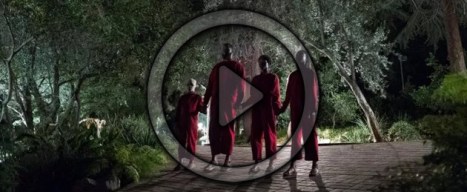
  6. Us
  7. Peppa Pig: Festival of Fun
  8. Pet Sematary
  9. Shazam!
  10. Dumbo

New releases:

  • Wonder Park
  • Hell Boy
  • Don’t Go
  • Little
  • mid90s
  • Wild Rose

The Great Regression: “Little”, “Shazam!”, “Unicorn Store” and the New Cinema of Arrested Development…

It’s always fun to pick at trends in contemporary cinema, especially when so many movies with similar ideas arrive in such rapid succession.

Film production is a long and arduous process. This is part of what distinguishes it from television. Films spend years in development and then production, their releases carefully managed and synchronised. As a medium, mainstream cinema often lacks the urgency suggested by the churn of television. It is harder to immediately react to trends. This is why, for example, the feature film Slender Man arrived more than half-a-decade after the character had taken the internet by storm and arguably after culture’s attention had wandered in other directions. Similarly, the success of movies like Iron Man and The Avengers led other studios to pursue that model of film-making, but it’s telling that the DCEU lagged roughly half a decade behind with Man of Steel and Justice League.
This is why it is particularly interesting when movies tackling the same big ideas happen to be released around the same time; Deep Impact and Armageddon, The Prestige and The Illusionist, Capote and Infamous. These films arrive so quickly that they are unlikely to exist in response to one another. Instead, they suggest similar ideas developed in parallel, perhaps hinting at some deeper motivating factor that spurred these similar ideas into development. Recent weeks have seen the release of three relatively distinct films operating in three very different genres; Shazam! is a superhero story, Little is a broad nostalgic comedy, Unicorn Store is a quirky independent film. However, each of those three films gets at the same idea.

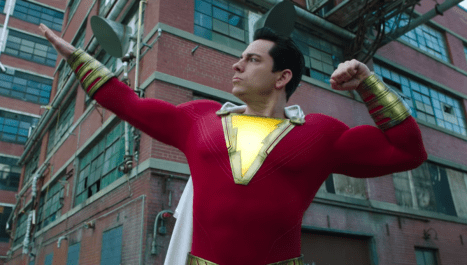
Shazam!, Little and Unicorn Store are all stories about the intersection of childhood and adulthood. Shazam!, Little and Unicorn Store all feature adults who become children, in a manner of speaking. Of course, Unicorn Store is rather less literal than the other two examples, with Kit content to simply recapture her childhood dreams rather than to physically transform herself into a child. While Shazam! might more accurately be described as the story of a child who becomes an adult, the story’s central thrust is that Billy Batson needs to lean to be comfortable being a child and that he cannot remain an adult superhero forever. (Indeed, the primary plot of Shazam! features an adult trying to reclaim “the power of Shazam”, with the film insisting that it belong to a child.)
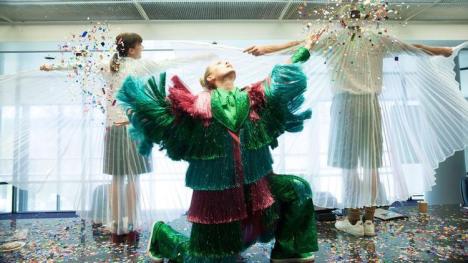
Still, taken together, these films suggest an interesting trend within contemporary pop culture. They hint at the awkward relationship that exists between childhood and adulthood in modern society, and the difficult that many individuals face in navigating the boundaries between the two. In Little, a forty-year-old tech entrepreneur finds herself transformed into her teenage self so that she might live the childhood that she previously denied herself. In Shazam!, a superhero is able to transform into a child with the mere mention of the title word, able to retreat from the responsibilities of heroism into the comforts of a warm and loving family environment. In Unicorn Store, Kit still lives in her parents’ house and sleeps in her childhood bedroom, dreaming of owning a unicorn.

These films are rather strange, in large part because they run counter to so many of the beloved stories with which they might otherwise be compared. During the eighties and even into the new millennium, children dreamed of the freedom that being an adult might afford them. In recent years, many of those children grew into adults who longed for the relative safety and security of childhood.

Continue reading

Non-Review Review: Little Woods

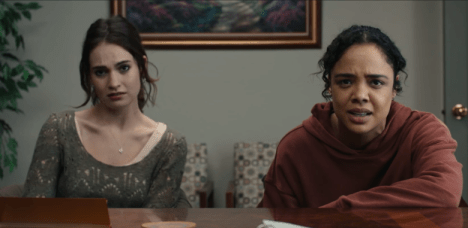
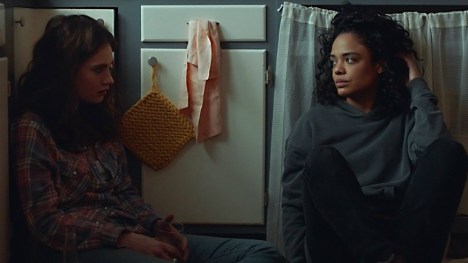
Little Woods is a slow and somber film that never rushes, perhaps because it understands that its characters have no place to go.

There’s a strong central irony built into Little Woods, a story that unfolds against the north-western frontier of Washington State. Ollie lives on what is effectively the edge of the frontier, that great American wilderness. However, manifest destiny has not delivered. The frontier is not as vast as it might seem. Instead, Ollie finds herself trapped on the edges, pressed against the limits of the United States. Little Woods is a story about the boundaries on the extremes of the American Dream. It is no coincidence that Nia DaCosta’s theatrical debut opens and closes at the Canadian border; it is a story of character who are pressed and squeezed against the margins, at the end of everything that they know.

The circumstances Tessa-t her.

There is a compelling stillness to Little Woods, anchored in a fantastic central performance from Tessa Thompson. Little Woods works well in several different modes: as a character study, as a crime drama, as a frontier story. The film is suspenseful when it needs to be, capable of making the audience squirm when it wants them to. However, it is most effective in its relative stillness. Little Woods never feels sensationalist or absurd. It never feels exploitative or stylised. Instead, there is something very effectively grounded and mundane in the portrait that the film traces of those people trapped on the margins. There is something very matter-of-fact about the way in which Little Woods portrays the choices (or, more importantly, the lack of choices) afforded its characters.

Little Woods is an evocative, effective and atmospheric about characters living in a liminal space.

Sister act.

Continue reading

Non-Review Review: Little

Little overcomes some big problems.

There are a number of very obvious flaws with Little. On a very superficial level, the film suffers from the problem that affects a lot of comedies. Little is simply not as funny as it thinks that it is. The jokes are not bad, and don’t fall flat, but also don’t land as efficiently as they might. Even beyond that, Little suffers from some very serious structural issues. The film has a short attention span, often allowing its focus to wander without a clear sense of purpose or motivation. More than that, Little often struggles to decide which of its two primary plots (and leads) to focus upon.

A Little goes a long way.

These are serious issues, and they prevent Little from working as well as it might otherwise. However, the film works much better than these issues would suggest. There is something surprisingly endearing about Little, a genial quality that prevents the film from ever crashing too hard. It isn’t just the relatively simple (bordering on simplistic) central thesis about childhood and playfulness, it is also the empathy that the film feels for most of its cast, especially those introduced as comedic fodder. Little is a very pleasant film, particularly by the standards of studio comedy.

However, the film’s ace in the hole is its fifteen-year-old star Marsai Martin, perhaps best known for her work on Blackish. Martin produced Little as a vehicle for her talent, and it is an effective showcase. Martin carries a surprising amount of the film with a surprisingly nuanced performance for what is a deliberately broad comedy. Martin is not only game for the film’s jokes, but also capable of handling the broad emotional range (and swift emotional transitions) that the script demands of her. Little might just be Martin’s big break.

Somebody’s assistant could use a pay bump.

Continue reading

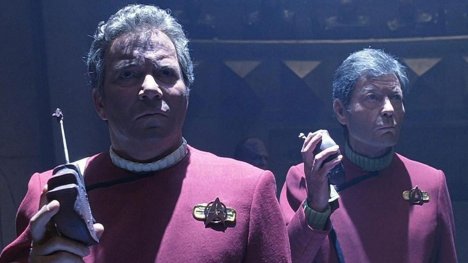
“The Undiscovered Country… the Future!”: Star Trek VI and the Unexpected End of History…

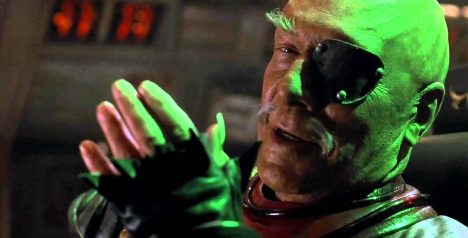
Early in Star Trek VI: The Undiscovered Country, the Klingon Chancellor Gorkon offers what appears to be a fairly dramatic misreading of Hamlet.

Opening a dinner between the representatives of the Klingon High Council and the senior staff of the Enterprise, Gorkon raises his glass of Romulan Ale in salute. “I offer a toast,” he states. “The undiscovered country, the future.” By most accounts, this isn’t what Shakespeare meant when he allowed the Danish Prince to monologue about “the undiscovered country.” The dialogue is quite explicit that Shakespeare was talking about death rather than the future. Hamlet is reflecting upon the possibility of “something after death, the undiscover’d country from whose bourn no traveller returns.” To be fair to Gorkon, this may be a simple translation error; after all, the Klingon Chancellor boasts that “you have not experienced Shakespeare until you have read him in the original Klingon.”

However, increasingly, The Undiscovered Country suggests that Gorkon’s toast is not a simple misreading of the Bard. In the most obvious of senses, Gorkon himself gets to travel to “the undiscovered country” almost immediately after the dinner, murdered by two assassins in Starfleet uniforms as part of a plot to destabilise the possibility of peaceful relations between the Klingon Empire and the Federation. Indeed, even within the larger context of the Star Trek franchise, there is a sense that the future of the Klingon Empire is inexorably associated with death. Gorkon’s peace with the Federation sets in motion the gradual decay and decline of the Klingon Empire that runs through stories like Heart of Glory, Sins of the Father, The Way of the Warrior, Tacking Into the Wind.

However, watching The Undiscovered Country more than a quarter of a century removed from its original context, that seeming misstatement seems increasingly deliberate and calculated. The Undiscovered Country is perhaps the most under-appreciated of the Star Trek films, in large part due to how it consciously and deliberately twins the notions of “death” and “the future”, insisting that perhaps the past must die so that the future might live. In the world of The Undiscovered Country, death is still frightening and mysterious and uncharted. However, it is also a necessary part of growth and evolution. In the years since the release of The Undiscovered Country, it seems like more franchises could take that idea to heart.

Continue reading

New Podcast! Scannain Podcast (2019) #13!

It’s time for the Scannain podcast!

This week, I join Grace Duffy, Ronan Doyle and Jay Coyle to discuss the week in film. There’s a lot to cover this week, most obviously the passing of Agnès Varda, who was something of a patron saint of the podcast. However, the film news also covers the United States Justice Department’s intervention in the row between Netflix and the Academy, big announcements from Cinema Con, news about Disney’s purchase of Fox, the Newport Beach Film Festival, and the Celtic Media Awards.

All of this plus the top ten and the new releases.

The top ten:

  1. How to Train Your Dragon III: The Hidden World
  2. Die Walkure – Met Opera 2019
  3. The Lego Movie 2: The Second Part
  4. Green Book
  5. Instant Family
  6. Lucifer
  7. What Men Want
  8. Captain Marvel
  9. Us
  10. Dumbo

New releases:

Non-Review Review: Unicorn Store

Unicorn Store is, appropriately enough, a strange beast.

Brie Larson’s feature-length directorial debut, adapted from a screenplay by Samantha McIntyre, struggles to manage its tone. What is Unicorn Store? Who is the target audience for Unicorn Store? The stylistic sensibilities of Unicorn Store evoke the modern American mid-budget indie film; the listless title character stuck in arrested development, the cast populated by distinguished character actors like Joan Cusack and Bradley Whitford, the use of shaky handheld camerawork to create a sense of grounded intimacy and authenticity. However, the narrative itself aspires towards something more surreal and strange, the sort of abstract stylised magical realism associated with directors like Michel Gondry or Tim Burton.

Painting a perfect picture.

Similarly, the story itself never seems to figure out at what level it wants to pitch itself. Is Unicorn Store meant for children, with its empowering story about the importance of pursuing one’s dreams in a world that expects too much adult responsibility too quickly? If so, the narrative is too rooted in adult fears and anxieties to really land, the whimsical wonder often eroded by more mundane realities that are of little interest to a young audience. Is Unicorn Store aimed at an older audience then, people like the lead character Kit, who never grew up despite society constantly telling them that they needed to? If so, the story is too light and fluffy, too superficial and too simplistic in its outlook.

Perhaps, like the mysterious “Store” featured in the film, Unicorn Store is trying too hard to be all things to all people. Indeed, the climax of the film hinges on the idea that the eponymous “Store” cannot satisfy all of its customers. While the Unicorn Store attempts to put an optimistic spin on this, there is a sense in which this is true of the film itself. Unicorn Store seems so eager to be everything that anybody could want it to be that it never figures out what it actually is.

Making her mark.

Continue reading

Non-Review Review: Missing Link

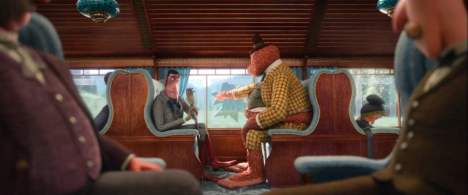
Missing Link is yeti ‘nother triumph for stop motion animation studio Laika.

To be fair, Missing Link is a different beast than Kubo and the Two Strings, the last major release from the studio and one of the most striking (and under-appreciated) animated films of the last decade. Kubo and the Two Strings was a lyrical and powerful fairy tale, a surprisingly weighty meditation on big ideas like the stories that people tell and the losses that they carry around with them. Missing Link is a much lighter film than that, a piece of film that is much less consciously mature in the story that it is telling. This is not to suggest that Missing Link is shallow or superficial, or that it ignores big ideas in favour of small delights. However, Missing Link is a film that foregrounds its visceral thrills over its central themes, and there isn’t anything inherently wrong with that.

Armed and dangerous.

Although Missing Link director Chris Butler co-wrote the script for Kubo and the Two Strings, it is probably more accurate to treat Missing Link as a more mature extension of Butler’s last work for the studio. Missing Link might be seen as a more reflective and introspective take on some of the core ideas of ParaNorman, a similar high-energy romp that meditated upon the relationship that exists between mankind and those things which exist beyond mortal comprehension. Missing Link is sturdily constructed from a narrative perspective, with well-defined characters who are given strong arc and a script that understands both what it is trying to say and how best to say it without tripping over itself. However, the script also understands that it is not the primary draw to Missing Link.

Whereas Kubo and the Two Strings felt like an intricate portrait drawn from the deepest pools of the animators’ imagination, Missing Link is a much more kinetic and dynamic piece. Missing Link is a globe-trotting adventure that spans from the deep blue-green forests of Washington State to the snowy plains of the Hindu Kush. It is the sort of rollicking old-fashioned adventure populated by heroes who spend a lot of time charting train lines and ferry lanes on maps, where obligatory back story is delivered against mesmerising backdrops, and where a variety of energised and imaginative action scenes arrive to a tightly-calculated schedule. Missing Link might lack the complexity of Kubo and the Two Strings, but there’s an infectious dynamism to Missing Link that neatly compensates.

Following their train of thought.

Continue reading

Non-Review Review: Pet Sematary

The horror in Pet Sematary is primal and ancient, both literally and figuratively.

The tropes that power Pet Sematary were already familiar and old-fashioned by the time that Stephen King published the book more than a quarter of a century ago. Indeed, there are extended stretches of the novel when Pet Sematary feels like a game of Stephen-King-related mad-libs: a dash of paternal anxiety here, a sense of existential dread about the American wilderness there, a familiar older character to provide exposition thrown in, and a climax where everything gets very brutal very quickly.

“You just take a left at the Pet Seminary.”

Even beyond the sense of Pet Sematary as a collection of familiar Stephen King elements blended together, the novel riffed on familiar genre elements. There was more than a faint whiff of The Monkey’s Paw to the basic plot, the story of a seemingly wondrous device that could resurrect the dead only for the person responsible to realise that their beloved had come back “wrong” – or, as Jud helpfully summarises, that “sometimes dead is better.” (The novel alluded to this more directly with the story of Timmy Baterman, which is consigned to a newspaper clipping in this adaptation.)

Writer Jeff Buhler, along with directors Kevin Kölsch and Dennis Widmyer, clearly understand that appeal. The script for Pet Sematary makes a number of major alterations to the book’s plot, but most are logical and organic, rooted in the realities and necessities of cinematic storytelling more than the desire to change things for the sake of changing them. For the most part, Pet Sematary revels in the old-fashioned blend of Americana and horror that defines so much of King’s work, the mounting sense of dread and the decidedly pulpy sensibility.

The purr-fect villain.

Pet Sematary only really runs into trouble in its third act, and this is arguably a problem that is carried over from the source material despite the major branching choices that the script makes leading up to that point. The issues with the third act are not those of character or plot, but instead of tempo and genre. In a weird way, these third act issues make Pet Sematary feel like a spiritually faithful adaptation, carrying over something of the essence of the book, for better and for worse.

Pet Sematary is at is strongest when building mood and mounting dread, when offering its own shading on the familiar iconography of a haunted and untamed wilderness. Pet Sematary is at its weakest when it is forced to shape that dread into a more conventional horror movie climax.

Shades of grey.

Continue reading

New Podcast! Scannain Podcast (2019) #12!

It’s time for the Scannain podcast!

This week, I join Ronan Doyle and Jay Coyle to discuss the week in film. It’s a light week for Ronan and myself, but Jay has us covered with deep dives that extend from Varda through to the joy of Music and Lyrics or the siren call from Under the Silver Lake. In terms of film news, we mark the passing of Broncho McLoughlin, take a look at April at the Irish Film Institute, check in on the release date of The Dig and chart a number of upcoming Irish digital releases.

The top ten:

  1. Fisherman’s Friends
  2. Fighting With My Family
  3. A Dog’s Way Home
  4. How to Train Your Dragon III: The Hidden World
  5. Green Book
  6. The Lego Movie 2: The Second Part
  7. Instant Family
  8. What Men Want
  9. Captain Marvel
  10. Us

New releases:

  • The Vanishing
  • Being Frank: The Chris Sievey Story
  • Dumbo
  • Out of Blue