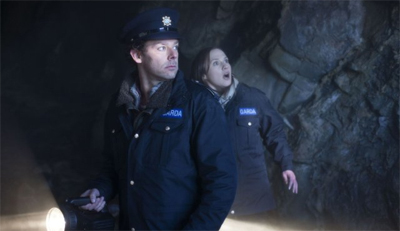
Grabbers is a fascinating little premise, executed in a delightfully quirky and off-kilter manner. Very much an affectionate homage to classic creature features (you can spot Night of the Living Dead playing in the background of one early scene), director Jon Wright and writer Kevin Lehane are sure to give the story a delightfully stereotypical Irish twist. While the Americans might defeat a potentially hostile alien invasion with moral certitude and superior firepower, or the the British might best those otherworldly monsters with a stoic stiff upper lip, the inhabitants of the even stereotypically named “Erin Island” take on their visitors using the sheer unmitigated power of the pub lock-in.
It’s a premise that could easily collapse under its own weight, or become one joke extended well past the point of hilarity, but it’s to the credit of Wright, Lehane and the cast that it flies through its hour-and-a-half runtime.
Safe House is a perfectly fine international thriller, which manages to effectively capture the look and feel of its setting in South Africa. Light on plot and characterisation, but heavy on action and atmosphere, Safe House isn’t necessarily required viewing. In fact, it has a great deal of difficulty convincing the audience to emotionally invest in either of the two lead characters. Still, director Daniel Espinosa keeps things ticking over with a workman-like efficiency on a simple plot and Denzel Washington is as charming a leading man as ever.
Devil actually has a pretty interesting B-movie premise, evoking the sort of cheesy thrill of an eighties horror. Six strangers are trapped inside an elevator… and one of them might be Satan. It’s a fairly straight-forward idea, albeit one that the script and direction needlessly complicate and convolute as they attempt to fill up the seventy-seven minutes. In many ways, Devil feels like something of a classic horror throwback, a simple high concept that relies on occasionally overstated jump scares rather than gratuitous gore or carnage. It’s not necessarily the best representation of the genre, but – if you can suspend your disbelief and live with the overwrought corniness – it’s an affectionate old-fashioned homage.
The biggest problem with Shrek the Third is arguably reflected in its lead character. Despite producing two sequels, making a boatload of money and establishing a massively iconic franchise, it seems like the creators are unwilling to accept their changed reality. Much like the title character refuses to adapt to his new-found circumstances, and the possibility that he will become a father, Shrek the Third refuses to admit that it has essentially become the fairy-tale establishment that it so sorely ridiculed and mocked. The wry and subversive take of fairy tales championed by the original Shrek is no longer on the outside looking in, but on the inside looking out. Shrek the Thirdjust stubbornly refuses to accept that.
So, Sight & Sound has conducted their “top fifty films of all time” poll, held once a decade since 1952. With two polls, one for directors and one for critics, it’s certainly an interesting way to measure the pulse of the cinematic establishment. This year, for example, Citizen Kane was vanquished from the top spot, replace by the critics with Vertigo and by the directors with Tokyo Story. The publication of such a list is always a great spark for cinematic debate and discussion – with some commentators describing the lists as conservative or humourless and some directors using it as an opportunity to publish their own lists. Personally, I always find such list-making fun, if ultimately a little pointless.
Have to admit, I’m quite curious to see how The Bourne Legacy plays out. It’s being released in the States on Friday and here next Monday. I’ve written before about how the structure of the film intrigues me, and Universal Pictures Ireland just sent over this behind-the-scenes look at the film. Enjoy. And if any international readers get a chance to see this before I do, let me know what you thought. (No spoilers, please!)
You can also win some Bourne-related goodies here, with thanks to Universal.
Julius Caesar is a very ropey production. Produced by Commonwealth United Entertainment and American International Pictures, it doesn’t stand up as an enduring adaptation of Shakespeare’s tragedy. While quite a few of the essential ingredients are lacking, Charlton Heston actually does a fairly good job as Marc Anthony – it’s just that he’s never quite as good as Marlon Brando had been in the role back in 1953. On the other hand, Jason Robards is woefully miscast as Brutus, transforming “noble Brutus” from the most honest man in Rome to the most sinister of assassins. The production values are fairly decent, but Julius Caesar perhaps provides evidence that these sorts of historical epics were already on the way out by the start of the 1970s.
Friends! Romans! Countrymen! Lend my your expensive set designers!
The premise of Justice (or Seeking Justice, as it is named in the States) is not fundamentally unworkable. The basic plot seems almost like an affectionate homage to Hitchcock, with people essentially trading motivations for murder, with a mysterious organisation (known as “the Organisation”) offering people a chance for revenge against the person who hurt them – but with a caveat. If they do you a favour, you will have to do them a favour later on. It’s not a bad premise for a revenge thriller, but the problem with Justiceis that it takes itself far too serious, and expects us to do the same. What could have been a cheesy-yet-enjoyable thriller becomes an overly long and self-important waste of time.
The first Guy Ritchie Sherlock Holmes was a pulpy pleasure, an enjoyable steampunk occult mystery with a casual sense of fun and two solid central performances with Robert Downey Jr. and Jude Law as Holmes and Watson respectively. Unfortunately, the sequel, A Game of Shadows, doesn’t seem to be quite as much fun. It seems to lack the pulpy edge of its predecessor, perhaps taking itself a bit too seriously at times. The are moments when Ritchie seems to get into the swing of things, and Downey Jr. and Law work as well together as ever, but A Game of Shadowsdoesn’t quite feel like the ideal spectator sport.
I actually quite enjoyed Jonathan Demme’s 2004 remake of The Manchurian Candidate, even if it seems to lack the same clear political bite of the novel and original film version of the tale. In many respects, Demme’s film adaptation is a triumph of atmosphere, featuring a superb cast and a perpetual sense of uncertainty. While its politics seem a bit less provocative and engaging than the source material, Demme is still a superb film maker. There’s a wonderful sense of unease and discomfort that seems to pervade every frame of the film, with the politics of the movie perhaps the only facet that is never unclear.