• Following Us

  • Categories

  • Check out the Archives


  • Awards & Nominations

Non-Review Review: Detroit

Detroit is a powerful and visceral piece of cinema, one that loses its way in a muddled second act.

The Hurt Locker and Zero Dark Thirty cemented Kathryn Bigalow’s talent for conveying a sense of chaos and disorganisation on film. It can be very difficult to capture the messiness of real life in the movies, given how cluttered narratives can become distracting or disorienting. It takes a very real talent to guide the audience through this carnage in a way that captures the organic ambiguities of the story while ensuring that nobody is lost or distracted. Bigalow has a very rare talent for that.
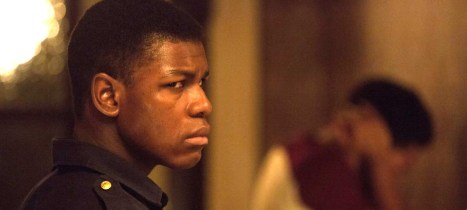
Insecurity guard.

Unsurprisingly, Detroit works best in its opening and closing acts, when the narrative pulls back to the real-life story covering the Detroit Riots in late July 1967. The film’s opening and closing beats have the feel of a weird docudrama, with Bigalow using handheld cameras and tight focus in a way that allows her to blend footage of the cast with archive material. Characters are identified by legends down the bottom of the screen, while the audience is frequently put in the position of confused spectators in a way that captures the mere anarchy loosed upon the city.

However, Detroit fumbles a little bit in its second act. For the middle of the film, Detroit narrows its focus significantly. Instead of providing socio-economic and political context for the entire riots, or dealing with the aftermath of horrific events, Detroit transforms into a story about a bunch of characters locked in a confined space together. As the film’s closing text admits, these sequences are much less verifiable than the snapshots populating the opening and closing acts, much less a matter of public record.

Big Mackie.

The second act of Detroit is a more conventional fictional narrative. While the movie is never less than interesting and clever, that organic sensibility is lost. During the first and third acts, the focus is on the broader story of the larger community, so it does not matter that many of these characters feel like archetypes and ciphers. When Detroit zooms in on the characters, they seem drawn too crudely to support the scrutiny. Detroit works a lot better as an epic social study, and less well as a claustrophobic character study.

Bigalow struggles to get the balance right, resulting in a film that is certainly ambitious and worthy, but also more uneven than her recent output. Detroit is too confident and too professional to be deemed a failure, but its second act is too shallow to be a success either.
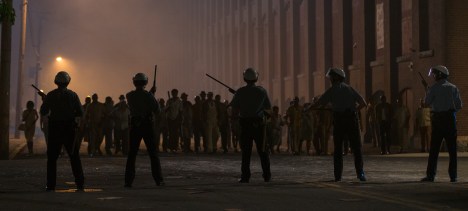
I predict a riot.

Continue reading

Dunkirk and Issue of Genre Legitimacy

The release of Dunkirk has been interesting in many ways.

Most obviously, it seems to confirm Christopher Nolan as a brand name unto himself, managing to open a blockbuster war movie with no stars to speak of to impressive box office results in the middle of July. The film has been widely acclaimed, both by critics and by movie-goers; it scores well on Rotten Tomatoes, Metacritic, IMDb and CinemaScore. There is already talk of a massive Oscar push for the film, with reports of Academy screenings being so packed that additional screenings had to be scheduled.

However, beneath all of this success, there is an interesting narrative forming. There is a recurring suggestion that Dunkirk is not just a great piece of cinema from an incredibly talented director, but that it in some way represents a maturing of Nolan’s talent. Some of the critical narrative of Dunkirk has been framed almost as a cinematic “coming of age” story for Christopher Nolan, as if the veteran forty-six-year-old film maker is finally delivering on potential that has been teased over the past seventeen years.

In a not-untypical comment, David Fear at Rolling Stone reflected, “Everyone knew he had a mastery of the medium. Dunkirk proves he knows how to use it say something.” At The Guardian, Andrew Pulliver suggested that Nolan had finally earned one of the stock comparisons that had been (misguidedly) following him for most of his career, “With Dunkirk, Nolan may at last be able to walk the Kubrick walk.” The implication seems to be that Nolan’s previous nine films were all creative dry runs, cinematic confectionery suggesting (but never delivering on) true artistic talent.

This is, of course, complete nonsense. Nolan arguably established himself as a bona fides film maker with Memento, which was an impressive theatrical debut. Memento was structurally ambitious, thematically rich, and exceptionally clever. Nolan followed that up with Insomnia, a remake of a Scandinavian thriller. He then segued into a big-budget reimagining of the Batman mythos with Batman Begins, The Dark Knight and The Dark Knight Rises, interspacing them with his own projects of interest, The Prestige, Inception and Interstellar.

Whatever an audience member might make of individual films on that resume, and some are undoubtedly better than others, it seems quite clear that Nolan has been doing good work for a long time. Dunkirk is not a break in the pattern. It is in many ways a continuation and extrapolation of his earlier work. It is not so much a quantum leap forward in terms of technique, but simply a nudge in a different direction. So, why is Dunkirk being treated as a vital moment in Nolan’s career? It seems likely because Dunkirk belongs to a much more respectable genre than its Nolan stablemates.

Continue reading

No, Christopher Nolan is not “the Next Stanley Kubrick”

Another Christopher Nolan film, another round of stock comparisons.

To his credit, Nolan sparks genuine critical debate and discussion online, even if there’s an uncomfortable whiff of sensationalism to the coverage. Is Christopher Nolan responsible for everything that is wrong with Hollywood right now? (Spoiler: No. Not at all. Not even slightly.) Is Christopher Nolan a pompous and privileged douchebag for wanting audiences to see his film in the format that he has intended? (Spoiler: While he could probably be a bit more mindful that one size doesn’t always fit all, dude has a right to have a preference about how his work is consumed.)

To be fair, these provocative and confrontational articles at least provide a nice reprieve from the listacles and fan service that define so much of the discourse about modern summer movies. How does [minor character] set up the future of [major franchise]? How many easter eggs did you identify from in [franchise blockbuster]? One of the advantages of Hollywood’s modern franchise-driven mindset is that it makes ranking [entire franchise] articles popular and recyclable. It is exhausting. At least a new Nolan film tends to mean new director-centric debates.

That said, there is one comparison that tends to get rehashed quite a bit. Almost every time that Christopher Nolan releases a feature film, film writers who really should know better stop to ask whether Christopher Nolan is the next Stanley Kubrick. Andrew Pulver addressed the comparison in The Guardian, providing a nice piece of symmetry to an article he wrote almost a decade ago. Christopher Priest, author of The Prestige, made the case only a few years ago.

It is a fairly obvious argument. Both Nolan and Kubrick are directors who worked at a remove from the press, tending to live and work outside the studio system while developing their ideas. They both seem to straddle the Atlantic, both having spent a lot of time living in England and working in America. Neither director ever seemed entirely comfortable talking to the press or doing the publicity circuit. Both produce films that are very stylishly produced, often tending to keep the audience at a slight remove from their characters that some may consider “cold.”

However obvious the comparison might be, it relies on a fundamental misunderstanding of both directors.

Continue reading

The Sound of Not-Quite Silence: The Era of Dialogue-Lite Blockbusters

There are several remarkable things about the blockbuster slate for 2017. The most obvious is that the blockbuster slate for 2017 is remarkably strong.

It is definitely the strongest slate of summer releases since at least 2012, if not 2008. Sure, there have been misfires like CHiPs or Baywatch or Transformers: The Last Knight, but there has also been a lot of great stuff. Wonder Woman, Baby Driver, War for the Planet of the Apes, Dunkirk, The Big Sick. Going back to earlier in the year, there is a fine selection of genre material. Get Out, Logan, John Wick: Chapter II. Even the second-tier blockbusters like Kong: Skull Island, Spider-Man: Homecoming, Guardians of the Galaxy, Vol. 2 are relatively solid.

However, there is also an interesting trend in how these stories are being told. In particular, the summer blockbusters of 2017 are quite interesting on a formal level. In particular, these blockbusters are very invested in non-verbal storytelling. While the superhero movies of the summer – Guardians of the Galaxy, Vol. 2, Wonder Woman, Spider-Man: Homecoming – still conform to a familiar structure of dialogue-driven exposition, a lot of the other films tend to be quite light on conventional dialogue, relying on other ways of communicating character, story and theme.

This is most obvious with War for the Planet of the Apes and Dunkirk, impressive blockbusters that feature a number of extended dialogue-light scenes. When the characters do communicate, it is often in unconventional ways; the technical dialogue plays beneath the soundtrack in Dunkirk, while the apes communicate through sign language in War for the Planet of the Apes. In some ways, Baby Driver is also part of this trend. It is a movie that features dialogue, but is largely driven by its soundtrack. It characters often seem to speak in pulp clichés, with movie’s individuality shining on Baby’s iPod.

Continue reading

Non-Review Review: Dunkirk

Dunkirk is compelling in its contradictions.

Dunkirk concerns a pyrrhic victory, a defeat which became a source of national pride. Dunkirk is at once a story rooted in a very particular event and a mythic narrative populated by archetypal characters. Dunkirk follows three parallel stories as they move towards a singular inevitable climax, although those narratives are allowed to move at their own pace towards those epic events and even overshoot one another. Dunkirk is at once chaotic and disjointed, and yet moving with a very clear sense of purpose and direction.

Directed by Christopher Nolan, it is too much to describe Dunkirk as a “puzzle box” narrative. It always very clear to the audience exactly what is going on, and the movie’s mysteries and revelations tend to be smaller and intimate rather than broad and sweeping. Nevertheless, it is a movie consciously unstuck in time, recalling Nolan’s long-standing fascination with shifting his narrative backwards and forwards along a timeline. (Insomnia, The Dark Knight and The Dark Knight Rises stand out as Nolan’s most linear films.)

Dunkirk is a war epic in the broadest possible sense, its narrative bouncing between three separate timelines covering the retreat from the eponymous port. However, there is also a faint sense that Dunkirk itself is unstuck in time. As much as the film is rooted in the reality of the 1940 evacuation of Dunkirk, it speaks to something much bigger and more sweeping. There is a vagueness to Dunkirk which suggests that the film might well speak to realities beyond its specific setting.

Continue reading

Non-Review Review: Star Trek – Insurrection

“I think I’m having a mid-life crisis,” Riker tells Troi at one point in Star Trek: Insurrection, and it might be the most telling line in the film.

Insurrection is many things, perhaps too many things. However, it primarily feels like a meditation on what it means to grow old, focusing on the cast of Star Trek: The Next Generation. That first live-action Star Trek spin-off had revived the franchise as an on-going cultural concern, even launching a feature film franchise including Star Trek: Generations and Star Trek: First Contact, and spawning its own spin-offs including Star Trek: Voyager and Star Trek: Deep Space Nine.

A fist full of Data.

However, by the time that Insurrection arrived, The Next Generation was looking quite old. The Next Generation had launched more than a decade earlier, and had been off the air for almost five years. Although it had been a pop cultural behemoth, even its children (or its younger siblings) were starting to look a little long in the tooth. Deep Space Nine was in its final season, and Voyager was closer to its end than to its beginning. There was a creeping sense of fatigue and exhaustion.

In theory, this positions Insurrection quite well. After all, the original feature film franchise really came into its own when the characters found themselves forced to confront their own mortality. Star Trek II: The Wrath of Khan breathed new life into the franchise as it forced Kirk to come to terms with his old age, while Star Trek III: The Search for Spock indulged the sense of grown-ups behaving badly in a story that forced Kirk to throw aside his ship and his career in service of an old friend.

Picard’s hairpiece was fooling nobody.

Stories about age and mortality resonate, and so Insurrection has a fairly solid foundation from which to build. There is just one sizable problem. The cast and crew of The Next Generation have no intention of growing old, of wrestling with mortality, of confronting their age. Insurrection is fundamentally a story about rejecting this maturity and this sense of age, of refusing to accept that time takes its toll and denying that old age is best faced with solemn dignity and reflection.

Insurrection is a story about mamboing against the dying of the light.

A familiar dance.

Continue reading

Non-Review Review: The Big Sick

What is most striking about The Big Sick is the sense of authenticity, and not in the most obvious way.

The Big Sick was written by the husband and wife team of Kumail Nanjiani and Emily Gordon, loosely inspired by their own romance. Nanjiani plays a fictionalised version of himself, a stand-up comedian working in Chicago dealing with the weight of his parents’ expectations. Zoe Kazan plays a slightly more fictionalised version of Gordon, swapping out the surname Gordon for Gardner. The broad strokes of the story conform to how Nanjiani and Gordon came to meet and fall in love, and some of the barriers that arose between them. So The Big Sick is authentic in a very literal way.

However, The Big Sick is most striking in its small moments. While the movie is obviously built around the narrative arc of this true-to-life relationship, it perfectly captures all the weird little moments that define people. Nanjiani is a comedian by profession and Gordon is a psychologist, and there is a sense that both are keen observers of human nature. There are a lot of little touches in the film that resonate, that add a sense of convincing realism and gravity to a story that is dealing some very weighty material. (After all, the title of the film kind of hints at the stakes.)

The Big Sick is an astoundingly beautiful piece of work.

Full disclosure: Kumail Nanjiani is a very nice person. I don’t know him personally, but he very kindly agreed to write the intro to my upcoming book Opening the X-Files: A Critical History of the Original Series. Which I believe was in the middle of the production of this film, so I greatly appreciate that.

Continue reading

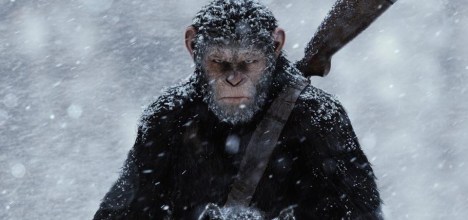
Non-Review Review: War for the Planet of the Apes

The most evocative image in War for the Planet of the Apes is the United States flag, with an alpha and an omega scrawled across it.

This thematic juxtaposition is repeated throughout the film. The antagonistic human forces at the heart of War for the Planet of the Apes use the symbols as a logo. When they recruit apes into their ranks, they brand them with the symbol. When the audience is invited into their camp around half-way through the film, an oil tanker is marked the graffiti “the end and the beginning.” In some ways, this is a reflection on War for the Planet of the Apes as the final movie in a prequel trilogy, but it is also a much stronger thematic statement.

Cool customer.

At the heart of War for the Planet of the Apes is the idea that the apocalypse is not scary because it represents the end of something, but that the collapse of civilisation is so unnerving because it represents a clear slip backwards. The apocalypse threatens mankind with the idea that people are nothing more than animals, no better than their ancestors when push comes to shove. The apocalypse suggests that everything that has been accomplished can be lost in an instant. In the end, people retreat back to what they truly were, and it is horrifying.

War for the Planet of the Apes is not so much a movie about the collapse of a civilisation as a grim argument that the very idea of civilisation is transient and illusory.

Take a bow.

Continue reading

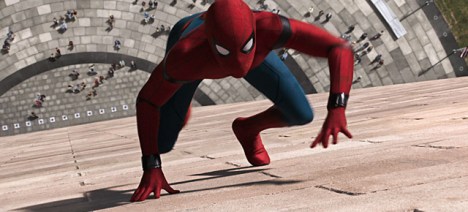
Non-Review Review: Spider-Man – Homecoming

Spider-Man: Homecoming is two movies, both effectively set up by the title.

In its most literal sense, it is a teenage coming of age movie set against the backdrop of a superhero action film. More than any other entry in recent superhero canon, Homecoming is very explicitly a “young adult” movie. It is Peter Parker channeled through John Hughes, the tropes and conventions of the genre as glimpsed through the prism of a teen movie. As such, the “homecoming” of the title is a seismic event in the school calendar.

He ain’t playin’.

In a more metaphorical sense, Homecoming is the story of integrating Peter Parker into the larger Marvel Cinematic Universe that began with Iron Man. It is a story that celebrates the joint custody agreed between Marvel Studios and Sony Pictures, the deal that allows Spider-Man to appear in Captain America: Civil War while allowing for the appearances of several major characters from The Avengers in this feature film.

One of these movies is stronger than the other. About half of Homecoming is a really great Spider-Man-as-John-Hughes teen film, while the other half is a so-so Avengers sequel.

Climbing to new heights?

Continue reading

Non-Review Review: The House

The House comes from the writing duo Brendan O’Brien and Andrew Jay Cohen, representing Cohen’s directorial debut.

O’Brien and Cohen are perhaps best known for their work on Neighbours and Neighbours II: Sorority Rising, two of the more successful “overgrown manchildren” movies of the past few years. (They also worked on the somewhat underrated Mike and Dave Need Wedding Dates.) While these sorts of movies about grown-ups behaving badly are a dime-a-dozen in the modern comedy landscape, Neighbours and Neighbours II were elevated by a number of factors: attention to their female leads, very canny casting, clever shifts in the film’s moral weight at key moments.

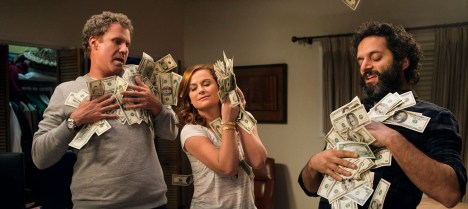
They are so money.

The House is perhaps a more modest proposal than Neighbours and Neighbours II. It is certainly a lot more straightforward in its plotting and character arcs, a simplicity reflected in the relatively abridged run-time of eighty-eight minutes. (To be fair, both Neighbours and Neighbours II kept their runtime just over the hour-and-a-half mark, which seems about right for a broad comedy.) However, it shares one key strength. It is a movie that very skilfully captures the feeling of a mid-life crisis, and the yearn to return to into a belated adolescence.

The House is a little uneven in places, prone to the structural problems that haunt a lot of contemporary blockbuster comedy from the jokey asides that jar with the narrative to the oh-so-tidy resolution, but it has a solid core. It is a movie that understands the middle-class middle-aged urge to break bad in the most banal of fashions, just a hint of sadness lurking beneath its more absurd twists. The House doesn’t always win, and maybe it hedges just a little too much, but it knows the game that it is playing.

A dicey proposition.

Continue reading