• Following Us

  • Categories

  • Check out the Archives


  • Awards & Nominations

Non-Review Review: Fight Club

Fight Club was released in 1999, and seems to perfectly capture a brief moment in the history of disemfranchised American masculinity.

Situated between the end of the Cold War and the start of the War on Terror, Fight Club is the story of disenfranchised middle-class masculinity, a cultural group gripped by sense of impotence and despair and lost amid an era of financial prosperity and material success. “We’re the middle children of history, man,” Tyler Durden informs his followers. “No purpose or place. We have no Great War… no Great Depression.” It’s a line that gets more bitterly ironic with each re-watch.

A film frequently misunderstood by a significant portion of its fans and its critics, Fight Club is perhaps the quintessential cult film of the nineties. A clever hook that encourages further viewings, a mean subversive streak and a bleak irreverence that is impossible to look away from, Fight Club manages to perfectly encapsulate a moment of shared cultural consciousness and insecurity.
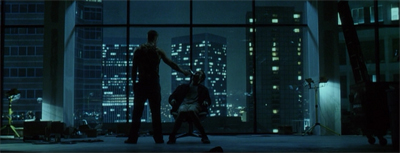
Seeking a friend at the end of the world...

Seeking a friend at the end of the world…

Note: This review contains spoilers for Fight Club. Consider yourself warned.

Continue reading

Non-Review Review: 22 Jump Street

Comedy sequels can be a tough beast.

After all, a joke isn’t as funny the second time around and – if it is – there’s always the DVD.  Comedy sequels often find themselves trapped between a rock and a hard place. They have to pay homage and due respect to what came before, but they can’t simply tread out the same old jokes. It isn’t a case of simply doing the same thing but bigger, as with most sequels. Comedy sequels are a tough nut to crack.

The genius of 22 Jump Street is the way that it accepts this and turns it into the biggest joke of the film.

Jumping back into their roles...

Jumping back into their roles…

Continue reading

Non-Review Review: The Edge of Tomorrow

As with Oblivion, the last “Tom Cruise in the future” blockbuster, The Edge of Tomorrow feels like a gigantic big-budget episode of The Outer Limits. It’s low on character and high in concept. The film moves fast enough to gloss over the assorted problems that come with a typical time travel narrative. The script is witty enough to keep the audience engaged, and Tom Cruise is solid enough leading man to hold it all together.

The Edge of Tomorrow is wonderfully enjoyable high-concept thrill ride, and one of the stronger offerings of the summer so far.

It's not the end of the world...

It’s not the end of the world…

Continue reading

Non-Review Review: Maleficent

As portrayed in the classic 1959 version of Sleeping Beauty, Maleficent is an absolutely fascinating character. Like so much in that film, she is woefully under-developed, but brilliant character design by Marc Davis and sterling voice work from Eleanor Audley helped to fashion an iconic characters. In spite (or perhaps because) of the fact that Sleeping Beauty establishes so little about her, Maleficent endures one of the most recognisable and memorable characters in the Disney animated canon.

So, if a live-action villain-centric feature film was going to tackle one of the classic villains from the studio’s rich history, it makes sense that Maleficent would be chosen. Angelina Jolie seems almost born to play the role, carrying herself with a regal grace, an icy detachment, an impeccable sense of comic timing and spot-on vocal impersonation of Eleanor Audley. The production design on Maleficent is absolutely stunning, with the movie occasionally seeming like an animated classic brought to life.

If only the same amount of enthusiasm had been invested in the script.

All fired up...

All fired up…

Continue reading

Non-Review Review: Maleficent

As portrayed in the classic 1959 version of Sleeping Beauty, Maleficent is an absolutely fascinating character. Like so much in that film, she is woefully under-developed, but brilliant character design by Marc Davis and sterling voice work from Eleanor Audley helped to fashion an iconic characters. In spite (or perhaps because) of the fact that Sleeping Beauty establishes so little about her, Maleficent endures one of the most recognisable and memorable characters in the Disney animated canon.

So, if a live-action villain-centric feature film was going to tackle one of the classic villains from the studio’s rich history, it makes sense that Maleficent would be chosen. Angelina Jolie seems almost born to play the role, carrying herself with a regal grace, an icy detachment, an impeccable sense of comic timing and spot-on vocal impersonation of Eleanor Audley. The production design on Maleficent is absolutely stunning, with the movie occasionally seeming like an animated classic brought to life.

If only the same amount of enthusiasm had been invested in the script.

All fired up...

All fired up…

Continue reading

Non-Review Review: Sleeping Beauty (1959)

Sleeping Beauty is very much a product of the fifties, with the movie’s production spanning most of the decade. The story work commenced in 1951, with vocal performances recorded the following year. The movie was eventually released in 1959, to lukewarm critical and commercial success.

However, Sleeping Beauty reflects the fifties in other ways. The story about a young woman who needs to learn to do as her guardians instruct her, how marriage is really the ideal prospect for a woman of sixteen, and about how people we label as “evil” are unquestionably beyond redemption, Sleeping Beauty really plays to a very fifties mindset.

(Appropriately enough, the high budget and lacklustre box office performance of Sleeping Beauty would be a major part of the reason that Walt Disney would post its first annual loss in 1960.)

Sleep well...

Sleep well…

Continue reading

Non-Review Review: X-Men – Days of Future Past

X-Men: Days of Future Past works best as a paean for sixties optimism. A little bloated and messy, with not enough room for all its characters or side plots, X-Men: Days of Future Past could do with a trim or three. At the same time, it’s a very thoughtful and reflective blockbuster, pondering questions about innocence and idealism. There’s a sense that X-Men: Days of Future Past works better as a sequel to X-Men: First Class than it does an epilogue and critique of X-Men III.

Blue skies are gonna clear up...

Blue skies are gonna clear up…

Continue reading

Non-Review Review: Godzilla (2014)

Gareth Edwards’ Godzilla remake exhumes the classic movie monster for one more epic city-destroying brawl. Appropriately enough, the film feels like something of a relic itself – albeit a relic from an era more recent than the prime of its featured monster. Opening with the excavation of a giant skeleton in the Philippines, and with the revelation that the titular creature was first awakened in 1954, there’s a sense of coy self-awareness to Gareth Edwards’ monster movie tribute.

This wry self-awareness only extends the film so much leeway. At the heart, Godzilla feels like a nineties blockbuster created with modern technology. If the film had a sense of humour, it would look a lot more like Godzilla-by-the-way-of-Roland Emmerich than the 1998 attempt to reintroduce the character to American audiences.

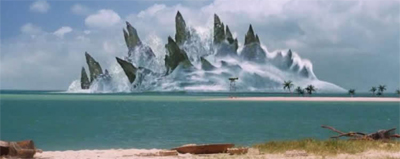
Who says Godzilla is washed up?

Who says Godzilla is washed up?

Continue reading

Non-Review Review: Bad Neighbours

Bad Neighbours is a serviceable – if unexceptional – comedy. The story of two young parents engaged in a turf war with the college fraternity next door, Bad Neighbours feels somewhat slight, even for its abbreviated ninety-seven minute runtime. The laughs are there, and the movie never outstays its welcome, but there’s a sense that the film spends a considerable amount of its runtime in neutral – ramping up for some wonderful sequences, but never building enough momentum to truly take off.

So you think you can dance...

So you think you can dance…

Continue reading

Non-Review Review: The Wind Rises

Best known in Europe and America for beautiful animated fantasies like Ponyo, Howl’s Moving Castle or Spirited Away, Hayao Miyazaki has opted for something a little bit different with his final – heavily publicised as “farewell” – film. The Wind Rises has touches of fantasy and looks absolutely beautiful, it represents a different sort of animated film. More of a historical drama and romance than an escapist fantasy, The Wind Rises is a thoughtful exploration of Japan in the lead-up to the Second World War.

Focusing on Mitsubishi aircraft designer Jiro Horikoshi, the film is a lavish animated period drama about the construction of the infamous Japanese “Zero Fighter” – the A6M Zero. The fighter of choice during the Second World War, The Wind Rises notes that the pilots flying those planes never came back as the film reflects on the social context of Japan’s march towards war, and the characters caught in the middle like an umbrella trapped in a strong wind.

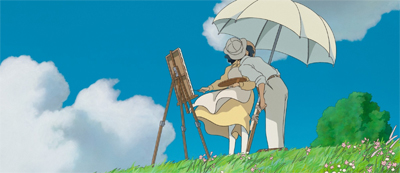
thewindrises3

Continue reading