• Following Us

  • Categories

  • Check out the Archives


  • Awards & Nominations

Star Trek – Metamorphosis (Review)

The first Star Trek pilot, The Cage, was produced in 1964. To celebrate its fiftieth anniversary, this December we are reviewing the second season of the original Star Trek show. You can check out our first season reviews here. Check back daily for the latest review.

Gene L. Coon’s last solo script for Star Trek, Metamorphosis is an intriguing episode that seems trapped between two extremes.

A love story operating within the unique confines of the Star Trek universe, it is nominally a story about how love can take just about any form. Here, it’s a story between a lonely old man and sentient cloud of sparkles. However, at the same time, Metamorphosis is aggressively and actively heteronormative – suggesting that while it may be acceptable for a man to fall in love with a non-corporeal entity, that alien has to be female.

All your Cochranes are belong to us...

That “in love” glow…

Continue reading

Space: Above and Beyond – R & R (Review)

This November (and a little of December), we’re taking a trip back in time to review the third season of The X-Files and the first (and only) season of Space: Above and Beyond.

R & R is what might be described as a “monkey’s paw” situation.

Space: Above and Beyond finally gets to air on Friday nights. It had been promised a Friday night slot in early development, before Fox moved it to Sunday to make room for Strange Luck. Glen Morgan and James Wong had been promised the coveted Friday night slot again in January 1996, but it never materialised. Finally, late in the season, Fox manage to air an episode of Space: Above and Beyond on a Friday night. That episode would even air directly before The X-Files. And not just any episode of The X-Files. Jose Chung’s “From Outer Space”, a classic.

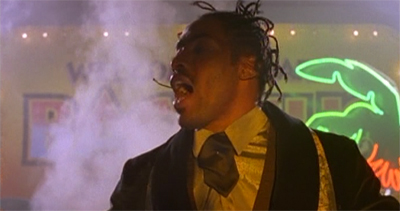
Everything is Coolio!

Everything is Coolio!

However, as the Host himself points out in R & R, everything has its price. Here, it seemed like Fox had chosen the most stereotypically network-friendly episode of Space: Above and Beyond to air in that Friday night slot. So there were hot young people at night clubs, celebrity cameos, romance, angst, melodrama, absurdity. It is one of the most grotesquely heightened episodes of Space: Above and Beyond ever produced, to the point that Hawkes picks up and drops a drug addiction as only one of the episode’s three primary plot threads.

R & R is not a good episode of television. It is the weakest that Space: Above and Beyond has been in quite some time, and the weakest it would be from this point onwards. It seems like a cruel irony that it finally managed to get that Friday night slot it so desperately wanted.

Chalk it up as a misfire...

Chalk it up as a misfire…

Continue reading

Star Trek (Marvel Comics, 1980) #4-5 – The Haunting of Thallus!/The Haunting of the Enterprise! (Review)

The first Star Trek pilot, The Cage, was produced in 1964. To celebrate its fiftieth anniversary, this December we are reviewing the second season of the original Star Trek show. You can check out our first season reviews here. Check back daily for the latest review.

Marvel certainly had an unconventional approach to publishing Star Trek.

The company had licensed the comic book rights following the release of Star Trek: The Motion Picture. They had released a successful adaptation of the film as part of their Marvel Super Special line and had re-package the three-part adaptation as the first three issues of an on-going Star Trek comic book. Written by Marv Wolfman and illustrated by Dave Cockrum, it was clear that Marvel had big plans for Star Trek. However, it also quickly became clear that they had no idea where they wanted to go with the comic.

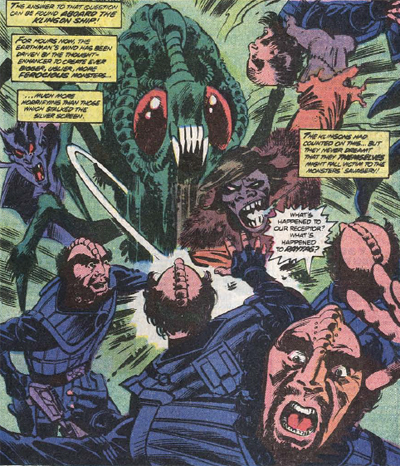
Here there be monsters...

Here there be monsters…

After all, they immediately followed up the big three-issue opening arc with a comic where the Enterprise discovered a haunted house floating in space. While it was certainly a catchy image, it wasn’t exactly a quintessential Star Trek premise. It seemed that Marvel had no idea what to do with the comic. Writer Marv Wolfman wrote the first of the two issues comprising the storyline, handing the second issue over to Mike W. Barr. He would only stick around for two issues before handing the comic over to Tom DeFalco. DeFalco wrote a single issue before moving on.

It is a rather disjointed comic book, one which lacks the strong narrative voices that DC would give to their late-eighties licensed Star Trek comics. Then again, it is probably easy enough to deduce all of this from the fact that the first original Star Trek storyline published by Marvel featured a haunted house floating in space.

In space, everyone can hear you scream...

In space, everyone can hear you scream…

Continue reading

The X-Files – Hell Money (Review)

This November (and a little of December), we’re taking a trip back in time to review the third season of The X-Files and the first (and only) season of Space: Above and Beyond.

Hell Money is an oft-overlooked episode of The X-Files.

The positioning in the third season probably doesn’t help. It comes directly after Teso Dos Bichos, probably the season’s weakest episode. It is also positioned in the gap between Pusher and Jose Chung’s “From Outer Space”, two broadly-loved episodes that serve as pitch-perfect examples of The X-Files both on- and off-format. In contrast, Hell Money is something a little stranger. It is not as conventional as Pusher, nor as radical as Jose Chung’s “From Outer Space.”

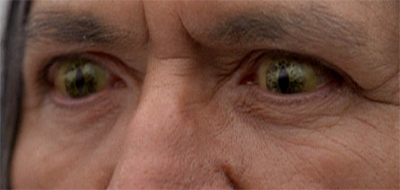
Seeing is believing...

Seeing is believing…

Instead, Hell Money is an episode of The X-Files that loosely fits the show’s format. Mulder and Scully investigate a bunch of macabre murders where sinister forces are at work. However, in keeping with the broad themes of the third season, the evil in Hell Money takes a particularly banal form. There are no monsters here; at least, not any supernatural monsters. The only ghosts that haunt the narrative are metaphorical. There is a culture alien to our leads, but one a bit more grounded than extraterrestrials.

Hell Money is a clever and thoughtful piece of television that feels subtly and harrowingly subversive.

The writing is on the wall...

The writing is on the wall…

Continue reading

Star Trek – Catspaw (Review)

The first Star Trek pilot, The Cage, was produced in 1964. To celebrate its fiftieth anniversary, this December we are reviewing the second season of the original Star Trek show. You can check out our first season reviews here. Check back daily for the latest review.

Catspaw was the first episode to enter production for that second season of Star Trek. However, it was not the first to air. Amok Time served as the season opener. Instead, Catspaw was produced as something of a rarity – a Star Trek holiday special. Produced in May, it was eventually broadcast during the last week of October. Given the subject matter and trappings of the episode, that seems highly appropriate.

We are, after all, looking at what amounts to a Star Trek Halloween Special.

Bones joins the cast...

Bones joins the cast…

Continue reading

Space: Above and Beyond – Pearly (Review)

This November (and a little of December), we’re taking a trip back in time to review the third season of The X-Files and the first (and only) season of Space: Above and Beyond.

Richard Whitley is one of the more promising writers on Space: Above and Beyond.

While Pearly does not benefit (and indeed actively suffers) from the same loose structure that made Dear Earth work so well, it is an episode very much in touch with what the show wants to be about. It is very much a science-fiction version of a classic Second World War story, to the point where Whitley himself has described it as an adaptation of the classic Humphrey Bogart movie Sahara. It is a nice glimpse at several facets of the conflict that we have not seen yet, but which make sense in context.

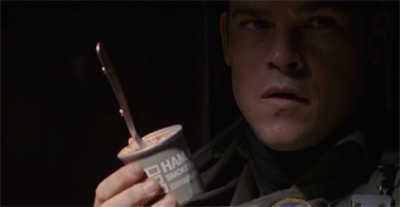
Canned ham...

Canned ham…

That said, there are serious problems with Pearly. It is very clear that the production managed to get ahold of a tank for filming, and sought to capitalise on that. The episode’s structure feels rather forced and unstructured in places, full of contrived coincidences that seem a little strange when considered as a whole. Not all of the character interactions feel genuine, and not all the episode’s big moments feel entirely earned. These are legitimate problems, and they do hold Pearl back.

At the same time, Pearly is an episode simmering with potential and ambition. It is hard to hate.

Crossed wires...

Crossed wires…

Continue reading

Star Trek (Gold Key) #1 – The Planet of No Return! (Review)

The first Star Trek pilot, The Cage, was produced in 1964. To celebrate its fiftieth anniversary, this December we are reviewing the second season of the original Star Trek show. You can check out our first season reviews here. Check back daily for the latest review.

The Star Trek comics published by Gold Key are somewhat infamous additions to the Star Trek canon. The company began publishing comic book tie-ins in July 1967, in the gap between the first and second seasons of the original Star Trek show. They continued to publish those tie-ins until 1978, when the license passed to Marvel. These early comics have become the source of much derision over the years, with fans dismissing them as hollow cash-ins produced by people with little understanding of the franchise itself.

However, recent years have seen something of a reappraisal of these early comic books. Once IDW Publishing secured the rights to produce tie-in Star Trek comic books, they devoted considerable effort to archiving and releasing classic and little-seen material from the franchise’s history. They released the Star Trek newspaper strips in a two-volume set, before turning their attention to the classic Gold Key comic books. It is a very worthwhile attempt to provide fans with a glimpse of oft-overlooked chapters in the franchise’s history.
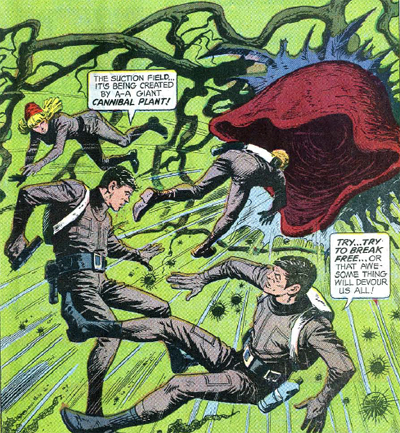
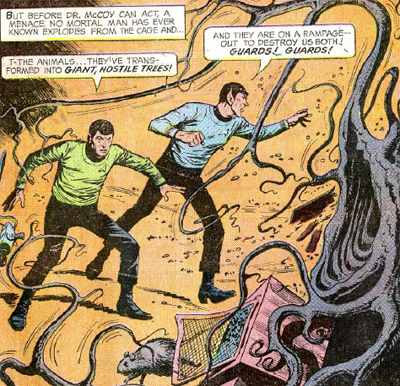
Plant life...

Plant life…

The Gold Key Star Trek comics are messy. A lot of the criticisms hold true. There are all manner of continuity errors in the production of the comic. Artist Alberto Giolitti takes quite some time to figure out what Scotty looks like, and the colourists take a bit of time to figure out what uniforms various cast members should be wearing. The writing is similarly clunky, with characters sounding a little out of sort as the basic plot details seem to stand at odds with still-relatively-small Star Trek canon had been established by the closing credit of Operation — Annihilate!

And yet, despite all these considerable flaws, these comics do make for an interesting time capsule. They don’t feel quite like Star Trek so much as an impression of what Star Trek would look described to somebody who has never seen it, filtered through the lense of fifties and sixties science-fiction comics. The early issues feel like three blind men describing an elephant, and it is glorious.
Branching out...

Branching out…

Continue reading

The X-Files – Teso Dos Bichos (Review)

This November (and a little of December), we’re taking a trip back in time to review the third season of The X-Files and the first (and only) season of Space: Above and Beyond.

It happens.

Every once in a while, there is a misfire. This is especially true when producing a genre television series churning out over twenty episodes a year. Inevitably, some of those episodes will fail; a few will fail spectacularly. Such is the way of things. It is hard to think of a twenty-odd episode season of anything that managed to maintain consistent levels of brilliance for a full season. All you can really hope is that the eventual and inevitable misfire is mostly technical.

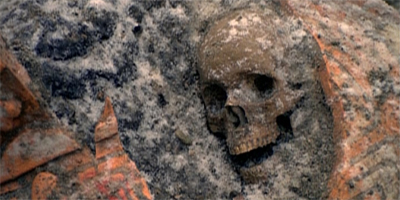
No bones about it...

No bones about it…

Teso Dos Bichos is a terrible episode of The X-Files. It is a terrible episode of television in general. However, it is terrible in ways that are mostly banal. This isn’t a failure of overreaching ambition, like Fearful Symmetry. It isn’t a missed opportunity, like 3. It isn’t even a racist and sexist nightmare, like Excelsis Dei. Instead, Teso Dos Bichos is just bad television. It is an episode that probably didn’t work on paper, containing elements that were unlikely to work on film either.

Given how strong the third season has been, there’s a desire to brush past Teso Dos Bichos, and pretend it simply did not happen.

Cat people!

Cat people!

Continue reading

Non-Review Review: The Penguins of Madagascar

The Penguins of Madagascar is solid family entertainment. It does not rank among the best of Dreamworks’ animated output, nor among the year’s best animated films. However it is a fun adventure movie that moves along at just the right pace – allowing a number of action set-pieces and a solid cast carry most of the weight. The Penguins of Madagascar is fun and solid; it is arguably more fun and more solid than any of the three Madagascar movies that spawned this spin-off.

The Penguins of Madagascar is just what the doctor ordered with the holiday season approaching. It is a film that makes for a solid family diversion, a movie that will appeal to kids without pandering too heavily, and will acknowledge the adults in the audience without losing focus. It is an enjoyable romp, one that delivers almost perfectly on what it sets out to do. It isn’t transcendental or brilliant in the way that The Lego Movie was, but it is more than merely functional.

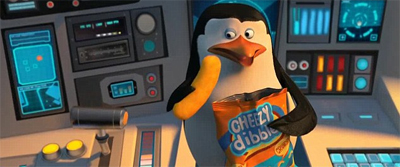
Cheesy? Sure.

Cheesy? Sure.

Continue reading

Non-Review Review: Wild

Wild is adapted from Wild: From Lost to Found, Cheryl Strayed’s autobiographical account of her spiritual 1,100 mile trek across the California Pacific Trail. The bulk of the movie features Reese Witherspoon carrying a gigantic backpack stuffed with the essentials – described accurately, and perhaps affectionately, by some observers as a “monster.” This image adorns the posters and publicity materials, and feels strangely appropriate. Cheryl may have carried a gigantic back upon her back, but Reese Witherspoon carries the entire movie.

To be fair, Wild is not a bad film on its own merits. It is perfectly functional, if a little familiar in places. However, it is Reese Witherspoon’s performance that sets the film apart. It is a powerful and naked lead performance which counts among the best work in the actress’ career. The plot and character beats may feel like they have been inherited from countless other “find yourself in nature” films, it is Witherspoon who imbues Cheryl (and, by extension, the film) with a warm humanity.

Into the wild...

Into the wild…

Witherspoon a momentous performance, and Wild seems keenly aware of this. The film knows it has a gifted performer at its core giving one of the most memorable performances of the year. So Nick Hornby’s screenplay and Jean-Marc Vallée are clever enough to stand back; the bulk of the film seems built around Witherspoon, a showcase for the performer. That is a lot of weight; even more than the hefty backpack that Strayed carried with her across California. Witherspoon is more than up to the task.

Wild is a movie that lives or dies on the strength of its lead performance. Luckily, Witherspoon is tremendous.

A long walk home...

A long walk home…

Continue reading