• Following Us

  • Categories

  • Check out the Archives


  • Awards & Nominations

Star Trek: Voyager – Macrocosm (Review)

If Star Trek: Voyager is going to commit itself to emulating Star Trek: The Next Generation, there are probably worse ways to do it.

Macrocosm is not a bad riff on Genesis, another sci-fi monster story from Brannon Braga. Braga has an interest in the overlap between horror and retro science-fiction, as demonstrated by scripts from Schisms to Sub Rosa to Threshold. While none of these episodes count among Braga’s best work, and many are considered among his worst, they very clearly represent a subject of interest to him. Given the third season misfires with Warlord and The Q and the Grey, a light run-around action story is not the worst episode that Voyager could produce at this point.

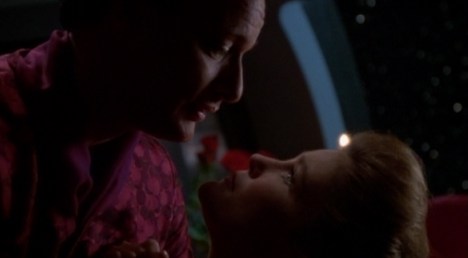
Going viral.

Going viral.

Macrocosm has more than its fair share of problems. It is structured oddly, it is laboured with exposition, it is not technically as tight as it needs to be. However, there is a lot to be said for an episode that casts Kathryn Janeway as John Rambo, stalking killer monsters through the dimly-lit corridors of her own starship. It is at the very least a refreshing change of pace. Besides, if Jean-Luc Picard gets to be an action hero in scripts like Starship Mine or Star Trek: First Contact, it seems only fair that Janeway should get her chance.

The biggest problem with Macrocosm is the episode that it might have been. The original pitch for the episode was much more ambitious than the version that made it to screen. Unfortunately, this is very much the narrative of the third season of Voyager, and perhaps the show as a whole. Macrocosm was a bold idea that was gradually watered down to form a passable imitation of The Next Generation.

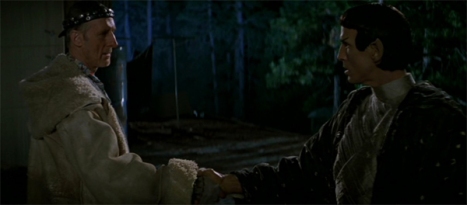
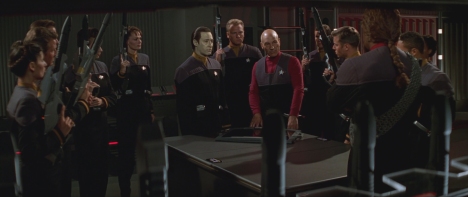
"It's going to get very First Contact in here, very quickly."

“It’s going to get very First Contact in here, very quickly.”

Continue reading

Non-Review Review: Arrival

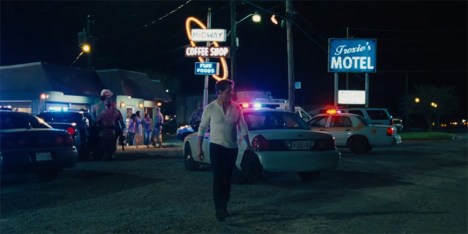
Arrival has a number of great central ideas, and a fantastic central performance.

Those ideas get the film relatively far. Arrival is a film strong enough to stand on the basis of its high concepts and its leading performance. Arrival plays with a whole host of big and bold science-fiction ideas that hint at powerful philosophical questions about humankind’s place in the universe and their perception of their very existence. These ideas are clever and thought-provoking, capable of sparking many late-night conversations over pizza or refreshments in the way that great movies tend to do. Amy is simply wonderful as the movie’s primary character.

Going in circles.

Going in circles.

Unfortunately, Arrival hits something of a wall once it fully maps out its big ideas and its bold premises. The film has these sometimes clever notions, but never expends the necessary energy to tie them into a coherent plot or a logical character arc. Arrival seems to think that these ideas are smart enough that there is no thought required in how best to use them. The result is a muddled film, one that seems as likely to conjure frustrated questioning of its underlying logic as much as of its big ideas

Ironically, Arrival charts an interesting course but never quite gets there.

Falling to Earth.

Falling to Earth.

Continue reading

Non-Review Review: The Light Between Oceans

There are times when The Light Between Oceans almost makes sense.

At certain moments in the film’s two-hour-plus runtime, the clouds part and the sky clears. In these fleeting seconds, it becomes clear what The Light Between Oceans is trying to do and what it wants to be about. A beacon seems to shine through the film, reaching out to the audience and guiding them towards the heart of the film. There are moments when things seem to align and The Light Between Oceans almost gels into the melodramatic morality play to which it aspires, much like the withdrawing might reveal some hidden treasure.

All at sea.

All at sea.

Inevitably, the tide comes rushing back in. The Light Between Oceans becomes cluttered and clumsy. The film aspires to be a profound commentary on grand themes like loss and responsibility, a story about love and forgiveness. However, the narrative is clunky. The film strives for a moral weight that it never quite manages to attain, contorting its narrative and characters in strange directions that serve vague notions while undercutting a sense of coherence.

The Light Between Oceans might consider itself to be the stoic and restrained lighthouse keeper at its core, a character who tries his best to be the moral centre as the sea tosses and the heaven rages around him. Unfortunately, it feels more like the rowing boat discovered towards the end of the first act, one lost and adrift, driven not by purpose but contrivance.

Somewhere... beyond the sea...

Somewhere… beyond the sea…

Continue reading

Star Trek: Voyager – The Q and the Grey (Review)

The Q and the Grey is an extraordinary cynical piece of work.

What better way to mark the release of Star Trek: First Contact into cinemas than to ensure that the very next episode of Star Trek: Voyager to broadcast features a guest appearance from one of the most beloved recurring characters to have appeared on Star Trek: The Next Generation? After all, the series had just led into the release of the movie with Future’s End, Part I and Future’s End, Part II providing a mid-nineties reimagining of the beloved Star Trek IV: The Voyage Home.

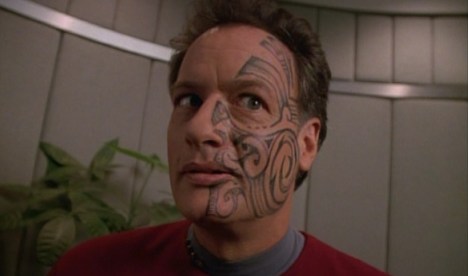
Pitching Q.

Pitching Q.

More than that, with Michael Piller gone from the writers’ room, the production staff had laid out a vision for the future of Voyager. The series effectively jettisoned any number of ideas that Piller had fostered over the first two seasons, from tension between Starfleet and the Maquis to the Kazon to Lon Suder to the idea of long-form storytelling to the relationship between Neelix and Kes. Instead, Voyager had decided to pitch itself as the most generic Star Trek ever, with little reference to the central premise of the series from here on out.

Indeed, The Q and the Grey is the second story in a very short space of time to make light of the crew’s journey home by refusing to press a more powerful guest star for assistance. In Future’s End, Part I and Future’s End, Part II, the ship’s temporally displaced return to Earth was shrugged with only a few lines of dialogue used to explain why this trip halfway across the galaxy could not be exploited to shorten their journey home. In The Q and the Grey, Janeway declines Q’s offer of assistance to get the crew home.

Bold-faced liar.

Bold-faced liar.

“My crew and I will get home,” Janeway informs Q. “We’re committed to that. But we’re going to do it through hard work and determination. We are not looking for a quick fix.” It is effectively the “building character” excuse for why Janeway doesn’t simply ask Q to return the ship home at the end of the story when the dust settles; nobody actually knows why that is, but it is probably best to offer some moral argument. The fact the Q could easily return the ship home, saving the lives of those who will die in the years ahead, is glossed over.

However, that does not matter, because Voyager has largely rejected its central premise. This no longer a series about a crew desperately longing to get home, except when it provides a convenient motivation. This is a Star Trek spin-off that is content to offer reheated leftovers inherited from The Next Generation. In this case, The Q and the Grey feels like a retread of Q Pid, a particularly uninspiring Next Generation episode. Next, Macrocosm will offer its own take on Genesis, another less than iconic Next Generation story.

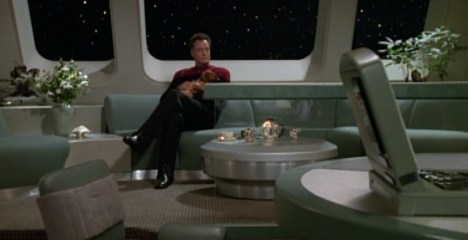
And your little dog, too.

And your little dog, too.

All of this is building, to Voyager‘s most blatant and obvious inheritance from The Next Generation. The Borg are coming to Voyager, in greater numbers and higher concentration than they ever appeared on The Next Generation, as the show continues awkwardly trying on its older sibling’s clothes. It is disappointing and uninspiring by equal measure, watching Voyager abandon any pretence of its own identity in favour of something safer and more familiar. Then again, this was always a Star Trek show about longing for the comforts of home.

However, The Q and the Grey is not merely unoriginal and uninspired, it is also unfortunate. Kenneth Biller’s script is cringe-inducing and embarrassing, illogical and misogynistic. The biggest issue with The Q and the Grey is not that Voyager has settled for offering a pale imitation of The Next Generation. The problem is that that the imitation is downright terrible in its own right.

It fingers.

It fingers.

Continue reading

Non-Review Review: Jack Reacher – Never Go Back

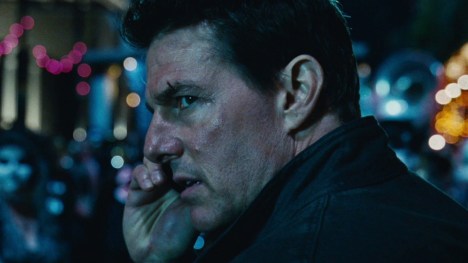
It is a strange experience, to watch one’s action hero icons grow up.

Tom Cruise is approaching fifty five years of age, although Jack Reacher: Never Go Back convincing places his character in his “mid-forties.” Watching the film, this feels entirely reasonable. Cruise is still a lean, mean, action-film-making machine with a dynamism that would put many younger stars to shame. If Tom Cruise isn’t in peak physical condition, he cannot be far off. Watching Never Go Back, it is not Cruise himself that gives the game away. The leading man is as limber as ever, energised at just the thought of another impressive stunt sequence.

You know where to Reacher me, if you have to.

You know where to Reacher me, if you have to.

It is the memory of Tom Cruise that gives the game away. Studies suggest that the peak age for cinema attendance is still somewhere between eighteen and forty. Tom Cruise would have been headlining films long before many modern movie-goers started attending the cinema with any real frequency. From Risky Business to Legend to Top Gun, Cruise has been a cinematic fixture for over three decades. That is a remarkable accomplishment, serving as something of a cultural constant.

For most of its runtime, Never Go Back feels very much like a middling demonstration of Cruise’s action movie bona fides. Like Jack Reacher, this is a standard actioner without the confident direction that has elevated Tom Cruise’s best work of the past few years. However, Never Go Back comes alive in those fleeting moments where it brushes against the idea of its leading man facing adulthood, positioning itself as a weird movie about a nineties action movie hero who inexplicably finds himself saddled with a makeshift family.

Literal life line.

Literal life line.

Continue reading

Non-Review Review: Queen of Katwe

Early in Queen of Katwe, chess teacher Robert Katende notes that his young prodigy Phiona Mutesi can see eight moves ahead.

It is a remarkable visual, as Phiona halts their game in order to play out the next eight moves of their match culminating in the inevitable checkmate. There is an elegance to the movements, the choreography of the pieces moving across the board, and Mutesi intuitively understands not only where her pieces should go, but where her opponent’s pieces will go. This ability to predict the flow of a particular game, the narrative that it will chart, is the key to Phiona’s future and her best chance of getting out of the Katwe slums.

queenofkatwe1

In some ways, this sequence feels like something of a commentary on the film itself. The true story of Phiona Mutesi is truly remarkable, serving as an archetypal underdog story about a young girl from the Ugandan slums who went on to become one of the best chess players in the world. Queen of Katwe unfolds rather like that chess game, a series of moves and counter-moves that any savvy audience member will recognise beat-for-beat as the narrative of this sort of tale. Queen of Katwe holds very few surprises in terms of story.

And yet, in spite of that, there is something truly remarkable in watching that story play out, just as there is something striking in watching those pieces of wood move across the board. Queen of Katwe is a beautiful and joyous piece of film, a very old story that is very well-told, anchored in three fantastic central performances and some great direction from Mira Nair.

queenofkatwe

Continue reading

Star Trek: Deep Space Nine – The Ascent (Review)

Discussions of Star Trek: Deep Space Nine tend to focus on the big sweeping events and the epic scope.

It is easy to see why this is the case. Over the course of the show, alliances break and empires fall. Characters are elevated from the lowest rungs of the social ladder to command over entire planets. Whereas Star Trek: The Next Generation worked hard to flesh out alien cultures like the Romulans and the Klingons, it never committed to the kinds of sweeping long-form narratives that unfolded across the run of its younger sibling. The fall (and rise and fall again) of Cardassia, the broken and mended peace with the Klingons, the Dominion War.

"And to round out the thirtieth anniversary, we're going to climb the Paramount logo."

“And to round out the thirtieth anniversary, we’re going to climb the Paramount logo.”

Deep Space Nine deserves (and receives) a great deal of credit for telling these stories. Indeed, the franchise would not make another attempt at storytelling on this scale until the final two seasons of Star Trek: Enterprise. However, focusing on the bigger picture tends to gloss over the other strengths of Deep Space Nine. As much as the show crafts epic long-running stories of betrayal and redemption that span seasons of broadcast television, it interspaces these epic beats with lots of smaller character moments.

The Ascent is a wonderful example of this. The fifth season of Deep Space Nine is one of the most sweeping and epic seasons in the history of the franchise, but it still finds time for the smaller beats. The Ascent is essentially a set of low key character studies, playing to the strengths of both the cast and the characters.

An uphill struggle.

An uphill struggle.

Continue reading

Non-Review Review: Star Trek – First Contact

Star Trek: First Contact caps off the thirtieth anniversary celebrations with one eye to the past and one eye to the future.

The second film to feature the cast of Star Trek: The Next Generation is surprisingly nostalgic in places. The script makes several rather blatant nods towards Star Trek II: The Wrath of the Khan, perhaps the consensus pick for the best Star Trek feature film. It marks the return of a memorable antagonist from the parent series, serving as a direct sequel to a particular episode and pitting the lead character in a battle of wills against an old opponent. More than that, it builds upon a rich tradition of the franchise riffing upon Moby Dick.

"This scene is going to seem really ironic when they launch Star Trek: Enterprise."

“This scene is going to seem really ironic when they launch Star Trek: Enterprise.”

However, there are other major influences. Most notably, the film leans quite heavily upon Star Trek IV: The Voyage Home. In both films, the Enterprise crew film themselves sent back in time to save Earth from an alien threat, resulting in comedic misadventures as the characters interact with a supporting cast native to this time period. Most analysis of First Contact tends to focus on The Wrath of Khan parallels, as they dominate the primarily plot. Nevertheless, the secondary plot draws heavily from The Voyage Home.

More than that, the feature film draws heavily upon the existing Star Trek mythos. The movie is a direct sequel to The Best of Both Worlds, Part I and The Best of Both Worlds, Part II, recognising that two-parter as the moment that The Next Generation truly came into its own and stepped out from under the shadow of the original Star Trek series. Even beyond that acknowledgement of franchise history, First Contact does not take the crew back in time to the present day or a historical event. It takes the crew back to the point at which the future of Star Trek truly begins.

"Mister Worf, I'll be damned if I'm going to let Star Trek: Deep Space Nine out-badass me."

“Mister Worf, I’ll be damned if I’m going to let Star Trek: Deep Space Nine out-badass me.”

Still, while the movie is constructed as a definite celebration of the past, it also serves to define the future of the franchise. The template for the remaining Rick Berman years can be found in this feature film. The success of the action and adventure beats in this instalment undoubtedly informed the emphasis on such elements in Star Trek: Insurrection and Star Trek: Nemesis. The final two films in this particular iteration of the franchise owe a lot more to this particular film than to Star Trek: Generations.

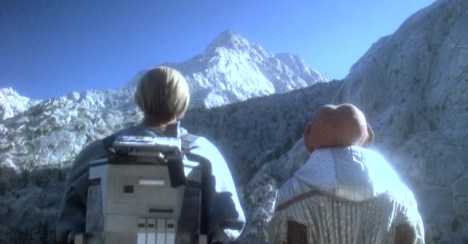
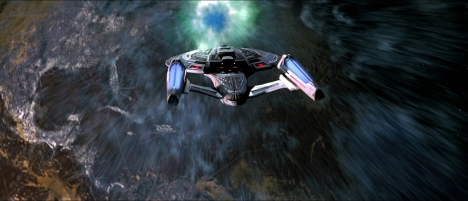
Even more, the impact of the film reached well beyond this set of characters. The other three television series were all heavily shaped and defined by this particular feature film. Star Trek: Deep Space Nine inherited a lot of the look and feel of this film, with the crew swapping out into these grey uniforms with Rapture. The Dominion War would use a lot of the ships designed for the combat sequence towards the opening of the scene. Some of the other production design also bled in, including the space suits in Empok Nor.
No time like the past.

No time like the past.

Star Trek: Voyager would inherit some of that production design as well, including the space suits in episodes like Day of Honour or Demon. However, the film’s biggest impact on that particular series was the renovation of the Borg. Brannon Braga would seize upon the idea of the Borg as a recurring threat, setting them up in episodes like Blood Fever and Unity mere months after the release of the film. The Borg would serve as the basis of the big third and fourth season two-parter, Scorpion, Part I and Scorpion, Part II. Alice Krige would appear in Endgame.

In its own way, this film also signals the end of the Berman era. The arrival of the Vulcan ship in the closing minutes serves to set up the premise of Star Trek: Enterprise. James Cromwell would make the torch-passing cameo in Broken Bow, reprising his role as Zefram Cochrane. The idea of doing a prequel television series that charted the origin of the franchise feels very much rooted in the (critical and commercial) success of this iteration of the film franchise.
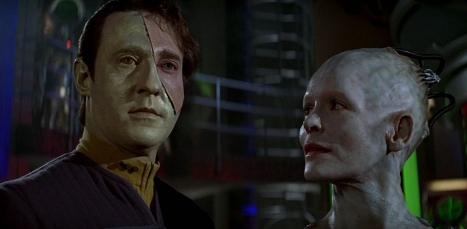
"Captain, when the Borg promised you a pound of flesh, it turns out that they meant it literally."

“Captain, when the Borg promised you a pound of flesh, it turns out that they meant it literally.”

On the audio commentary, writers Brannon Braga and Ronald D. Moore speak of the thirtieth anniversary as “the peak” of the franchise. After all, it seemed like the celebrations would last forever. First Contact was just one small part of a whole season of television that marked the best that the franchise had to offer. There was a wide selection of material, including episodes like Trials and Tribble-ationsFlashbackFuture’s End, Part I and Future’s End, Part II. Following all of those, First Contact was really just the cherry on top of a very delicious cake.

However, the issue with First Contact as “the peak” is quite simple. From this vantage point, the audience can survey the entire Berman era. First Contact is positioned so that the audience can see the metaphorical beginnings of the Star Trek franchise, but also the makings of the end of this particular iteration. From the peak, there is only one direction.

"Just checked Rotten Tomatoes there. Still the best in the series. Don't make me put on Nemesis, Mister Worf."

“Just checked Rotten Tomatoes there. Still the best in the series. Don’t make me put on Nemesis, Mister Worf.”

Continue reading

Star Trek: Voyager – Warlord (Review)

Warlord is another example of Star Trek: Voyager pitching itself as the most generic iteration of Star Trek.

At its core, Warlord is an example of the old Star Trek staple, the body-swapping personality-swap episode. There are dozens of examples from across the length and breadth of the franchise, asking regular performers to play different characters. The loosest definition would include William Shatner’s work in The Enemy Within or Roxann Dawson’s work in Faces. A more narrow sampling would include episodes like The Turnabout Intruder or The Schizoid Man. There were plenty of these episodes before Warlord, and there will be plenty after.

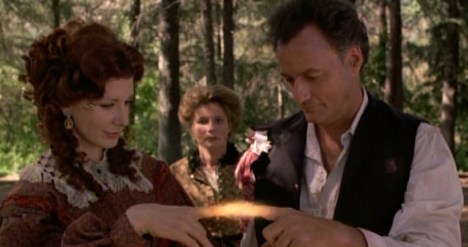
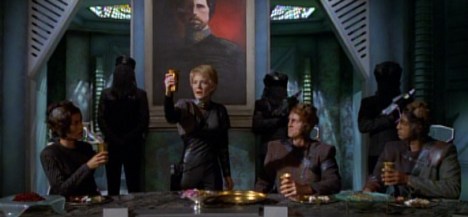
"A toast, to that most reliable of plot devices..."

“A toast, to that most reliable of plot devices…”

It is not a bad device, in theory. After all, playing the same character for twenty-odd episodes a year can be exhausting for a performer. Many actors relish the opportunity to shake things up, to put a new spin on an old role. (Chris Pine has only played Kirk three times, but already relishes the opportunity to see the character “go dark.”) It can be refreshing for the audience as well, giving them the opportunity to see exciting new sides of familiar characters. Warlord certainly has an intriguing enough hook in that regard: casting Jennifer Lien as a psychotic dictator.

The extent to which a given possession episode work is largely a matter of execution rather than concept. By that measure, Warlord comes up very short.

Make love, not Warlord.

Make love, not Warlord.

Continue reading

Luke Cage – You Know My Steez (Review)

You Know My Steez draws down the curtain on the first season of Luke Cage.

In many ways, the season finale encapsulates the best and worst of the season before it. The episode is strongest when it focuses on the characters and their performers, allowing space for actors like Alfre Woodard and Simone Missick to breath. It underscores the core themes of the season, from the importance of having a black superhero show through to the cultural significance of Harlem. Indeed, You Know My Steez does an excellent job bringing the show around a full circle from Moment of Truth and Code of the Streets.

lukecage-youknowmysteez2a

At the same time, there is an awkwardness and a clumsiness to the storytelling, from the decision to open with an underwhelming fifteen-minute brawl in the centre of Harlem to the choice to spend the rest of the episode setting up threads to be divided between an inevitable second season and the launch of The Defenders. Pacing and structure have never been a strength for Luke Cage, and that is particularly obvious with You Know My Steez. It is an episode that seems stitched together from a selection of dangling threads leading into and flowing out of the season.

Still, You Know My Steez has a winning charm to it, one that almost excuses the strange pacing and the contrived plotting. If anything, the decision to wrap up the inevitable climactic throw down a full half-hour before the end of the episode ensures that Luke Cage never loses sight of its characters and its world.

lukecage-youknowmysteez12a

Continue reading