• Following Us

  • Categories

  • Check out the Archives


  • Awards & Nominations

Non-Review Review: Maudie

This film was seen as part of the Audi Dublin International Film Festival 2017.

“Show me the way you see the world,” urges one buyer of Maud Lewis approximately half-way through Maudie, capturing the ageless appeal of just about any artistic vision. There is something exciting and unique about the opportunity to examine the world from a unique vantage point, to perceive time and space from the perspective of somebody else.

That is particularly true of Maud Lewis, the Canadian folk artist who captured the international imagination through the forties and into the fifties. Lewis had a very unique perspective on the world, capturing her surroundings and even people in crude two-dimensional terms with a surprising amount of depth. The little incongruous details of these seemingly simplistic paintings turned Lewis into a cultural icon, whose influence and legacy perseveres to this day.

maudie

Wedded to convenience.

The biggest problem with Maudie is that the film completely lacks any sense of original or distinctive vision, any real effort to see the world as it must have appeared to Maud Lewis. As much as the film and the surrounding characters might laud Maud for her distinct approach to painting, Maudie is a much more conventional tale. Maudie hits just about every biography cliché in the book, without offering any keen insight or shrewd observation. It lacks those small well-observed nuances that really brought Lewis’ work to life.

A superb central performance from Sally Hawkins cannot elevate a film that is so eager to engage in twee unreconstructed nostalgia.

Painting a pretty picture.

Painting a pretty picture.

Continue reading

Non-Review Review: Fences

Fences is a superb play, with a great cast, that makes for a reasonably solid film.

Fences was adapted by playwright August Wilson from his 1983 Pulitzer-Prize-winning stage play. Although Wilson passed away in 2005, the resulting film is very faithful to that stage-bound sensitivity. Perhaps out of respect for the writer, or out of respect for the story’s origin on the stage, director Denzel Washington never really pushes Fences beyond its source material. Fences has a superb A-list cast, but it never quite feels like a feature film adaptation.

Living life to the Maxson.

Living life to the Maxson.

Instead, Fences feels like it is trapped somewhere in the limbo between stage and screen, feeling like one of those adaptations from the earliest days of television when the medium never knew exactly where it fell between those two pillars. Fences retains a tight cast and a very fixed location, much like the stage play. It retains monologues and confrontations that play out over extended scenes that recall theatre rather than taking advantage of cinema’s ability to let time lapse.

To be fair, the cast superb and the source material is impressive. It is easy to understand why Washington adopted such a reverent and respectful approach to the cinematic adaptation. However, Fences never feels like anything more than the sum of its very impressive parts. In fact, it might feel like a little less.

Mending fences.

Tightly-knit family unit.

Continue reading

Star Trek: Deep Space Nine – Resurrection (Review)

In many ways, Resurrection is the mirror universe story that Star Trek: Deep Space Nine has been trying to tell for the better part of three seasons.

It is the most obvious of parallel universes, the classic variant on the “there but for the grace of God…” story that science-fiction tackles so effectively. After all, both Mirror, Mirror and Crossover were episodes that used the mirror universe to posit alternate versions of the Federation and the Occupation. It makes sense that the next logical extension of this Star Trek high concept would be an episode focusing on alternate versions of specific characters. How different would a person be, if they were to be transposed to an entirely different context?

Mirrors of one another.

Mirrors of one another.

Deep Space Nine tried to touch on this with Through the Looking Glass and Shattered Mirror, two mirror universe episodes that centred around the character of mirror!Jennifer Sisko. Through the Looking Glass allowed Benjamin Sisko to come face-to-face with his long-dead wife, while Shattered Mirror allowed Jake Sisko to spend some time with his deceased mother. Unfortunately, neither episode really lived up to that potential, hampered by weak performances from Felecia Bell and by the distraction of high camp.

Resurrection is very much the third attempt that this very basic story, and suffers a little bit from that sense of fatigue. However, the execution is substantially better this time around. While Philip Anglim is hardly the franchise’s strongest guest performer, he is a better actor than Bell. More than that, keeping the action anchored on the “real” Deep Space Nine stops the story from veering into high camp. It might be damning with faint praise, but Resurrection is probably Deep Space Nine‘s second best mirror universe episode.

Holy ex-boyfriend, Kira!

Holy ex-boyfriend, Kira!

Continue reading

Star Trek: Voyager – Year of Hell, Part II (Review)

Year of Hell, Part I and Year of Hell, Part II might just be the most representative episodes of Star Trek: Voyager.

Taken together, these episodes perfectly embody the restrictions placed upon the third Star Trek spin-off. They are a boldly ambitious story of a ship that finds itself in hostile territory surrounded by a hostile force with superior firepower, all while playing into the recurring themes and fascinations of the wider series. However, they are also a two-parter that wraps up with an incredibly convenient resolution that handily resets the status quo in a manner that allows the ship (and the series) to avoid any lasting consequences from this blockbuster story.

The hole in things.

The hole in things.

The result is one of the most thrilling and engaging stories of Voyager‘s seven-season run, among the most satisfying of the series’ impressive “blockbuster” two-parters. However, its sense of scale and scope exists very much in contrast to the episodes around it, a truly epic story that leaves no lasting mark. An audience member skipping from Scientific Method to Random Thoughts would be completely oblivious of the episode. For an episode of such weight, great care is taken to ensure that its passage causes no disturbance.

Year of Hell, Part I and Year of Hell, Part II do an excellent job capturing the essence of Voyager.

Annorax-ed with guilt.

Annorax-ed with guilt.

Continue reading

18. Eternal Sunshine of the Spotless Mind – “Two Guys Die Alone 2017” (#85)

Hosted by Andrew Quinn and Darren Mooney, The 250 is a fortnightly trip through some of the best (and worst) movies ever made, as voted for by Internet Movie Database Users.

This time, a Valentine’s treat. Michel Gondry’s Eternal Sunshine of the Spotless Mind.

An exploration of memory and loss, Eternal Sunshine of the Spotless Mind imagines a world in which people can pay to have traumatic and heartbreaking memories scrubbed from their minds. The film follows Joel as he elects to undergo the procedure to erase his relationship with Clementine, but at the last minute he suffers buyer’s remorse.

At time of recording, it was ranked the 85th best movie of all time on the Internet Movie Database.

podcast-eternalsunshineofthespotlessmind

Continue reading

Star Trek: Deep Space Nine – You Are Cordially Invited… (Review)

You Are Cordially Invited… is very much a breather episode.

After all, that introductory six-episode arc was exhausting. It was breathtaking in its scope and ambition, a sketch of life during wartime that spanned light-years and divided the cast for half a dozen episodes. It makes sense that You Are Cordially Invited…, the first episode to feature the crew reunited on Deep Space Nine, would attempt to strike a lighter tone. Star Trek: Deep Space Nine might be crafting a long-form war story, but that does not mean that the show is abandoning its warmth and humanity.

Their first argument.

Their first argument.

Indeed, You Are Cordially Invited… makes a great of sense from a structural perspective. There is an obvious impulse to contrast the show’s darker moments with lighter touches. In the Cards was an endearing comedy about the interconnected lives on the station, airing right before the show scattered those lives in Call to Arms. More than that, Call to Arms featured the wedding of Rom and Leeta as a prelude to the Dominion invasion. Following up the occupation arc with a comedy about the wedding of Worf and Dax adds a sense of symmetry to it all.

You Are Cordially Invited… might not be the strongest comedy episode in the run of Deep Space Nine, suffering a little bit from being overly conventional and entirely predictable, but it does have an infectious sense of enthusiasm that works well in contrast to the high intergalactic stakes of the previous seven episodes.

Relight my fire...

Relight my fire…

Continue reading

Star Trek: Voyager – Year of Hell, Part I (Review)

Year of Hell, Part I and Year of Hell, Part II might just be the perfect episodes of Star Trek: Voyager.

Taken together, these episodes perfectly demonstrate the raw potential and strength of the third Star Trek spin-off. They are a boldly ambitious story of a ship that finds itself in hostile territory surrounded by a hostile force with superior firepower, all while playing into the recurring themes and fascinations of the wider series. Year of Hell, Part I and Year of Hell, Part II are effectively a story that finds history itself under threat, while emphasising Brannon Braga’s interpretation of Janeway by setting her against a similarly obsessive opponent.

Things fall apart.

Things fall apart.

The result is one of the most thrilling and engaging stories of Voyager‘s seven-season run, among the most satisfying of the series’ impressive “blockbuster” two-parters. Although the show is still being broadcast in the standard nineties 4:3 aspect ratio, it feels like a widescreen story. Part of that is due to the fact that the two-parter unfolds over three quarters of an entire year, part of that is the expanded room for storytelling, part of that is the fact that history itself hangs in the balance, part of that is the fact that Voyager itself feels at stake.

Year of Hell, Part I and Year of Hell, Part II do an excellent job capturing the essence of Voyager.

The Voyager cast Christmas party took a heavier toll than usual.

The Voyager cast Christmas party took a heavier toll than usual.

Continue reading

Non-Review Review: The Founder

The Founder is a reasonably solid drama, anchored in a strong central performance and a timely narrative.

In form, The Founder plays like a very old fashioned piece of prestige cinema. It is a grand and sweeping character-driving historical drama that spans a seven-year period from Dick and Mac McDonald’s first encounter with Ray Kroc to his eventual purchase of the family and business name. Unlike many contemporary historical dramas, there is no tight focus on a singular significant historical event. The Founder does not attempt to illuminate its central character through intense scrutiny of one big moment. Instead, it tries to tell the whole story.

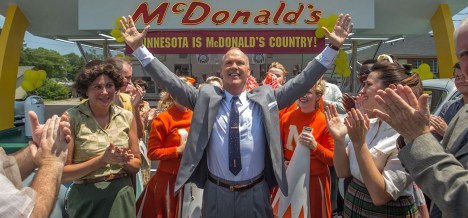
Foundation myth.

Foundation myth.

The Founder hits all of the expected beats from a film like this. Although it is obvious rooted in a true story, the movie tracing an arc as smooth as that iconic golden “m.” This not necessarily a bad thing. The Founder knows what it is doing, and it sets out about doing it in an efficient manner. In its own strange way, this feels appropriate. The Founder is as precisely constructed as the “swift service” engine that Ray Kroc elevates from a local quirk to a national franchise. The Founder never falters too badly, never meanders unforgivably.

More than that, The Founder has the luxury of a fantastic central performance from Michael Keaton as the huckster salesman who attaches himself to a small family business and manoeuvres himself to the head of an international empire.

He only wants his cut.

He only wants his cut.

Continue reading

Non-Review Review: 20th Century Women

20th Century Women is more affective than effective.

Mike Mills’ late seventies drama is far too quirky for its own good, often feeling more like a dramatised video essay than a narrative film. Mills provides a rake of social context for his story, from samples of Lodger to references to The Man Who Fell to Earth. He plays an extended section of President Jimmy Carter’s “Crisis of Conscience” address to the nation and even inserts some footage from Koyaanisqati. Characters monologue (and even dialogue) over careful compositions as the camera tracks across footage.

Making a splash.

Making a splash.

Everything in 20th Century Women feels overstated. It is not enough to have characters quote extended passages from contemporary literature and poetry, Mills makes sure to cite his sources up on screen. The result is that 20th Century Women feels more like an annotated thesis statement than an engaging story. Mills keeps the camera at a distance from his characters, constantly moving through scenes instead of allowing them to develop organically. Everything is quirky and arch.

The result is that 20th Century Women suffocates its most interesting elements; its characters, its cast, its engagement with American masculinity and femininity on the cusp of Reaganism. This is a movie that strives so hard for authenticity that it only exposes its artifice.

Fanning the flame.

Fanning the flame.

Continue reading

Star Trek: Deep Space Nine – Sacrifice of Angels (Review)

Sacrifice of Angels goes like the clappers.

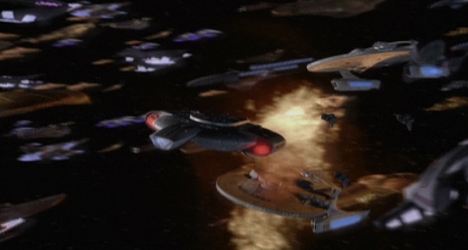
If Favour the Bold worked so well because it took its time and invested in character dynamics in the shadows this epic confrontation, then Sacrifice of Angels works so well because it just powers through to the end of the story. Sacrifice of Angels is an immaculately paced piece of science-fiction television, an episode that kicks into gear that the spectacular effects shot of the Starfleet fighters swooping down over those Galor-class destroyers in a haze of phaser fire and chaos. The episode doesn’t let up, powering through the plot to get back to the familiar status quo.

Fields of fire.

Fields of fire.

Sacrifice of Angels is also a meticulously constructed piece of television, with all of the dominoes aligned over the previous five episodes dropping at just the right point in a way that seems organic and natural, allowing for moments that are both surprising and inevitable. It is a very clean and sleek episode of television, one built to a singular purpose with a minimum of superfluous material. It really is a triumphant conclusion to an ambitious six-episode opening arc, one of the most daring narrative experiments in the entire history of the Star Trek franchise.

More striking is the sense that Sacrifice of Angels is very pointedly not the end of the larger arc. The Dominion War that began with Call to Arms does not end in Sacrifice of Angels, even though Sisko retakes the station and the characters return home. The Female Changeling even acknowledges as much in her dialogue, “Contact our forces in the Alpha Quadrant. Tell them to fall back to Cardassian territory. It appears this war is going to take longer than expected.” This is not over, despite the assurances that the writing staff gave Rick Berman on launching the arc.

The whole damn ballgame.

The whole damn ballgame.

Then again, this makes perfect sense. Star Trek: Deep Space Nine was constantly and continuously reinventing itself over the course of its run, with several of the show’s season premieres serving as de facto pilots for a new and improved version of the show and several season-enders serving as de facto series finales bookending a particularly iteration of the series. The Way of the Warrior and Call to Arms are a great example, the fourth and fifth seasons bookended by the First and Second Battles of Deep Space Nine.

As such, it is probably more satisfying to look at Sacrifice of Angels as the end of another new beginning for the series, the end of an extended opening arc that is setting up themes and ideas that might hope to pay off over the following two seasons. In some ways, Sacrifice of Angels brings the show back to the end of Emissary. Once again, the Cardassian Occupation has come to an end. Sisko finds himself affirmed as the Emissary of the Prophets and the Commander of Deep Space Nine. This is the order of things.

Going for gold.

Going for gold.

Continue reading