• Following Us

  • Categories

  • Check out the Archives


  • Awards & Nominations

Non-Review Review: 20th Century Women

20th Century Women is more affective than effective.

Mike Mills’ late seventies drama is far too quirky for its own good, often feeling more like a dramatised video essay than a narrative film. Mills provides a rake of social context for his story, from samples of Lodger to references to The Man Who Fell to Earth. He plays an extended section of President Jimmy Carter’s “Crisis of Conscience” address to the nation and even inserts some footage from Koyaanisqati. Characters monologue (and even dialogue) over careful compositions as the camera tracks across footage.

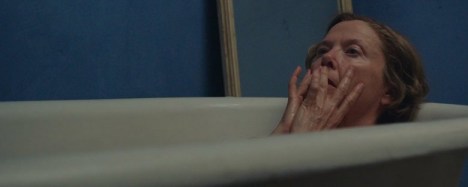
Making a splash.

Making a splash.

Everything in 20th Century Women feels overstated. It is not enough to have characters quote extended passages from contemporary literature and poetry, Mills makes sure to cite his sources up on screen. The result is that 20th Century Women feels more like an annotated thesis statement than an engaging story. Mills keeps the camera at a distance from his characters, constantly moving through scenes instead of allowing them to develop organically. Everything is quirky and arch.

The result is that 20th Century Women suffocates its most interesting elements; its characters, its cast, its engagement with American masculinity and femininity on the cusp of Reaganism. This is a movie that strives so hard for authenticity that it only exposes its artifice.

Fanning the flame.

Fanning the flame.

Continue reading

Star Trek: Deep Space Nine – Sacrifice of Angels (Review)

Sacrifice of Angels goes like the clappers.

If Favour the Bold worked so well because it took its time and invested in character dynamics in the shadows this epic confrontation, then Sacrifice of Angels works so well because it just powers through to the end of the story. Sacrifice of Angels is an immaculately paced piece of science-fiction television, an episode that kicks into gear that the spectacular effects shot of the Starfleet fighters swooping down over those Galor-class destroyers in a haze of phaser fire and chaos. The episode doesn’t let up, powering through the plot to get back to the familiar status quo.
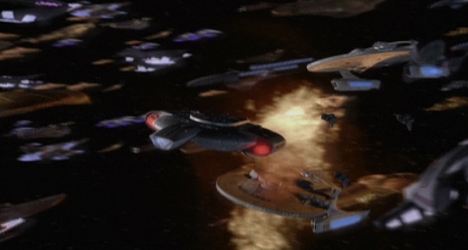
Fields of fire.

Fields of fire.

Sacrifice of Angels is also a meticulously constructed piece of television, with all of the dominoes aligned over the previous five episodes dropping at just the right point in a way that seems organic and natural, allowing for moments that are both surprising and inevitable. It is a very clean and sleek episode of television, one built to a singular purpose with a minimum of superfluous material. It really is a triumphant conclusion to an ambitious six-episode opening arc, one of the most daring narrative experiments in the entire history of the Star Trek franchise.

More striking is the sense that Sacrifice of Angels is very pointedly not the end of the larger arc. The Dominion War that began with Call to Arms does not end in Sacrifice of Angels, even though Sisko retakes the station and the characters return home. The Female Changeling even acknowledges as much in her dialogue, “Contact our forces in the Alpha Quadrant. Tell them to fall back to Cardassian territory. It appears this war is going to take longer than expected.” This is not over, despite the assurances that the writing staff gave Rick Berman on launching the arc.
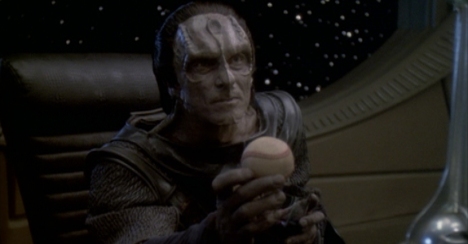
The whole damn ballgame.

The whole damn ballgame.

Then again, this makes perfect sense. Star Trek: Deep Space Nine was constantly and continuously reinventing itself over the course of its run, with several of the show’s season premieres serving as de facto pilots for a new and improved version of the show and several season-enders serving as de facto series finales bookending a particularly iteration of the series. The Way of the Warrior and Call to Arms are a great example, the fourth and fifth seasons bookended by the First and Second Battles of Deep Space Nine.

As such, it is probably more satisfying to look at Sacrifice of Angels as the end of another new beginning for the series, the end of an extended opening arc that is setting up themes and ideas that might hope to pay off over the following two seasons. In some ways, Sacrifice of Angels brings the show back to the end of Emissary. Once again, the Cardassian Occupation has come to an end. Sisko finds himself affirmed as the Emissary of the Prophets and the Commander of Deep Space Nine. This is the order of things.
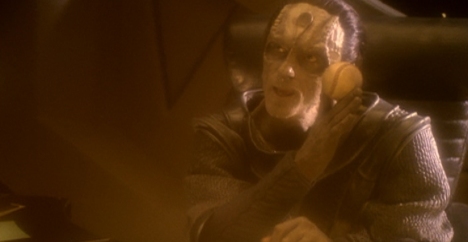
Going for gold.

Going for gold.

Continue reading

17. Manchester by the Sea – This Just In (#178)

Hosted by Andrew Quinn and Darren Mooney, This Just In is a subset of the fortnightly The 250 podcast, looking at notable new arrivals on the list of the 250 best movies of all-time, as voted for by Internet Movie Database Users.

This time, Kenneth Lonergan’s Manchester by the Sea.

podcastmanchesterbythesea

Continue reading

Non-Review Review: The LEGO Batman Movie

“I have aged phenomenally,” Bruce Wayne confesses about half-an-hour into The LEGO Batman Movie.

He is not wrong. The LEGO Batman Movie is in many ways an overt celebration of the legacy of the Caped Crusader, the pop culture icon who remains one of the most recognisable figures in the world. Repeatedly over the course of the film, character reference Batman’s rich history, from the Joker’s confession that they have known each other for “seventy-eight years” or Alfred’s reference to “that weird [phase] in 1966” or even Barbara Gordon’s slideshow presentation that goes back to the cover of Detective Comics #27 and the forties film serial.

Holding it all together...

Holding it all together…

The framework of The LEGO Batman Movie allows the characters and the script to comment upon the Batman mythology. The script is crammed with references from the length and breadth of the character’s publication history, from “Bat shark repellent!” to particular costume styles to minor villains to musical cues to fourth-wall-breaking references to other media that has inspired various interpretations of the Caped Crusader. This allows The LEGO Batman Movie to be explicitly about Batman in a way that few Batman stories can be.

As such, The LEGO Batman Movie offers a very broad summary of the Batman mythology and characters, surveying decades of printed and screen material to reduce Batman to his most simply and essential qualities. The LEGO Batman Movie offers a very compelling portrait of Batman as a man so traumatised by loss that he never allowed himself to grow up, while somehow subconsciously cultivating a family around himself. For all the character’s lauded darkness, The LEGO Batman Movie celebrates the hope at the heart of that mythology.

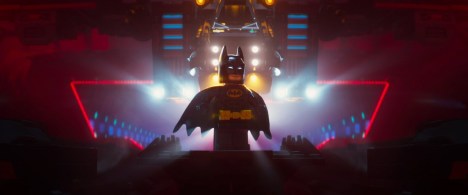
Welcome to his man-cave.

Welcome to his man-cave.

Continue reading

Star Trek: Voyager – Scientific Method (Review)

Scientific Method is in many ways the flip side of the coin to episodes like Nemesis, Distant Origin or Remember.

Nemesis, Distant Origin and Remember were effective demonstrations of Jeri Taylor’s approach to Star Trek: Voyager, a conscious effort to downplay the unique premise of the show in favour of pitching a more generic sort of Star Trek. With that in mind, Nemesis, Distant Origin and Remember constructed powerful allegories to examine pressing contemporary issues through the lens of science-fiction, resulting in episodes that represented one of the most defining aspects of the franchise: the sci-fi-tinged morality play.

Built into Voyager's DNA.

Built into Voyager’s DNA.

Not every example of this approach worked as well as those three episodes. Voyager began leaning into this more archetypal and generic Star Trek storytelling at the start of its third season, and the results were quite hit-and-miss. There were certainly brilliant examples in the seasons ahead, like Living Witness or Blink of an Eye. But not every allegory worked as well. Sometimes, the episodes were too didactic, like Critical Care or Repentance. Sometimes, the episodes were too generic, like The Chute. Sometimes, they were just ill-judged, as with Retrospect.

Scientific Method is a very bland and forgettable episode of Star Trek. It is not necessarily bad, but it is also not particularly memorable. In some ways, it demonstrates the limitations of the “generic Star Trek” approach to scripting for Voyager. Without a set of interesting and well-developed characters with strong dynamics in a series with a unique identity, an average episode can feel rather flat.

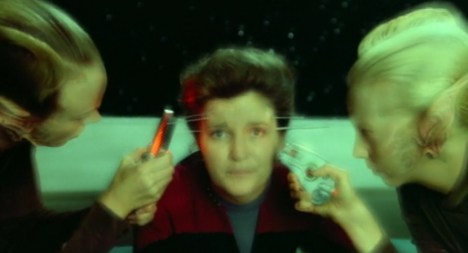
Give her head peace.

Give her head peace.

Continue reading

Star Trek: Deep Space Nine – Favour the Bold (Review)

With Favour the Bold, the writers begin winding down the ambitious six-episode arc that opens the sixth season of Star Trek: Deep Space Nine.

Indeed, Favour the Bold plays almost like the first part of a two-parter nestled at the end of the sprawling six-episode arc that opens the sixth season. At the end of the teaser, Sisko unveils his ambitious plan to Dax, boasting, “We’re going to retake Deep Space Nine.” It is the story that very clearly moves the arc that began with Call to Arms towards its conclusion, manoeuvring the series back towards the familiar status quo in which Captain Benjamin Sisko commands a lone Federation outpost near the distant planet of Bajor.

Point man.

Point man.

Favour the Bold is very much about lining up everything for the climax of the arc, moving the pieces into place so that that the dominoes can begin falling as early as possible in Sacrifice of Angels. However, the episode benefits from the fact that a lot of the heavy-lifting has already been done by this point in the arc. Behind the Lines already had Odo betray Kira, Rom get arrested and Damar figure out how best to dismantle those pesky self-replicating mines. That is already a lot of the table-setting for the arc’s epic conclusion, before Favour the Bold even begins.

As such, Favour the Bold has the luxury of beginning with a lot of its work already done and ending at the point where the action truly commences. The result is a surprisingly relaxed penultimate episode for this ambitious arc, one with the freedom to indulge in smaller character-driven scenes and the space in which to breathe.

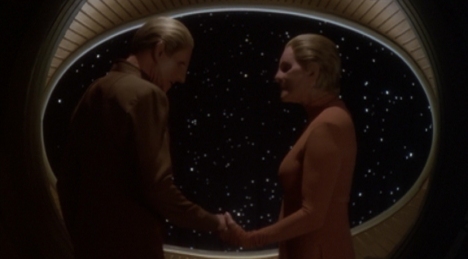
They just need some space.

They just need some space.

Continue reading