• Following Us

  • Categories

  • Check out the Archives


  • Awards & Nominations

Star Trek: Deep Space Nine – Business as Usual (Review)

Business as Usual is, appropriately enough, a very typical Star Trek morality play.

It is a relatively rare example of Star Trek: Deep Space Nine engaging in the sort of pointed social commentary that many fans expect of the genre, the rather straightforward moral lesson couched in science-fiction trappings; The Devil in the Dark as a commentary on “the other”, A Taste of Armageddon as a condemnation of the Vietnam War, Let That Be Your Last Battlefield as a critique of racism in general. There are all but expected in a Star Trek show, but Deep Space Nine rarely plays them particularly straight.
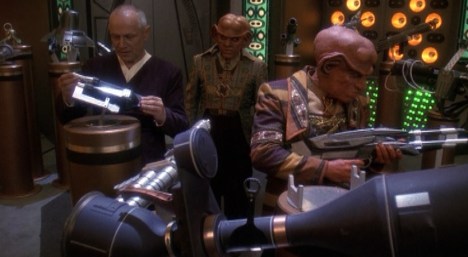
Disarming conversationalists...

Disarming conversationalists…

Deep Space Nine has told issue-driven stories before, with In the Hands of the Prophets serving to explore the gap between creationists and those who believe in evolution or Past Tense, Part I and Past Tense, Part II constructed as a direct commentary on Los Angeles’ plans to lock up their homeless population. However, the series tend to favour broader commentaries about grander themes. The show arguably as a timeless quality because it tends not to dwell too heavily upon specific ideas, instead meditating on particular themes like authority and conflict.

Indeed, Star Trek: Voyager is a lot more traditional in this respect. That writing staff has a clear fondness for the archetypal Star Trek morality play, constructing episodes as metaphors for contemporary issues; Remember explores Holocaust denial, Distant Origin deals with creationism, Displaced offers a reactionary take on immigration. Even non-issue-driven episodes like Darkling and Fair Trade make a point to stress the franchise’s utopian values in a manner much more overt than Deep Space Nine.

The hard sell.

The hard sell.

With that in mind, Business as Usual feels strangely old-fashioned. It is very much an episode of Deep Space Nine in terms of setting and character, in that no other Star Trek show would have a lead character knowingly and willingly become an arms dealer. However, it feels very much like an archetypal Star Trek show in that it is an episode about how the arms trade is implicitly immoral and horrific. It is a very worthwhile message, and in no way diminished by its obviousness, but it does feel surprisingly clear cut when compared to episodes like The Ship or Rapture.

Business as Usual is essentially a very conventional Star Trek story that is elevated by one of the best guest casts in the history of the franchise.
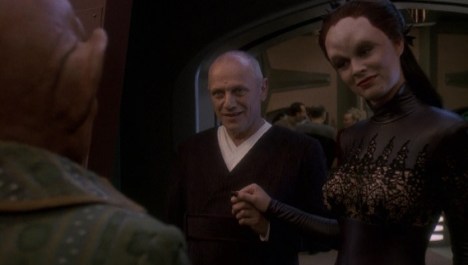
"No, Mister Quark, I expect you to buy!"

“No, Mister Quark, I expect you to buy!”

Continue reading

Non-Review Review: Sully – Miracle on the Hudson

Sully: Miracle on the Hudson has a certain Frank Capra quality to it.

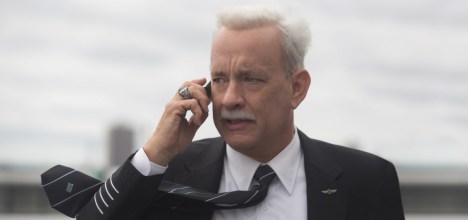
To be fair, a lot of that comes from the casting of Tom Hanks in the title role. Hanks radiates a certain ineffable integrity, a “Hanksian Decency” that informs his performances in films as diverse as Bridge of Spies and Inferno. It is tempting to think of him as “America’s Dad”, particularly given the grey hair and the moustache that he donned for the title role here. However, it is also tempting to think of him as a latter-day Jimmy Stewart, the embodiment of a certain type of fundamental American decency that lends itself to this sort of narrative.

Hanks for the memories.

Hanks for the memories.

Similarly, director Clint Eastwood has a similar philosophy. Eastwood’s films tend to be organised around strong moral principles. Often those principles are articulated in terms of personal responsibility, particularly the responsibility that individuals have for others whether in a professional capacity (J. Edgar) or a personal capacity (Million Dollar Baby) or simply by virtue of being there (Gran Torino). Eastwood’s recurring fascination with individual responsibility makes him a quintessentially American director.

This combination is ideally suited to Sully, which is constructed as something akin to a modern-day American fairytale.

"Mr. Sullenberger goes to the NTSB Debriefing."

“Mr. Sullenberger goes to the NTSB Debriefing.”

Continue reading

Star Trek: Deep Space Nine – A Simple Investigation (Review)

A Simple Investigation is a quiet little episode.

This is particularly true in the context of the crowded second half to the fifth season of Star Trek: Deep Space Nine. In Purgatory’s Shadow and By Inferno’s Light radically upended the status quo and set the fifth season on a march towards A Call to Arms. The threat of war looms large over the second half of the season, following the admission of Cardassia into the Dominion. There is a creeping sense of inevitability to episodes like Blaze of Glory and Soldiers of the Empire.

Strange bedfellows...

Strange bedfellows…

At the same time, Deep Space Nine takes a little while to adjust to that dramatic shift. The Dominion and Cardassia only come back into focus with Ties of Blood and Water, the episode that reintroduces Weyoun to the series. Still, episodes like Doctor Bashir, I Presume and Business as Usual have a sense of weight to them as they offer up high-stakes family drama and arms-dealing morality plays. In contrast, A Simple Investigation feels relatively low key. It is not an episode with profound consequences or shocking revelations.

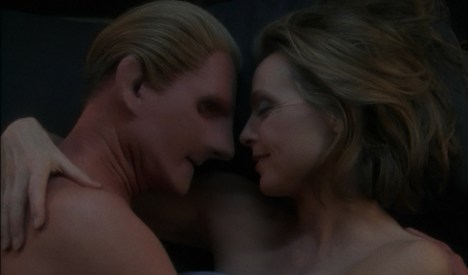
Instead, A Simple Investigation plays as a small-scale cyberpunk noir romance in which Odo falls head-over-heels in love with a guest star whom he will never see again. With all the chaos unfolding across the length and breadth of the fifth season, A Simple Investigation feels surprisingly… simple. The problems of these little people don’t amount to a hill of beans in this crazy world, but A Simple Investigation still takes the time to fixate upon them.

Star struck.

Star struck.

Continue reading

Non-Review Review: Moana

Moana is a fantastic demonstration of the timeless appeal of the long-standing Disney formula.

At first glance, Moana seems very much like an archetypal animated Disney film. It is the story of a young woman who is forced to adventure outside of her comfort zone, surrounded by adorable animal sidekicks and trickster mentors on an archetypal hero’s journey that is set to a toe-tapping soundtrack. It is a template that has served Disney very well, producing any number of beloved family classics over the year. Moana is very much a celebration of that template, and an example of why it works so well.

Islands in the Pacific... That is what we are...

Islands in the Pacific…
That is what we are…

At the same time, there is a faint layer of self-awareness to the script that serves it well. Moana might appear to be an archetypal Disney fairytale story, but that is largely down to its central character. Moana is a celebration of its title character, to the point that it frequently seems like she is propping up the narrative. This is not to suggest that Moana is a deconstruction or subversion in anyway. Instead, the movie almost as a distillation of the appeal of the classic “princess” narrative. It is a story that trusts its lead character to hold a disorganised story together.

Surrounded by dysfunction and chaos, Moana is an affectionate tribute to these sorts of stories.

Good (demi-)god, man!

Good (demi-)god, man!

Continue reading

9. Stalker (#203)

Why did you take my watch?

Hosted by Andrew Quinn and Darren Mooney, The 250 is a fortnightly trip through some of the best (and worst) movies ever made, as voted for by Internet Movie Database Users. New episodes are released every second Saturday at 6pm GMT, with the occasional bonus episode between them.

This time, Andrei Tarkovsky’s Stalker.

There is a zone. At the centre of the zone, there is a room. An author and a professor wander through the mysterious quarantined zone, guided by a veteran known as a “stalker.”

At time of recording, it was ranked the 203rd best movie of all time on the Internet Movie Database.

podcast-stalker

Continue reading

Star Trek: Voyager – Favourite Son (Review)

Favourite Son feels like the culmination of something that has been festering across the third season of Star Trek: Voyager.

The Star Trek franchise is generally regarded as progressive and forward-thinking. There is some debate to be had about whether this is an accurate summary of the franchise, given some of the creative decisions made over the course of its half-century run. However, there are times at which the franchise feels particularly liberal and points at which it feels particularly reactionary. A product of the mid-nineties, running through to the turn of the millennium, Voyager tends to feel very conservative in places.

This is a little bit what watching the episode feels like.

This is a little bit what watching the episode feels like.

In the second season, this reactionary tendency played out through the treatment of the Kazon in episodes like Initiations and Alliances. In the third season, with the Kazon long gone, it seems that Voyager has turned its reactionary gaze upon its female cast members. To be fair, the show’s first two seasons had any number of unfortunate creative decisions when it came to various female characters. Most notably, the decision to turn Seska into a baby-crazed maniac in Manoeuvres did not bode for the first female-led Star Trek series.

Nevertheless, a misogynist streak has manifested itself across the third season as a whole. In some cases, this has been relatively subtle; like the awkward insistence upon sexualising three-year-old Kes in the eyes of her two mentor figures in Warlord and Darkling. In other cases, this has been the entire point of the plot; like the decision to have Q try to sleep with the franchise’s first female lead and introduce his shrewish wife in The Q and the Grey or to introduce a psycho stalker in Alter Ego.

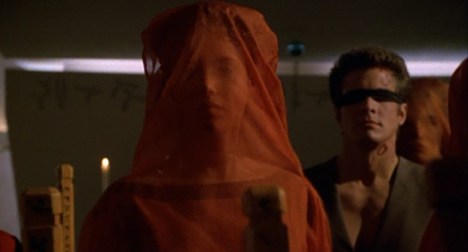
The original red wedding.

The original red wedding.

Other times, this sexist attitude has bubbled through the background of various episodes to the point that it builds to critical mass. Torres is victimised by her male colleagues over the course of three straight episodes, and none of them are held accountable; she is sexually assaulted by Vorik in Blood Fever, stunned by Chakotay in Unity, and tortured by the evil!EMH in Darkling. In each of those cases, the show seems to shrug off the violence committed by male characters against one of the show’s female leads.

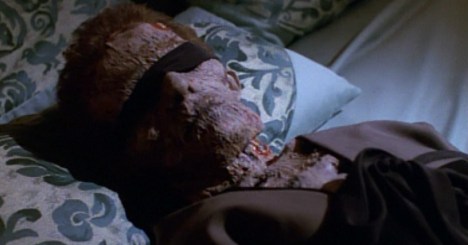
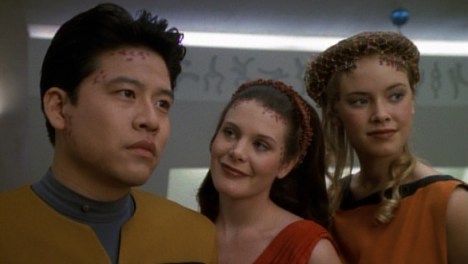
All of these elements come to the fore in Favourite Son, an episode that would have been painfully retrograde had it aired as part of the original series during the sixties. Favourite Son is that most uncomfortable myth dressed up in science-fiction drag, the tale of an island of beautiful women using their sexual prowess to lure men into their clutches to emasculate them. It is terrifying to think that this episode made it to air in the late nineties.

A beautiful dream.

A beautiful dream.

Continue reading

Star Trek: Voyager – Rise (Review)

Rise is in many ways a very typical episode of Star Trek: Voyager.

It is an episode that certainly has an interesting premise. For all its myriad flaws, Voyager tended to have a genuine interest in playing with science-fiction concepts. At its worst, this attitude manifested itself through the various “anomaly of the week” stories that followed a familiar pattern of the ship encounter some sort of strange phenomenon with predictable results. Often this phenomenon involved time travel or interstellar dust clouds, a trend that could be traced back to early episodes like Time and Again or The Cloud.

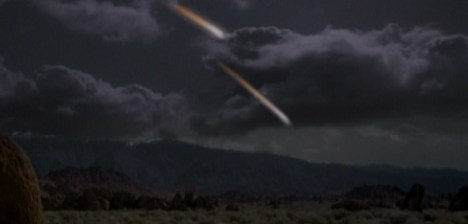
That crashing feeling.

That crashing feeling.

However, Voyager did occasionally use its interest in science-fiction storytelling to construct interesting stories. Deadlock might have set a damning precedent for the show, but it was compelling television. Blink of an Eye is a very clever little story. In true Star Trek fashion, Voyager would even use these science-fiction ideas to construct engaging allegories like the exploration of holocaust denial in Remember or the meditation on creationism in Distant Origin.

These concepts gave the series a sense of texture. They served to distinguish the show from its siblings. For example, Star Trek: Deep Space Nine was generally less interested in science-fiction high concepts than in characterisation and politics. When those sci-fi elements did show up, they were usually to torture O’Brien in episodes like Whispers, Visionary, Hard Time and Time’s Orphan. Of course, Deep Space Nine had sci-fi concept-driven stories like Playing God or One Little Ship, but they tended to stand out more from the series around them.

Up on the roof's the only place I know...

Up on the roof’s the only place I know…

Rise has a suitably high concept, a core idea that could easily have been lifted from the pages of the same pulp magazines that inspired The Cloud Minders. The episode is essentially a paranoid thriller unfolding within a confined space, but that confined space just happens to be a giant elevator that stretches from the surface of the planet into orbit. The premise is ridiculous, feeling like it was lifted from forties or fifties periodicals with giant insects and half-naked men on the cover. In other words, it feels of a piece with Innocence or The Thaw or Tuvix.

It is too much to argue that Rise has a brilliant concept, but it at least has an intriguing one. While it might be hard to use the basic elements of Rise to construct a classic, it should be relatively straightforward to construct a thrilling episode of television. Unfortunately, Rise simply does not work. More than that, Rise does not work for the most boring of reasons. As with a lot of Voyager, the episode is an interesting premise undercut by both a deeply flawed (and half-hearted) execution and the show’s own long-standing structural weaknesses. This happens all too often.

A dark moment for the series.

A dark moment for the series.

Continue reading

Non-Review Review: Allied

There is something of the uncanny about Allied, a pervading sense of “not-quite-right-ness” that pervades the film.

In some ways, that vague feeling of uncanniness recalls director Robert Zemeckis’ work in stop-motion computer animation in the earlier years of the century. There was something deeply uncomfortable about the director’s work on films like The Polar Express or A Christmas Carol, a sense of strange lifelessness beneath meticulously and painstakingly crafted exteriors. Zemickis’ computer-generated experiments often felt like they were trying too hard to mimic something organic and spontaneous.

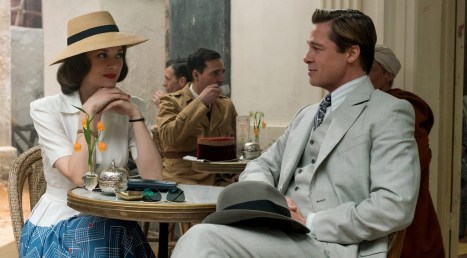
Casa closed.

Marryin’ Marion

There is a similar sentiment to Allied, which plays very much as a love letter to classic Hollywood cinema. Indeed, the opening forty minutes of the film are dedicated to a very stylish couple operating out of “French Morocco.” Inevitably, their clandestine dealings bring them to a version of Casablanca that seems rooted more in Hollywood history than in reality. Unfolding against the backdrop of the Second World War, dealing with themes of love and betrayal, and starring a bona fides movies star, Allied feels very much like an approximation of a classic movie.

However, it never quite gets there.

Marryin' Marion.

Casa closed.

Continue reading

Non-Review Review: The Edge of Seventeen

The Edge of Seventeen is a fantastic coming of age film from writer and director Kelly Fremon Craig.

The script sparkles, the casting is spot-on, the humour is well-observed. Like so many great coming of age comedies, The Edge of Seventeen understands that familiar teenage angst where the entire world seems to have been constructed as a sadistic (and highly targetted) Rube Goldberg machine for the sole purpose of torturing one single individual. The Edge of Seventeen balances this all very deftly, creating a set of circumstances that understandably feel like the end of the world to the lead character, but which seem comical to a more matured detached audience.

Teenage wildlife.

Teenage wildlife.

However, the true strength of any coming of age film lies in the casting. Easy A was a fantastic film, but it was cleverly elevated by the shrewd casting of Emma Stone as its wry protagonist. The Edge of Seventeen places Hailee Steinfeld at the centre of its teenage universe. Steinfeld delivers a pitch-perfect performance that meticulously walks the line between sardonic and vulnerable. The Edge of Seventeen has the luxury of a well-crafted and well-observed script, but it lives or dies by its central performance.

Steinfeld is phenomenal.

Animated discussion.

Animated discussion.

Continue reading

Star Trek: Deep Space Nine – Doctor Bashir, I Presume (Review)

Doctor Bashir, I Presume is a strange little episode.

It directly follows In Purgatory’s Shadow and By Inferno’s Light, a two-part story in which it was revealed that Doctor Julian Bashir had been abducted by the Dominion at some point during the fifth season and replaced with a changeling infiltrator. Although the maths can be a little difficult to work out, it is suggested that Bashir was replaced by a changeling at some point before Rapture. With that in mind, it seems strange that the very next episode of Star Trek: Deep Space Nine should reveal that the recently returned Julian Bashir is himself an imposter.

"Oh, shiny."

“Oh, shiny.”

However, even on its own terms, Doctor Bashir, I Presume is a very odd piece of television. The hook of the episode is a guest appearance from Robert Picardo as Lewis Zimmerman. Picardo is making a crossover appearance from Star Trek: Voyager where he played the EMH, who had also made an appearance in Star Trek: First Contact. Picardo is a fine dramatic actor, but the character is notable for being comic relief. Doctor Bashir, I Presume begins as a light-hearted quirky piece, turning sharply at the half-way point to become a gritty science-fiction family drama.

All of this is quite jarring. However, Doctor Bashir, I Presume works surprising well. A large part of that is down to how strange the episode is, often feeling like an intimate family drama about recrimination and disappointment set against the backdrop of a massive science-fiction franchise.

A selfie with himself.

A selfie with himself.

Continue reading