• Following Us

  • Categories

  • Check out the Archives


  • Awards & Nominations

Star Trek: Enterprise – E² (Review)

Next year, Star Trek is fifty years old. We have some special stuff planned for that, but – in the meantime – we’re reviewing all of Star Trek: Enterprise this year as something of a prequel to that anniversary. This August, we’re doing the third season. Check back daily for the latest review.

Conventional wisdom treats as a bump in the road between The Forgotten and The Council, an episode that could easily be skipped on a marathon rewatch of the season. The argument suggests that the episode ultimately provides little meaningful information and advances the season’s over-arching plot by inches. The most critical of fans will consider an episode that saps the momentum out of the final run of the third season, preventing a clear home run between Azati Prime and Zero Hour.

This is certainly true from a plot-driven perspective. It would be easy enough to trim from the twenty-four episode season order without anybody batting an eyelid. At least Shran gets to make a cameo appearance in Zero Hour, while Lorian fades into discontinuity and non-existence. Like so many time travel stories, the final act of conveniently erases itself from existence. This just reinforces the sense that nothing that happened actually mattered in the grand scheme of things.
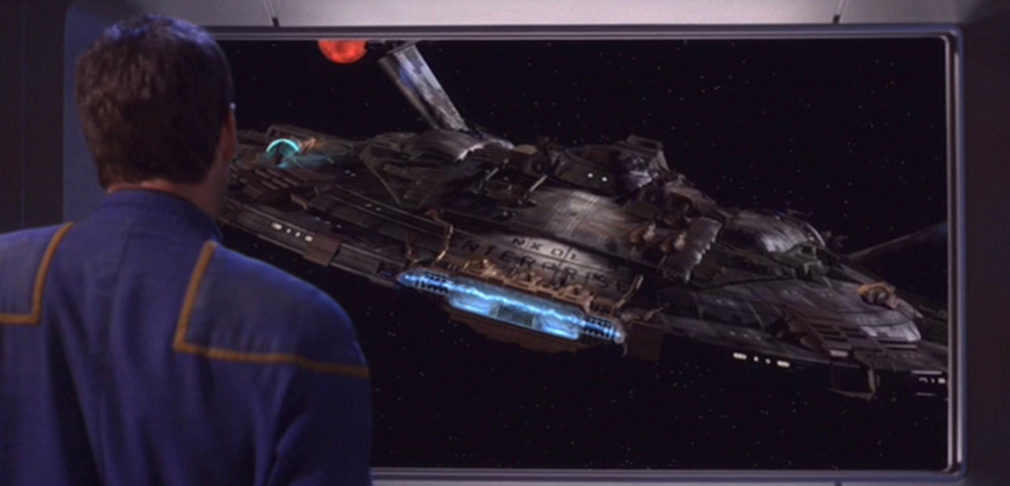
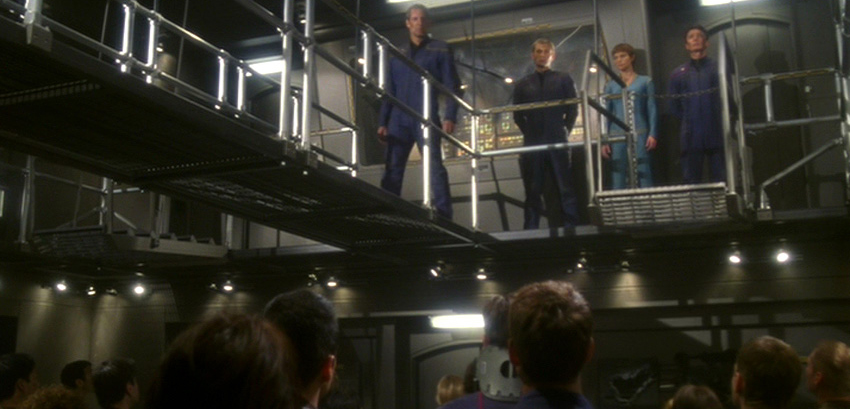
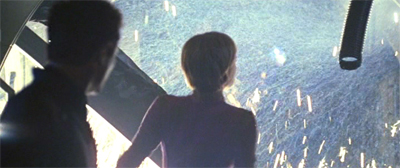
It's like looking in a mirror...

It’s like looking in a mirror…

This is another example of the complications that tend to come with serialised storytelling. The conventional way of telling a long-form story is to drive it via plot – to have a clear path along which the characters might advance with a number of clear markers along the way. In the case of the third season of Star Trek: Enterprise, the launch of the Xindi weapon is an obvious marker; it is a plot point which the show must address before the end of the season. As such, the show’s serialisation is typically measured by whether it moves the crew in relation to that plot point.

doesn’t move the crew appreciably closer to that plot point. There is a miniature hurdle for the crew to overcome (getting into the subspace corridor to make the meeting with Degra), but it is very clearly just window-dressing on a plot that is very clearly more interested in the time-travel dynamics of having the Enterprise crew meet their descendants. The same narrative ground could have been covered by having Degra accompany Archer to the Xindi Council at the end of The Forgotten.
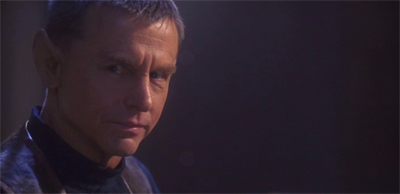
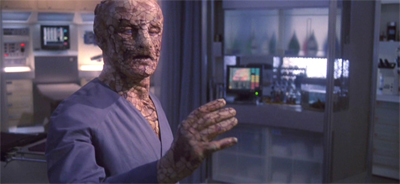
He's all ears...

He’s all ears…

However, plot is not the only thing important to long-form storytelling. Theme and character are just as important, as The Forgotten demonstrated. The biggest problem with is that it is a plot-driven episode of television that advances the season’s thematic and character arcs, but with a story that is disconnected from the season as a whole. Which is a shame, because the thematic and character dynamics are fascinating. This is the perfect point at which to confront Archer with the idea of legacy and consequence; to ask what kind of future might lie ahead.

As with a lot of the scripts for the third season, feels like a meditation on Enterprise‘s relationship with the rest of the franchise and where it stands at this point in its run.
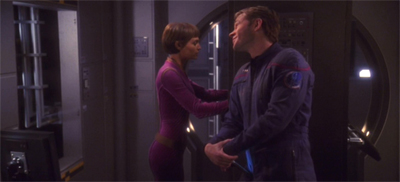
"Worf and Dax neve rhad to put up with crap like this."

“Worf and Dax neve rhad to put up with crap like this.”

Continue reading

Star Trek: Enterprise – The Forgotten (Review)

Next year, Star Trek is fifty years old. We have some special stuff planned for that, but – in the meantime – we’re reviewing all of Star Trek: Enterprise this year as something of a prequel to that anniversary. This August, we’re doing the third season. Check back daily for the latest review.

The Forgotten opens with a funeral service.

It is nominally a service for the eighteen people who died in the Xindi attack. (The total was given as seventeen in Damage, but it is possible that Archer is counting the death of Fuller from Anomaly or that another crew member died in the interim from their wounds.) It is a nice illustration of just how strongly the final stretch of the third season embraces serialisation, with the episode’s teaser serving as a coda to the events of the previous two episodes. It is a nice, small touch that sets the mood for the episode ahead.

Funeral for a friend...

Funeral for a friend…

However, it also seems like a very self-aware sequence. Archer is nominally talking about the death of eighteen characters, but he might as well be talking about the looming death of this iteration of the Star Trek franchise, or of the death of innocence that featured in Damage. “We’re in bad shape, I can’t deny that,” Archer tells his crew. He could just as easily be talking about the show, which seemed practically under siege at this point. “But we’re still in one piece. Enterprise is a tough ship. She took more than anyone could ask her to and then some.”

In many ways, the beating that the Enterprise took in Azati Prime reflects the beating that Star Trek: Enterprise had taken over its three year run: from a fandom hostile to the idea of a prequel and unsatisfied with an overly familiar storytelling structure; from a network that had changed hands during the first season of the show; from an eager Hollywood press that could smell blood in the water that had been ripely aged eighteen years; even from former allies like Majel Barrett, William Shatner and Ronald D. Moore.

Tripping over his emotional state...

Tripping over his emotional state…

The Forgotten is a story that is very consciously symbolic and metaphorical. It is also something of an oddity. In a way, it feels like a more successful version of what the show attempted with Harbinger, offering a light character-driven story falling between two bigger beats in the larger plot arc. With its fixation on sex and violence, Harbinger was goofy and pulpy in equal measure. In contrast, The Forgotten is an episode that is morose and sombre. It is an episode that very clearly articulates where the third season is going – and where it always has been going.

If Damage was a show about how Star Trek could easily get lost in a grim and gritty War on Terror metaphor, The Forgotten reveals that the third season was never about rationalisation or justification. The Forgotten is a show about how the Star Trek franchise needed to find a way back to its more traditional values.

A massive breach...

A massive breach…

Continue reading

Star Trek: Enterprise – Damage (Review)

Next year, Star Trek is fifty years old. We have some special stuff planned for that, but – in the meantime – we’re reviewing all of Star Trek: Enterprise this year as something of a prequel to that anniversary. This August, we’re doing the third season. Check back daily for the latest review.

The stock comparison for Damage is In the Pale Moonlight.

This makes a great deal of sense. After all, both are Star Trek episodes that hinge on a series of morally questionable decisions made by the lead actor in a moment of sheer desperation. In In the Pale Moonlight, Benjamin Sisko starts a chain of events that builds towards the assassination of a Romulan Senator to trick the Romulans into joining the war effort. In Damage, Jonathan Archer resorts to piracy in order to obtain the parts necessary to make a meeting with Degra in order to plead against the use of the Xindi weapon.

A met a man who wasn't there...

A met a man who wasn’t there…

There are some notable differences, of course. In purely practical plotting terms, Sisko dominates the narrative of In the Pale Moonlight; the entire story is related directly by Sisko to the audience in the form of a personal log. In contrast, Damage is split between the demands of Archer’s own arc in the episode and various other continuity elements; the episode needs to get Archer back to his ship and devote a considerable amount of time to T’Pol’s addiction. As a result, it lacks the keen focus that made In the Pale Moonlight so compelling.

At the same time, there is something much more direct about Damage. Sisko is quite detached from the horrors of In the Pale Moonlight, with the audience insulated from his choices through the use of a framing device and Sisko himself insulated through his use of Garak to conduct all the unpalatable actions. In contrast, Archer makes a point to bloody his own hands over the course of Damage. He doesn’t have somebody else to make the decision for him; he leads the boarding party himself.

Everything comes apart...

Everything comes apart…

It is a very bold an unsettling choice, a culmination of a character arc that has been pushing Archer towards this sort of horrific choice since Anomaly. The third season of Star Trek: Enterprise has not been entirely consistent when it comes to its character arcs, working better in broad strokes than in fine detail. Nevertheless, Damage represents a very clear commitment to the promise of the third season of Enterprise; an interrogation of the franchise’s core values in an increasingly morally ambiguous world.

Damage is a deeply uncomfortable and unsettling episode of Star Trek, but it is arguably a necessary one. It is, in many ways, a criticism of the moral absolutism that informs a lot of discussion about terrible situations, suggesting that reality is often a lot more complicated than people might hope it would be.

Drowning his sorrows...

Drowning his sorrows…

Continue reading

Non-Review Review: We Are Your Friends

Appropriately enough, We Are Your Friends feels like a selection of remixed samples of other movies.

The script for We Are Your Friends dutifully hits all the requisite beats from a coming of age story about a young man trying to find his way in the world; in this case, “the world” refers to “the San Fernando valley”, just over the Hollywood Hills. Appropriately enough, We Are Your Friends positions the valley (“the Valley”) as a sort of purgatory for those who want to get out towards better things; aspiring DJs and actors trapped in dull routine who must learn to stay true to themselves to attain meaningful (and not just material) success.

The beat goes on...

The beat goes on…

It is a very familiar story structure, one that lends itself to the sense of social striving associated with other (more substantial) films about life in Los Angeles. We Are Your Friends doesn’t have a story as much as it has an outline; the requisite steps that young would-be DJ Cole Carter must take on the path to stardom. There is an older mentor with feet of clay, a troubled love interest also looking for meaning in the world; there is the false promise of financial security, a tragic lesson about life lived to access.

However, all of this is drawn so broadly that We Are Your Friends is a tracklist rather than an album. Director Max Joseph brings commendable energy to the film, and Zac Efron is quite affable as a protagonist more cliché than character. Wes Bentley adds just a hint of flavour to an otherwise ambient film. We Are Your Friends is inoffensive, but ultimately more visually interesting than completely satisfying.

Hey, Mister DJ, put a record on...

Hey, Mister DJ, put a record on…

Continue reading

Star Trek: Enterprise – Azati Prime (Review)

Next year, Star Trek is fifty years old. We have some special stuff planned for that, but – in the meantime – we’re reviewing all of Star Trek: Enterprise this year as something of a prequel to that anniversary. This August, we’re doing the third season. Check back daily for the latest review.

If you can end on a high note, the audience will forgive a lot.

The third season of Star Trek: Enterprise is one of the boldest and most ambitious seasons of Star Trek ever produced; it is certainly the most adventurous season of the franchise to air outside of Star Trek: Deep Space Nine. However, on an episode-to-episode basis, the quality is quite variable. There are great episodes (Impulse, Twilight), underrated episodes (North Star, Exile), fun episodes (Stratagem), and experimental episodes (Harbinger), but there are also a lot of episodes that are more interesting in theory than in practice.

Explosive finalé...

Explosive finalé…

It becomes increasingly obvious over the course of the season that the writing staff did not plan the year-long arc far enough in advance and that the show struggles to figure out where it wants to go after the initial burst of speed wears off. There are even a couple of outright stinkers that rank with the worst that the franchise ever produced. However, there is a lot to be said for an ending. The third season of Enterprise hits a few speed bumps along the way, but it manages to rally for an impressive and largely satisfying conclusion.

Azati Prime begins the march towards the end of the season. It was the first episode to be filmed after the Christmas break, suggesting that it was the work of a revitalised writing staff and an energised production team. More than that, it was broadcast as the last episode before a six-week break in the broadcast schedule, suggesting that everybody involved knew exactly the kind of hit that they had on their hands. It injects an incredible energy into a show that might be racing towards its own apocalypse.

Future's end...

Future’s end…

Continue reading

Non-Review Review: Hitman – Agent 47

Hitman: Agent 47 is not a good film, but it is bad in interesting ways.

The video game adaptation fad of the nineties has given way to a wave of blockbuster comic book movies. Those comic book adaptations have fared much better – both critically and commercially – than fare like Super Mario Brothers or Street Fighter or Mortal Kombat. As such, Hitman: Agent 47 feels like something of an outlier; it is a reboot of a video game property that already failed to take flight in a movie released eight years ago. Even if there is a resurgent interest in video game movies, it seems strange to return to this video game movie.

You know, that looks like a highly impractical way to hold those guns...

You know, that looks like a highly impractical way to hold those guns…

At the same time, there is something quite compelling about the structuring of Hitman: Agent 47. Perhaps inspired by the success of the relative fidelity of twenty-first century comic book adaptations, Hitman: Agent 47 struggles to provide a relatively faithful adaptation of the game-playing experience. Though the structure and tone of the movie might jar with the source material, director Aleksander Bach is careful to preserve as much of the game-play experience as possible. Extended sequences of Hitman: Agent 47 play as a walkthrough of a life-like video game.

Which, of course, only serves to make the film feel somewhat redundant; watching a bunch of actors play through scripted game-play-like scenarios might offer a faint echo of the thrill of playing a video game, but captures none of the investment.

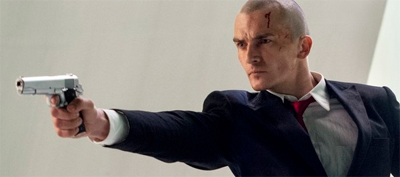
Bloody mess...

Bloody mess…

Continue reading

Star Trek: Enterprise – Hatchery (Review)

Next year, Star Trek is fifty years old. We have some special stuff planned for that, but – in the meantime – we’re reviewing all of Star Trek: Enterprise this year as something of a prequel to that anniversary. This August, we’re doing the third season. Check back daily for the latest review.

Hatchery is a very odd episode.

On the one hand, it feels like another irrelevant detour on the path to Azati Prime. It is a standalone episode about a wacky adventure that the crew have upon discovering a crashed ship on the surface of a dead world, playing with the standard Star Trek tropes about mind control and possession. This is not the first time that a Star Trek character has had their behaviour dramatically altered by an alien compound, and it does seem a bit distracting to tell this story at this point in this season, even in the aliens in this case are insect!Xindi.

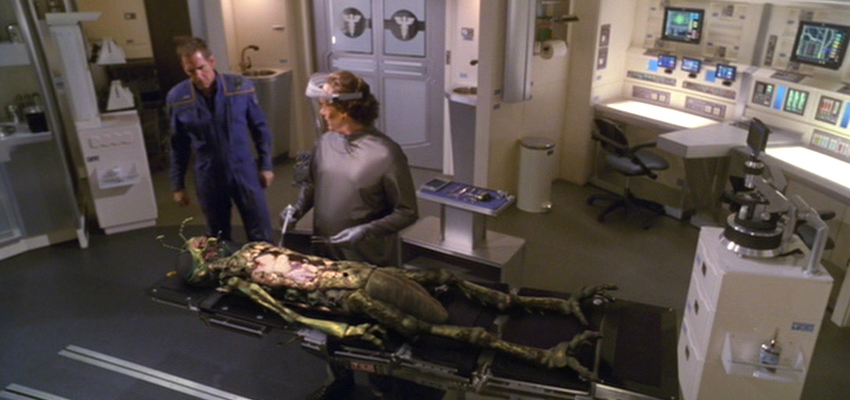
Slice o' life...

Slice o’ life…

At the same time, it does feel like an important episode thematically. The third season of Star Trek: Enterprise is packed with all manner of existential explorations of what it means to be Star Trek. What are the essential ingredients of the franchise? How far can you wander off the template without breaking it? What does Star Trek even mean in a post-9/11 world? There are aspects of Hatchery that deal with these questions rather directly, as the episode explores the consequences of putting a bunch of marines on a Star Trek ship.

It just feels rather surreal that “Archer goes crazy from bug spray” should be the jumping-off point for that particular story.

"Hey there, little fella..."

“Hey there, little fella…”

Continue reading

Non-Review Review: Me and Earl and the Dying Girl

There is a weird sense of entitlement that runs through certain strand of indie cinema, one that argues that a certain kind of comfortable middle-class male angst is almost overwhelming. At the risk of generalising, it feels like a millennial anxiety, the sense that the world was promised to an eager young generation who have found themselves subsisting as passengers and background extras in a world that was supposed to bow to their whims.

The emotionally immature male protagonist who must learn to embrace his gift and be himself (or self-actualise or self-realise, depending on how you feel about the trend) is ubiquitous.  It is arguably nothing new. Certainly, one can trace a clear lineage between the stock Woody Allen protagonist and any number of modern cinematic depictions of middle-class masculinity, from Listen Up Philip to Liberal Arts.

meandearlandthedyinggirl4a

Continue reading

Star Trek: Enterprise – Doctor’s Orders (Review)

Next year, Star Trek is fifty years old. We have some special stuff planned for that, but – in the meantime – we’re reviewing all of Star Trek: Enterprise this year as something of a prequel to that anniversary. This August, we’re doing the third season. Check back daily for the latest review.

If Harbinger was a surprisingly experimental piece of Star Trek, then Doctor’s Orders is something far more conventional. If Harbinger was an attempt to do something relatively novel within the framework of Star Trek: Enterprise, then Doctor’s Orders offers the viewer something they’ve seen before.

This applies in a very literal sense. There are quite a few similarities between the plot of Doctor’s Orders and One. Both are effectively one-hander bottle shows focusing on a popular member of the cast, working from the premise that an anomaly of the week requires the rest of the crew to go into stasis. From that starting point, both episodes become studies of isolation and loneliness. Both character find themselves confronting hallucinations while dealing with a perceived threat to the ship.

Yes. Doctor's Orders was a very strange choice for Sweeps.

Yes. Doctor’s Orders was a very strange choice for Sweeps.

To be fair, this is neither the first nor the last time that the Star Trek franchise will feature a plot largely recycled from existing elements. With over seven hundred episodes in the can, there will inevitably be some overlap and similarities. However, Doctor’s Orders feels familiar in another more primal sort of way. One of the big tensions of third season is a need to balance the demands of a larger story arc with a twenty-odd episode season. There is a very odd equilibrium to be struck between the long-form story and episodic standalone adventures.

Doctor’s Orders is very much an old-school episodic Star Trek adventure that could exist quite apart from the demands of the third season as a whole. It is an example of the sorts of internal tensions at work on the show.

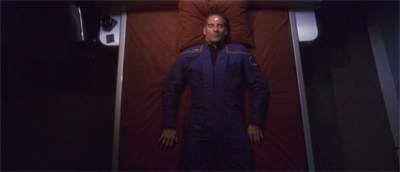
The sleep of the just...

The sleep of the just…

Continue reading

Star Trek: Enterprise – Harbinger (Review)

Next year, Star Trek is fifty years old. We have some special stuff planned for that, but – in the meantime – we’re reviewing all of Star Trek: Enterprise this year as something of a prequel to that anniversary. This August, we’re doing the third season. Check back daily for the latest review.

It goes almost without saying that the third season of Star Trek: Enterprise was an attempt to revitalise a franchise that had already been on television for a decade and half. It was an attempt to do something quite radical and dynamic with a television property that had become rather staid and conservative. Star Trek: The Next Generation had been perfectly calibrated for the late eighties and early nineties, but its approach towards storytelling was increasingly outdated after seven seasons of Star Trek: Voyager.

One of the recurring issues in the first season of Enterprise was the conflict between the established franchise structure and something more adventurous and exciting. So many of those first season episodes seemed laboriously paced and awkwardly arch; there was a sense of dull routine rather than exciting adventure. The show would occasionally try to deviated from the established template (to varying degrees of success) with stories like Dear Doctor, Shuttlepod One, and A Night in Sickbay, but narrative conservatism won out in the sophomore season.

"So... sweeps?"

“So… sweeps?”

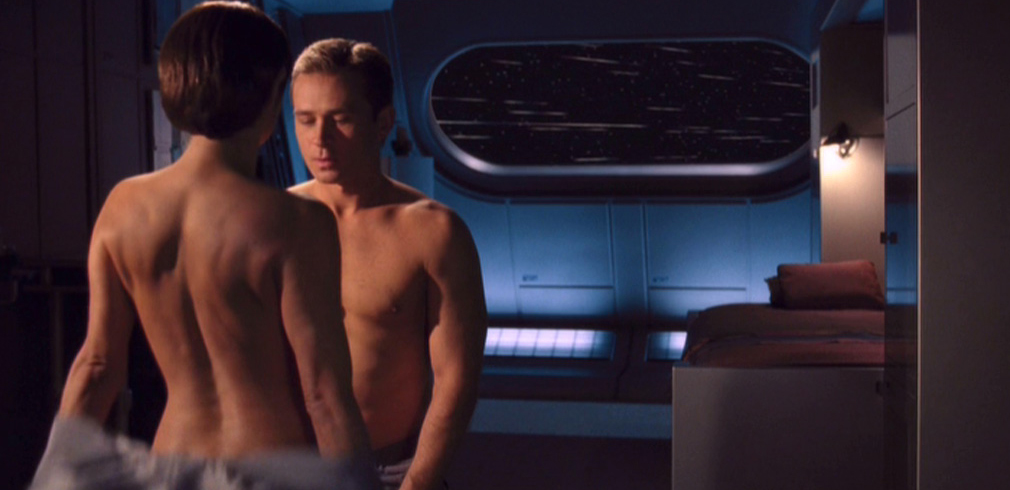
In many ways, Harbinger plays as a return to those earlier experiments in story structure. It is an episode that is not driven by story. Although the strange alien discovered by the crew provides a suitably dramatic climax, most of Harbinger is built around established character dynamics. Trip and T’Pol begin working through the sexual tension that has existed between them since the start of the third season; Reed and Hayes do something similar in a very different fashion. In the meantime, the ship just cruises along en route to the third season’s next big plot beat.

Harbinger is not entirely successful in this regard. There is a sense that the franchise is still figuring out how to construct episodes that don’t conform to a rigid story structure, with the mysterious alien visitor serving as an effective crutch to help get around these problems. Still, it is an interesting experiment and an example of how the show is consciously trying to reinvent itself in a manner that is more than simply cosmetic.

Expanding his Sphere of influence...

Expanding his Sphere of influence…

Continue reading