• Following Us

  • Categories

  • Check out the Archives


  • Awards & Nominations

Millennium – Skull and Bones (Review)

This July, we’re taking a trip back in time to review the sixth season of The X-Files and the third (and final) season of Millennium.

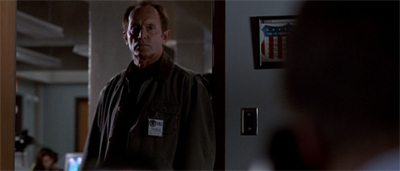
Skull and Bones brings a lot of the problems with the third season of Millennium to the fore.

Most obviously, the third season of Millennium is making a conscious effort to return to the aesthetic and style of the first season, with an emphasis on horrific crimes and abhorrent psychologies. In interviews around the launch of the third season, Chris Carter repeatedly suggested that something had been lost in the second season. TEOTWAWKI was an issue-driven episode about school shootings and Y2K. Closure was a story about how spree killers can engage in random patterns of violence and there is no way to reliably discern a pattern of logic in truly evil behaviour.
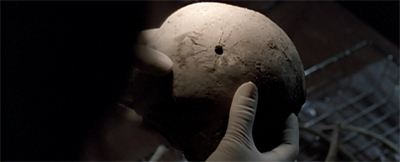
The hole in things...

The hole in things…

At the same time, the third season is struggling to deal with the legacy and impact of the second season. The Innocents and Exegesis rather clumsily attempted to write their way out of The Fourth Horseman and The Time is Now by downplaying the impact of the end of the world at the end of the second season. However, the third cannot completely erase what happened. The absence of Catherine Black and the presence of Peter Watts are constant reminders. The Millennium Group itself cannot revert back to its first season self.

Skull and Bones plays out this conflict, creating an impression of a show trapped at a crossroads with a problem it cannot resolve. Skull and Bones is an episode that attempts to both minimise the impact of the second season of Millennium while still acknowledging and building upon it. It is not an approach that lends itself to satisfactory or fulfilling storytelling. However, it does articulate just how confused the show must be at this point in its life cycle.
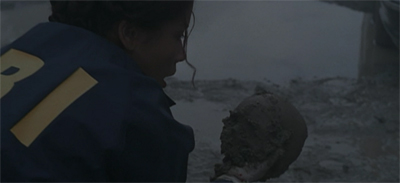
There are going to be a lot of Yorrick captions this time...

There are going to be a lot of Yorrick captions this time…

Continue reading

Millennium – … Thirteen Years Later (Review)

This July, we’re taking a trip back in time to review the sixth season of The X-Files and the third (and final) season of Millennium.

… Thirteen Years Later is infamously silly. That may not be such a bad thing.

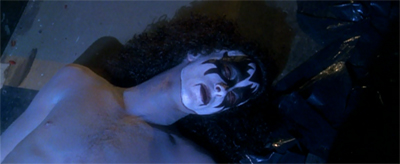
There are a lot of details that would seem to weigh against … Thirteen Years Later. It is the show’s first attempt at comedy since Darin Morgan left the staff at the end of the second season; any episode will suffer in comparison to Jose Chung’s “Doomsday Defense” or Somehow, Satan Got Behind Me. It is an episode built around a guest appearance from the rock band KISS to promote the release of their latest album, Psycho Circus. It is also an attempt to do wry self-aware meta-commentary and Hollywood satire, which could easily become indulgent.

KISS was 'ere...

KISS was ‘ere…

To be quite frank, … Thirteen Years Later doesn’t really work. It is messy and convoluted. A lot of the gags are obvious, and a lot of its satire of Hollywood feels somewhat stock. The framing device builds to a pretty lame (and entirely predictable) punchline. Some of the best gags in … Thirteen Years Later are shamelessly poached from better second season episodes – the idea of Frank Black in Hawaiian shirt comes from Jose Chung’s “Doomsday Defense” while the idea of Frank Black critiquing serial killer movies was hilarious in Midnight of the Century.

However, in spite of all that, … Thirteen Years Later has an energy and momentum that is sorely missing from much of the season around it. The third season has seen a return to the mood and aesthetic of the first season, which occasionally wallowed in gloom and self-importance. … Thirteen Years Later completely skewers that sense of self-importance. Its best jokes seem to be affectionate jabs at Millennium itself, demonstrating that the show still has a great sense of humour; even if it has gotten quite effective at hiding it.

The camera never lies...

The camera never lies…

Continue reading

Millennium – Closure (Review)

This July, we’re taking a trip back in time to review the sixth season of The X-Files and the third (and final) season of Millennium.

Closure is the first time that Emma Hollis has come into focus.

The character has been featured in the opening credits since The Innocents, but has mostly existed in the background. The Innocents and Exegesis made it clear that Hollis was a young agent who could act under her own initiative, but she was very much a secondary figure in a narrative largely about Frank trying to work through the loss of his wife. She played a significant role in TEOTWAWKI simply by virtue of being able to work with both Frank Black and Agent Barry Baldwin. It was hard to get a read on her character beyond the very basic elements.

"Closure" in one word.

“Closure” in one word.

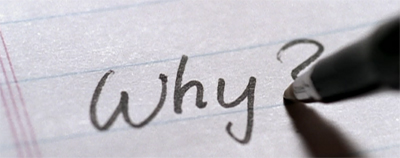
The opening scene of Closure makes it quite clear that his will be a Hollis-centric episode. While a senseless murder in a cheap hotel provides the sting leading into the credits, the teaser opens with Emma Hollis wandering through a graveyard and narrating to an unseen character. “I spend my days looking for reasons,” Hollis narrates. “The reasons people do what they do. It’s my job, it’s my way. I want to know why. Why it’s like this. Why good people die.” So it is quite clear where Closure is going from the outset.

Closure works reasonably well. It is much more modest episode than something like The Innocents, Exegesis, TEOTWAWKI, … Thirteen Years Later or Skull and Bones. It is an episode that feels like a conscious attempt to pull the show back towards the first season, hinting at an efficient serial killer procedural. Closure feels like a first season episode, and not just because of the procedural element. The decision to give Hollis a childhood trauma as motivation feels like a rather lazy way to flesh out her character. It is efficient, but it does feel a little too easy.

Smile!

Smile!

Continue reading

Millennium – TEOTWAWKI (Review)

This July, we’re taking a trip back in time to review the sixth season of The X-Files and the third (and final) season of Millennium.

The best thing that can be said about TEOTWAWKI is that it knocks quite a few items off Chris Carter’s “millennial anxieties” checklist – touching on issues of school shootings, gun control, Y2K, anarchy, survivalism, and a few more.

There are some good and interesting ideas in TEOTWAWKI. It is written by Chris Carter and Frank Spotnitz, the first script credited to either writer since the first season of the show. It seems like both writers were clearly thinking about Millennium while working on the fifth season of The X-Files, storing up ideas for late use. TEOTWAWKI is not a script suffering from a lack of ideas. In fact, it has too many ideas packed too tightly. The script isn’t particular graceful; none of the threads dovetail as neatly into one another as they really need to.

Blood money...

Blood money…

This is a recurring theme across the third season of Millennium. There are shows with interesting and compelling ideas, but they are mixed together in a way that doesn’t work – often mingling with some of the more unfortunate creative decisions driving the show. Episodes in the third season frequently feel like curate’s eggs – scrambled messes with good bits and bad bits that are ultimately impossible to separate. TEOTWAWKI might be an interesting mess, but it is still a mess.

TEOTWAWKI makes it clear that The Innocents and Exegesis were not a rough spell as Millennium tried to find its sea legs. This is the way that things will be going forward, at least for a while.

"Doomsday Defense" was a better read...

“Doomsday Defense” was a better read…

Continue reading

Millennium – Exegesis (Review)

This July, we’re taking a trip back in time to review the sixth season of The X-Files and the third (and final) season of Millennium.

It is odd to think of The Innocents and Exegesis as a two parter, despite the explicit “to be continued” that bridges the two episodes.

The Innocents is very much a straightforward procedural episode, with Frank rejoining the FBI and investigating a string of mysterious occurrences that are all connected. As Frank tries to pull himself back together after the death of his wife, various parties insist that he is more lost than ever before. There is a sense that Frank needs to work though what happened to him, regardless of the doubts expressed by his embittered father-in-law or his friendly supervisor at the FBI. Of course others doubt him, and of course he works through those doubts.

"I can see it all clearly..."

“I can see it all clearly…”

It is very much a standard “lead character gets his life back together” story, complete with obligatory sequence where Frank demonstrates he has made his peace with the loss of Catherine by using his story as emotional leverage to ply a confession (or, at least, an explanation) from a person of interest in the on-going investigation. The Innocents is a very banal and paint-by-numbers episode of television. Underneath all those biohazard warnings and eerie blue-eyed siblings, there is a strong procedural element to The Innocents. It feels trite and coy.

At the very least, Exegesis is more unique. It feels like an episode of Millennium, rather than some generic dime-a-dozen procedural. This is likely down to the fact that The Innocents was written by Michael Duggan and Exegesis was written by Chip Johannessen. Michael Duggan was a writer who had a lot of experience on procedurals (Law & Order and C-16: FBI), but who had no prior experience writing Millennium. Hired to run the show in its third year, he would only write two scripts for the show before departing seven episodes into the season.

Go fly a kite...

Go fly a kite…

In contrast, Chip Johannessen had helped to define Millennium’s identity in its first year. In fact, with a group of nearly identical female sisters working towards a mysterious goal (based on vague prophecy), Exegesis owes a great deal to Johannessen’s earlier script Force Majeure. While it does illustrate how Exegesis feels like a more traditional Millennium episode than The Innocents, it is not a comparison that does Exegesis any favours. Force Majeure was one of the best episodes the show ever produced; Exegesis is… not.

As with The Innocents, Exegesis is handicapped by a lot of the clumsy production decisions made at the start of the third season. It feels curiously disconnected from what came before; it plays a little too much like a reheated leftover from The X-Files; a lot of the nuance and development given to Peter Watts and the Millennium Group over the second season is washed away. Nevertheless, it does have a clearer sense of purpose and energy than The Innocents. It feels like Johannessen knows what he wants to say, even if the show is still tripping over itself.

Welcome back, Frank.

Welcome back, Frank.

Continue reading

Millennium – The Innocents (Review)

This July, we’re taking a trip back in time to review the sixth season of The X-Files and the third (and final) season of Millennium.

So, how do you write your way out of the end of the world?

To be fair, it is not an easy assignment. The Fourth Horseman and The Time is Now are two spectacular pieces of television, but they arguably work better as a series finalé than a season finalé. Once Fox decided to renew Millennium for a third season, the biggest problem facing the staff was the challenge of writing around the apocalypse that had arrived at the end of the second season. It is a problem that hobbled the third season of Millennium coming out of the gate. However, it was not the only such problem.

Guess who's Black?

Guess who’s Black?

Millennium is a show that feels particularly disjointed from year-to-year. It has been argued – quite convincingly – that Millennium was really three different shows, and that no two seasons of Millennium convincingly resemble one another. The third season of Millennium would be a different beast than the second. The Innocents and Exegesis demonstrate that clearly and quite articulately. The two-part season premiere made it quite obvious that Millennium was no longer a show particularly interested in ideas of apocalypse – whether global or personal.

Unfortunately, it seemed like the show had no real idea of what it wanted to be.

"Yep, this is what Chris Carter found when he took the show back."

“Yep, this is what Chris Carter found when he took the show back.”

Continue reading

John Rozum and Alex Saviuk/Charles Adlard/Gordon Purcell’s Run on The X-Files (Topps) (Review)

This May and June, we’re taking a trip back in time to review the fifth season of The X-Files and the second season of Millennium.

It is amazing to think that Topps’ licensed comic book tie-in to The X-Files lasted three-and-a-half years, let alone that it was such a success that it spawned a second on-going series, a miniseries and a considerable volume of one-shots and digests and annuals. If anything, Topps enjoyed greater success exploiting the license than even IDW has – despite the fact that Topps was a relatively young company with minimal experience in comic book publishing while IDW has a reputation for (and a lot of experience at) skilfully leveraging these sorts of tie-in properties.

This success would be remarkable in any context, but the comic book succeeded at a time of turmoil for the entire comic book industry. The late nineties were not a good time for comics, with the speculation bubble imploding and Marvel filing for bankruptcy. The success of Topps’ X-Files comic book is in many way a triumph of the brand, yet another reminder of how the series was on top of the world. There were lots of others – the ratings, the film, the tie-in video game – but the success of the comic was part of the narrative of The X-Files at this stage of its life.

xfiles-remotecontrol10

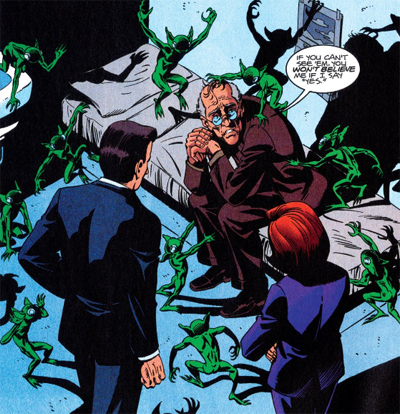
The comics themselves are actually surprisingly good. There is a reason that one of the first things that IDW did upon receiving the license was to publish “classic” collections of these comics. One of the more interesting aspects of the monthly series was the way that it managed to feel like The X-Files while still seeming suited to the medium in question. Stefan Petrucha and Charles Adlard pitched their run as something akin to a Vertigo comic, feeling like a crossover between The X-Files and the work of Grant Morrison or Neil Gaiman.

The influences on John Rozum’s run are a lot less ambitious. Time and time again, Rozum seems to position his run on The X-Files as a rather strange hybrid between the first season of the television series and pulpy fifties horror comics. There are quite a few stories in Rozum’s run that might easily be read alongside Fantagraphics’ E.C. Comics archives, albeit guest starring Mulder and Scully. (And modern fashions. And phones. And so on.) It is a perfectly reasonable and legitimate way to approach the idea of “X-Files comic books.”

xfiles-beprepared3

Indeed, it seems especially reasonable given the existing tensions between Ten Thirteen and Topps over the comics. The relationship had been fraught since the early days of the comic, with Ten Thirteen objecting to both Petrucha’s dense and ambitious plotting and Adlard’s moody and atmospheric art. Petrucha was fired from the title after sixteen issues, while Adlard was phased out in favour of better likeness artists like Gordon Purcell or Alex Saviuk. Ten Thirteen wanted a safer and more conventional comic book under Rozum’s pen, and they got it.

While it is easy to understand why these creative decisions were made, it does not make them any more palatable. Rozum’s work on The X-Files is generally quite consistent and occasionally even impressive. But it seldom seems ambitious or exciting. Under Petrucha, the tie-in comic carved out its own space that intersected with the parent show. Under Rozum, the comic book seems to do nothing but skirt the margins.

xfiles-cropduster2

Continue reading

Non-Review Review: Magic Mike XXL

Well, if you’re going to do a sequel, it’s not a bad bet to go bigger.

Magic Mike XXL is a film that knows exactly what its audience wants, making a point to emphasise that this same attribute is what makes the “male entertainers” at the heart of the film so special. At one point, young heart throb Ken serenades his audience with a D’Angelo’s Untitled (How Does It Feel?), perfectly setting for the tone. Magic Mike XXL knows what its viewers are demanding, and dedicates itself to shamelessly satisfying their needs. The audience wants more, and they get more.

The problem with Magic Mike XXL is that it goes just a little bit too big. Bigger is not always better, as “male entertainer” (“Big”) Dick Richie discovers, spending the entire movie searching for the metaphorical “glass slipper.” The original Magic Mike ran a little bit too long at ten minutes short of two hours. Magic Mike XXL extends that runtime by twenty minutes. The result is a film that feels rather bloated. The pacing could be tighter. Some trimming and cutting might have served the film well.

Nevertheless, Magic Mike XXL maintains a lot of the charm and positive energy that made the original such a surprise hit. There is nothing wrong with trying to please your audience, even if there is such a thing as too much teasing.

Is the magic back?

Is the magic back?

Continue reading

Non-Review Review: The X-Files – Fight the Future

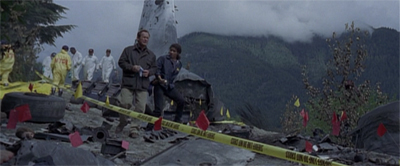
The X-Files: Fight the Future is often described as the mythology episode that somehow got released into theatres. In her review, Joyce Millman teased that Fight the Future was little more than “a two-hour episode of the show, except with better production values and a nicer wardrobe for Scully.” It is a fair point. It is not too hard to imagine a slightly cheaper version of Fight the Future split into two parts and replacing The End and The Beginning as the two-parter bridging the fifth and sixth seasons of the show.

Certainly, Fight the Future retains the late-stage mythology’s reluctance to provide any real sense of closure to the long-running plot about alien invasion and colonisation. Writers Chris Carter and Frank Spotnitz increase the stakes by using some of that sweet blockbuster money to pay for a gestating alien fetus, but what do Mulder and Scully actually accomplish? What would a viewer jumping from The End to The Beginning miss, except for the fact that the Well-Manicured Man has left the mortal plane to visit that great Somerset estate in the sky?

What you've all been waiting for, admit it...

What you’ve all been waiting for, admit it…

The answer is nothing, but that is not the point. As much as Fight the Future enjoys playing with the trappings of the mythology (black oil! bees! tanker trucks! space ships! Oklahoma City!), the film is only interested in the idea of alien colonisation as a vehicle to explore the show’s central relationship. Carter and Spotnitz have shrewdly realised that Fight the Future will have the largest possible audience for the show, and has decided to give the general public what they want.

As a two-hour mythology episode, Fight the Future leaves a lot to be desired. As a two-hour Mulder and Scully ship tease, it is right on the money.

Buried secrets...

Buried secrets…

Continue reading

Non-Review Review: Love and Mercy

The music biography is a surprisingly familiar genre.

For all that there are thousands upon thousands of musicians with their own life stories and histories, the plotting of these sorts of stories always seems to hit on the same beats. The rhythm and tempo might change, but the notes feel the same. This was rather strongly pronounced a decade ago, when Walk the Line and Ray were released in quick succession and Walk Hard: The Dewey Cox story provided a delightfully surreal skewering of the conventions associated with these sorts of films.

Where there's a Wilson, there's a way, son...

Where there’s a Wilson, there’s a way, son…

There is always a childhood trauma at the root of the story; whether it is a dead relative or parental abuse, there is always a suitable motivator for artistic expression. Similarly, fame is always something of a mixed blessing, with material success only serving to exaggerate a larger spiritual emptiness. Dependencies come rather naturally, whether on drugs or on other people. Eventually, it seems like true love allows our protagonist to find themselves before they find their happy ending. Having a ready-made (and thematically appropriate) soundtrack probably helps.

In most cases, the material is elevated by the skill with which the story is put together. If the film must hit all those familiar notes, then the moving parts make all the difference. Walk the Line and Ray were buoyed by mesmerising central performances from actors at the peak of their game. Love and Mercy hits a lot of these common plot beats as it maps out the troubled life of Brian Wilson. Even a viewer unfamiliar with the arc of Wilson’s life will have a pretty good idea of what to expect from the film.

That sinking feeling...

That sinking feeling…

At the same time, Love and Mercy benefits from a collection of strong performances. Paul Dano and John Cusack play the musician at various stages of his life, jumping back and forth between his controversy-creating career highs and subsequent lows. The bulk of the supporting cast is teamed up with Cusack, creating an interesting circle of characters around Wilson in the late eighties and into the nineties. Elizabeth Banks is Melinda Ledbetter, a Cadillac saleswoman who gets caught up with Wilson. Paul Giammatti is controversial psychotherapist Dr. Eugene Landy.

Love & Mercy is at its best when it feels playful and accessible, and is at its worst when it feels familiar and well-trodden. It is a fascinating sketch at the life and times of Brian Wilson, with a recognisable structure elevated by a great ensemble.

Pet sounds...

Pet sounds…

Continue reading