• Following Us

  • Categories

  • Check out the Archives


  • Awards & Nominations

Star Trek: Enterprise – Future Tense (Review)

Next year, Star Trek is fifty years old. We have some special stuff planned for that, but – in the meantime – we’re reviewing all of Star Trek: Enterprise this year as something of a prequel to that anniversary. This April, we’re doing the second season. Check back daily for the latest review.

The Temporal Cold War arguably works better as a metaphor than a plot.

There is something quite compelling about the imagery of Star Trek‘s past and future doing battle within the confines of a troubled prequel, of outside forces meddling in a narrative, of the characters caught in the grip of forces they cannot understand. To expect the Temporal Cold War to make sense is to miss the point; to expect clear resolution is foolhardy. Instead of serving as a strong narrative thread running through Star Trek: Enterprise, it serves as a visual manifestation of the troubles haunting the show. It also serves as a very effective story backdrop.

Let's do the time warp again...

Let’s do the time warp again…

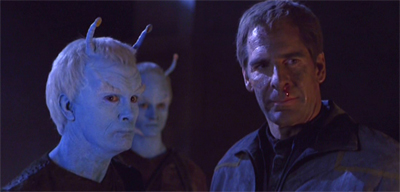
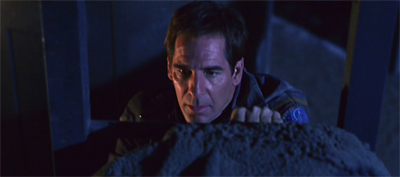
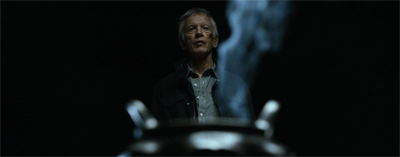
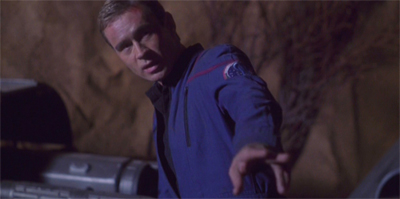
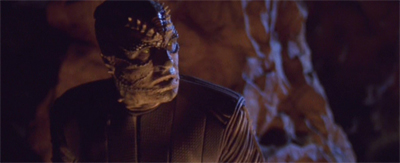
Future Tense has a pretty straightforward story. Archer and his crew discover a piece of floating space debris. They bring it aboard, discovering it is not what it appears to be. The Suliban show up, claiming salvage rights. The Tholians arrive, demanding the same. A chase ensues, as Archer tries to outrun the two alien species desperate to get their hands on the technology. Future Tense is a classic chase narrative, as multiple parties fight over what Hitchcock described as a “macguffin.” Little is revealed, nothing is proven, everything is resolved so neatly that it seems divine intervention is at work. Maybe it is.

And yest, despite – or perhaps because – of this narrative simplicity, Future Tense stands as a highlight of the troubled second season. Future Tense leaves almost every question about the Temporal Cold War unanswered, but it is a tight and efficient action adventure. Like Cold Front before it, it recognises that the Temporal Cold War is a story as much as a backdrop. The fact that it is mysterious and nonsensical and arbitrary make it all the more compelling. After all, that is how it must appear to Archer.
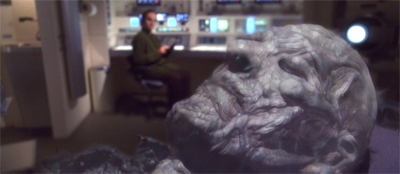
Alien bodies...

Alien bodies…

Continue reading

Daredevil – Nelson v. Murdock (Review)

To celebrate the launch of Marvel’s Daredevil and the release of Avengers: Age of Ultron, we are reviewing all thirteen episodes of the first season of Marvel and Netflix’s Daredevil. Check back daily for the latest review.

Franklin P. “Foggy” Nelson is perhaps the most constant fixture of Matt Murdock’s personal life.

The lawyer was created by Stan Lee and Bill Everett for the first issue of the comic, published in April 1964. It seems like Foggy has always been there for Matt in one form or another. “Nelson and Murdock” is the heart of Matt Murdock’s life as a lawyer, and so Foggy is generally around to deal with the fallout from whatever crisis has engulfed Matt’s life from one moment to the next. However, Foggy is notable because he is really the only member of the Daredevil cast who can be described as a “regular” character since the book’s inception.

daredevil-nelsonvmurdock2

Despite the fact that Stan Lee and Bill Everett were clearly inspired by The Amazing Spider-Man, Daredevil never developed an ensemble with quite the same depth and breadth. While casual comic book fans can list off dozens of Peter Parker’s friends and colleagues from the earliest years, Matt Murdock has always had a rougher time building up a steady and reliable supporting cast. Part of this is undoubtedly down to the book’s difficulty finding its own identity. Characters came and went as the creative team tried new directions.

Through all of that, Foggy stuck around.

daredevil-nelsonvmurdock5

Continue reading

Star Trek: Enterprise – Cease Fire (Review)

Next year, Star Trek is fifty years old. We have some special stuff planned for that, but – in the meantime – we’re reviewing all of Star Trek: Enterprise this year as something of a prequel to that anniversary. This April, we’re doing the second season. Check back daily for the latest review.

It is weird to think that Star Trek was dying in early years of the twenty-first century.

After all, the original series had greatly increased its cultural cachet at the height of the Cold War. The adventures of James Tiberius Kirk offered an optimistic alternative to total nuclear annihilation and a doomsday clock that was rapidly approaching midnight. Logic would suggest that utopian fantasy was all the more essential when contrasted against harsh reality. In fact, it seemed like cynicism and pessimism thrived in the (relatively) peaceful and prosperous decade following the collapse of the Cold War. The X-Files and Star Trek: Deep Space Nine were inescapably products of the nineties.

I'm blue dabba dee dabba dii...

I’m blue dabba dee dabba dii…

So one imagines that the dread and fear that took root in the wake of 9/11 might somehow make the optimism and hope of Star Trek all the more essential. After all, pundits and commentators wasted no time in suggesting that irony and cynicism were passé. Stephen Thompson, editor of The Onion, suggested that the age of irony had ended only a week after the attacks.  Graydon Carter, editor of Variety, observed, “I think it’s the end of the age of irony. Things that were considered fringe and frivolous are going to disappear.” In a highly publicised Time article, Roger Rosenblatt rejoiced.

Of course, irony was far from dead, as films like Team America: World Police demonstrated. The Colbert Report became a cultural phenomenon. The Onion is still in business. However, the speed with which these commentators latched on to the idea of the death of irony suggested that the mood had changed perceptibly. Maybe not definitively, maybe not completely, but there was a change in the air. If ever there was a time for the optimism and the utopianism of Star Trek, it would be this particular moment.

"This is the point where everything changed..."

“This is the point where everything changed…”

However, it seemed like 9/11 eroded the franchise’s faith in utopia. Understandably – and perhaps inevitably – Star Trek: Enterprise found itself warped by images and iconography associated with the attacks. The tradition idyllic alien worlds associated with the franchise – visible in early episodes like Strange New World and Civilisation were quickly replaced by landscapes evoking the popular mood – apocalyptic cityscapes of Shadows of P’Jem and Shockwave, Part II, the deserts of Desert Crossing, the militaristic settings of Detained and The Communicator, or even the darkness of Rogue Planet.

It was as if 9/11 had warped the psychological landscape of the Star Trek universe, throwing everything into doubt. Far from responding to that real-world tragedy with optimism and hope, it seemed that Enterprise only lost certainty in itself. Cease Fire is an episode that feels plagued by self-doubt and insecurity, even as it tries to find its way back to the franchise’s trademark idealism. It may not quite find its way back to the path, but it makes a reasonable effort.

It's all in ruins...

It’s all in ruins…

Continue reading

Daredevil – Speak of the Devil (Review)

To celebrate the launch of Marvel’s Daredevil and the release of Avengers: Age of Ultron, we are reviewing all thirteen episodes of the first season of Marvel and Netflix’s Daredevil. Check back daily for the latest review.

There is an interesting inherent contradiction baked in Daredevil, perhaps mirroring the conflicts within the show’s title character.

In many respects, Daredevil is utterly unlike anything else produced by Marvel Studios. It stands quite firmly apart from the studio’s style in projects like The Avengers or Thor or Guardians of the Galaxy or Agents of S.H.I.E.L.D. The show is a lot more cynical and grounded. It is a lot more violent and gritty than anything else that the company has produced as part of their shared on-screen universe. It looks and feels quite distinct from the rest of the company’s output. It has a style and mood all of its own.

daredevil-speakofthedevil

However, for all that darkness and brooding, Daredevil is arguably the most familiar and traditional of superhero narratives produced by Marvel Studios. Matt Murdock might be more violent and brutal than any other major character in this shared universe, but he is also the most typical superhero. He is the only hero in the Marvel Cinematic Universe to have a proper secret identity. He is also the only hero in the Marvel Cinematic Universe to have a firm “no kill” rule.

This creates an absolutely fascinating conflict within the structure of the show, as Daredevil manages the wonderful task of being both the most typical and the most atypical of the Marvel Studio productions.

daredevil-speakofthedevil37

Continue reading

Star Trek: Enterprise – Stigma (Review)

Next year, Star Trek is fifty years old. We have some special stuff planned for that, but – in the meantime – we’re reviewing all of Star Trek: Enterprise this year as something of a prequel to that anniversary. This April, we’re doing the second season. Check back daily for the latest review.

It’s been a long road.

Continuing the effort in Dawn to refocus Star Trek: Enterprise on franchise core values, Stigma offers a good old-fashioned allegory episode. It is a script clearly designed to stand alongside earlier iconic Star Trek shows like A Taste of ArmageddonErrand of MercyLet That Be Your Last BattlefieldToo Short a SeasonThe High GroundHalf a LifeEthics, The Outcast, Rejoined and Distant Origin. This is a big and important episode, dealing with big and important themes. In this case, the stigma associated with HIV/AIDS and (whisper it) homosexuality.

It's just not in the show's DNA at this point...

It’s just not in the show’s DNA at this point…

Of course, it arrives well over a decade too late. Writer David Gerrold had pitched his own allegory about HIV/AIDS and homosexuality with Blood and Fire during the first season of Star Trek: The Next Generation. The script was a little clunky, but – rather than rework it – the producers decided to shut it down completely. During that show’s third season, David Livingston was on hand to stop the show from providing the franchise’s first glimpse of a homosexual couple in The Offspring. What queer content made it into Star Trek seemed somewhat haphazard.

The decision to allow Lal to chose her own gender in The Offspring is remarkable, because it goes almost unremarked. Dax’s deduction that Pel has a crush on Quark in Rules of Acquisition comes before Pel reveals that she is a female passing herself off as male. The sincerity of The Outcast was somewhat undermined by the decision to cast a female performer in the role of genderless alien who is attracted to Riker. The good work of Rejoined is undercut by the crassness of Profit and Lace and The Emperor’s New Cloak.

Meditating on a contemporary issue...

Meditating on a contemporary issue…

There was a time when an episode like Stigma would have seemed cutting edge and provocative. Broadcast during the first (or even the second) season of The Next Generation, the episode would have challenged a number of the underlying public assumptions about the spread of HIV/AIDS and attacked a very real (and very frank) homophobic policy from the government. The biggest problem with Stigma is that it features Captain Jonathan Archer instead of Captain Jean-Luc Picard.

Of course, this suggests a very tangible issue with Enterprise at this stage of its life-cycle. It still feels like a show stuck in the past. This is still Star Trek as it was being produced in 1989, despite the fact that it is now 2003. It is a problem that has haunted Enterprise since the broadcast of Fight or Flight, but one which is really emphasised not only by the plotting of Stigma, but also in its political targets.

"You know, given how often I seem to risk removal from the ship, I should probably just keep this packed..."

“You know, given how often I seem to risk removal from the ship, I should probably just keep this packed…”

Continue reading

Daredevil – Shadows in the Glass (Review)

To celebrate the launch of Marvel’s Daredevil and the release of Avengers: Age of Ultron, we are reviewing all thirteen episodes of the first season of Marvel and Netflix’s Daredevil. Check back daily for the latest review.

Much like Stick, Shadows in the Glass emphasises the relatively episodic nature of Daredevil.

If Stick was “the mystical ninja tie-in episode”, then Shadows in the Glass is the obligatory “villain episode.” This is evident in the choice to open with a teaser dedicated to the morning routine of Wilson Fisk. It is a nice structural choice to repeat the sequence two more times, once at the midpoint and once towards the end. The second iteration of the sequence plays much the same as the first, but the third version plays out with both Wilson Fisk and Vanessa Marianna, suggesting that Fisk is no longer as alone as he claimed to be in Rabbit in a Snowstorm.

daredevil-shadowsonglass3

Daredevil is a show that really does take advantage of its format to flesh out and develop the world of Matthew Murdock. It would have been easy to structure Daredevil as a simply thirteen-hour origin story with a reasonably high budget. However, the show capitalises on the extra space afforded to a thirteen-episode season. None of the Marvel films could afford to devote fifty minutes of character development to the antagonist, and even Loki has never been given as much narrative attention as Fisk. (Only Michael Fassbender’s Magneto can compete with Vincent D’Onofrio’s Fisk.)

Shadows in the Glass provides Wilson Fisk with a supervillain origin story very clearly designed to mirror that of Matt Murdock.

daredevil-shadowsonglass6

Continue reading

Daredevil – Stick (Review)

To celebrate the launch of Marvel’s Daredevil and the release of Avengers: Age of Ultron, we are reviewing all thirteen episodes of the first season of Marvel and Netflix’s Daredevil. Check back daily for the latest review.

Sitting smack bang in the middle of the season, Stick is something of an oddity.

It demonstrates just how episodic Daredevil can be in structure. Stick lets its focus move away from Matt’s conflict with Wilson Fisk, offering an episode built around a guest star and shedding some light on one of the members of Fisk’s cabal. “Ride with me tonight,” Stick urges Matt. “Help me destroy Black Sky, keep it off the streets, and I promise you this: Wilson Fisk will know the taste of fear the day he faces you ’cause he’ll know that you kicked the guy he’s afraid of right in the nuts.” Fisk is still a target here, albeit one temporarily shifted to the background.

daredevil-stick20

There are obviously ripples from Stick that reverberate through the rest of the season. Nobu’s loss here helps to mount more pressure on Fisk in Shadows in the Glass, while it leads to a very physical confrontation between Nobu and Matt in Speak of the Devil. At the same time, it remains curiously disengaged from the show around it. Despite the fact that the casting of Scott Glenn was announced with the fanfare reserved for primary cast members like Rosario Dawson or Vincent D’Onofrio, this is his only appearance in the whole thirteen-episode season.

Of course, there might very well be a reason for this. Stick is the only episode of the first season with a closing scene that hints at something far beyond the scope of this individual show – a coming “war” between mystical and magical forces. In some ways, Stick feels like it takes advantage of the episodic structure of a thirteen-episode season to relegate all the obligatory set-up and world-building for material outside the show to a single episode in the middle of the season. This is perhaps the ideal place for it, not distracting from the beginning or the end of the run.

daredevil-stick5

A lot of this feels like set-up for the Defenders project that will unite all four of the Netflix and Marvel miniseries, bringing together characters like Matt Murdock, Jessica Jones, Luke Cage and Danny Rand to fight an incredible evil in much the same way that The Avengers brought together Iron Man, Captain America, Thor and Hulk. Stick seems to allude to something decidedly more epic in scope than the details of this individual thirteen-episode run. It is, essentially, the second act of Iron Man 2 structured as a mid-season episode of Daredevil.

However, it all works. Stick might be divorced from the larger plot concerns of the season around it, but it never loses sight of its main characters. After a run of episodes focusing on Wilson Fisk, Stick brings the focus back to Matt Murdock. The return of Matt’s childhood mentor might be tied to some larger plot, but it also helps explain Matt’s character a bit more. Meeting Stick, we get to know a little bit more about how Matt ended up this way.

daredevil-stick

Continue reading

Daredevil – Condemned (Review)

To celebrate the launch of Marvel’s Daredevil and the release of Avengers: Age of Ultron, we are reviewing all thirteen episodes of the first season of Marvel and Netflix’s Daredevil. Check back daily for the latest review.

So, let’s talk about Frank Miller.

daredevil-condemned3

Continue reading

Star Trek: Enterprise – Dawn (Review)

Next year, Star Trek is fifty years old. We have some special stuff planned for that, but – in the meantime – we’re reviewing all of Star Trek: Enterprise this year as something of a prequel to that anniversary. This April, we’re doing the second season. Check back daily for the latest review.

Dawn arrives at a very delicate moment in Star Trek history.

Star Trek: Nemesis had hit cinemas the weekend before The Catwalk aired. It had been an immediate and humiliating disaster for Paramount. It arrived in a stuffed Christmas season, amid a relentless onslaught of big budget blockbuster fare – competing for space against Harry Potter and the Chamber of Secrets, Die Another Day and Lord of the Rings: The Two Towers. It was the first Star Trek film not to open at the top of the United States box office, landing second to Maid in Manhattan.

Engineering a solution...

Engineering a solution…

The prognosis for Star Trek as a franchise had not been particularly optimistic for quite some time. The ratings had been in decline since Star Trek: The Next Generation went off the air. Star Trek: Enterprise was airing on a dying network. Changing management at UPN was less friendly to the franchise than it had been. However, the spectacular failure of Star Trek: Nemesis was perhaps the most public blow the franchise had taken. The critics now had ammunition; the vultures were circling; the franchise was on the ropes for the world to see.

The Catwalk had aired a few days after Nemesis crash-landed, when the franchise was still reeling. The first episode of Star Trek to air in 2003, Dawn was broadcast after the franchise and the public had time to properly process the disaster. It goes without saying that there was a lot of pressure on the episode.

Alien nation...

Alien nation…

Continue reading

Non-Review Review: Avengers – Age of Ultron

Avengers: Age of Ultron is a hot mess.

It is fun, witty and fast-moving. However, it is also disjointed, uneven and awkward. Age of Ultron is a big and bombastic summer blockbuster, but it feels like Marvel learned very little from The Avengers. Rather than simply taking what worked in the first film, it often seems like Age of Ultron doubles down on every part of its predecessor. There’s more action, there’s higher stakes, there’s bigger conflict, there’s more Tony, there’s even less of an idea what to do with Thor, there’s more continuity.

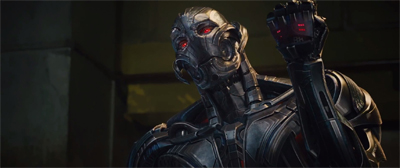
"Hey, at least I beat the Terminator prequel to cinemas, right?"

“Hey, at least I beat the Terminator prequel to cinemas, right?”

“More” seems to the be the word here. Age of Ultron is bigger than its predecessor in just about every way. The film boasts an ensemble so large that it threatens to collapse under its own weight – a fact perhaps wryly acknowledged by the genocidal robot’s evil plan at the climax. While it is nice to have more diversity in the cast – The Avengers are no longer a bunch of white guys and their token female colleague – it does seem like Age of Ultron strains and groans under all that Joss Whedon and Marvel heap upon it.

Bigger is not always better.

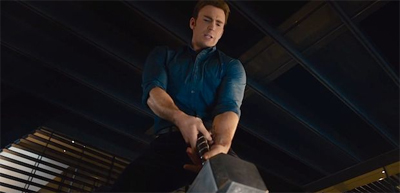
You know, "pull Thor's hammer" is probably not a family friendly party game...

You know, “pull Thor’s hammer” is probably not a family friendly party game…

Continue reading