• Following Us

  • Categories

  • Check out the Archives


  • Awards & Nominations

Star Trek: Enterprise – Cogenitor (Review)

Next year, Star Trek is fifty years old. We have some special stuff planned for that, but – in the meantime – we’re reviewing all of Star Trek: Enterprise this year as something of a prequel to that anniversary. This April, we’re doing the second season. Check back daily for the latest review.

Cogenitor is a brutally subversive gut-punch.

Coming towards the end of the second season, on the cusp of major changes to the way that Star Trek: Enterprise would be run, Cogenitor is structured as a piece of self-aware criticism of the moral methodology of the Star Trek franchise as a whole. For most of its runtime, Cogenitor plays as a stock Star Trek narrative. Confronting a perceived injustice in an alien culture he just met, Trip takes it upon himself to set things right – to make life better for an oppressed minority. His heart is in the right place; the narrative repeatedly assures us that his position is justified.

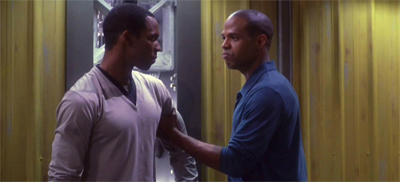
Guilt Trip.

Guilt Trip.

However, Trip’s solution to this moral dilemma is inadequate. Trip follows the standard Star Trek rule book for a situation like this – he does not cause a scene with the alien culture, instead respectfully empowering the oppressed individual by exposing them to the wonders of the universe so that they might change their world themselves. Trip exposes the eponymous cogenitor to humanist ideals and philosophy, offering his guest a new way of looking at the cosmos. It is sweet, touching and heartwarming.

Then it goes horribly wrong. Refusing to grant amnesty to the cogenitor, which had taken the name “Charles”, Enterprise warps off into the distance in search of new adventures and new opportunities. Any other episode of Enterprise would end there, but Cogenitor affords itself a four-minute coda which reveals the oft-overlooked consequences of this sort of casual meddling in the affairs of others. Through a combination of circumstances and decisions, Archer and Trip find that what should have been a triumphant humanist narrative became a tragedy.

A literal Star Trek.

A literal Star Trek.

Cogenitor feels like a criticism of the moral methodology of Star Trek; of the familiar episodic storytelling pattern that has our heroes warp away from complex situations after imposing their own morality on a culture they only just encountered. It is not too hard to imagine similar brutal twist endings or earlier Star Trek stories like The Hunted or Who Watches the Watchers? There is a sense that Cogenitor is making a none-too-subtle criticism of the assumptions that the Star Trek franchise has taken for granted over the years.

Cogenitor rejects the idea that fleeting engagement with other cultures can be sure to have the desired result. It is a point that feels particularly appropriate at the tale end of the second season of Enterprise, as the franchise was ready to make a (relatively) clean break from that kind of rigidly episodic storytelling. However, it also reflects an awareness of more nuanced and complicated political and social realities in the midst of the War on Terror. It would be nice to believe that societies can be “fixed” as easily as Kirk or Picard suggested, but the reality is decidedly more difficult.

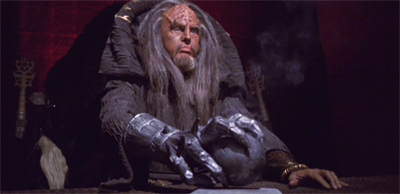
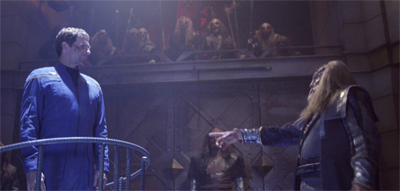
The water polo ball is in Archer's court...

The water polo ball is in Archer’s court…

Continue reading

Star Trek: Enterprise – The Breach (Review)

Next year, Star Trek is fifty years old. We have some special stuff planned for that, but – in the meantime – we’re reviewing all of Star Trek: Enterprise this year as something of a prequel to that anniversary. This April, we’re doing the second season. Check back daily for the latest review.

One of the more interesting aspects of a heightened franchise like Star Trek is the way that invites particular members of staff to define their own voices. On most of the Star Trek shows, it is easy to distinguish the work of particular writers from one another. Ronald D. Moore likes militarism and world-building; Brannon Braga likes time travel and classic science-fiction. There are clear voices that can be distinguished from the choir on each of the shows, for better or for worse.

Although it enjoyed a considerably shorter run than the other Star Trek spin-offs, Star Trek: Enterprise is no exception.  The Breach is a script credited to writers Chris Black and John Shiban. The two had collaborated unofficially on Canamar, a script credited to Shiban alone. The two would work together again on First Flight towards the end of the season. It is certainly a partnership that had considerable potential, if not for Shiban’s departure at the end of the season.

What's up, Doc?

What’s up, Doc?

In many respects, The Breach feels like the product of those two voices. Xenophobia is a major theme of The Breach – as it was in Shiban’s other scripts for the season like Minefield, Dawn or Canamar. Like their last collaboration on Canamar and their future collaboration on First Flight, it seems The Breach presents a more balanced version of Archer than episodes like The Crossing or Horizon. This is a version of Archer who feels compelled to do the right thing, but without the same oppressive self-righteousness that drives his more awkward moments.

However, it seems like Chris Black provides The Breach with its very traditional and old-fashioned Star Trek aesthetic. A veteran of genre television with an understanding of the narrative conventions associated with the franchise, Black understands how Star Trek storytelling is supposed to work. The Breach is perhaps a little too formulaic and traditional in its storytelling, but it does demonstrate that – despite its best efforts – The Crossing had not completely buried a certain optimistic strain of Star Trek ethics.

Into darkness...

Into darkness…

Continue reading

Star Trek: Enterprise – Horizon (Review)

Next year, Star Trek is fifty years old. We have some special stuff planned for that, but – in the meantime – we’re reviewing all of Star Trek: Enterprise this year as something of a prequel to that anniversary. This April, we’re doing the second season. Check back daily for the latest review.

Horizon takes us backwards.

Early in the episode, the Enterprise is redirected to investigate a strange interstellar phenomenon. “This system’s almost thirty light years behind us,” Mayweather observes. Archer responds, “Admiral Forrest assures me it’s only a temporary detour.” This is largely what Horizon feels like, a journey back to the first season of Star Trek: Enterprise. Horizon is a deathly dull episode, but it would be more tolerable had it aired early in the first season. At least it is not as offensive as Unexpected or Terra Nova.

"A Travis episode? I'll be right there!"

“A Travis episode? I’ll be right there!”

There is something particularly regressive about Horizon, as if the episode is a relic of the show that Enterprise used to be. It focuses on human space exploration outside of Starfleet, as promised in episodes like Terra Nova or Fortunate Son. It gives the audience another glimpse into “boomer” life and even opens with Mayweather relaxing in “the sweet spot”, the first time that the audience has seen that location since Broken Bow. Even the plot feels like a retread of first season episodes – a strange hybrid of Fortunate Son and Silent Enemy.

The character beats are no better. Horizon struggles to construct a credible character-driven story for Mayweather. Unable to figure anything out, the show decides to saddle him with the same character arc that Hoshi repeated in episodes like Fight or Flight, Sleeping Dogs or Vox Sola. The problems are compounded by the script’s lack of trust in Anthony Montegomery to carry the himself, leading to an extended (and dull) first act and a padded (and dull) subplot. If Judgment made a sterling defense of Enterprise, Horizon is a damning argument for the prosecution.

Freight stuff...

Freight stuff…

Continue reading

Star Trek: Enterprise – Judgment (Review)

Next year, Star Trek is fifty years old. We have some special stuff planned for that, but – in the meantime – we’re reviewing all of Star Trek: Enterprise this year as something of a prequel to that anniversary. This April, we’re doing the second season. Check back daily for the latest review.

Judgment is the first episode of Star Trek to do something interesting with the Klingons since Tacking Into the Wind, almost four years earlier.

After all, it never seemed like Star Trek: Enterprise had any real idea what to do with the Klingons. The show had made use of Klingons in Broken Bow, Unexpected, Sleeping Dogs and Marauders – but none of these episodes seemed particularly interested in telling a story about Klingons. Enterprise seemed primarily interested in the Klingons as a connection to the franchise’s long and distinguished history. After all, Klingons are almost as iconic a part of Star Trek as Spock; working a few bumpy-headed warriors into your script was a nice way of acknowledging the Star Trek legacy.

Trial of the twenty-second century...

Trial of the twenty-second century…

Certainly, Enterprise was not interested in committing to the same Klingon world-building in which Star Trek: The Next Generation and Star Trek: Deep Space Nine had revelled. There are a lot of reasons for this. Over ten seasons, writer Ronald D. Moore had probably said just about everything that needed to be said about the Klingons; trying to say something new or interesting without his input was certainly daunting. More than that, Enterprise had committed itself quite firmly to episodic storytelling in its first two years; even the Andorians and Vulcans were still barely developed.

So David A. Goodman’s script for Judgment is ambitious, particularly in light of the spectacular failure of his (heavily re-written) work on Precious Cargo. Constructing an episode that might easily be misread as a rehash of Star Trek VI: The Undiscovered Country was a pretty bold choice, particularly given the problems that the show had endured while trying to construct an homage to Elaan of Troyius and The Perfect Mate. On paper, Judgment is an assignment that could easily explode spectacularly. It might not be as crazy a gambit as A Night in Sickbay, but it is a story with lofty objectives.

The court has spoken.

The court has spoken.

With so much of the second season feeling like it is running on auto-pilot, the energy and enthusiasm of Judgment is infectious. Singularity, Vanishing Point, Canamar and The Crossing felt like they were constructed using blueprints of what a Star Trek episode should look like. It is refreshing to watch an episode of Enterprise that seems genuinely excited to playing with these particular toys. In that sense, Judgment sets the mood for the final stretch of the season – despite duds like Horizon and Bounty, the final run of episodes feels like a band playing an encore for a show on the cusp of monumental change.

Although not facing the same threat of cancellation that loomed at the end of the third and fourth seasons, the second season of Enterprise feels like the last gasp of a particular model of Star Trek production, one no longer as viable as it once had been. Starting with Judgment, the show seems to acknowledge that things are going to have to change dramatically and soon; however, there is a clear attempt to bid this particular iteration of Star Trek a fond farewell. As such, any and all references to The Undiscovered Country feel entirely appropriate.

“Don’t wait for the translation! Answer me now!”

Continue reading

Daredevil – Daredevil (Review)

To celebrate the launch of Marvel’s Daredevil and the release of Avengers: Age of Ultron, we are reviewing all thirteen episodes of the first season of Marvel and Netflix’s Daredevil. Check back daily for the latest review.

In a way, the biggest problem with origin stories is that you know where they have to end up.

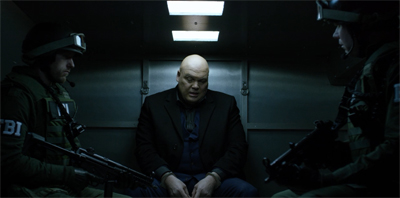
It is easy enough to predict the ending of the first season of Daredevil. Matt Murdock is the costumed superhero who dresses up as a devil to fight crime in Hell’s Kitchen. He practices law with his best friend at “Nelson and Murdock.” Wilson Fisk has embraced his identity as a supercriminal in his own right. His plans to redevelop Hell’s Kitchen are soundly defeated. Evidence is put in the hands of the authorities, allowing our heroes to be exonerated and our villains to be identified.

daredevil-daredevil10

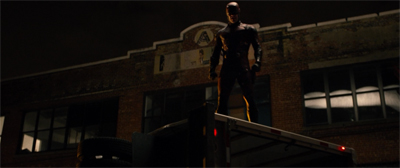
It is a very clear arc, because it has to end somewhere close to where every Daredevil story begins. Indeed, even the title of the episode alludes to that. This is the point at which Matt Murdock ceases to be “the Devil of Hell’s Kitchen” or “the Man in the Mask.” This is the point at which he formally adopts the name “Daredevil.” This is the point at which he puts on a live action version of his iconic costume. This is the point at which the show stops being a Daredevil origin story and becomes just a Daredevil story.

So it makes sense that Daredevil feels a little bit anticlimactic and a little bit overly familiar. The episode doesn’t fight the pull of gravity that draws it towards the inevitable status quo. Despite the shock at the end of The Ones We Leave Behind, the season finalé offers no real shock or twist or subversion. It is exactly what it claims to be. It is functional, efficient and clean. It is not a bad ending by any means. In fact, it is quite satisfying. At the same time, it does feel just a little too tidy and neat for its own good.

daredevil-daredevil14

Continue reading

Star Trek: Enterprise – The Crossing (Review)

Next year, Star Trek is fifty years old. We have some special stuff planned for that, but – in the meantime – we’re reviewing all of Star Trek: Enterprise this year as something of a prequel to that anniversary. This April, we’re doing the second season. Check back daily for the latest review.

The Crossing represents a troubling return to form for the second season of Star Trek: Enterprise in a number of ways.

In terms of basic storytelling, the show is back at the point where it is simply throwing Star Trek plots into a blender and serving up a rather unappetising smoothy. The Crossing is packed with familiar Star Trek tropes – it is Return to Tomorrow by the way of Power Play through Cathexis. The idea of non-corporeal entities hijacking living bodies is not particularly novel, and The Crossing really has nothing new to offer in terms of that sort of story. There is no element of The Crossing as fun as Leonard Nimoy’s performance in Return to Tomorrow or the hostage crisis stakes of Power Play.

Here's Trip!

Here’s Trip!

However, even without the feeling of reheated leftovers, The Crossing is a very ugly little story. It reflects the reactionary post-9/11 politics of the show, the sense of isolationism and xenophobia that have become part of the fabric of Enterprise. The Crossing is essentially a fifties horror film repurposed as a post-9/11 cautionary tale about the dangers of trusting people who are not like you. It feels like a pretty solid indication of just how thoroughly Star Trek has lost its way. The decision to just externalise these anxieties in The Expanse is long overdue.

The fact that The Crossing is credited to the two showrunners driving Enterprise is quite worrying, particularly given that it serves to express an uncomfortable subtext running through the season.

Having a gas time...

Having a gas time…

Continue reading

Daredevil – The Ones We Leave Behind (Review)

To celebrate the launch of Marvel’s Daredevil and the release of Avengers: Age of Ultron, we are reviewing all thirteen episodes of the first season of Marvel and Netflix’s Daredevil. Check back daily for the latest review.

The Ones We Leave Behind builds off The Path of the Righteous, continuing to declutter the board a Daredevil moves closer and closer to the finalé.

The Ones We Leave Behind features the final appearances from a number of supporting players, clearing the way for Daredevil to focus on the final conflict between Matt Murdock and Wilson Fisk. In particular, The Ones We Leave Behind sees Madame Gao excusing herself from the narrative, leaving Leland Owlsley as the last standing member of Fisk’s little cabal following the deaths of Vladimir and Nobu. Gao talks to Owlsley about the necessity of removing distractions from the life of Wilson Fisk; it seems like The Ones We Leave Behind is removing its own distractions.

daredevil-theonesweleavebehind19

Of course, Madame Gao is not the only major departure to feature in The Ones We Leave Behind. The closing scene of The Ones We Leave Behind features Wilson Fisk murdering Ben Urich with his own hands. It is a rather shocking twist, particularly given how steady a fixture Ben Urich has been in the comic books since his first appearance in June 1978. Urich has played major roles in the iconic runs of writers like Frank Miller, Brian Michael Bendis and Ed Brubaker. He is a pretty core part of Daredevil‘s ensemble cast.

It is a very effective and very shocking death sequence, and one that really helps to raise the stakes for the season finalé.

daredevil-theonesweleavebehind26

Continue reading

Non-Review Review: The Good Lie

The Good Lie works very well.

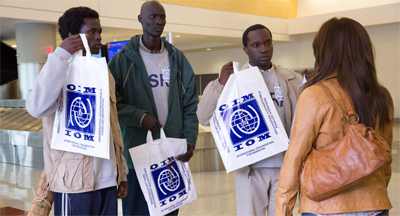
Margaret Nagle’s script was inspired by the “lost boys” who escaped the Sudanese Civil War. These displaced refugees found themselves scattered. Some walked hundreds of miles to neighbouring countries like Ethiopia or Kenya. Some travelled even further, emigrating to countries like the United States. The Good Lie is a fascinating exploration of the lives of four such immigrants who arrive in their new home in the year 2000, finding themselves struggling to adapt to life in America. It is a subject that could easily seem exploitative or maudlin.

Packing light...

Packing light…

It would be easy to turn The Good Lie into a heavy-handed meditation on human suffering as explored through the eyes of these four immigrants. The poster for The Good Lie allots considerable space to actress Reese Witherspoon, and it would be easy to write the story as told from the perspective of the American characters who interact with these new arrivals. It is to the credit of Nagle’s script that The Good Lie never allows its focus to shift, that it is never distracted by the more prominent American cast members.

The Good Lie is perhaps a little bit too broad in its humour at points, and its structure occasionally feels a little contrived. However, there is a lot of warmth and affection underpinning the script, with the sense of humour helping to relieve what could easily descend into an overly solemn drama.

Leaving on a jet plane...

Leaving on a jet plane…

Continue reading

Star Trek: Enterprise – Canamar (Review)

Next year, Star Trek is fifty years old. We have some special stuff planned for that, but – in the meantime – we’re reviewing all of Star Trek: Enterprise this year as something of a prequel to that anniversary. This April, we’re doing the second season. Check back daily for the latest review.

The story behind Canamar is much more interesting than the story told in Canamar.

On the surface, Canamar is quite simple – Star Trek does Con Air.” However, it had an interesting journey from original pitch to televised episode. Indeed, Canamar developed from David A. Goodman’s attempts to break out Judgment, trying to figure out what would happen to Archer after he had been found in Klingon court. Originally, the crew would have rescued Archer from a prison transport rather than Rura Penthe. However, producer Brannon Braga took such a liking to the “Archer on a prison transport” concept that he pulled it out of Judgment and assigned it to John Shiban to script.

"Have you seen Con Air?" "No." "Good. Then this'll all seem new to you."

“Have you seen Con Air?”
“No.”
“Good. Then this’ll all seem new to you.”

However, Braga also divorced Canamar completely from Judgment. Archer would no longer be a prisoner on a Klingon prison transport. Instead, he would find himself mistakenly arrested by an entirely new alien species a couple of episodes before he’d find himself arrested by a more recognised alien species. It feels somewhat redundant, with the first act of Canamar rushing through set-up of plot beats that would feel more organic and fluid if they came from an early episode explicitly designed to build to the idea of Archer on the prison transport.

Canamar is a prime example of just how out of touch Star Trek: Enterprise was with the television landscape, reinforcing the sense that the second season of the show was a holdover from some much earlier period of television production.

"It's the ship that made the Kessel Run in less than twelve parsecs. I've outrun Imperial starships."

“It’s the ship that made the Kessel Run in less than twelve parsecs. I’ve outrun Imperial starships.”

Continue reading

Daredevil – The Path of the Righteous (Review)

To celebrate the launch of Marvel’s Daredevil and the release of Avengers: Age of Ultron, we are reviewing all thirteen episodes of the first season of Marvel and Netflix’s Daredevil. Check back daily for the latest review.

With The Path of the Righteous, the first season of Daredevil properly enters its end game.

After a lot of soul-searching and contemplating, Matt Murdock is spurred back to action – albeit in a somewhat limited capacity. Matt spends most of the hour searching out Melvin Potter to help design a new costume. This is perhaps the most obvious indication that the end of the season is fast approaching; Matt is beginning to transition away from the costume inspired by Frank Miller and John Romita Jr.’s The Man Without Fear and more towards something approaching his iconic comic book outfit.

daredevil-thepathoftherighteous2

At the same time, Wilson Fisk finds himself desperately losing ground. Vanessa Marianna is in a coma, poisoned during an event hosted and organised by Fisk. Karen Page and Ben Urich have found Marlene Vistain, and begun piecing together a past that Fisk worked very hard to bury. On top of that, The Path of the Righteous ends with Fisk suffering a fairly dramatic personal loss, when Karen Page repeatedly shoots James Wesley. It seems fair to suggest that the ground is shrinking from under him.

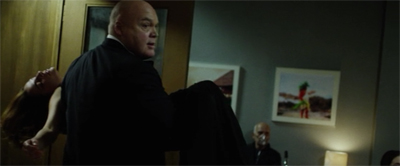
However, it is interesting that The Path of the Righteous sidelines Matt and Fisk so thoroughly. Fisk spends the entire episode in a hospital, while Matt is running errands that feel disconnected from the immediate threat. As such, The Path of the Righteous allows for some focus on the supporting cast and the wider ensemble. The biggest dramatic beat of the episode is carried by two supporting players, as Karen Page and James Wesley square off against one another.

daredevil-thepathoftherighteous

Continue reading