• Following Us

  • Categories

  • Check out the Archives


  • Awards & Nominations

Non-Review Review: A Walk Among the Tombstones

A Walk Among the Tombstones is an oddly nostalgic serial killer film.

The movie is an adaptation of Lawrence Block’s novel of the same name. Block originally published A Walk Among the Tombstones in 1992, around the time that pop culture’s fascination with serial killers was building to a crescendo. Thomas Harris had released Red Dragon and The Silence of the Lambs to universal acclaim. Jonathan Demme’s film adaptation of The Silence of the Lambs had managed to sweep the Oscars, despite the handicap of a February 1991 release.

Dead letters...

Dead letters…

Scott Frank’s feature film adaptation moves the action forward to 1999, towards the tail end of pop culture’s interest in serial killers. Morgan Freeman’s career in serial killer films offers perhaps the best illustration of the state of the genre. By this point, Freeman had already moved on from 1995’s stylish se7en towards 1997’s efficient Kiss the Girls and was on the cusp of 2001’s unnecessary Along Came a Spider. The serial killer’s stock was falling, and the serial killer would soon be replaced by another bogeyman.

This shift in the story’s setting makes it feel like A Walk Among the Tombstones is a funeral ode towards the serial killer.

Lives are on the line...

Lives are on the line…

Continue reading

Non-Review Review: Noble

Christina Noble has done a lot of good in the world. She has helped 700,000 street children in Vietnam and Mongolia. She has devoted her life to charity pursuits. Travelling to Ho Chi Minh City in 1989, she made it her mission to help those who could not help themselves. She has done a phenomenal job of raising awareness and of improving the standard and quality of life of children who would otherwise be neglected or exploited. She is affectionately known as “Mama Tina” by the children she helps.

There is probably a great movie to be made about the life and times of Christina Noble. Sadly, Noble is not it.

noble3

Continue reading

Star Trek: Deep Space Nine – Past Tense, Part II (Review)

This September and October, we’re taking a look at the jam-packed 1994 to 1995 season of Star Trek, including Star Trek: Deep Space Nine and Star Trek: Voyager. Check back daily for the latest review.

Past Tense, Part II is a nice way to close out Star Trek: Deep Space Nine‘s solo run, the only period in the show’s history where it was the only Star Trek on television. Caretaker, the première of Star Trek: Voyager, would be the next episode of the franchise to air. Deep Space Nine spent a lot of its early third season attacking various foundations of the Star Trek universe, as if hoping to demonstrate how profoundly different the show was from its predecessors.

The Search promised a war brewing on the horizon, and presented a cynical view of Starfleet foreign policy, where pacifism amount to appeasement. House of Quark reduced the Klingon Empire to a joke. Equilibrium suggested that Sisko could live with (and passively enable) a government lie if it kept his friend alive. Second Skin hinted that things might not be as they appear to be. The Abandoned embraced the idea that sometimes people are incapable of being anything more than what their genes might tell them to be. Defiant was the story of sibling desperately trying to prove his unique identity.

Everything is under control...

Everything is under control…

Part of me wonders if this very cynical stretch of episodes is responsible for the perception of Deep Space Nine as an incredibly cynical and pessimistic television show – one consciously at odds with the utopian ideals of the franchise. After all, this was the stretch where Deep Space Nine was most in the spotlight. It had the spot previously allocated to Star Trek: The Next Generation in most markets. It had no televised competition. If ever Star Trek fans were going to jump on board Deep Space Nine, this was the moment. It seems quite possible that this run of episodes cemented the show’s reputation.

So it seems strange that Deep Space Nine should wait until its last possible moment in the sun to embrace the humanism and optimism at the heart of the franchise. Past Tense is a story about building paradise, and about how humanity has the capacity to be so much better than we currently are. In short, it’s quintessential Star Trek, right down to the occasionally heavy-handed moralising and utopian idealism.

Keep your hat on...

Keep your hat on…

Continue reading

Non-Review Review: The Equaliser

Appropriately enough for a movie featuring a climax that might be dubbed “Die Hard at the Home Depot”, The Equaliser does exactly what it says on the tin.

The revenge thriller is a tried-and-tested storytelling model. Similarly “the unstoppable killing machine relapses” is a pretty effective stock plot element. There is very little surprising to be found in The Equaliser. There’s never any real doubt about our hero. There’s never a twist that can’t be seen coming a mile away. Appropriately enough, given our hero’s fixation on time-keeping, everything in The Equaliser is constructed like clockwork. There is minimal clutter, no extraneous element. It works right out of the box.

When all you have is a hammer...

When all you have is a hammer…

And yet, despite that, it largely works. For all that one can follow instructions, watch-making is an artform. The Equaliser may not be an exceptional example of the form, but it is a fine demonstration of just how much technical skill counts in putting something like this together. Denzel Washington may be the most likeable leading man of his generation. Even when he is attacking mobsters with corkscrews or suffocating adversaries in their cars, there’s something strangely charming about him.

It helps that director Antoine Fuqua goes all in on The Equaliser. There are no half-measures here. The Equaliser doesn’t just hit the necessary beats. It smashes them.

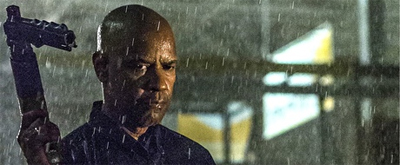
Tears in the rain...

Tears in the rain…

Continue reading

Star Trek: Deep Space Nine – Past Tense, Part I (Review)

This September and October, we’re taking a look at the jam-packed 1994 to 1995 season of Star Trek, including Star Trek: Deep Space Nine and Star Trek: Voyager. Check back daily for the latest review.

It’s weird to think that Past Tense aired at the very end of the period where Star Trek: Deep Space Nine was the only Star Trek on television. The two parts were broadcast in early January 1995, after the release of Star Trek: Generations but before the broadcast of Caretaker, the pilot episode of Star Trek: Voyager.

In a way, these are the most “Star Trek”-y episodes of the third season of Deep Space Nine. Embracing the franchise’s utopianism and optimism, the two episodes are even structured as a gigantic homage to The City on the Edge of Forever. Unlike the somewhat cynical and jaded run of episodes leading into them, Past Tense seems to exist as an episode that could draw fans of Star Trek: The Next Generation into Deep Space Nine.

Panic in the streets...

Panic in the streets…

It would have made sense to position the episodes earlier in the season, where they might have done a better job of attracting casual Star Trek viewers jonesing for a fix after The Next Generation went off the air. Unconnected to the serialised long-form plot of Deep Space Nine, engaging with important social issues of contemporary society and playing with familiar Star Trek tropes like time travel, it’s hard to imagine an episode of the third season of Deep Space Nine better suited to reeling in viewers.

As it stands, though, Past Tense aired at the last possible moment where Deep Space Nine could truly claim to be “the only Star Trek on television”, making the two-parter feel more like a footnote than a crescendo. It’s a shame, as Past Tense remains a vastly underrated instalment of the show’s third season.

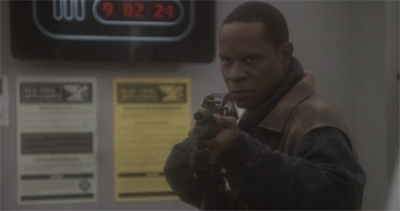
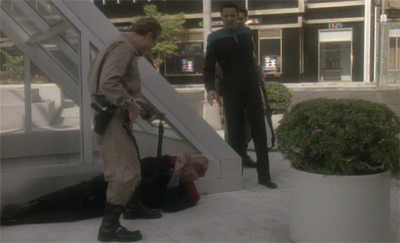
Arresting drama...

Arresting drama…

Continue reading

Win! A Copy of David Gerrold’s World of Star Trek!

As you may have picked up, we are big fans of Star Trek here at the m0vie blog, and we are big fans of David Gerrold as well. Mr. Gerrold has recent released a number of his classic novels in eBook format, including The World of Star Trek. Originally published in 1973 and updated in 1984, the book offered a behind-the-scenes glimpse of the franchise and is an invaluable glimpse behind the curtain. A full list of Mr. Gerrold’s eBooks are available via his official site, or by clicking the image below.

We have an excerpt from the classic below and Mr. Gerrold has kindly volunteered to host a give away here. For your chance to win a copy – and four of David Gerrold’s eBooks of your choosing – simply leave a comment below. Simply leave a comment on the article stating you would like to be entered in the draw and we’ll pick a name from a hat. Enjoy!

World of Star Trek_giveaway

Continue reading

Doctor Who: Listen (Review)

Are you making conversation?

I thought I might give it a try.

Listen is an episode important in its unimportance.

It is the first non “event” episode credited to Moffat as a solo writer since The Beast Below. Every episode credited exclusively to Moffat since The Beast Below has been a premiere or a finalé or two-parter or a special of some description. Listen is the fourth episode of Peter Capaldi’s first season, following a celebrity pseudo-historical written by Mark Gatiss. It is an episode that is about very little. There is a lot of talking, and a lot of sitting, and – as the title implies – a lot of listening. It is utterly unlike any other episode of Doctor Who ever produced.

doctorwho-listen17

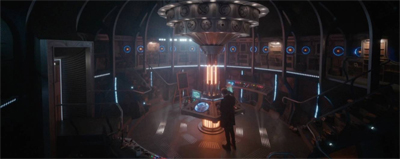
Midnight in the TARDIS…

Listen has a central mystery that it refuses to resolve, a wealth of lovely character moments, and just the faintest trace of Moffat’s “timey-wimey” stuff. As with a lot of Moffat’s writing for the show, Listen is packed with little details that seem to exist to drive fans wild, but which make a lot of sense for those willing to relax and go with it. It is fascinated with negative space, with the characters ruminating on how questions are more important than answers, and how nothing can be more defining or revealing than something.

It is an episode that feels very much in touch with the mood and themes Moffat era. In keeping with Moffat’s style since he took over the show, Listen is a lesson in the art of misdirection.

doctorwho-listen6

Chalking it up to a title drop…

Continue reading

Star Trek: Deep Space Nine – Fascination (Review)

This September and October, we’re taking a look at the jam-packed 1994 to 1995 season of Star Trek, including Star Trek: Deep Space Nine and Star Trek: Voyager. Check back daily for the latest review.

Well, that could have been much more unpleasant than it ultimately was.

Yes, that’s damning with faint praise, but Fascination feels like a long sigh of exhaustion after what has been a tough run of episodes. The last episode of Star Trek: Deep Space Nine to air in 1994, Fascination came at the end of a production crunch that had seen the show desperately grasping for time. Quite a few of the first ten episodes of the season had been rushed through, with varying results – from Second Skin to Meridian.

So the fact that Fascination is not a massive soul-destroying screw-up on the scale of Meridian is a good thing, even if the episode’s plot does smell a little bit of desperation.

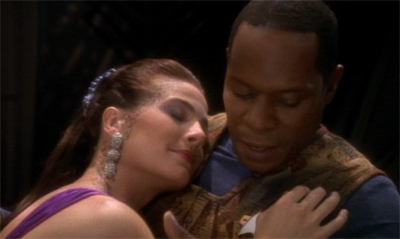
Dax can be quite touchy...

Dax can be quite touchy…

Continue reading

Star Trek: Deep Space Nine – Defiant (Review)

The September and October, we’re taking a look at the jam-packed 1994 to 1995 season of Star Trek, including Star Trek: Deep Space Nine and Star Trek: Voyager. Check back daily for the latest review.

Defiant is a cheeky piece of work.

On the surface, it appears to be a rather lame bit of cross-promotion for the release of Star Trek: Generations. The first movie featuring the cast of Star Trek: The Next Generation had opened three-days before Defiant aired, and so it seemed like the perfect opportunity to get a nice cameo from a well-loved cast member and remind audiences that the film was currently in cinemas. Jonathan Frakes is a likeable actor, and Riker has been used as an ambassador for the series before. He appeared in Cybill, after all.

However, then Defiant takes one sharp left-turn, massively upsetting expectations and becoming something a lot more interesting than a cross-media tie-in.

Guess who's coming to Quark's...

Guess who’s coming to Quark’s…

Continue reading

Star Trek: Deep Space Nine (Malibu Comics) #29-30 – Sole Asylum (Review)

The September and October, we’re taking a look at the jam-packed 1994 to 1995 season of Star Trek, including Star Trek: Deep Space Nine and Star Trek: Voyager. Check back daily for the latest review.

Whatever happened to Thomas Riker?

Star Trek: Deep Space Nine receives a lot of credit for its move towards serialisation as a prime-time genre show. It wasn’t a pioneer in the same way that Babylon 5 was or even Murder One had been, but it was was definitely ahead of the curve. Deep Space Nine arguably holds up better today than any of the other Star Trek shows, and part of that is down to the way that the show leaned into serialisation. Actions had consequences, effects lingered after the credits.

Hostage of fortune...

Hostage of fortune…

The show was very much leaning that way in the second and third season, building up plot threads that would pay off down the line. The Dominion had been seeded in the show since Rules of Acquisition. The Romulan and Cardassian pre-emptive strike was foreshadowed by episodes like Defiant and Visionary. In the third season, it became clear that Deep Space Nine was ready to commit to some long-form storytelling, in a way that was unusual for a high-profile syndicated genre show in the nineties.

However, it is tempting to give Deep Space Nine a little bit too much credit. There were points where the show seemed to struggle with pay-off and arc-building. In Emissary, Sisko was tasked with bringing Bajor into the Federation; that never happened. After Battle Lines, Kai Opaka never appeared again. Characters who seemed important dropped into and out of the show at random; characters like Martok’s son Drex, Bajoran First Minister Shakaar Edon, Subcommander T’Rul… and Thomas Riker.

The welcome wagon...

The welcome wagon…

Continue reading