• Following Us

  • Categories

  • Check out the Archives


  • Awards & Nominations

Non-Review Review: Planes 2 – Fire and Rescue

It’s the eyes.

When computer-generated animation first emerged, the hardest part was the eyes. Figures could be rendered in a completely photo-realistic fashion, right down to individual strands of hair, but the eyes were always a problem. If the eyes weren’t right, the animated characters – no matter how thoroughly rendered – inevitably felt like they were beckoning us into the uncanny value. The opposite was also true; cartoonish figures and inanimate objects could be imbued with incredible humanity if the eyes were right.
All fired up...

All fired up…

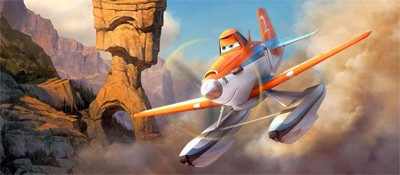
The computer-generated animation in Planes 2: Fire and Rescue is certain competent. It is not cutting edge, but computer-generated animation has reached a point where it doesn’t have to be cutting edge to work effectively. There are action sequences, there is physical comedy, there are stylised insets. While Planes 2: Fire and Rescue doesn’t break new ground, it is relatively polished.

However, it’s the eyes. A stylised decision in keeping with the world established in Cars, the planes have eyes that look like two-dimensional drawings on the windscreen. It’s a very simple representation of the eyes. It is also a decision that undoubtedly makes them a lot more toyetic. The planes can move their wipers and control the height and width of their windscreens to generate all sorts of exaggerated expression. However, the eyes never seem more than stickers, unable to convey depth or nuance.

Flying so low...

Flying so low…

Continue reading

Peter Tomasi & Patrick Gleason’s Run on Batman & Robin – Pearl & Death of the Family (Review)

23rd July is Batman Day, celebrating the character’s 75th anniversary. To celebrate, this July we’re taking a look at some new and classic Batman (and Batman related) stories. Check back daily for the latest review.

Peter Tomasi is one of the best supporting writers in comics. Writing a supporting title in a shared superhero universe is a very daunting task. It requires a unique ability to weave into (and out of) events and storylines dictated by more high-profile writers on more popular books. Due to the structuring of superhero publishing, the direction for an entirely line is typically dictated by one (or maybe two) books, with the rest of the line alternating between supporting those books and trying not to make waves.

Tomasi is very good at this. His Green Lantern Corps book provided a suitably solid support for Geoff Johns’ more high-profile Green Lantern comic. He was the logical choice to take over Batman & Robin after Grant Morrison departed, even if the book did cycle through a variety of creators including Paul Cornell and Judd Winick. Tomasi is a writer with a lot of experience as an editor, and – as such – has a knack for picking up on themes and core values of particular writers.

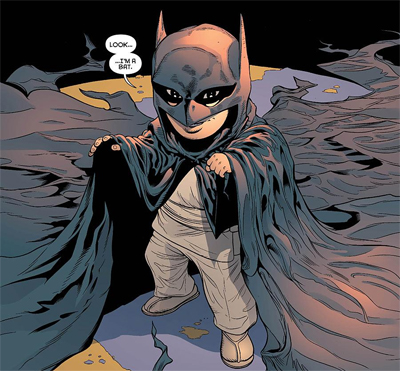
He shall become a bat...

He shall become a bat…

Following the “new 52” relaunch, Batman & Robin was very much a satellite book in DC’s Batman line. It was a holding pattern, a book designed to feature Damian Wayne while Grant Morrison prepared to launch into Batman Incorporated. It was part of a line that was largely being driven by Scott Snyder and Greg Capullo’s work on Batman. There was no sense writer Peter Tomasi and Patrick Gleason would be doing anything particularly bold or daunting with the book at this moment in time.

Dutifully, following an eight-issue introductory arc, Born to Kill, Batman & Robin found itself bouncing around between various high-profile crossovers in the Batman line and in the wider context of DC’s publishing schedule. In the spate of issues between Born to Kill and the end of Grant Morrison’s Batman Incorporated run, Tomasi and Gleason find themselves navigating a veritable minefield of DC continuity and crossovers.

Everything burns...

Everything burns…

Continue reading

Geoff Johns’ Run on Justice League – Throne of Atlantis (Review/Retrospective)

23rd July is Batman Day, celebrating the character’s 75th anniversary. To celebrate, this July we’re taking a look at some new and classic Batman (and Batman related) stories. Check back daily for the latest review.

Geoff Johns on Justice League should be one of the defining superhero comic books of the twenty-first century.

After all, Johns has done a lot to define DC over the past decade or so. Johns is one of the defining voices in superhero comics. He has enjoyed long and successful runs on iconic characters. His work sells well and has generally garnered positive reviews over the course of his career. Johns knows how to “centre” a character and to help cut to their core. 52 is generally regarded as a high watermark of twenty-first century DC comics, and Johns is the only one of the four authors still consistently working at DC comics.

Everybody out of the water!

Everybody out of the water!

So putting Geoff Johns on Justice League is a no-brainer. Indeed, many fans had been expecting a high-profile run from Geoff Johns on the title long before the “new 52” relaunch. Given Johns’ successful runs on Action Comics, Green Lantern and The Flash, writing all of these characters together should be a recipe for success. When it was announced that writer Geoff Johns and artist Jim Lee would be handling the relaunched Justice League title, it seemed like a veritable worldbeater of a title.

In sales terms, Johns’ Justice League remains a success. However, it has been less satisfying from a creative standpoint. Artist Jim Lee departed the book after a year – with several fill-in artists along the way. However, even with DC drafting Ivan Reis to replace Lee, Justice League is not as satisfying as it should be. There are lots of reasons for this, but the biggest problem with Johns’ Justice League is that it always seems so fixated on what is happening next that it never appreciates the moment.

She really sweeps him off his feet...

She really sweeps him off his feet…

Continue reading

Peter Milligan and Kieron Dwyer’s Run on Batman – Dark Knight, Dark City (Review/Retrospective)

23rd July is Batman Day, celebrating the character’s 75th anniversary. To celebrate, this July we’re taking a look at some new and classic Batman (and Batman related) stories. Check back daily for the latest review.

Peter Milligan and Kieron Dwyer’s Dark Knight, Dark City shot to prominence when writer Grant Morrison incorporated some of its elements into his expansive Batman epic. This three-issue 1990 Batman story arc garnered a lot of attention and even earned a reprint in 2011 as part of the DC Comics Presents line. That is certainly deserved, as Dark Knight, Dark City is a genuinely classic Batman story.

Milligan hits on a lot of the themes that he would develop over his subsequent Detective Comics run. There’s a sense that the writer is scripting a version of Batman that owes at least as much to the tradition of horror comics as it does to traditional superhero narratives. Indeed, Milligan could easily have reworked most of his Batman stories for Hellblazer with only a minimum amount of changes.

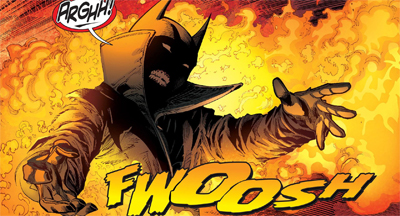
Suit up...

Suit up…

Portraying Batman as a strange and surreal character inhabiting a strange and surreal world, Milligan paved the way for a lot of occult weirdness that would become a fixture of the Batman line into the nineties and beyond. It is very difficult to imagine Grant Morrison’s extended run without Milligan’s influence. It could also be argued that Milligan paved the way for the distinctive and stylised portrayal of the Dark Knight in Doug Moench and Kelley Jones’ mid-nineties run.

Haunting, thoughtful and influential, Dark Knight, Dark City is an underrated masterpiece.

Who is afraid of the big, bad bat...

Who is afraid of the big, bad bat…?

Continue reading

Batman – The Cult (Review/Retrospective)

23rd July is Batman Day, celebrating the character’s 75th anniversary. To celebrate, this July we’re taking a look at some new and classic Batman (and Batman related) stories. Check back daily for the latest review.

The Dark Knight Returns has a lot to answer for.

Although written “out of continuity” as the last Batman story, critically deconstructing and examining the Caped Crusader, The Dark Knight Returns remains a hugely influential piece of the Batman canon. It’s a story that was hugely influential in comics as a whole, but which understandably had a major influence on Batman. To pick an easy example, both of the recent “guiding” writers on the Batman franchise – Scott Snyder and Grant Morrison – can be seen to react to The Dark Knight Returns a variety of ways.

They are dead to him.

They are dead to him.

In a way, no author was more responsible for porting over concepts from The Dark Knight Returns as effectively as Jim Starlin. Although Starlin is perhaps most associated with Marvel’s cosmic saga, the author did write two massively iconic and distinctive Batman stories. Starlin was the author who wrote A Death in the Family, the story that killed off Jason Todd. He also wrote The Cult, a story about Gotham under siege from an evil religious leader who manages to “break” Batman.

The Cult itself was influential. Aspects of The Cult can be seen in Christopher Nolan’s The Dark Knight Rises, a story about an urban uprising from the sewers and Batman’s attempts to rebuild himself to save Gotham. Unfortunately, as with Starlin’s other iconic Batman story, there’s a sense that The Cult works better in theory than in execution.

A Deacon of light...

A Deacon of light…

Continue reading

Non-Review Review: Dawn of the Planet of the Apes

Constructing a satisfying sequel is an artform unto itself. It is something that requires a great deal of skill. As with any aspect of filmmaking, building off an earlier film is a very difficult thing to do. Producing a sequel comes with its own set of artistic risks and challenges, its own obstacles and hurdles. Navigating those potential problems and finding a way to meet (and even surpass) expectations without straying too far from the framework of the original film is difficult.

As with making any movie, there are existing frameworks and structures that do a little help make navigating those problems a little easier. Perhaps the structure of Star Wars: The Empire Strikes Back is the most obvious example. Using the trust established by the first film, the ensemble are split up to carry different strands of the plot, revealing scattered pieces of a larger whole, before reuniting for an epic finalé. Bryan Singer used this approach for X-Men II and How to Train Your Dragon 2 also followed it.

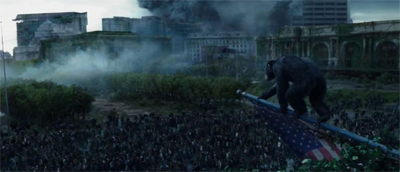
Playing him for a chimp, eh?

Playing him for a chimp, eh?

Dawn of the Planet of the Apes is in an interesting position. It is a sequel to a remake; a remake of a film franchise that was originally iconic and influential, before dying a slow and humiliating public death as the series diminished and collapsed. Not only does Dawn of the Planet of the Apes come with the expectations of Rise of the Planet of the Apes, it comes with the revived expectations of the entire Planet of the Apes franchise; expectations restored by Rise of the Planet of the Apes.

Dawn of the Planet of the Apes chooses a very clever structure for this sequel, loosely following the sequel framework typified by Christopher Nolan’s work on The Dark Knight. This is a very clever approach, and it pays dividends. Dawn of the Planet of the Apes is an ambitious and exciting sequel, a wonderful post-apocalyptic epic and an engaging moral parable.

Going ape for it...

Going ape for it…

Continue reading

Mike W. Barr and Alan Davis’ Run on Detective Comics (Review/Retrospective)

23rd July is Batman Day, celebrating the character’s 75th anniversary. To celebrate, this July we’re taking a look at some new and classic Batman (and Batman related) stories. Check back daily for the latest review.

When DC comics published Crisis on Infinite Earths, it was a brave new world. Everything was new again. Nothing could be taken for granted. The company had the opportunity to start again with its characters and properties, offering a new beginning to iconic heroes that would hopefully welcome new readers while learning from prior successes and past failures. It was an exciting time in the industry, one bristling with potential.

In many respects, the defining Batman story in the immediate aftermath of Crisis on Infinite Earths was Batman: Year One. Even today, Year One remains a foundational text for Batman, one of the best (and most influential) stories ever told using the character. It defined Batman for the eighties and nineties, and beyond. Frank Miller offered readers a new and updated origin for the Caped Crusader that teased a new way of looking at Gotham City and its inhabitants.

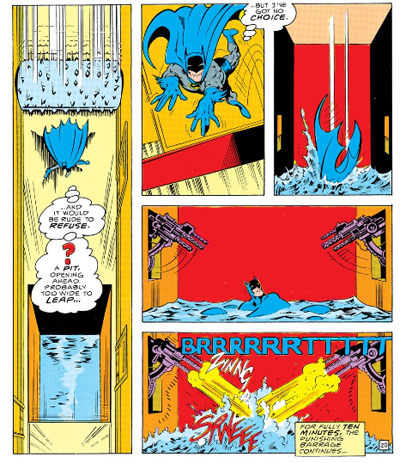
"It's a trap!"

“It’s a trap!”

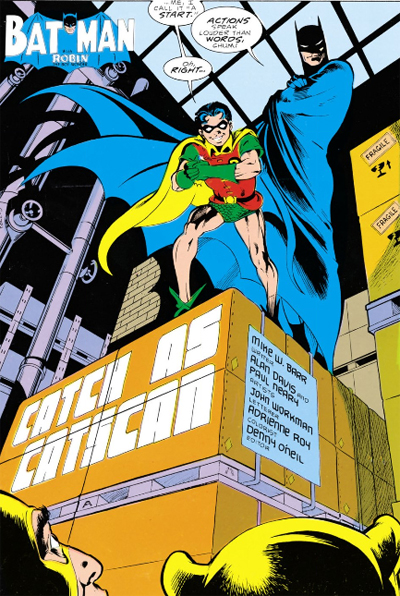
Meanwhile, a more quiet revolution was in progress over on Detective Comics. Writer Mike W. Barr and Alan Davis began their run on Detective Comics in the immediate aftermath of the now-all-but-forgotten Legends crossover. Although the duo were lucky enough to work on the book over the fiftieth anniversary of Detective Comics, their work was somewhat overshadowed by the publication of Year One in their sister publication – to the point that their run culminates in Year Two, a sequel to Year One.

Still, while it never got the attention that it deserved, Barr and Davis did a lot to offer an alternative to Miller’s gritty and grounded reimagining. Featuring death traps and puns and brainwashing and dodgy jokes, Barr and Davis seem almost subversive. It is as if the duo are working hard to import all the stuff that might otherwise be washed away by Crisis on Infinite Earths, reminding readers that with world of Batman has always been absurd, and that is not necessarily a bad thing.

Talk about making an entrance...

Talk about making an entrance…

Continue reading

Scott Snyder & Greg Capullo’s Run on Batman – Death of the Family (Review/Retrospective)

23rd July is Batman Day, celebrating the character’s 75th anniversary. To celebrate, this July we’re taking a look at some new and classic Batman (and Batman related) stories. Check back daily for the latest review.

In many respects, despite the massive hype that it received and the gigantic crossover that it spawned, Death of the Family is structured as an anti-epic. The triumphant return of the Joker to the world of Batman over a year into the “new 52” instead turns into a deconstruction and criticism (and arguably a rejection) of the character. Sandwiched between Scott Snyder and Greg Capullo’s much larger and more ambitious epic Batman stories, Death of the Family is a story about how small the Joker really is.

In many respects, Death of the Family reads best as the story of a collapsing relationship, where one partner refuses to deal with the fact that the other has outgrown them.

Ever dance with the devil in the pale moonlight?

Ever dance with the devil in the pale moonlight?

Continue reading

Mark Waid’s Run on Justice League of America – Tower of Babel (Review/Retrospective)

23rd July is Batman Day, celebrating the character’s 75th anniversary. To celebrate, this July we’re taking a look at some new and classic Batman (and Batman related) stories. Check back daily for the latest review.

Although actually published in 2000, Tower of Babel is the third definitive Batman story of the nineties. Running only four issues instead of a massive sprawling crossover across an entire line of comic books, Tower of Babel is certainly more condensed than either Knightfall or No Man’s Land, hitting on many of the same themes and concepts. It is very much constructed as a cautionary tale – a warning about taking a particularly cynical approach to Batman to its logical extreme.

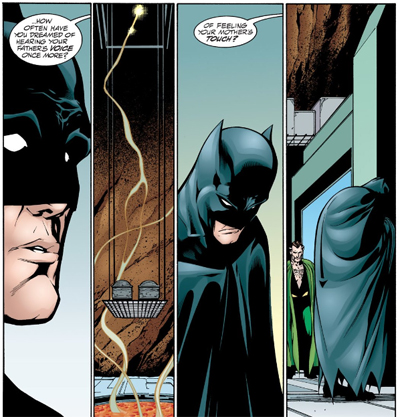
Due to his stand-off-ish nature, the nineties iteration of Batman is sometimes affectionately (or not so affectionately) referred to a “Batjerk.” This version of the character has a wonderful knack of pushing his friends and allies away, making enemies, and escalating problems due to arrogance and ego. In many respects, Tower of Babel is a quintessential “Batjerk” story, where Batman’s anti-social tendencies lead to the humiliation and defeat of the entire Justice League using his own plans.

The last temptation of Batman...

The last temptation of Batman…

Continue reading

Batman: Shadow of the Bat – The Last Arkham (Review)

23rd July is Batman Day, celebrating the character’s 75th anniversary. To celebrate, this July we’re taking a look at some new and classic Batman (and Batman related) stories. Check back daily for the latest review.

In 1992, DC comics launched Shadow of the Bat. It ran for eight years and ninety-two issues. Alan Grant wrote most of those issues, before his creative relationship with the publisher eventually broke down. (Grant is still upset about the manner of his dismissal.) As the driving force behind the book, Grant was able to give Shadow of the Bat its own unique flavour, focusing on the madness of Gotham, and the strangeness of its inhabitants.

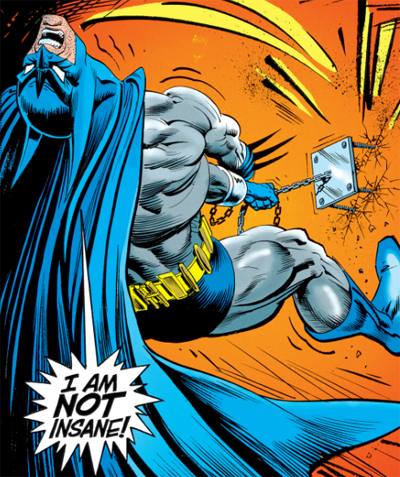
The opening four-part story, The Last Arkham, remains perhaps the most definitive of Grant’s contributions to the Batman mythos, teaming up with artist Norm Breyfogle to offer a rather creepy and unnerving exploration of the city’s ever-slipping sanity.

Me thinks the Batman doth protest too much...

Me thinks the Batman doth protest too much…

Continue reading