• Following Us

  • Categories

  • Check out the Archives


  • Awards & Nominations

The X-Files – Apocrypha (Review)

This November (and a little of December), we’re taking a trip back in time to review the third season of The X-Files and the first (and only) season of Space: Above and Beyond.

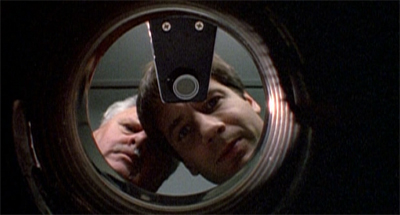
Eyes are a major recurring motif in Apocrypha.

To be fair, eyes were a frequently recurring motif throughout The X-Files. Rob Bowman managed a couple of beautiful shots of reflections and peeping in 731, for example. It makes sense that The X-Files should place such emphasis on eyes – it is a saga about truth and belief and faith, all of which must be explored through perception. “I want to believe,” Mulder’s iconic poster proclaims. As the cliché goes, seeing is believing.
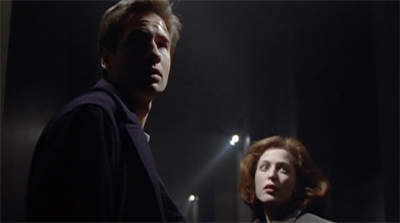
Iconic Mulder/Scully pose!

Iconic Mulder/Scully pose!

That is definitely the case here, with Apocrypha built to a climax where both the audience and the characters are explicitly refused the opportunity to see key moments. Mulder and Scully are escorted out of the North Dakota silo before they can see anything incriminating. The audience doesn’t even get to see the space ship taking off. Even the death of Luis Cardinal takes place off-screen, with Mulder revealing it in a throwaway line in the show’s penultimate scene.

With all of this going on, it makes sense that so much of the imagery in Apocrypha should be built around eyes – with the black oil infection manifesting in its hosts’ eyes, the shooting of the silo as a giant eye staring into space, and even the design of the alien space ship evoking the Eye of Providence.
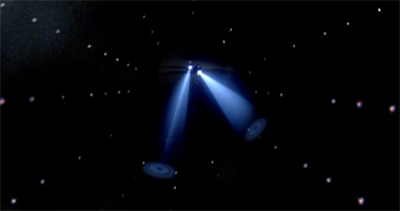
Up in the sky!

Up in the sky!

Continue reading

The X-Files – Piper Maru (Review)

This November (and a little of December), we’re taking a trip back in time to review the third season of The X-Files and the first (and only) season of Space: Above and Beyond.

Piper Maru and Apocrypha continue a pretty clear thematic throughline for the show’s third season mythology episodes.

As with The Blessing Way/Paper Clip and Nisei/731, Piper Maru and Apocrypha tell a story about how we relate to the past. In particular, in keeping with the rest of the third season mythology, it is a show about the legacy of the Second World War. The X-Files is a show that is sceptical of the decisions made by the American government towards the end of the Second World War, particularly as those decisions shaped and moulded the present. In many ways, The X-Files is a show about history and legacy, trauma and consequence.

A fish out of water...

A fish out of water…

Piper Maru and Apocrypha are less direct about this connection than the earlier mythology episodes. They aren’t about the war criminals given safe habour after the Second World War in return for scientific knowledge or tactical advantages. Instead, Piper Maru and Apocrypha are shows about dredging up the past and confronting the consequences of past actions. These two episodes are not only steeped in American popular history, but also in the show’s internal continuity. The majority of what happens here is driven by events we’ve seen in the show.

At the same time, Piper Maru and Apocrypha represent an attempt to boldly expand and push the mythos forward in the same way that Colony and End Game did at this point in the second season. The result is an intriguing two-parter that feels a little muddled and messy, an example of the show stumbling slightly as it tries to grow outwards. Although the mythology is still working a lot more efficiently than it would in later seasons, there is a sense of clutter beginning to filter in.

The eyes have it...

The eyes have it…

Continue reading

The X-Files – Grotesque (Review)

This November (and a little of December), we’re taking a trip back in time to review the third season of The X-Files and the first (and only) season of Space: Above and Beyond.

Grotesque is probably Howard Gordon’s strongest script for The X-Files.

F. Emasculata had demonstrated that Howard Gordon and Chris Carter worked very well together as a writing team. Carter was very good at big philosophical concepts, while Gordon was very adept at structuring a plot. Gordon knows how to build momentum and suspense, and his best scripts benefit from that particular talent. It helps that Gordon and Carter are probably the writers with the best understanding of Mulder as a character at this point in the show’s run.

Here there be monsters...

Here there be monsters…

Grotesque is an intriguing episode, particularly when examined in the context of the third season. The first and second season of The X-Files had been rather experimental in nature – the show tried to figure out what worked and what didn’t. The third season built off the successes of those earlier seasons. The idea seemed to be that the show would do more of what had worked, only better. So there were more two-part mythology episodes, more grounded stories, more comedy.

Grotesque is fascinating because it draws as much from earlier stories that didn’t work, using the lessons that the show had learned in the years since in order to make them work this time around.

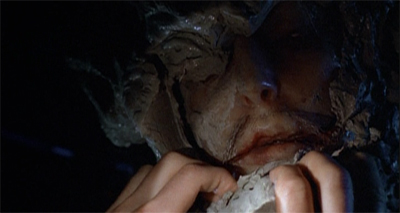
Face-off...

Face-off…

Continue reading

The X-Files – Syzygy (Review)

This November (and a little of December), we’re taking a trip back in time to review the third season of The X-Files and the first (and only) season of Space: Above and Beyond.

On original broadcast, Syzygy and War of the Coprophages were separated by three weeks, airing either end of January.

That probably helps to make Syzygy seem like less of a disappointing retread on initial broadcast, but it doesn’t help on modern binge re-watches. Even allowing for the three weeks between the episodes, Syzygy was always going to suffer in comparison its direct predecessor. If War of the Coprophages was Darin Morgan affectionately mimicking Chris Carter’s style, then Syzygy feels like Carter’s attempt to write a script in a voice quite close to that of Darin Morgan.

The horny beast...

The horny beast…

Structurally, the third season is constructed quite cleverly – and Syzygy is a massive part of that. The third season seems to fold in on itself, which means it makes sense for Syzygy to serve as a fun house mirror War of the Coprophages from a purely structural perspective. The problem is that this decision adds a lot to the third season of the whole while undermining Syzygy itself. It feels like an unsatisfactory decision.

However, even divorced from context, Syzygy is still a mess of an episode. Carter would go on to provide some of the show’s most comedic hours in later seasons, and Syzygy marks a starting point of that trend. It is not an auspicious beginning.

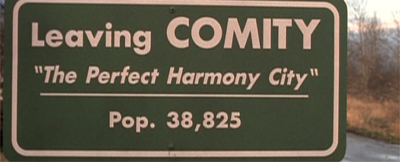
Reading the signs...

Reading the signs…

Continue reading

Space: Above and Beyond – Level of Necessity (Review)

This November (and a little of December), we’re taking a trip back in time to review the third season of The X-Files and the first (and only) season of Space: Above and Beyond.

Coming hot on the heels of Who Monitors the Birds?, Level of Necessity was almost destined to be a little disappointing. Who Monitors the Birds? is perhaps the quintessential episode of Space: Above and Beyond, encapsulating the show’s core themes and utilising its world in a clever and constructive manner. In contrast, Level of Necessity seems almost rote. It is an episode that might have been written for any other nineties science-fiction show.

There are some nice ideas here, but Level of Necessity feels far too generic. In fact, it seems like the episode is centred around Damphousse not because the story makes any more sense for her than it does for any other character, but because she is the only character who has yet to occupy the centre of a story. Thomas J. Wright directs quite well, and Richard Kind makes for a solid guest star. However, Level of Necessity suffers from the fact that it could be an episode of any other show.

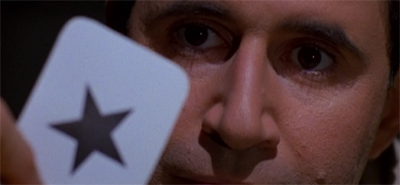
Stars in his eyes...

Stars in his eyes…

Continue reading

The X-Files (Topps) #1/2 – Tiptoe Through the Tulpa (Review)

This November (and a little of December), we’re taking a trip back in time to review the third season of The X-Files and the first (and only) season of Space: Above and Beyond.

Tiptoe Through the Tulpa is another nice “extra” from Topps’ licensing of The X-Files. The comic book was Topps’ most successful property, and the company worked very hard to promote it across various platforms. They tried to recruit potential readers from within the comic book industry and outside the comic book industry, devoting considerable time and energy to advertising the ongoing series.

Stefan Petrucha and Charles Adlard had provided promotional strips for TV Guide and for Hero Illustrated, both very clear attempts at courting potential new readers. Both strips adopted very different approaches. Aimed at as broad an audience as possible, the strip for TV GuideCircle Game – was a tight five-page story that covered a lot of ground in a very efficient manner. In contrast, the strip for Hero IllustratedTrick of the Light – was very clearly targeted at a much more niche audience, featuring in-jokes and references for fans and geeks.

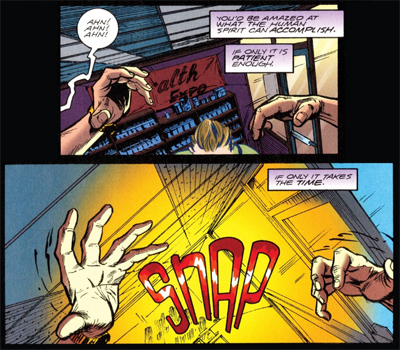
He's not 1/2 the man he used to be...

Herbert’s not 1/2 the man he used to be…

Tiptoe Through the Tulpa was written as a tie-in promotion for Wizard magazine, a giveaway for people who read the comic industry’s most popular collector and insider magazine. People would buy Wizard #53, fill out a form and then send away for their copy of the seventeen-page X-Files #1/2. It was a gimmick, but it was a gimmick that was very clearly aimed at broadening the comic’s audience, convincing a few readers who wouldn’t otherwise try the book to check out a “free” sample comic.

As such, Tiptoe Through the Tulpa is written as a seventeen-page comic that could serve as a potential jumping-on point for new readers. It is rather light, rather simple, but nevertheless makes for a clean and effective X-Files one-shot.

Cue theme music...

Cue theme music…

Continue reading

The X-Files – War of the Coprophages (Review)

This November (and a little of December), we’re taking a trip back in time to review the third season of The X-Files and the first (and only) season of Space: Above and Beyond.

It is very odd to describe any Darin Morgan episode as “underrated.” And yet, despite that, War of the Coprophages feels like the underrated Darin Morgan teleplay.

Clyde Bruckman’s Final Repose had appeared towards the start of the season, featuring a powerhouse guest performance from Peter Boyle. Both Boyle and Morgan would win Emmys for their work on that episode, and Clyde Bruckman’s Final Repose is perhaps Morgan’s most conventional script for The X-Files or Millennium. In contrast, Jose Chung’s “From Outer Space” is perhaps the most adventurous and gonzo episode of The X-Files ever produced, coming at the end of the season and relentlessly (but affectionately) mocking the show’s core iconic mythology.

Down the drain...

Down the drain…

In contrast, War of the Coprophages sits in the middle, literally and figuratively. It is positioned almost precisely in the middle of the third season, with Morgan writing the screenplay in an exceptionally short period of time. It isn’t a truly exceptional example of a monster-of-the-week episode in the way that Clyde Bruckman’s Final Repose was, but it also isn’t as off-the-walls and bizarre as Jose Chung’s “From Outer Space.” It doesn’t feel like it has as much to say about death as Clyde Bruckman’s Final Repose, nor as much about life as Jose Chung’s “From Outer Space.”

And yet, in its own way, War of the Coprophages as an incisive and well-constructed commentary on The X-Files as a television show while allowing Morgan to tackle his recurring themes about society and humanity, and whether the world is what we would like to think that it is.

Bug hunt...

Bug hunt…

Continue reading

Space: Above and Beyond – The River of Stars (Review)

This November (and a little of December), we’re taking a trip back in time to review the third season of The X-Files and the first (and only) season of Space: Above and Beyond.

And so this is Christmas.

On the face of it, doing a Christmas episode of Space: Above and Beyond seems absurd. Space: Above and Beyond is a show about a grim and relentless future war, where human lives are sacrificed in a long and brutal slog. It is very hard to reconcile that with the traditional structure of a Christmas story, which typically draws together a family so that they might celebrate the possibility of “peace on Earth” and “goodwill to all men.”

Homecoming...

Homecoming…

And yet, the episode works in spite of this contrast – or, perhaps, because of it. The River of Stars opens with a monologue narrated by Wang that helps to set the mood for the next forty-five minutes, documenting the well-known Christmas truces that took place during the First World War. Although these spontaneous demonstrations of good will and trust were by no means unique, those temporary reprieves served as a reminder of the humanity that often seemed lost amid the pain and the bloodshed.

If any show could use a charming feel-good story about the possibility of peace on Earth and goodwill towards other people, Space: Above and Beyond might be it.

Staring at the stars...

Staring at the stars…

Continue reading

The X-Files (Topps) – The Pit (Review)

This November (and a little of December), we’re taking a trip back in time to review the third season of The X-Files and the first (and only) season of Space: Above and Beyond.

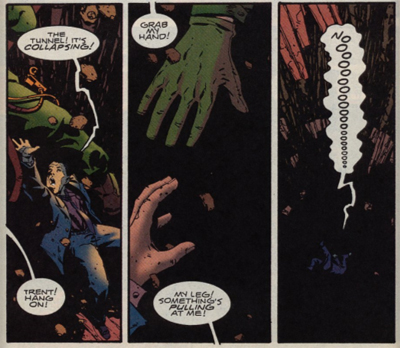
Tucked away in the Winter 1996 issue of The X-Files Magazine and republished with The Silent Sword in September 1996, The Pit is an atmospheric short story from Petrucha and Adlard, demonstrating the two work quite well together across a variety of formats. The Pit is only nine pages long, including two splash pages – and another half-page splash. There isn’t a lot of room for plot or detail. Instead, Petrucha and Adlard opt for mood and atmosphere, crafting a weird and spooky little diversion.

All fall down...

All fall down…

Continue reading

The X-Files – Revelations (Review)

This November (and a little of December), we’re taking a trip back in time to review the third season of The X-Files and the first (and only) season of Space: Above and Beyond.

Religion, eh?

In the mid-nineties, religion was a very difficult subject to navigate on network television. The so-called “culture wars” were in full swing at the middle of the decade, with religious values serving as a particularly brutal battleground. Religion is a very thorny and contentious subject. As recently as 2012, more than 40% of polled Americans stated they would not vote for an atheist candidate in a presidential election. Pete Stark would admit to being an atheist in 2007, becoming the first self-identified atheist in the United States Congress.

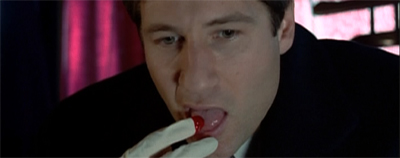
Mulder's got a taste for adventure...

Mulder’s got a taste for adventure…

As a result, it is very difficult to have a meaningful and thoughtful conversation about it. “There’s a man that I work with – a friend – and usually I’m able to discuss these things with him… but not this,” Scully confesses at the end of the episode. While undoubtedly a comment on Mulder’s stubborn refusal to engage with Scully on the topic, it also feels like a commentary on the awkwardness of any public discussion about religious beliefs or values, which was prone to become highly charged and contentious.

The conventional wisdom was that you didn’t talk about religion at the dinner table. It wasn’t much easier on television. This puts Revelations in a very awkward position.

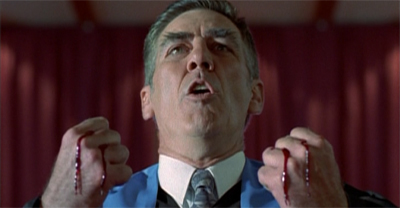
A bloody business...

A bloody business…

Continue reading