• Following Us

  • Categories

  • Check out the Archives


  • Awards & Nominations

American Nightmares, Part I: Old Frontiers… (The Revenant/The Hateful Eight)

Trying something new. Or rather something old. Been a while since we published an old-fashioned thinkpiece on here, and been thinking a lot about America as filtered through film in 2015-2016. We’ll be publishing a series of these articles in the coming week. If you’d like to see more of this sort of content, please comment or share or facebook or tweet, so we know you like it.

The United States of America is a relatively young country.

Like all other countries, it has its own history and mythology. As with many of those countries, that history and mythology intertwine. The European settlers may have inherited some of that mythology from their ancestors across the Atlantic or appropriated some from the indigenous population, but a lot of that history and mythology was cultivated wholesale. The American Dream. Manifest Destiny. The idea that this was a wild continent to be tamed through the sheer strength of will of those rugged early settlers.
westerns9

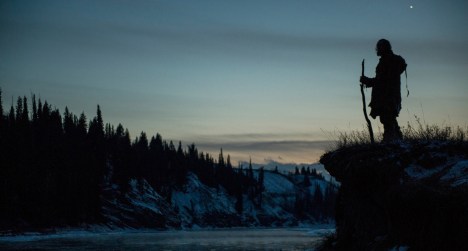
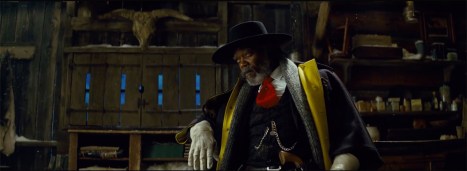
Britain has knights. Ireland has rebels. America has cowboys. It is tempting to look upon these archetypal mythic figures as something far removed from the modern day, something so far in the distant past that they may never have existed as all. Particularly given the historical decline of the western genre in recent decades, it is easy to consider the cowboy a historical artifact covered in centuries of dust and disconnected from the modern world. Billy the Kid does not seem so far removed from King Arthur, Wyatt Earp from Brian Boru.

Of course, the reality is much more complicated. The overlap between the history and mythology is striking; these stories seemed to be mythologised before they were allowed to fad into history. The Great Train Robbery was released in 1903, and generally considered to be the first cinematic western. Although past its prime, the era of the American frontier was still in progress. Oklahoma would only become a state in 1907, with Arizona and New Mexico would become states in 1912. There is a sense that the country was still forming as the mythology coalesced.
westerns3 Continue reading

Star Trek: Voyager – Parturition (Review)

This February and March, we’re taking a look at the 1995 to 1996 season of Star Trek, including Star Trek: Deep Space Nine and Star Trek: Voyager. Check back daily Tuesday through Friday for the latest review.

One of the more interesting aspects of the second season of Star Trek: Voyager is its stubborn refusal to give up on elements that simply do not work.

Time and again, and often at the behest of producer Michael Piller, the second season returns to concepts that were problematic and troublesome in the first season. The obvious goal is to fix those problems so that those elements can be successfully reintegrated into the surrounding show. This is why the second season returns to concepts like the Kazon as a threat and Tom Paris as a rebel and Neelix as a character with a useful function on the ship. This is not a bad approach. If the first season of a show is about experimentation, then the second season is about calibration.

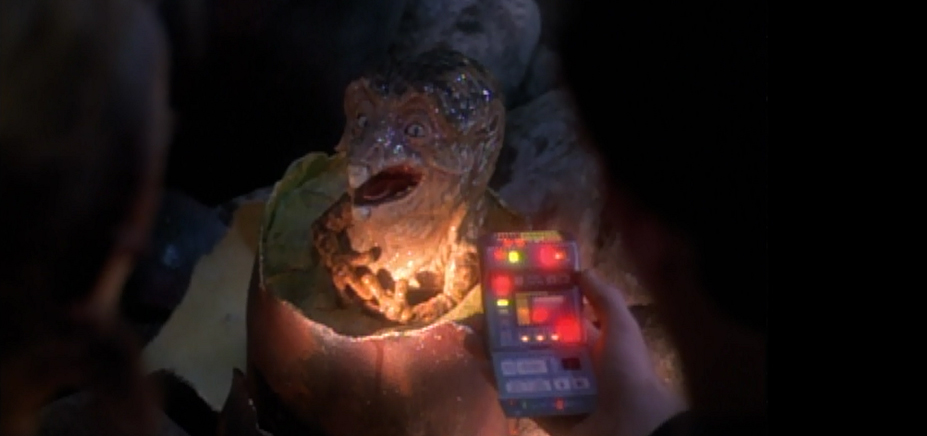
Two men and a lizard lady...

Two men and a lizard lady…

It is hard to begrudge Michael Piller this approach. After all, it had worked quite well on Star Trek: The Next Generation and Star Trek: Deep Space Nine. In particular, it took Deep Space Nine about three years before it figured out how to make characters like Bashir, Dax and Quark capable of carrying their own episodes without making the audience want to bash their heads against a large blunt surface. It is not unreasonable to take the same approach to dealing with the elements of Voyager that are not working.

There is a very significant difference, though. The problematic elements of Voyager have little to do with execution; they are fundamental problems with the concepts. The Kazon do not work as a threat because they are one of worst alien species that Star Trek ever produced, rooted in some rather unpleasant racial stereotypes tied to contemporary Los Angeles gang culture. Tom Paris does not work as a rebel and womaniser because Robert Duncan McNeill works better as a charming goof. Neelix’s romance with Kes is toxic because she is a child and he’s possessive.

Cooking up a storm...

Cooking up a storm…

As such, it feels like the second season of Voyager spends a lot of time fixing problems that are fundamentally unfixable. One of the great aspects of the premise of Voyager is the fact that the show is in a constant state of movement. Unlike the cast of Deep Space Nine who are fixed in a single place, the cast of Voyager are constantly moving forward. It is possible for Voyager to jettison the parts that are simply not working. (Cue lazy joke about the size of Kazon space.)

Parturition is an example of this phenomenon, as Voyager tries to “fix” the toxic relationship between Neelix and Kes, while offering Tom Paris some small semblance of character growth. Unfortunately, it seems very attached to the idea of Neelix and Kes as a romantic couple and Tom Paris as a playful romantic rogue, which means that the best that it can hope to do is to not make the underlying problems any more obvious. While Parturition is nowhere near as bad as Elogium or Twisted, it still feels like a series treading water.

It's time for the Delta Quadrant's favourite fifties sitcom, "Last Tango With Paris."

It’s time for the Delta Quadrant’s favourite fifties sitcom, “Last Tango With Paris.”

Continue reading

The X-Files – Roadrunners (Review)

This October/November, we’re taking a trip back in time to review the eighth season of The X-Files and the first (and only) season of The Lone Gunmen.

In case there was any doubt, Roadrunners proves that the eighth season of The X-Files means business.

In some ways, it seems remarkable that Roadrunners did not receive a warning about graphic content. The season would wait until Via Negativa before offering a viewer discretion advisory. Roadrunners is one of the most uncomfortable and unsettling episodes in the show’s nine-season run, one that cements the “back to basics” horror aesthetic of the eighth season as a whole. It was clear from the opening three episodes that the eighth season was intended as a return to the darkness of the first five seasons, but Roadrunners commits to the idea.

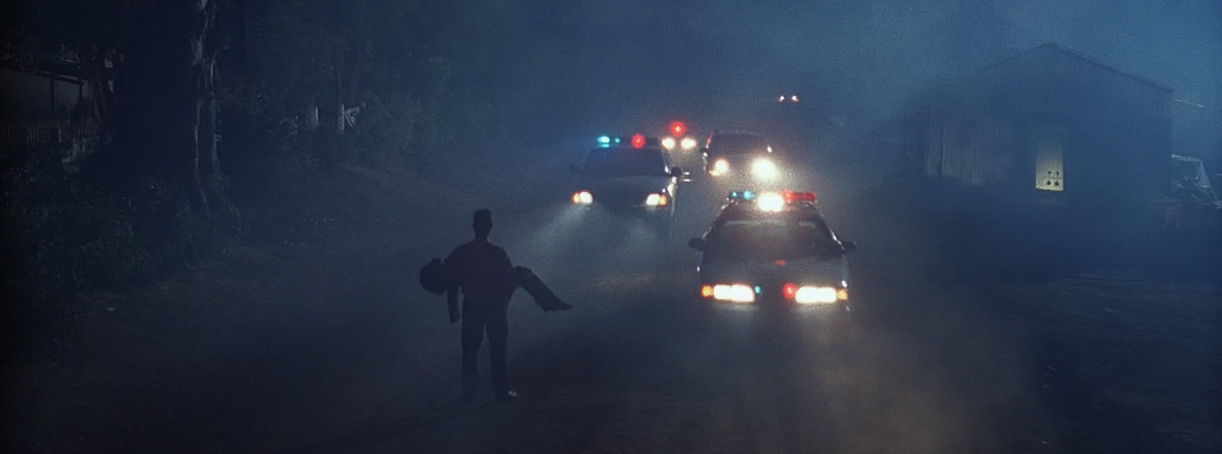
Off-road...

Off-road…

Roadrunners is a “back to basics” script in a number of ways, even beyond its very graphic horror stylings. It is a very good “small town” story, returning to the motif that populated many of the show’s early episodes. It is a story about an eccentric and isolate space in America, a place with its own unique character and its own rich history and traditions. It is a place that stands quite apart from the modern world, that might have looked the same at the turn of the twentieth century as it does at the start of the twenty-first.

Roadrunners could be seen as Vince Gilligan’s answer to Home, a similarly brutal (and unsettling) small-town tale.

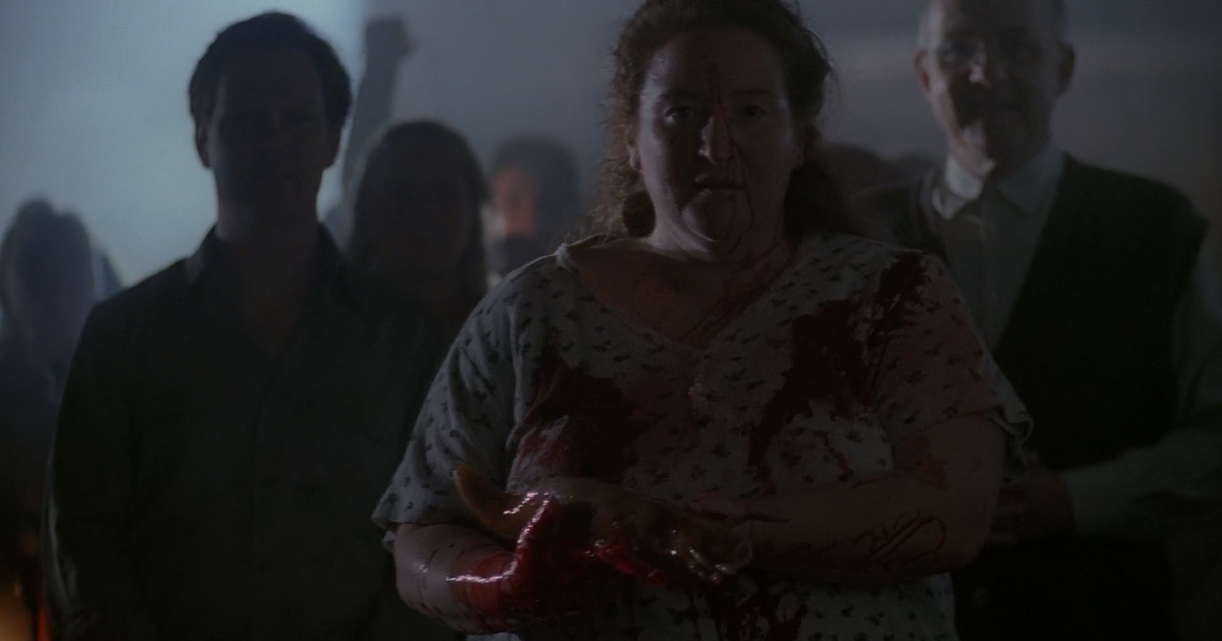
"On to new business. Today's mission is for all of you to go to the brain slug planet." "What are we going to do there?" "Just walk around not wearing a helmet."

“On to new business. Today’s mission is for all of you to go to the brain slug planet.”
“What are we going to do there?”
“Just walk around not wearing a helmet.”

Continue reading

Star Trek: Enterprise – North Star (Review)

Next year, Star Trek is fifty years old. We have some special stuff planned for that, but – in the meantime – we’re reviewing all of Star Trek: Enterprise this year as something of a prequel to that anniversary. This August, we’re doing the third season. Check back daily for the latest review.

It is surprising just how hasty some sections of Star Trek fandom are to dismiss North Star as absurd or ham-fisted or ridiculous.

It is precisely those qualities the make North Star quintessential Star Trek.

Spectre of gun...

Spectre of gun…

Continue reading

The X-Files – Drive (Review)

This July, we’re taking a trip back in time to review the sixth season of The X-Files and the third (and final) season of Millennium.

In many ways, Drive feels like an episode that tackles the move to California head-on.

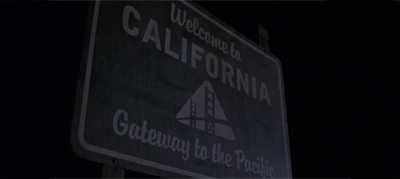
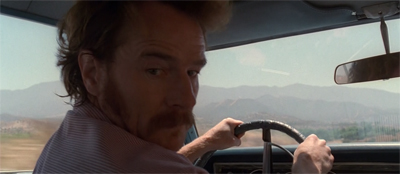
After all, the plot of Drive essentially finds Mulder trapped in a car heading westwards through Nevada and into California. The episode even lingers on a “welcome to California” sign, tacitly acknowledging the massive change that had taken place behind the scenes between the fifth and sixth seasons of The X-Files. It is a very clever way of addressing a major change to the production of the show, one that is candid and open about the fact that things are inherently different now.

"Running out of west..."

“Running out of west…”

More than that, Drive figures out how to build an episode of The X-Files around the change in production location. The sixth season often finds the production team struggling to find the right tone and mood to match the new location; after all, the show cannot simply pretend that it is still filming in Vancouver. California is sunnier, hotter and drier than Vancouver ever was – the sixth season of The X-Files spends a little time trying to adapt to those new filming conditions.

This challenge is arguably most obvious in the string of (literally and metaphorically) lighter episodes in the first stretch of the season. The sixth season is quite controversial among fans of the show because there is a period of time where it seems like The X-Files might transform itself into a quirky romantic sit-com. Episodes like Triangle, Dreamland I, Dreamland II, How the Ghosts Stole Christmas and The Rain King would be the lighter episodes of any previous season; they seem to pile in on top of one another at the start of the sixth season.

Feels like going home...

Feels like going home…

In contrast, Drive is very much a quintessential episode of The X-Files. It is a classic episode of the show. It is scary, it is tense, it is meticulously constructed. There is humour to be found, but the stakes feel real and personal. Writer Vince Gilligan very shrewdly plays into the constraints of the new Los Angeles production realities. A lot of Drive takes place during the day on long desert roads. It takes advantage of California’s impressive interstate system, with twenty-five highways covering almost two-and-half thousand miles.

However, Drive is more than simply a demonstration that The X-Files can still work in its new home. Drive is a superb piece of television in its own right. It is highly regarded as one of the finest episodes of The X-Files from the second half of the run. It is notable for a wonderful premise, a great script, and a mesmerising guest performance from Bryan Cranston. Drive would be the first collaboration between writer Vince Gilligan and actor Bryan Cranston, but not the last.

Drive of your life...

Drive of your life…

Continue reading

Non-Review Review: Slow West

There is a reason that the western has fallen from popularity after its cinematic heyday.

For decades, it seemed like Hollywood punctuated its release of western films with sampling for other genre, returning time and again to the story of the men who shaped America from the ground up. Over the years, the familiar tropes have been deconstructed and reconstructed and deconstructed again. They have been mashed up and knocked down and spun around. They have been torn apart and thrown back together with reckless abandon. With all of that going on, it often seems like anything that the genre has to say has been said and repeated time and again.

Life is peaceful there...

Life is peaceful there…

There are probably still things to be said about the myth of the Old West, even if the genre seems as explored and catalogued as the American continent itself. There are little hidden pockets and eccentric spaces that might hold a surprise or several. Slow West doesn’t necessarily have anything new or revelatory to say about the western. It seems unlikely to shatter any illusions or break any preconceptions. A lot of the ground covered by Jay Cavendish and Silas Selleck on their trek westward will be familiar to anybody with a passing knowledge of the genre.

At the same time, there is a lyrical beauty to Slow West. The film is a haunting and evocative trip through a landscape that most viewers know better than their own locality. Slow West might not say anything particularly earth-shattering, but it does articulate itself clearly and elegantly. It is a meticulously crafted film, finely constructed and sumptuously filmed. It might be a tourist trip over well-travelled group, but it takes the most scenic route imaginable.

Saddle up!

Saddle up!

Continue reading

Star Trek: Enterprise – Marauders (Review)

Next year, Star Trek is fifty years old. We have some special stuff planned for that, but – in the meantime – we’re reviewing all of Star Trek: Enterprise this year as something of a prequel to that anniversary. This April, we’re doing the second season. Check back daily for the latest review.

Well, it looks like Star Trek: Enterprise used up most (if not all) of its ambition for the second season.

The second season of Enterprise got off to a fairly decent start, Shockwave, Part II notwithstanding. Minefield and Dead Stop weren’t perfect, but they were taking the show in a direction that seemed promising. A Night in Sickbay may have been a pretty serious misfire, but it was still a very ambitious instalment of the series. However, it seemed like that ambition was not to last. The second season of Enterprise becomes fairly conventional from this point out – fairly relaxed and fairly generic.

"We don't like your kind around here..."

“We don’t like your kind around here…”

This is the type of approach that producers will frequently describe as “back to basics.” More cynical commentators might use the phrase “back to the well.” The goal seems to be to offer the audience more of what they’ve had before, to repeat what had worked in earlier episodes in earlier seasons in earlier shows. There’s a creeping sense of familiarity to the whole exercise, as if the writing staff are merely filing the numbers (and character names) off old scripts so that they can be recycled. It is very environmentally friendly.

Marauders starts the trend, offering viewers what amounts to The Magnificent Seven… in space, with Klingons!” It works quite well as a diversion or change of pace. It is significantly less satisfying as a direction for the rest of the season.

"Settlement this!"

“Settlement this!”

Continue reading

Millennium – The Wild and the Innocent (Review)

This February and March, we’re taking a trip back in time to review the fourth season of The X-Files and the first season of Millennium.

The Wild and the Innocent is an ambitious piece of television.

It is not a piece of television that works as well as it might, the execution of the central ideas leaving a little to be desired, but it is an episode that commits whole heartedly to something unique. In I Want to Believe, Robert Shearman refers to The Wild and the Innocent as “a plot more suited to Cormac McCarthy than Chris Carter.” He’s not wrong. The Wild and the Innocent is a story about cycles of violence and abuse in the American south, a grim road movie with some very harsh conclusions about the way that the world works.

That sinking feeling...

That sinking feeling…

It still fits within the milieu of Millennium. After all the classic “serial killer road movie” is still a serial killer story, and Millennium has already carved out that niche for itself. However, the image of Frank Black and Peter Watts following a trail of bodies from Missouri down through Arkansas suggests a different show than the one that has been airing since The Pilot. In many respects – with its heavy philosophical voice-over, its country-tinged soundtrack, its fixation on the outlaw couple – The Wild and the Innocent feels almost like some old American folk tale.

There’s something decidedly old-fashioned here, with the episode playing more like a western than a police procedural. In the documentary Order in Chaos, Carter described Frank Black as character from a story “like Shane, like any cowboy, any good movie, Western movie.” As such, he fits in quite comfortably with this new type of story.

Road warrior...

Road warrior…

Continue reading

The X-Files – Pusher (Review)

This November (and a little of December), we’re taking a trip back in time to review the third season of The X-Files and the first (and only) season of Space: Above and Beyond.

Pusher is perhaps one of the most effective stand-alone “monster of the week” stories that the show ever did.

It is no wonder that the episode is frequently cited among the best episodes of The X-Files ever produced, but it is telling that it was identified by Slate as the perfect “gateway” episode of the show. If you want to give someone a taste of The X-Files without burdening them with continuity or back story, this is a good choice. It may not be the best episode that Vince Gilligan ever wrote, and it may not even be the best episode of the third season, but it is one the strongest demonstrations of what the show does on a weekly basis.

Mano a mano...

Mano a mano…

Pusher is the first episode that Vince Gilligan wrote after joining The X-Files writing staff. It is the only episode credited to Gilligan in the show’s third season. He had been offered a position on staff after turning in Soft Light at the end of the second season, but had hesitated before accepting the job. When he did accept the job, he came down with a dose of infectious mononucleosis. As a result, Gilligan only wrote one script for the third season, despite becoming one of the show’s most prolific writers.

Pusher is a pulpy delight, a spectacularly constructed standalone that perhaps points the way to Gilligan’s later work.

Gift of the gab...

Gift of the gab…

Continue reading

My 12 for ’13: Django Unchained & Suckerpunching Expectations

This is my annual countdown of the 12 movies that really stuck with me this year. It only counts the movies released in Ireland in 2013, so quite a few of this year’s Oscar contenders aren’t eligible, though some of last year’s are.

This is number 2…

Slavery seems to have been bubbling away at the back of the American pop cultural consciousness this year. Quentin Tarantino’s Django Unchained and Steven Spielberg’s Lincoln were both Best Picture nominees at this year’s awards ceremony. 12 Years a Slave is making pretty impressive head-way for next year’s Oscars, embarrassing moments like the film’s European marketing aside. They are all superb and moving films, but Tarantino’s Django Unchained is probably the strongest of them.

djangounchained8

Continue reading