• Following Us

  • Categories

  • Check out the Archives


  • Awards & Nominations

Star Trek: Voyager – Persistence of Vision (Review)

This February and March, we’re taking a look at the 1995 to 1996 season of Star Trek, including Star Trek: Deep Space Nine and Star Trek: Voyager. Check back daily Tuesday through Friday for the latest review.

In some respects, the second season of Star Trek: Voyager can be seen as a conflict over the future of the show.

On the one hand, Michael Piller had returned to the franchise following the failure of the television show Legend. With Ira Steven Behr overseeing Star Trek: Deep Space Nine, Piller returned to focus his attention on the second season of the younger Star Trek show. After all, the second season was a disorganised mess, with the production team struggling to get the necessary scripts together on time. Having a safe pair of hands on board to help guide the show might come in handy.
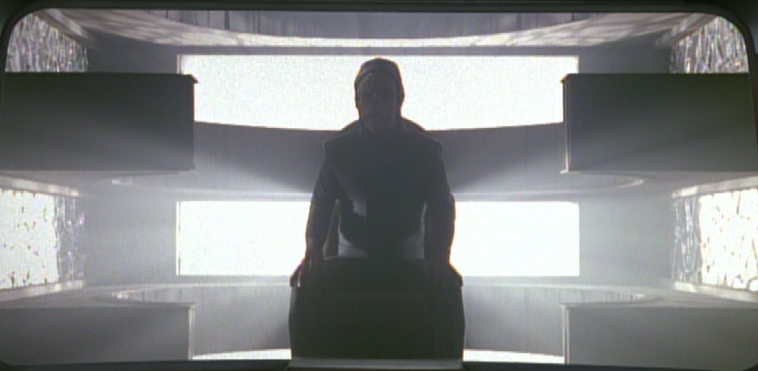
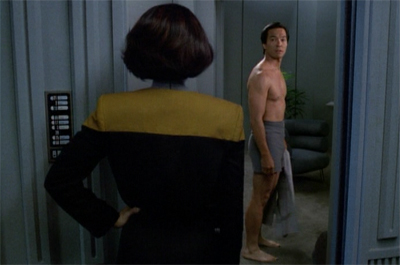
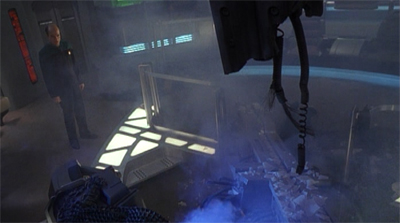
"It's a bridge AND a tanning salon, simultaneously..."

“It’s a bridge AND a tanning salon, simultaneously…”

On the other hand, Jeri Taylor had been around the show since Caretaker. She had taken over the reins after Piller’s departure and had supervised the tail end of the first season. Taylor had arrived on the Star Trek franchise just a year after Piller, and had been a vital part giving Star Trek: The Next Generation its unique voice and mood. Over the course of the second season, it became increasingly clear that Michael Piller and Jeri Taylor had very different visions for the future of Star Trek: Voyager, and those visions were coming into conflict.

History ultimately vindicated Jeri Taylor. The second season of Voyager was the last television season of Star Trek to be directly overseen by Piller, while Jeri Taylor become the guiding light of the third and fourth seasons of the show. Whatever problems might exist with those two seasons television, they are at least more stable and consistent than the first and second years of the show. It is, of course, arguable that Piller never got his own change to exercise his own vision of the show unimpeded – and so that is not a fair measure.
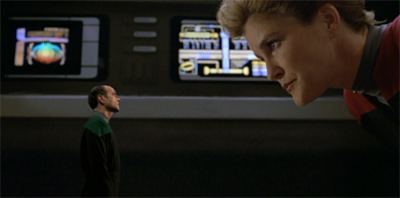
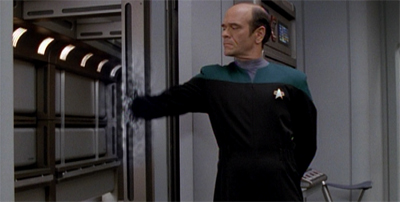
Cutting the Doctor down to size...

Cutting the Doctor down to size…

In a way, the conflict between Piller and Taylor’s versions of Voyager is quite clearly typified in this early run of episodes. The show had breezed through the four episodes left over from the first season production block, and desperately needed ideas to keep afloat. The senior producers rolled up their sleeves and got involved. Piller was largely responsible for Parturition and Tattoo, while Taylor oversaw Persistence of Vision. None of these episodes are perfect, but it is quite clear that Taylor is increasingly the show’s safest bet going forward.

Persistence of Vision is a very flawed episode of television, playing to some of Taylor’s more uncomfortable recurring motifs. However, it is much more interested in actually moving Voyager along than either of Piller’s contributions.
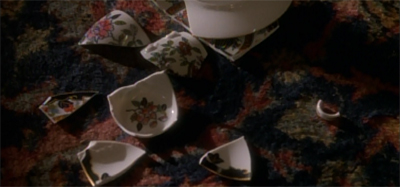
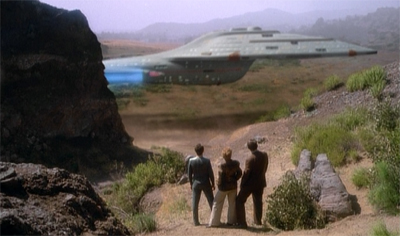
"The teacup that I shattered did come together."

“The teacup that I shattered did come together.”

Continue reading

Star Trek: Voyager – Parturition (Review)

This February and March, we’re taking a look at the 1995 to 1996 season of Star Trek, including Star Trek: Deep Space Nine and Star Trek: Voyager. Check back daily Tuesday through Friday for the latest review.

One of the more interesting aspects of the second season of Star Trek: Voyager is its stubborn refusal to give up on elements that simply do not work.

Time and again, and often at the behest of producer Michael Piller, the second season returns to concepts that were problematic and troublesome in the first season. The obvious goal is to fix those problems so that those elements can be successfully reintegrated into the surrounding show. This is why the second season returns to concepts like the Kazon as a threat and Tom Paris as a rebel and Neelix as a character with a useful function on the ship. This is not a bad approach. If the first season of a show is about experimentation, then the second season is about calibration.

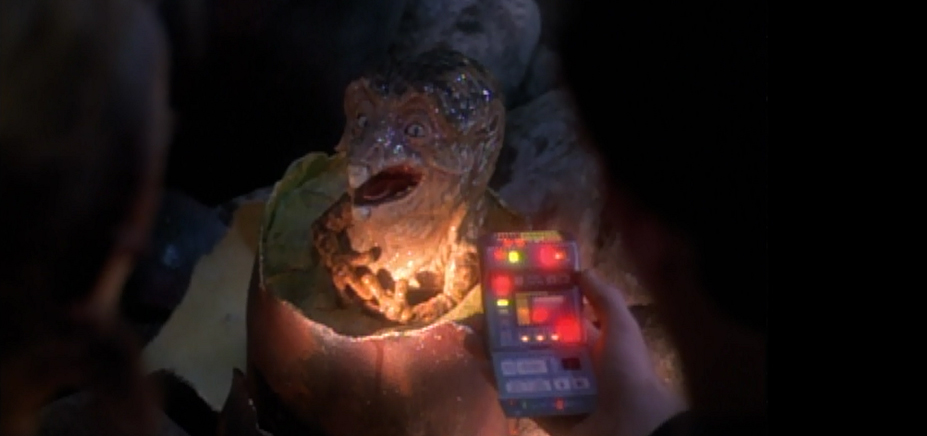
Two men and a lizard lady...

Two men and a lizard lady…

It is hard to begrudge Michael Piller this approach. After all, it had worked quite well on Star Trek: The Next Generation and Star Trek: Deep Space Nine. In particular, it took Deep Space Nine about three years before it figured out how to make characters like Bashir, Dax and Quark capable of carrying their own episodes without making the audience want to bash their heads against a large blunt surface. It is not unreasonable to take the same approach to dealing with the elements of Voyager that are not working.

There is a very significant difference, though. The problematic elements of Voyager have little to do with execution; they are fundamental problems with the concepts. The Kazon do not work as a threat because they are one of worst alien species that Star Trek ever produced, rooted in some rather unpleasant racial stereotypes tied to contemporary Los Angeles gang culture. Tom Paris does not work as a rebel and womaniser because Robert Duncan McNeill works better as a charming goof. Neelix’s romance with Kes is toxic because she is a child and he’s possessive.

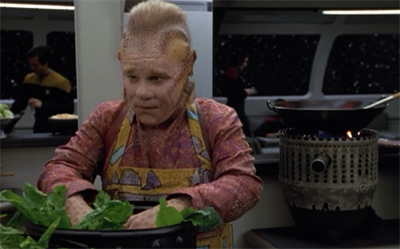
Cooking up a storm...

Cooking up a storm…

As such, it feels like the second season of Voyager spends a lot of time fixing problems that are fundamentally unfixable. One of the great aspects of the premise of Voyager is the fact that the show is in a constant state of movement. Unlike the cast of Deep Space Nine who are fixed in a single place, the cast of Voyager are constantly moving forward. It is possible for Voyager to jettison the parts that are simply not working. (Cue lazy joke about the size of Kazon space.)

Parturition is an example of this phenomenon, as Voyager tries to “fix” the toxic relationship between Neelix and Kes, while offering Tom Paris some small semblance of character growth. Unfortunately, it seems very attached to the idea of Neelix and Kes as a romantic couple and Tom Paris as a playful romantic rogue, which means that the best that it can hope to do is to not make the underlying problems any more obvious. While Parturition is nowhere near as bad as Elogium or Twisted, it still feels like a series treading water.

It's time for the Delta Quadrant's favourite fifties sitcom, "Last Tango With Paris."

It’s time for the Delta Quadrant’s favourite fifties sitcom, “Last Tango With Paris.”

Continue reading

Star Trek: Enterprise – Broken Bow (Review)

Next year, Star Trek is fifty years old. We have some special stuff planned for that, but – in the meantime – we’re reviewing all of Star Trek: Enterprise this year as something of a prequel to that anniversary. This January, we’re doing the first season. Check back daily for the latest review.

Broken Bow is probably the strongest pilot in the Star Trek canon, with Emissary and The Cage vying for second place.

That’s not saying a lot. Broken Bow is still a troubled production with some rather sizeable issues marring what is otherwise an ambitious début for a new Star Trek show. Watching, Broken Bow – as with watching most of the first few years of Star Trek: Enterprise (or just Enterprise) – it feels like the show is at war with itself. It wants to be something new and fresh and exciting, but it also wants to be an important part of this larger tapestry. And the episode has difficulty reconciling that.

New (old) frontier...

New (old) frontier…

So we get new aliens like the Suliban, but a plot that revolves around the Klingons; we get an entirely new crew with a Vulcan science officer and Southern gentleman as the Captain’s best friend; we get a ship without most of the conveniences that we take for granted on Star Trek, but with substitutes and a resolution that relies on technological gimmickry; we get to explore an uncharted part of the Star Trek canon, but with the intrusion of the future to help make it feel a little more familiar.

From the first episode, Star Trek: Enterprise seems to exist as a show trapped between what it could have been and what it has to be. It’s a premise rich with potential, but which still feels a little too much like everything that came before.

Into the sunset...

Into the sunset…

Continue reading

Star Trek: Voyager – Season 1 (Review)

This September and October, we’re taking a look at the jam-packed 1994 to 1995 season of Star Trek, including Star Trek: Deep Space Nine and Star Trek: Voyager. Check back daily for the latest review.

The best thing that can be said about the first season of Star Trek: Voyager is that it avoids being actively terrible.

This might sound like damning with the faintest of praise, but it’s worth looking at the show in the context of its siblings. None of the Star Trek spin-offs have had illustrious first seasons, often struggling to find their feet. It’s worth noting that Voyager‘s first season doesn’t contain any episodes that are as flat-out bad as something like Code of Honour, Angel One or The Passenger. While the show has more than its fair share of problems, it’s hard to look at the concept behind any episode in Voyager‘s first season and think “this is truly bad idea.”

voy-caretaker2

Of course, the logical counterpoint to that argument is the observation that the show hasn’t produced anything of equivalent quality to Heart of Glory, Conspiracy, Duet or In the Hands of the Prophets. This is perfectly legitimate criticism, and it really explains the problem with the first season of Voyager. While the show has avoided any spectacularly embarrassing decisions, it did this by completely avoiding any real risk.

The first season of Star Trek: Voyager is almost perfectly calibrated to land in the Star Trek comfort zone.

voy-learningcurve18

Continue reading

Star Trek: Voyager – Twisted (Review)

This September and October, we’re taking a look at the jam-packed 1994 to 1995 season of Star Trek, including Star Trek: Deep Space Nine and Star Trek: Voyager. Check back daily for the latest review.

It’s easy to see why the decision was made to bury Twisted as deep into the second season of Star Trek: Voyager as possible. The third of four episodes carried over from the end of the show’s first production year, it was the sixth episode of the show’s second broadcast season. Not only did it air behind the last episode produced as part of that first year, it also aired behind the first two episodes produced during the second season.

To be fair, Twisted isn’t a bad episode. It has a whole host of problems, but the most fundamental issue with Twisted is that it is incredibly dull. It’s the most pointless sort of story imaginable, where a bunch of weird stuff happens to our characters and there’s no way to save the day so they just sit around and wait patiently until it stops. While the script to Twisted is comprised of irritating moments, they don’t add up to anything substantial.

Twisted is very much the equivalent of forty-five minutes of Star Trek themed dead air.

"Why, hello there..."

“Why, hello there…”

Continue reading

Star Trek: Voyager – Non Sequitur (Review)

This September and October, we’re taking a look at the jam-packed 1994 to 1995 season of Star Trek, including Star Trek: Deep Space Nine and Star Trek: Voyager. Check back daily for the latest review.

Non Sequitur is a Brannon Braga script touching on familiar Brannon Braga concepts – big ideas like time and space and reality and existence. Harry Kim wakes up to find himself in bed with his girlfriend, Libby. The two are living in San Francisco on Earth. Ensign Harry Kim never served on Voyager, instead working in Starfleet Engineering on Earth. Unable to explain what has happened, Kim finds himself struggling to cope with the situation.

Luckily, in true Star Trek: Voyager fashion, everything is conveniently reset at the end of the episode.

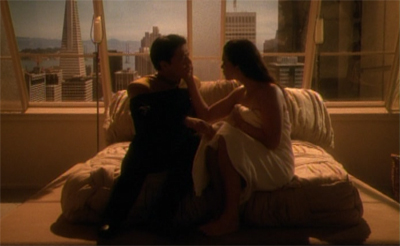
Feels like going home...

Feels like going home…

Continue reading

Star Trek: Voyager – Elogium (Review)

This September and October, we’re taking a look at the jam-packed 1994 to 1995 season of Star Trek, including Star Trek: Deep Space Nine and Star Trek: Voyager. Check back daily for the latest review.

Elogium is the first script from writer Kenneth Biller, even if it was his second script produced and his third script to air. Adapted from a script by Jeri Taylor from a freelance pitch from Jimmy Diggs, Elogium has gone through quite a few sets of hands before reaching the screen. In many respects, Biller’s script went through the opposite approach of many writers working on Star Trek for the first time.

Ronald D. Moore’s script for The Bonding and René Echevarria’s teleplay for The Offspring both went through story editor Melinda Snodgrass and executive producer Michael Piller for varying amounts of re-writes before their ideas reached the screen. In contrast, Biller’s début assignment is re-writing a script written by an executive producer from a freelance pitch. It’s no wonder that Elogium turned into such a mess.

Love in a turbolift...

Love in a turbolift…

The episode was produced towards the tail end of the first season of Star Trek: Voyager, and it’s almost a shame that it was held back into the second season. While hardly an episode deserving of repeat airing over the summer, it was also a pretty poor way of welcoming viewers into the show’s second season. It’s a problem with all of the hold-overs, except for Projections. The other three episodes carried over are among the weakest episodes of a troubled season. Elogium might not be quite as dull as Twisted or as unfocused as The 37’s, but it is a deeply creepy episode of television.

The two episodes produced during the second season to air in the first six weeks – Initiations and Non Sequitor – might not represent franchise high-points, but they are well-produced hours of television that suggest Voyager might be finding its feet. The hold-overs from the first season undermine that sense of progress.

Neelix was shocked to discover that Ocampan children were not found under cabbage patches...

Neelix was shocked to discover that Ocampan children were not found under cabbage patches…

Continue reading

Star Trek: Voyager – Projections (Review)

This September and October, we’re taking a look at the jam-packed 1994 to 1995 season of Star Trek, including Star Trek: Deep Space Nine and Star Trek: Voyager. Check back daily for the latest review.

Projections is really the first episode of Star Trek: Voyager that feels like it is the right script coming from the right staff writer. At the start of the show’s first season, it seemed like writing assignments were handed out almost at random, with no real acknowledgement of the relative strength of any of the writers involved.

Brannon Braga is one of the best science-fiction high-concept writers in the history of franchise, but he was assigned the character-driven second episode Parallax and the issue-driven Emanations; Michael Piller’s personal strengths were always more firmly aligned with character development, so it felt strange to see him writing the time travel adventure Time and Again and the anomaly of the week in The Cloud.

All by myself...

All by myself…

Pushing the boundaries of a writing staff is something worth doing – forcing various members of the team to ease themselves out of their comfort zone – but it felt counter-productive to do this during the first season of a new Star Trek show. After all, the first season is about putting the best foot forward, and many of the early scripts for the show feel like they were handed to the wrong writers during the development process.

With Projections, it feels like Brannon Braga finally has a Voyager script that plays entirely to his strengths as a writer. It is arguably his most character-driven script on the franchise to date, but it also anchored in a pretty fascinating existential dilemma. In many respects, it is a spiritual companion to Frame of Mind, a sixth season episode of Star Trek: The Next Generationpreoccupied with questions about what reality actually might be.

Everything falls apart...

Everything falls apart…

Following on from Heroes and Demons, Projections is only the second episode of Voyager to focus on the character of the Doctor. However, much like Heroes and Demons, it demonstrates the versatility of the character and the range of the actor. Projections is a very clever script that relies on its central character to really carry it across the line. At this point in Voyager‘s run, Robert Picardo seems to be one of the few members of the ensemble who could really pull it off.

The result is one of the (if not the) strongest episode of the show’s first two seasons – somewhat appropriate, given the way the show straddles the gap between the first and second seasons.

He's not all there...

He’s not all there…

Continue reading

Star Trek: Voyager – Initiations (Review)

This September and October, we’re taking a look at the jam-packed 1994 to 1995 season of Star Trek, including Star Trek: Deep Space Nine and Star Trek: Voyager. Check back daily for the latest review.

Broadcast as the second episode of the second season, Initiations was the first episode produced as part of the second season of Star Trek: Voyager. As three of the four shows carried over from the first season – Projections, Elogium and Twisted – were essentially budget-saving bottle shows, the plan was to shuffle some location-heavy episodes into the broadcast order to offer something a bit more exciting and engaging.

Initiations also marked the return of producer Michael Piller to the fold. Piller had left Voyager mid-way through the first season to work on another science-fiction show for UPN. After Legend was cancelled, Piller returned to work on Voyager and found himself presiding over a very troubled second season. The second season of Voyager would be the last time that Piller was actively involved in a season of Star Trek, and so it feels like a pretty momentous occasion for the franchise.

While not spectacular, and suffering from some lingering Kazon-related problems, Initiations is still an effective forty-five minutes of television.

Stargazing...

Stargazing…

Continue reading

Star Trek: Voyager – The 37’s (Review)

This September and October, we’re taking a look at the jam-packed 1994 to 1995 season of Star Trek, including Star Trek: Deep Space Nine and Star Trek: Voyager. Check back daily for the latest review.

The 37’s did not close out the first broadcast season of Star Trek: Voyager, as the producers had intended. The last episode produced in the first season run, it was held back in the schedule into the second season – a decision made by UPN to allow Voyager to get an early start the following autumn. Still, the decision to reposition The 37‘s as the premiere of the broadcast season is quite telling.

Airing ahead of the three episodes produced before it, and ahead of any episodes produced specifically for the second season, there’s a sense that the production team intend The 37’s to be an important episode. After all, the season premiere is just as important as the season finalé in the basic structure of a broadcast season. The finalé serves as a capstone for what has come before, while (hopefully) indicating what might follow. The premiere is a way of setting up what is yet to come.

We have lift-off...

We have lift-off…

So the positioning on The 37’s is interesting, because it indicates just how much the production team had invested in the episode. This is a big episode of Voyager, this is an important episode of Star Trek. As such, it makes for a completely unsatisfying experience. The 37’s isn’t a bad episode by any measure – it has a few interesting ideas and a few memorable elements – but it’s not ambitious. It doesn’t radically change Voyager, but it also doesn’t distil it. It doesn’t offer the sense of purpose lacking for morst of the first season.

The 37’s just sort of is. It’s an episode that would be functional shuffled into the middle of a season – a few episodes earlier or later than broadcast. However, it simply doesn’t work when scheduled into a high-profile slot, particular when it has been moved so consciously and so purposefully.

A second pilot?

A second pilot?

Continue reading