• Following Us

  • Categories

  • Check out the Archives


  • Awards & Nominations

Star Trek: Enterprise – Fight or Flight (Review)

Next year, Star Trek is fifty years old. We have some special stuff planned for that, but – in the meantime – we’re reviewing all of Star Trek: Enterprise this year as something of a prequel to that anniversary. This January, we’re doing the first season. Check back daily for the latest review.

Fight or Flight is reasonably solid as second episodes go. It’s very clear that Rick Berman and Brannon Braga are making a conscious effort to avoid the mistakes of Star Trek: Voyager. There’s a sense that they are trying to give Star Trek: Enterprise its own unique mood and flavour. As such, Fight or Flight feels like a story that isn’t just tailor-made for Enterprise, but is tailor-made for early in the first season of the show. It isn’t a story that could be done by another spin-off, and it’s also not a story that could be done by Enterprise even a year later.

While Fight or Flight works on a conceptual level, the execution feels a little strange. While Broken Bow was a big and bombastic Star Trek pilot with its own feel and rhythm, Fight and Flight feels almost quaint. As a piece of television, it’s constructed in a very meticulous and very precise manner, one that seems suspiciously outdated for a show broadcast in late 2001.
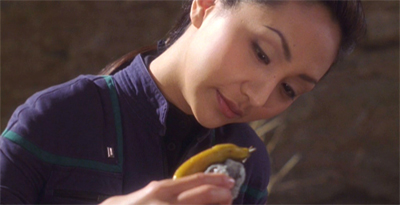
Slugging it out...

Slugging it out…

Continue reading

Star Trek: Voyager – Season 1 (Review)

This September and October, we’re taking a look at the jam-packed 1994 to 1995 season of Star Trek, including Star Trek: Deep Space Nine and Star Trek: Voyager. Check back daily for the latest review.

The best thing that can be said about the first season of Star Trek: Voyager is that it avoids being actively terrible.

This might sound like damning with the faintest of praise, but it’s worth looking at the show in the context of its siblings. None of the Star Trek spin-offs have had illustrious first seasons, often struggling to find their feet. It’s worth noting that Voyager‘s first season doesn’t contain any episodes that are as flat-out bad as something like Code of Honour, Angel One or The Passenger. While the show has more than its fair share of problems, it’s hard to look at the concept behind any episode in Voyager‘s first season and think “this is truly bad idea.”

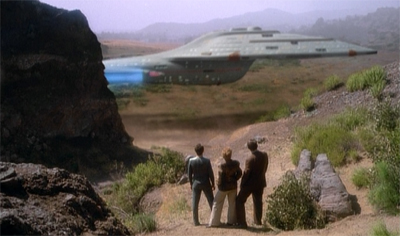
voy-caretaker2

Of course, the logical counterpoint to that argument is the observation that the show hasn’t produced anything of equivalent quality to Heart of Glory, Conspiracy, Duet or In the Hands of the Prophets. This is perfectly legitimate criticism, and it really explains the problem with the first season of Voyager. While the show has avoided any spectacularly embarrassing decisions, it did this by completely avoiding any real risk.

The first season of Star Trek: Voyager is almost perfectly calibrated to land in the Star Trek comfort zone.

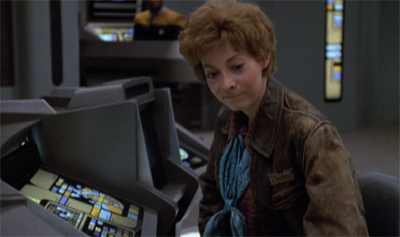
voy-learningcurve18

Continue reading

Star Trek: Voyager – The 37’s (Review)

This September and October, we’re taking a look at the jam-packed 1994 to 1995 season of Star Trek, including Star Trek: Deep Space Nine and Star Trek: Voyager. Check back daily for the latest review.

The 37’s did not close out the first broadcast season of Star Trek: Voyager, as the producers had intended. The last episode produced in the first season run, it was held back in the schedule into the second season – a decision made by UPN to allow Voyager to get an early start the following autumn. Still, the decision to reposition The 37‘s as the premiere of the broadcast season is quite telling.

Airing ahead of the three episodes produced before it, and ahead of any episodes produced specifically for the second season, there’s a sense that the production team intend The 37’s to be an important episode. After all, the season premiere is just as important as the season finalé in the basic structure of a broadcast season. The finalé serves as a capstone for what has come before, while (hopefully) indicating what might follow. The premiere is a way of setting up what is yet to come.

We have lift-off...

We have lift-off…

So the positioning on The 37’s is interesting, because it indicates just how much the production team had invested in the episode. This is a big episode of Voyager, this is an important episode of Star Trek. As such, it makes for a completely unsatisfying experience. The 37’s isn’t a bad episode by any measure – it has a few interesting ideas and a few memorable elements – but it’s not ambitious. It doesn’t radically change Voyager, but it also doesn’t distil it. It doesn’t offer the sense of purpose lacking for morst of the first season.

The 37’s just sort of is. It’s an episode that would be functional shuffled into the middle of a season – a few episodes earlier or later than broadcast. However, it simply doesn’t work when scheduled into a high-profile slot, particular when it has been moved so consciously and so purposefully.

A second pilot?

A second pilot?

Continue reading

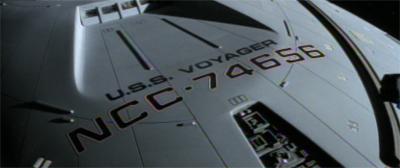
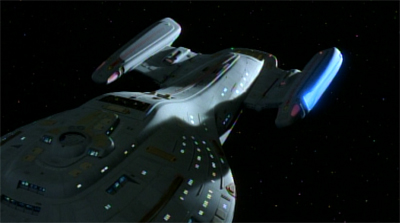
Star Trek: Voyager – Caretaker (Review)

This September and October, we’re taking a look at the jam-packed 1994 to 1995 season of Star Trek, including Star Trek: Deep Space Nine and Star Trek: Voyager. Check back daily for the latest review.

So, Star Trek: Voyager.

Where do we begin? Voyager is probably the most divisive and controversial of the Star Trek spin-offs, the one that carries a lot of the blame for the franchise’s decline and decay in the mid to late nineties. It is the series that connects the tail end of the success story that was Star Trek: The Next Generation to the start of the dying gasp that was Star Trek: Enterprise. This spin-off had the misfortune to launch at the height of a revived franchise’s popularity and to finish as public interest waned.

Feels like going home...

Feels like going home…

Star Trek: Voyager felt like an act of hubris. It was positioned by Paramount to be the studio’s highest-profile television show. It was a feature of the television landscape, finally allowing Paramount the chance to leverage its own television network – a plan delayed since the late seventies, but deemed feasible in the mid-nineties. UPN branded itself “the first network of the new century”, a rather arrogant declaration. Caretaker was the first thing broadcast on UPN in early 1995, débuting to an audience of more than 21 million. However, Voyager would never reach those figures again.

Despite that success, things fell apart quickly. None of the shows that aired on UPN’s second night received a second season. The only shows to limp on to renewal from the network’s rocky first year were Voyager, The Sentinel and Moesha. Of these meagre freshmen hits. Voyager lasted the longest, with one more season to its name than Moesha. Over the summer of 1995, it was identified by The Los Angeles Times as the network’s “star survivor”, and the show upon which all of the network’s hopes rested. By 2000, five years later, the network had run up a debt of $800,000.

"I hope you don't mind, our tailors measured you while you were unconscious. It's all part of a standard probe."

“I hope you don’t mind, our tailors measured you while you were unconscious. It’s all part of a standard probe.”

That’s a lot of pressure for any television series to bear. Following (and, in the eyes of many, replacing) an illustrious predecessor, supporting the weight of a new television network, pushing into the future while remaining anchored to the past, it’s no wonder that Star Trek: Voyager wound up the confused mess that it became. Indeed, one can recognise many of the problems that would haunt the show through to its final season tied up in this pilot episode.

Continue reading