• Following Us

  • Categories

  • Check out the Archives


  • Awards & Nominations

The Spirit Archives, Vol. 11 (Review/Retrospective)

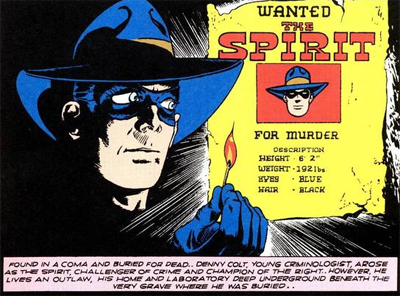
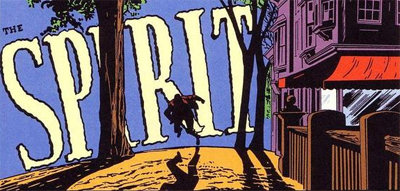
I have to admit that I feel a bit guilty for glossing over the World War II era of The Spirit. The era tends to get ignored because Will Eisner effectively handed over control of the strip to a variety of writers and artists while serving in the Armed Forces. The talent involved professionals like Jack Cole and Lou Fine, so it’s hardly as if it was neglected. Still, without Eisner’s passion driving the strip, it seemed to lose its way slightly. The aesthetic shifted even further the longer Eisner was away. Fans skipping from the first collection of post-Eisner work (The Spirit Archives, Vol. 5) to the work included here will see a radical change in style. While there was still a strong influence from Eisner, the comic simply didn’t look right. However, the differences extended deeper as well. On some primal level, The Spirit of the World War II era didn’t really feel right either.
Hounded by the Spirit of Will Eisner…

Continue reading

The Spirit Archives, Vol. 5 (Review/Retrospective)

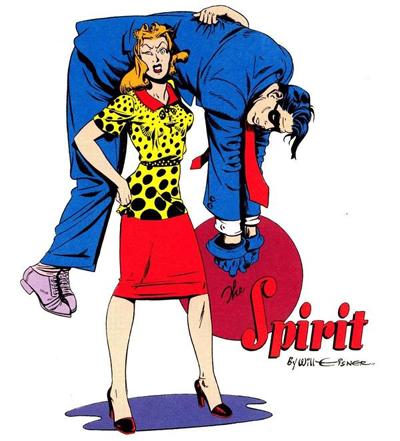
With The Spirit Archives, Vol. 5, we get our first real taste of what The Spirit looks like without Will Eisner. I’ve always felt like The Spirit belonged to Eisner in a way that very few iconic American comic book characters belong to a particular creator. The Spirit belonged to Eisner in the same way that The Adventures of Tintin belonged to Hergé. I am fond of Darwyn Cooke’s revival of the character, and there’s something interesting about the Kitchen Sink anthology series, but those exist mainly as curiosities or companion pieces to Eisner’s work on the character.

In many ways, this stretch of strips, published by Eisner’s staff and colleagues during his army service, feels the same sort of way. It’s more of a historical curiosity than an end to itself.

Lighten up…

Continue reading

Non-Review Review: The Oranges

There’s an interesting film in here, somewhere. The Oranges teases the possibility of brutally exposing the seedy underside of suburban life, as we follow an affair between a married man and his best friend’s daughter, but The Oranges is far too shallow to land anything resembling a killing stroke. The adult cast is composed of talented veterans, but the script doesn’t give them much to do – instead The Oranges treats their children as the focal point, misjudging the talent of young actresses Leighton Meester and Alia Shawkat. It all feels too light, too cosy, and too willing to pick the low-hanging fruit to really create an interesting study of life in the ‘burbs.

Keeping it in the family...

Keeping it in the family…

Continue reading

Star Trek: The Next Generation – The Last Outpost (Review)

To celebrate the twenty-fifth anniversary of Star Trek: The Next Generation, and also next year’s release of Star Trek: Into Darkness, I’m taking a look at the recent blu ray release of the first season, episode-by-episode. Check back daily for the latest review.

You know, a lot of people would argue that Star Trek is about understanding. That it’s about embracing and respecting cultures, even when they hold values different than your own. Sometimes that is to a fault, like in the last episode (Code of Honour) where Picard allowed his Chief of Security to engage in a fight to the death to avoid violating local custom. (Which he then violated by reviving the loser.) However, it appears that such open-mindedness only applies when you look and act appropriately human enough.

If you are a Ferengi, then your culture shouldn’t be respected and acknowledged. It should be mocked and ridiculed.

He’s all ears…

Continue reading

The Spirit Archives, Vol. 4 (Review/Retrospective)

As with the previous collection, the War looms large in The Spirit Archives, Vol. 4. While Eisner had been keenly following events in Europe from the start of the strip, things really come to a head here. These are the strips for the six months following the attack on Pearl Harbour, and – understandable – there’s a strong patriot undertone to everything here. Eisner would eventually put his patriotism into action when he was drafted, leaving his character in the hands of his staff – who dutifully kept the comic warm for him during his term of service. While Eisner’s early work on the strip isn’t quite as good as the work that would follow, and the shadow of the Second World War dominates, these are still fascinating stories told by a master storyteller.

Carrying on, naturally…

Continue reading

The Spirit Archives, Vol. 3 (Review/Retrospective)

Join us the December as we take a dive into the weird and wonderful Will Eisner Spirit Archives, the DC collections of the comic strip that helped define the medium.

At this point The Spirit had survived a year. That first year had seen Eisner establish the strip, lay down many of the rules that would define the comic for the rest of its impressive twelve-year run as a regular fixture in the Sunday papers. This third volume is hardly the most essential in the twenty-six volume set, but there’s a sense of confidence in the stories the Eisner is telling and how he is telling them. The strip arguably wouldn’t hit its stride until after Eisner left for the war, and came back with a broader range of experience, but one can see the roots of that later success even in these (relatively) early adventures.

We'll always have Damascus...

We’ll always have Damascus…

Continue reading

International On-Line Film Critics’ Poll Nominees Announced…

The nominees for the 2012 International On-Line Film Critics’ Poll 2012 have been announced. Open to all films released in the United States between November 2011 and November 2012, it allows for a slightly different playing field than the Oscars typically does. It also means that I am (as a non-American) far more likely to have seen all the nominees, with only Lincoln yet to see among the Best Picture nominees. Anyway, I will be sending in my ballot soon enough, but take a gander at the full list of nominees below. It’s a strong list, to be sure.

iolfcp1

Continue reading

The Spirit Archives, Vol. 1 (Review/Retrospective)

Join us the December as we take a dive into the weird and wonderful Will Eisner Spirit Archives, the DC collections of the comic strip that helped define the medium.

It’s hard to overstate the impact that Will Eisner had on comic books as a medium. The writer, entrepreneur and artist is known as “the father of the graphic novel”, with A Contract With God regard as one of te very first examples of the format. Eisner made massive in-roads into developing comics as a medium that merited discussion and attention, trying frantically to break out of the ghetto where the artform is so frequently trapped. While he has made countless pivotal contributions, arguably Eisner’s largest and most influential body of work can be found in The Spirit, the weekly comic strip that the author syndicated across America. Packaged with any number of respected newspapers, it was among the most widely-read comic strips in the country, but it also allowed Eisner the freedom to expand and develop his craft.

DC have collected the bulk of the character’s history in a series of their superb “Archive Editions”, from the first strip published through to Eisner’s last work on the title (with a supplementary volume published by Dark Horse). Here, in the first volume, we can see the artist honing his craft and developing the series into one of the most important in comic book history.

That’s his name!

Continue reading

Non-Review Review: The Red Riding Trilogy

The Red Riding trilogy is a triumph of British television drama, and proof that the British channels are capable of producing home-grown drama that is of the highest possible quality. Demonstrating that HBO doesn’t hold complete dominion over quality drama, the Red Riding films were of enough quality to earn a limited theatrical release in the United States. I know that a high profile and commercial success isn’t a universal guarantee of quality, but it is certainly worth noting when discussing these three films exploring crime and corruption in the three “Riding” administrative zones. (For the record, the three zones are “North”, “East” and “West.” There is no “South”, which feels appropriate given the themes of the trilogy.)

Mingling fact and fiction into a head noir-ish cocktail, Red Riding is highly recommended for those who like bleak and sophisticated drama.

Continue reading

Non-Review Review: Red Riding – The Year of Our Lord 1974

This is the North. We do what we want.

– Craven explains how things work to Eddie

Red Riding is certainly an ambitious effort. David Peace wrote four books exploring violence and corruption in Yorkshire, centring around the morbid history of brutality in the North. Occupying a strange ethereal realm between fact and fiction, sometimes those crimes are fictionalised, but sometimes real murders and murderers intersect. The child murders of this first instalment, Red Riding: 1974, evoke the infamous Moors murders in Manchester during the sixties, while the arrest of an innocent party calls to mind the case of Stefan Kiszko. Adapting the series of four books into a trilogy of films, Red Ridingmakes for a fascinating – if gloomy – exploration of the darker pages in the region’s cultural history.

He’s gone far (Gar)field…

Continue reading