• Following Us

  • Categories

  • Check out the Archives


  • Awards & Nominations

The X-Files – Mind’s Eye (Review)

This May and June, we’re taking a trip back in time to review the fifth season of The X-Files and the second season of Millennium.

Likely as a result of the peculiar factors around its production, the fifth season of The X-Files is a rather strange cocktail.

There are only twenty episodes in the season. Seven of those are mythology episodes – Redux I, Redux II, Christmas Carol, Emily, Patient X, The Red and the Black, The End. The rest of the season devotes considerable space to experimentation and adventurous storytelling. Episodes like Unusual Suspects and Travelers take the focus off Mulder and Scully. Shows like The Post-Modern Prometheus and Bad Blood are experimental in their storytelling. Episodes like Chinga and The Pine Bluff Variant focus almost exclusively on one or other of the leading duo.

Locked out...

Locked out…

Even the remainder are not what might be described as typical “monster of the week” stories. Both Detour and Folie a Deux focus on the relationship between Mulder and Scully as much as the monster at the heart of the story. Kill Switch is an episode written by a special guest writing team, one that defines itself by how odd it feels. All Souls is a meditation on Scully’s faith. The fifth season doesn’t really have a lot of room left for the classic episodic no-frills-attached “monster of the week” stories.

Which is part of what makes Mind’s Eye so fascinating. In any other season, Mind’s Eye would stand as a pretty solid example of the form – a pretty solid “this is what The X-Files does” episode of television like Pusher or Leonard Betts before it. However, the fifth season is so strange and weird in structure and form that Mind’s Eye stands out all the more. The best of the season’s straight-down-the-middle standalone stories, Mind’s Eye throws the rest of the season into contrast. It demonstrates just how odd the fifth season actually is.
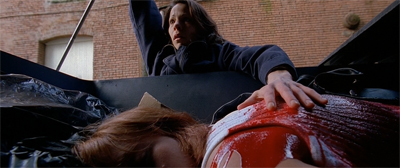
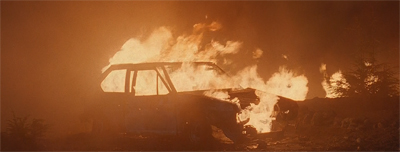
A bloody disaster...

A bloody disaster…

Continue reading

The X-Files (Topps) #38 – Cam Rahn Bay (Review)

This May and June, we’re taking a trip back in time to review the fifth season of The X-Files and the second season of Millennium.

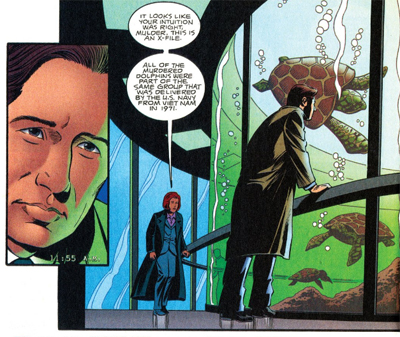
Cam Rahn Bay returns to one of the recurring themes of John Rozum’s run on Topps’ X-Files tie-in comic book.

It is essentially a cautionary tale amount mankind tampering with nature and the unforeseeable repercussions of such meddling. As such, it feels very much in keeping with scripts like Skybuster or Scum of the Earth. This idea of human hubris is a theme that is very much in keeping with The X-Files as a franchise, perhaps most keenly reflected in Chris Carter’s deep affection for Mary Shelley’s Frankenstein and for environmental causes. Cam Rahn Bay is very much in keeping with that aesthetic.

All at sea...

All at sea…

However, there are problems with the story. Most obviously, Rozum’s prose seems a little clunky and awkward. Cam Rahn Bay is a heavy-handed and clumsy meditation on mankind’s fixation with imposing its will over the natural world. However, there is also something slightly hypocritical about the story. As much as Cam Rahn Bay criticises the use of animals in a military capacity, it never seems to question the use of animals in captivity. While the training of dolphins to do military work is treated as deplorable, training them to do tricks for entertainment is lauded.

Cam Rahn Bay feels a little tonally ill-judged, with this fairly significant blindspot undermining a lot of Mulder’s impassioned rhetoric about how mankind treats the natural world.

"Sorry, I was just thinking abotu Deep Throat..."

“Sorry, I was just thinking abotu Deep Throat…”

Continue reading

The X-Files – Travelers (Review)

This May and June, we’re taking a trip back in time to review the fifth season of The X-Files and the second season of Millennium.

For all that the fifth season of The X-Files is building towards a major summer movie release, the production team seem surprisingly relaxed about it.

The fifth season is as experimental and as loose as the show ever got. Patient X and The Red and the Black suggested that Chris Carter didn’t even feel beholden to the continuity of The X-Files: Fight the Future, introducing new characters and concepts to the mythology that could not possibly be inserted into the film at this late stage. Similarly, the show was willing to play around with special guest writers like Stephen King and William Gibson, film an entire episode in black and white, focus on relatively minor characters, and reveal two separate secret histories of the X-files.

What do you call a baby Fox?

What do you call a baby Fox?

Of course, some of these innovations were driven by necessity or large goals. Patient X and The Red and the Black represent the beginning of the end for this stage of the mythology. Stories like Unusual Suspects and Travelers focus on characters other than Mulder or Scully because David Duchovny and Gillian Anderson were otherwise engaged. Nevertheless, there is a very relaxed vibe to the fifth season, as if the show is taking an extended moment to enjoy the peak of its popularity. As well it should.

Travelers is an episode that is far from essential in many respects. It is clunky in places, indulgent in others. It feels like the production teams are just happy to root through the old costuming wardrobe and prop departments, delighted to compose over-written monologues and stock characters. Travelers is light and fun, with its indulgence and its relative lack of substance making it more enjoyable than it would otherwise be.

He'll (Garret Dilla)hunt you down...

He’ll (Garret Dilla)hunt you down…

Continue reading

The X-Files: Season One (Topps) #6 – Space (Review)

This May and June, we’re taking a trip back in time to review the fifth season of The X-Files and the second season of Millennium.

If the jump to Ice suggested that the Season One line would only be covering the “highlights” of the first season of The X-Files, then the decision to immediately follow with an adaptation of Space puts paid to that theory.

Ice is generally regarded as one of the strongest stories of the first season. It is moody and atmospheric, tense and claustrophobic. It shines a light on the characterisation of Mulder and Scully, while also offering a particularly memorable (and unsettling) monster of the week. In contrast, Space is generally regarded as one of the weakest stories of the first season. It is clumsy and muddled, slow and dreary. The episode’s direction is bland and the special effects are woeful. On paper, it is probably the least likely choice for a Season One adaptation.

Face the future...

Face the future…

However, Space ultimately lends itself to a comic book adaptation. The story finds itself well-suited by the transition from live action footage to comic book page. there are a number of different reasons for this, but the truth is that the story is simply better suited to this format. That applies to the technical limitations imposed on film, but also to the storytelling conventions associated with comic books as opposed to live action television. It is a startling result, and arguably the biggest success of the entire Season One line.

Although it is a qualified accomplishment at best, Space is the first Season One comic that manages to surpass its source material.

Is there life on Mars?

Is there life on Mars?

Continue reading

The X-Files – The Red and the Black (Review)

This May and June, we’re taking a trip back in time to review the fifth season of The X-Files and the second season of Millennium.

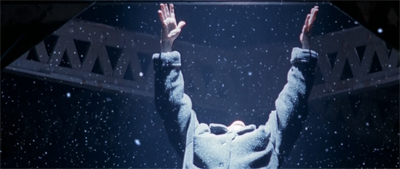
“Before the exploration of space, of the moon and the planets, man hailed that the heavens were the home and province of powerful gods who controlled not just the vast firmament, but the earthly fate of man himself and that the pantheon of powerful, warring deities, was the cause and reason for the human condition, for the past and the future, and for which great monuments would be created on earth as in heaven. But in time man replaced these gods with new gods and new religions that provided no more certain or greater answers than those worshipped by his Greek or Roman or Egyptian ancestors. And while we’ve chosen now our monolithic and benevolent gods and found our certainties in science, believers all, we wait for a sign, a revelation. Our eyes turn skyward ready to accept the truly incredible to find our destiny written in the stars.”

Lift me up...

Lift me up…

Continue reading

The X-Files (Topps) – Ground Zero #1-4 (Review)

This May and June, we’re taking a trip back in time to review the fifth season of The X-Files and the second season of Millennium.

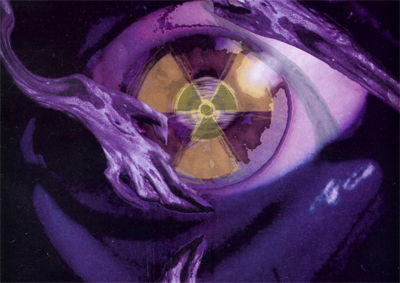
Ground Zero offers an indication of just how much success Topps was enjoying with their line of licensed X-Files comic books.

The monthly series was still being published, and Season One was on a bimonthly schedule. Both books had stable creative teams, and there was no indication that they were likely to wrap up any time soon. Of course, Topps would pull of the comic book market in late 1998, but there was no indication that they considered their X-Files line to be anything other than a complete success. As such, it made sense to expand the line. After all, the company had already used the brand to sell annuals and digests.

Eye see all...

Eye see all…

However, there was reportedly a considerable amount of friction between Topps and Ten Thirteen over the comic book line. Ten Thirteen was reportedly quite firm in what they would and would not allow to be published. Writers John Rozum and Stefan Petrucha have talked about how difficult it was to get their scripts published for the monthly series. It seems that Topps was eager to work around these restrictions. It is telling that neither Season One nor Ground Zero were original concepts; they were adaptations of ideas and stories Ten Thirteen had already approved.

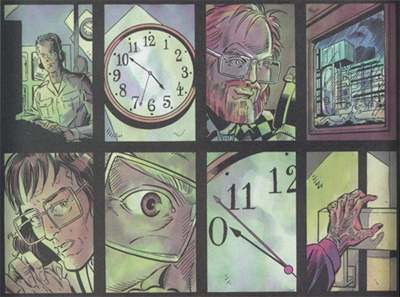
Ground Zero is written by veteran tie-in author Kevin J. Anderson. Anderson had already written a number of popular X-Files tie-in books and had provided a fill-in arc on the monthly comic book with Family Portrait. The artwork for Ground Zero is provided by Gordon Purcell, one of the best likeness artists in the business. Publishing a four-issue adaptation of a tie-in novel is the very definition of a “safe” choice to expand the line, and only illustrates some of the wasted opportunities towards the end of Topps’ stewardship of the license.

Doomsday clock...

Doomsday clock…

Continue reading

The X-Files – Patient X (Review)

This May and June, we’re taking a trip back in time to review the fifth season of The X-Files and the second season of Millennium.

This should not work.

There are lots of reasons why Patient X and The Red and the Black should simply implode under their own weight. Most obviously, they are scripts that are rather blatantly just piling more and more back story and convolution onto a framework that is already overloaded and over-stretched. They are introducing new characters at a late stage of the game. They rely on contrivance and sketchy character development. They seem to exist at odds with the script for The X-Files: Fight the Future, which had been written and shot, but was awaiting release.

Everything burns...

Everything burns…

However, despite all this, Patient X and The Red and the Black work very well together. They are the strongest story-driven mythology two-parter since Nisei and 731 at the start of the third season. There is an energy and drive to Patient X and The Red and the Black that has been largely absent from the show’s big blockbuster two-parters since Herrenvolk at the start of the fourth season. After a year-and-a-half treading water as the release date of the movie draws ever closer, it is nice to see Chris Carter cut completely loose.

Patient X and The Red and the Black form a story which doesn’t seem at all worried about what any of this means for the summer realise of Fight the Future. Parts of it become quite difficult to reconcile with the film as released. However, the two-parter is all the stronger for it.

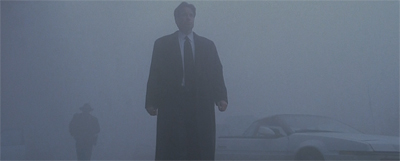
Fog of war...

Fog of war…

Continue reading

The X-Files – Kill Switch (Review)

This May and June, we’re taking a trip back in time to review the fifth season of The X-Files and the second season of Millennium.

On the surface of it, William Gibson seems a strange fit for The X-Files.

He certainly seems like a more eccentric choice than Stephen King. King was a writer famed for his horror stories, with a fascination for small-town life and an interest in guilt as a legacy of American history. On paper, King should have been the perfect “special guest writer” for the show, able to churn out a script that would resonate perfectly with the larger themes of The X-Files while still sitting comfortably within his own oeuvre. While Chinga is not a bad episode, it is not an exceptional episode by any measure. It feels perfectly adequate.

Well, that's going in the DVD menu.

Well, that’s going in the DVD menu.

As such, Kill Switch seems like a story that could go horribly wrong. Gibson is a writer most famous for his work in defining and popularising “cyberpunk”, a science-fiction subgenre that is far removed from the horror trappings generally associated with The X-Files. Gibson was a writer who tended to explore the possible future development of cyberspace and associated issues, while Carter worked very hard to anchor The X-Files in the now. Gibson’s stories seemed to take place in the not-too-distant future; Carter grounded The X-Files in a very particular now.

However, Kill Switch works. It works phenomenally well. It is an episode that feels markedly different from everything else around it, while still feeling like it belongs to The X-Files. The clash of styles is evident in Kill Switch, as writers William Gibson and Thomas Maddox find themselves adapting their themes and ideas to a completely different aesthetic. That is perhaps part of appeal. While Chinga made it look quite easy to construct a solid Stephen King story that was also a solid episode of The X-Files, Kill Switch is nowhere near as smooth. This is a different beast. And it is glorious.

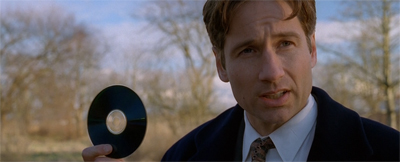
"Woah, woah, woah. What happened to floppies?"

“Woah, woah, woah. What happened to floppies?”

Continue reading

The X-Files (Topps) #37 – The Face of Extinction (Review)

This May and June, we’re taking a trip back in time to review the fifth season of The X-Files and the second season of Millennium.

Suspension of disbelief is a curiously fickle thing.

It is a concept that generates considerable debate in its function and application. After all, the normal mode of fiction generally accepts that fiction is… well, fictional. There is no real belief to shatter, because there is an innate understanding between artist and audience that a work of art should be interpreted as a representation of reality rather than a piece of reality. Even in the case of “true stories”, audiences will willingly and readily accept alterations and adjustments designed to streamline the story in question.

Ramming speed...

Ramming speed…

After all, the concept of “suspension of disbelief” is quite firmly disengaged from the concept of reality. The old cliché about “truth being stranger than fiction” illustrates the distinction. The real world (and the stories of the people who inhabit it) are full of coincidences and contrivances that audiences would consider to be lazy writing or poor construction if they appeared in a work of fiction. Nevertheless, while “suspension of disbelief” might be more complex than its three-word nature would suggest, it is a useful philosophy.

What “breaks” a work of fiction? At what point does the artist – whether intentionally or otherwise – push the audience out of the story? What causes a double take to occur or a quizzical eyebrow to raise? What story developments prompt angry sighs or bitter grumbling? There is no hard and fast answer. The line will always be arbitrary, varying from audience member to audience member. Everybody has different expectations when it comes to art, and so that threshold is distinct for every person.

"Don't worry, Scully! Stay right there... I'm going to get my camera."

“Don’t worry, Scully! Stay right there… I’m going to get my camera.”

Sometimes people can agree on where the line falls on a certain work, but everybody has their limits. There are some people who embrace perceived absurdities or inconsistencies or incongruities in their stories; there are some people who simple do not consider those absurdities or inconsistencies or incongruities to exist at all. One of the great things about The X-Files as a television show is the sense of adventure and excitement that the premise generates. It is highly flexible, allowing for almost anything.

At the same time, it seems quite clear that writer John Rozum and artist Alex Saviuk find themselves charging head-first towards that highly arbitrary and high flexible boundary with The Face of Extinction, a story about a secret race of intelligent goat people who have lived alongside human civilisation for millennia and who also (conveniently) speak perfect English. It is a rather absurd concept, and one that seems at odds with the relatively grounded style of the first five seasons of The X-Files.

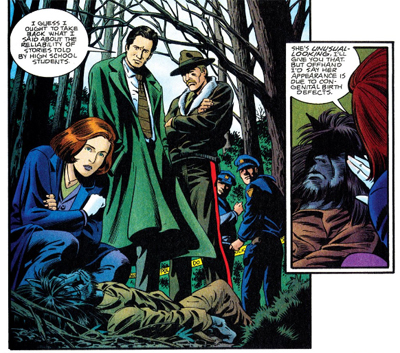
Beastly.

Beastly.

Continue reading

The X-Files – Chinga (Review)

This May and June, we’re taking a trip back in time to review the fifth season of The X-Files and the second season of Millennium.

Chinga is the episode of The X-Files that was written by Stephen King.

That is a pretty big deal. Stephen King is one of the most influential American writers of the twentieth and twenty-first centuries. He is a writer who has enjoyed tremendous commercial success, but who has also balanced that popularity with considerable respect of critics and academics. His work has permeated popular cultured, and sparked all sorts of analysis and exploration. While no creator of that calibre works without at least some small level of backlash, King is one of the most successful American writers by any measure.

Play time!

Play time!

Writing about King in A Century of Great Suspense Stories, Jeffery Deaver argued that the author “helped free the popular name from the shackles of simple genre writing. He is a master of masters.” As such, he should be quite a comfortable fit for The X-Files. Even aside from any stylistic sensibilities that he might share with the series, King is a creator who manages to consistently producer work that might be dismissed as “genre”, but manages to compete with more prestigious and high-profiler literature.

The X-Files did something similar in the nineties. It was a show that frequently dabbled in cult genres – it was a show that dealt with horror and science-fiction themes on a regular basis. However, thanks to the craftsmanship of those involved, The X-Files was frequently able to compete with more “serious” fare at the major awards ceremonies. Chris Carter worked very hard to prevent the show from being relegated to the horror or science-fiction “ghetto.” It was a show that could slide to high-brow to low-brow over a single act; that was part of what made it so fun.

A bloody disaster...

A bloody disaster…

So landing King was very much a coup for The X-Files. He was one of the best-selling and most prolific American writers of the nineties, with his name all over a wealth of media. All that Chinga really needs to do is exist. It would be next to impossible for Chinga to be anything but “that episode of The X-Files written by Stephen King.” Indeed, it seems almost unreasonable to expect anything more from it. The hype on Chinga was unbelievable – as one might expect from a television show that had bagged one of the most popular fiction writers around.

Chinga is a very flawed piece of television, an episode that feels too much like an early draft than a fully-developed concept. The styles of Chris Carter and Stephen King blend reasonably well, but there is a sense that neither is pushing the other out of their comfort zone. Chinga is a pretty average piece of television, a pretty average Stephen King story, and a pretty average episode of The X-Files. While not necessarily a catastrophic failure, it is hardly a fantastic success.

"Yeah, I'm sure this vacation will be completely uneventful!"

“Yeah, I’m sure this vacation will be completely uneventful!”

Continue reading