• Following Us

  • Categories

  • Check out the Archives


  • Awards & Nominations

The X-Files – The Goldberg Variation (Review)

This November, we’re taking a trip back in time to review the seventh season of The X-Files and the first (and only) season of Harsh Realm.

Jeffrey Bell does whimsical very well.

The Rain King and The Goldberg Variation are perhaps Bell’s two strongest contributions to The X-Files, and they stand as some of the show’s most light-hearted episodes. In a way, Bell was the perfect new writer for a show moving from moody Vancouver down to sunny Los Angeles, with his best contributions to the show managing to preserve the weirdness that fans had come to know and love while turning up the brightness at the same time. They were episodes that felt much more applicable to the show’s new home in California.

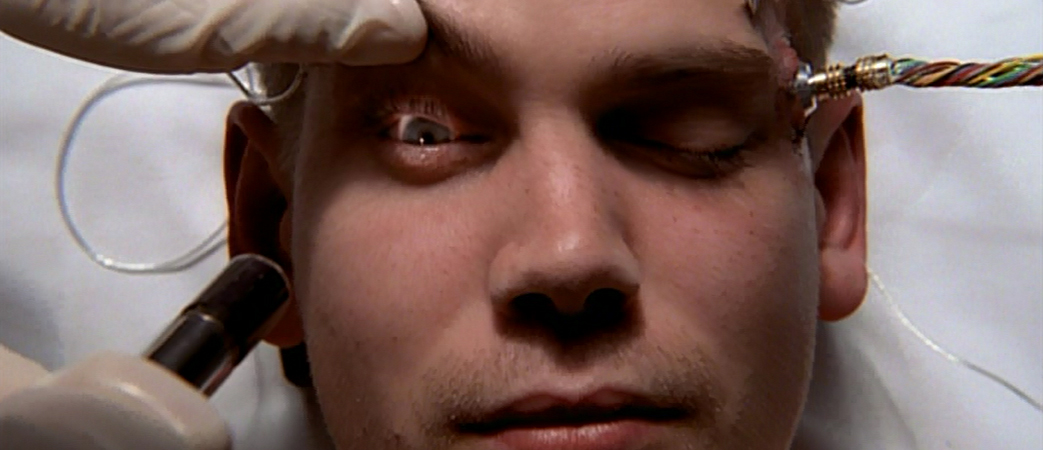
Eye see...

Eye see…

The Rain King and The Goldberg Variation are bright episodes, and not just in a literal sense. There is an optimism that runs through both scripts, suggesting that maybe the world is not an inherently hostile place and maybe not every X-file is plotting to eat your liver or carve out your cancer. Strange things happen in the world on every day, and some times those strange things can be wondrous as well as terrifying. While quite far removed from the aesthetic of the first five seasons, The Rain King and The Goldberg Variation are no less true to the spirit of the show.

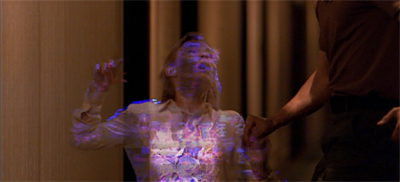
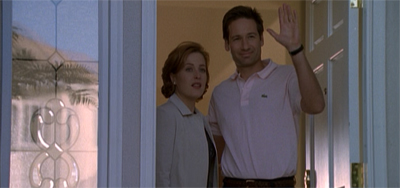
The Goldberg Variation is light entertainment. It is so light that there are points where it almost seems ready to float away. That may not be such a bad thing.
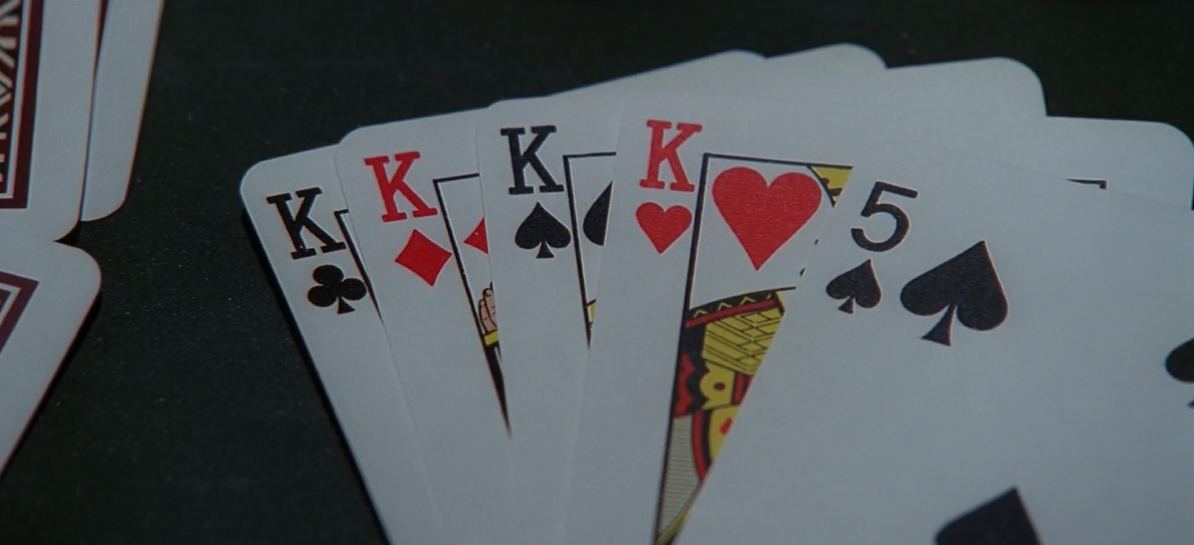
Sometimes you have to play the hand you're dealt...

Sometimes you have to play the hand you’re dealt…

Continue reading

The X-Files – Rush (Review)

This November, we’re taking a trip back in time to review the seventh season of The X-Files and the first (and only) season of Harsh Realm.

When did The X-Files get so old?

As with a lot of the seventh season, Rush is an episode that seems consciously aware of the series’ advancing age. Whether watching Mulder’s life go by in The Sixth Extinction II: Amor Fati or battling zombies in Millennium, the seventh season is acutely aware of the fact that any prime-time drama that has been on the air for seven years is rapidly approaching obsolescence. What was once young and fresh becomes old and tired. There is a sense that the series really wouldn’t mind the prospect of retirement, now that it’s well past the syndication mark.

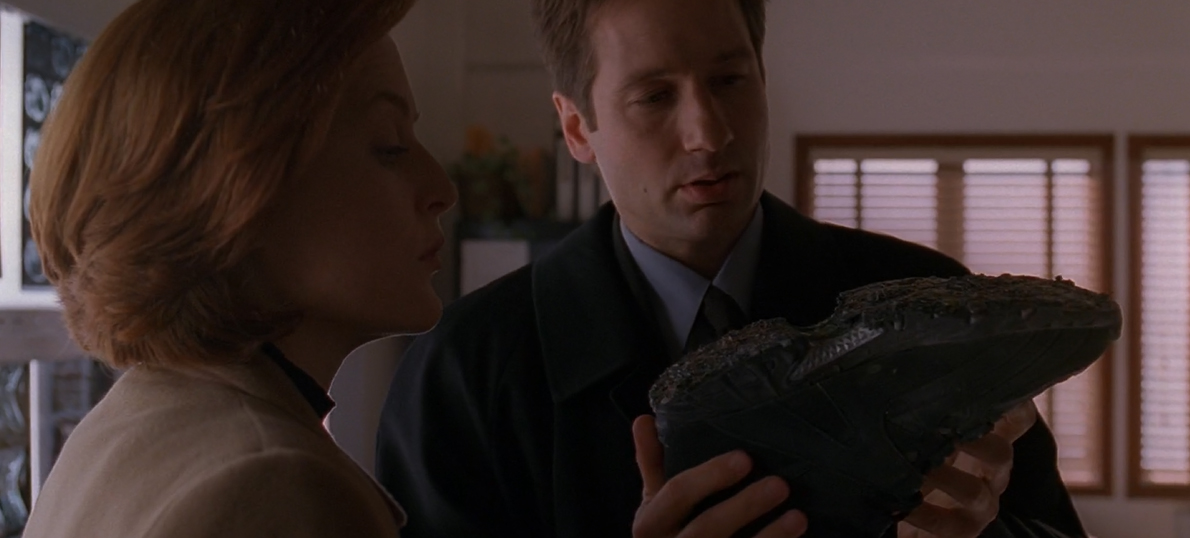
"He wore sneakers... for sneaking."

“He wore sneakers… for sneaking.”

Rush emphasises the advancing years of the show, often awkwardly putting its tongue in its cheeky as it suggests that Mulder and Scully are really lumbering dinosaurs trying to navigate the fast-paced world of high school. David Amann’s script is occasionally a little too wry and self-aware for its own good; this is an episode based around a laboured pun about how “speed” is also a drug, after all. Rush often demotes Mulder and Scully to passive observes, quipping and flirting from the sidelines as the plot unfolds around them.

Rush lacks the charm and dynamism that define the show’s (and the season’s) standout hours, but it is a well-constructed and enjoyable standalone adventure on its own terms. As with Hungry, it feels like a conscious effort to get “back to basics” with the series. If the seventh season is going to fixate on the series’ status as a televisual lame duck counting down its last few episodes, this is not such a bad way to do it.

Scully'll take a run at this...

Scully’ll take a run at this…

Continue reading

The X-Files – Millennium (Review)

This November, we’re taking a trip back in time to review the seventh season of The X-Files and the first (and only) season of Harsh Realm.

There are any number of ironies around the cancellation of Millennium.

The show was cancelled by Fox to make room for Harsh Realm, hoping that Chris Carter’s new show would perform better in the Friday night slot. Of course, that did not turn out to be the case; Harsh Realm was cancelled after only three episodes had been broadcast, all failing to even match the already low numbers of the third season of Millennium. A show in its third season was cancelled to make room for a hip new show that was pretty much dead on arrival. However, that is not the only irony.

Frank Black's return...

Frank Black’s return…

Millennium concluded with Goodbye to All That in May 1999. The show fell seven months shy of its own deadline. If Fox had commissioned only eight new episodes, the creative team would have been able to take the show right up to the turn of the millennium itself. (Well, in a way that would make sense to most viewers. “Nobody likes a maths geek, Scully.” Even one who is technically correct.) It seems like Frank Black would not get to see the arrival of the date that had defined his show. (It was the title, after all.)

If Christmas is the season of goodwill to all men, then it is a nice gesture that The X-Files invited Frank Black to ring in the new year (and the new millennium) with them. It might not be much more, but it is a nice gesture.

... is just one thing that fans remember about this episode.

… is just one thing that fans remember about this episode.

Continue reading

The X-Files – The Sixth Extinction II: Amor Fati (Review)

This November, we’re taking a trip back in time to review the seventh season of The X-Files and the first (and only) season of Harsh Realm.

My formula for greatness in a human being is amor fati: that one wants nothing to be different, not forward, not backward, not in all eternity. Not merely bear what is necessary, still less conceal it—all idealism is mendacity in the face of what is necessary—but love it.

– Friedrich Nietzsche, Ecce Homo

Everything burns...

Everything burns…

Continue reading

The X-Files – The Sixth Extinction (Review)

This November, we’re taking a trip back in time to review the seventh season of The X-Files and the first (and only) season of Harsh Realm.

The fate of individual human beings may not now be connected in a deep way with the rest of the universe, but the matter out of which each of us is made is intimately tied to processes that occurred immense intervals of time and enormous distances in space away from us. Our Sun is a second- or third-generation star. All of the rocky and metallic material we stand on, the iron in our blood, the calcium in our teeth, the carbon in our genes were produced billions of years ago in the interior of a red giant star. We are made of star-stuff.

– Carl Sagan’s Cosmic Connection

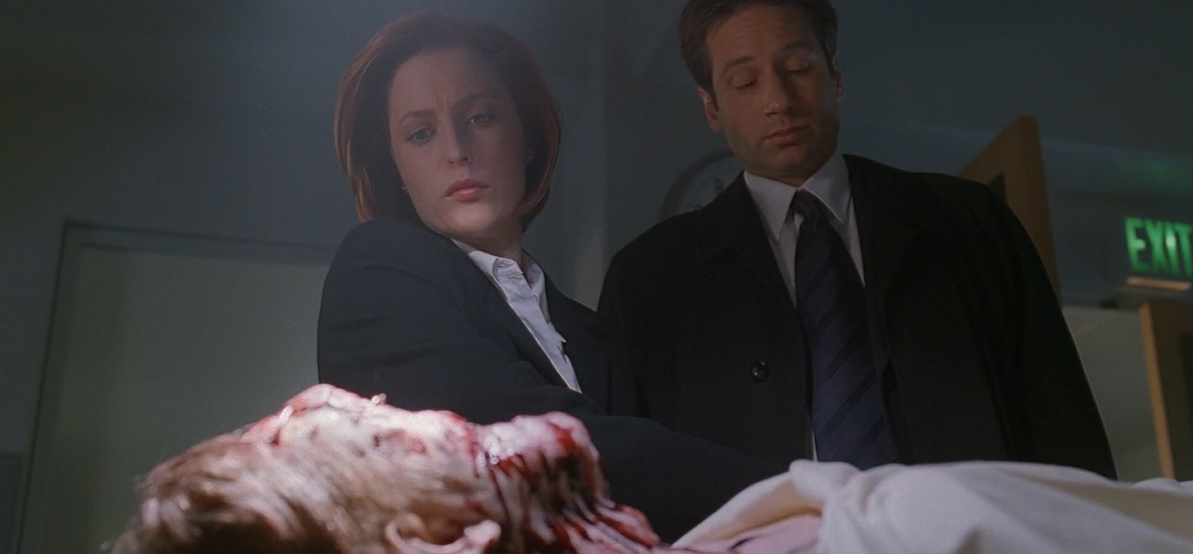
Sea of blood...

Sea of blood…

Continue reading

Harsh Realm – Inga Fossa (Review)

This November, we’re taking a trip back in time to review the seventh season of The X-Files and the first (and only) season of Harsh Realm.

Inga Fossa is a noteworthy episode of Harsh Realm for a number of reasons.

In production terms, it closes out the loose three-episode introduction to the series. The Pilot, Leviathan and Inga Fossa were all written by Chris Carter and served as an introduction to the world and rules of Harsh Realm. Perhaps owing to the relative complexity of the show’s premise, Carter takes a bit of time to lay out and establish the core ideas of the show. It isn’t until the end of Inga Fossa that characters like Thomas Hobbes and Sophie have reached the status quo that will carry them through the rest of the first season.

Game on...

Game on…

However, all of this is ultimately irrelevant. Inga Fossa will always be notable for being the final episode of Harsh Realm to air on Fox. Chris Carter’s new show was infamously cancelled after only three episodes were broadcast. The six episodes that had been produced before cancellation were quietly shuffled off Fox’s 1999 schedule; they eventually aired on FX in mid-2000, to little fanfare. The cancellation was a shocking development. The ratings were spectacularly terrible, but Harsh Realm had been intended to establish Carter as the network’s idea-generating machine.

Something was very wrong.

"You can't $@!# in here, this is the war room!"

“You can’t $@!# in here, this is the war room!”

Continue reading

Harsh Realm – Leviathan (Review)

This November, we’re taking a trip back in time to review the seventh season of The X-Files and the first (and only) season of Harsh Realm.

The first three episodes of Harsh Realm are an interesting combination, and not just because they were the only three episodes of the show to air before cancellation.

All three episodes are written by Chris Carter. The first two are directed by Daniel Sackheim. Taken together, they form a loose triptych. They are effectively three separate stories that come together to form a three-part pilot for the show. It is only by the end of Inga Fossa that Thomas Hobbes (and the audience) fully accept the virtual world into which they have been placed, embracing the hero’s journey that lies ahead. It isn’t until Kein Ausgang that the show really offers the audience a sense of how it might work on a weekly basis.

Fading out...

Fading out…

This is not to suggest that the events of The Pilot flow elegantly into Leviathan, nor that the events of Leviathan bleed over into Inga Fossa. All three episodes of television are discreet and individual; foreshadowing the format that the show would take in its relatively brief life. Interestingly, Carter does not take advantage of the show’s video game structure to enforce more rigid serialisation. If anything, most the nine episodes (particularly the back six) are rigidly episodic.

Leviathan is particularly relaxed in its structure. The Pilot offered all the spectacle and exposition necessary to establish Harsh Realm. In contrast, Leviathan is a bit more focused on mood and atmosphere. There is an impressive action sequence to close out the episode, but there is a larger sense that Leviathan is about establishing what day-to-day existence must be like in this virtual world.

General problems...

General problems…

Continue reading

Harsh Realm – Pilot (Review)

This November, we’re taking a trip back in time to review the seventh season of The X-Files and the first (and only) season of Harsh Realm.

Hereby it is manifest, that during the time men live without a common Power to keep them all in awe, they are in that conditions called Warre; and such a warre, as is of every man, against every man.

– Thomas Hobbes, Leviathan, The First Part, Chapter XIII

Harsh Realm is essentially a war story, or a collection of war stories.

To be fair, there are other themes that bleed through the show’s short nine-episode run; a critique of late-stage capitalism, a healthy dose of Chris Carter’s patented nineties existential spirituality, an exploration of American masculinity. The show plays on all sorts of genres across its short lifespan, from horror story to western to modern noir film. However, all of these unfold against the backdrop of a world locked in total warfare. The opening scenes of The Pilot unfold against the Siege of Sarajevo, setting the tone for the rest of the series.

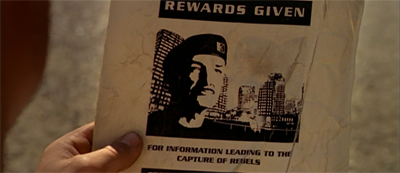
Tom's not here, man...

Tom’s not here, man…

Carter tends to wear his cinematic and televisual influences on his sleeves. The X-Files was a spiritual successor to Kolchak: The Night Stalker, with a little bit of The Parallax View and The Silence of the Lambs thrown in for good measure. Millennium launched in 1996 and owed a lot to the look and feel of David Fincher’s work on se7en. Harsh Realm owes a lot to the resurgence in war movies towards the end of the twentieth century, coming less than a year after Saving Private Ryan and The Thin Red Line both scored Best Picture nominations.

On the commentary for The Pilot, Chris Carter notes that the show’s protagonist was named for the philosopher Thomas Hobbes. Carter cites that Hobbes’ most famous observation is that life is “solitary, poor, nasty, brutish, and short.” The same might be said of the life of Harsh Realm.

Fading out...

Fading out…

Continue reading

The X-Files – Season 6 (Review)

This July, we’re taking a trip back in time to review the sixth season of The X-Files and the third (and final) season of Millennium.

The sixth season of The X-Files is notable for many different reasons. It was the first season after the release of The X-Files: Fight the Future. It was the first season following the move to Los Angeles. It saw the “end” (at least nominally) of the show’s conspiracy mythology in the massive Two Fathers and One Son two-parter. It was the first season to begin closer to the end of the show’s nine-year run than to the beginning. It was also the first season to open past the hundred-episode mark.

That last landmark is important, because it marks the point at which The X-Files could effectively be sold into syndication. One hundred episodes meant that a network could air the show five nights a week for twenty weeks, filling up almost half a year’s worth of broadcasting slots. Reaching the one hundred episode mark meant that a show was a bona fides success, and that anything else was really just gravy on top. The bulk of the work had been done. The X-Files would be a rare prime-time drama to pass two hundred episodes.

xfiles-howtheghostsstolechristmas2a

Of course, times have changed. By 2011, the number of episodes required for a syndication deal had slipped from one hundred to a mere eighty-eight, with the goal being four seasons of twenty-two episodes. (This trend happened while The X-Files was on the air, with the show dropping from twenty-four or twenty-five episodes in a season at the start of its run to twenty-two or twenty towards the end.) Even then, streaming has changed the media landscape, making it more possible than ever to syndicate show with shorter runs, like Community.

So syndication beckoned for The X-Files. In fact, syndication would pose no shortage of trouble for the show in the years ahead. During the seventh season, David Duchovny would file a lawsuit against Fox alleging that the company’s syndication policy had cost him financially. After the show went off the air, Carter would find himself embroiled in a similar lawsuit over syndication rights, delaying production of The X-Files: I Want to Believe. There are worse ways to argue that The X-Files was a victim of its own success than to look at the syndication of the show.

xfiles-arcadia7

Nevertheless, it was clear that The X-Files had accomplished everything that it could ever want by the start of the sixth season. Chris Carter had his five seasons and a movie. Fox had a show they could syndicate. David Duchovny had forced the production to move to Los Angeles so that he could spend time with his family. Although nobody knew it at the time, the fifth season secured the highest rankings that a season of The X-Files would enjoy in the Nielsen Ratings. So going into the sixth season of The X-Files, there was only one question hanging in the air.

What now?

xfiles-therainking25

Continue reading

The X-Files – Biogenesis (Review)

This July, we’re taking a trip back in time to review the sixth season of The X-Files and the third (and final) season of Millennium.

‘When Alexan­der saw the breadth of his domain, he wept for there were no more worlds to con­quer.’ Ben­e­fits of a clas­si­cal education.

– Hans Gruber, Die Hard

In hindsight, “ending” the mythology with a two-parter in the middle of the season was always a risky proposition.

Airing Two Fathers and One Son during February Sweeps was a logical decision. Ending the mythology that had been running through the show for five-and-a-half seasons was certain to grab the attention of casual viewers, reeling them in to boast up ratings. The X-Files had always aired mythology two-parters during Sweeps, putting them forward as examples of the best that the series could do and cementing the show’s claim to be “blockbuster television.” Choosing to wrap up the mythology during February Sweeps was just an extension of that approach.

Look what just washed up...

Look what just washed up…

And it worked. Two Fathers earned the second highest Nielsen score of the sixth season, landing just behind The Rain King. Two Fathers was the last time that The X-Files would rate so highly. As such, the decision to “close off” the mythology in the middle of the season was a very shrewd decision. However, it did raise questions about what the show would do at the very end of season. After all, The X-Files liked to bookend its seasons with mythology episodes, counting on a mythology cliffhanger to carry viewers across the long gap between seasons.

How do you tell a mythology story when you’ve just worked so hard to tidy it all away?

Behind the curtain...

Behind the curtain…

Continue reading