To celebrate the release of Man of Steel this month, we’re going Superman mad. Check back daily for Superman-related reviews.
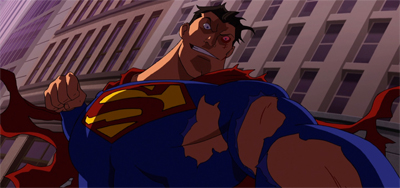
Superman has struggled with his pop culture credibility for quite some time now. The character is seen as too old-fashioned or outdated to really resonate in the modern world, standing for an overly simplistic and unquestioning moral philosophy which doesn’t take into account the nuances of current realities. Superman vs. The Elite, adapted from Joe Kelly’s What’s so Funny About Truth, Justice & the American Way?, represents an attempt to counter this opinion of Superman as a character. Unfortunately, it never really does so be convincing us that the character is still relevant. Instead, it creates a bunch of convenient straw men to oppose our hero, and never allows him to win on his own terms.
To celebrate the release of Man of Steel this month, we’re going Superman mad. Check back daily for Superman-related reviews.
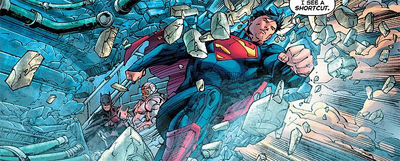
This should be the defining Justice League book of the 21st century. Geoff Johns is something of a DC comics super star, a writer who has worked on all manner of major and minor DC characters, and helped shaped the fictional universe for the better part of a decade. Jim Lee defined the look of DC comics, particularly with the revamped “new 52” character designs. He’s a super star artist who produces iconic superhero images. So pairing the two up on DC’s flagship book, relaunched as part of a line-wide initiative, should be something to watch. If Johns can turn Green Lantern into one of DC’s biggest franchises, imagine what he could do here.
However, their first six-issue arc, Origin, seemed troubled. It was a decently entertaining big-budget blockbuster of a comic book arc, but it didn’t really provide a clear vision of these characters and their world. New Frontier, for example, remains a more thoughtful and introspective origin story for the team of DC’s most iconic heroes.
The Villain’s Journey improves a great deal on Origin, but it’s still deeply flawed, with a sense that Johns and Lee are struggling under the weight of having to make these characters “relevant” to the modern world.
There are moments of brilliance in Man of Steel. I like the golden-hued Malick-esque glimpses of Middle America, evoking the work of Norman Rockwell. (Indeed, the earliest glimpse of Clark Kent’s life on Earth seems to evoke Teacher’s Birthday.) I like the decision to cast Jor-El as a pulpy science hero rather than a stand-in for God. I like the way that the movie embraces the concept of exceptionalism, and doesn’t shy away from the American ideals embodied in Superman’s mythology. I appreciate the development of the Kents into more than generic slices of apple pie.
However, for all of these lovely moments, there’s a sense that Man of Steel resents the fact that it is a superhero origin film. It’s easy to understand why. Superman origins are a dime a dozen, and it’s hard to imagine anybody could be unfamiliar with the broad strokes of the story. However, Man of Steel does find an interesting and nuanced angle on that first crucial Superman story… only to become something radically different. A little under half-way through, the film morphs into a big budget superhero spectacle, sandwiched between the outline of an origin story and chunks peppered throughout like some form of tossed salad.
Man of Steel suffers because it’s a lot less interesting than it might have been, and it revels in that comfortable blockbuster mediocrity.
Man of Steel arrives next week, and I’d be lying if I said I wasn’t looking forward to it. We’ll have a review on Tuesday, but we’re also doing a whole month of Superman coverage as well to celebrate everybody’s favourite Kryptonian. Check back every weekday evening and we should have some glimpse at one of the character’s many iterations from 1939 to present.
I like the way the trailers have been shaping up. There’s an absolute minimum of dialogue here, but Jor-El seems to be staying on point – the few sentences here suggest pretty much everything we need to know about the character. (I’d suggest there’s a deeper understanding of Superman in this two-minute action-heavy trailer than in all Superman Returns. “You can save them all” is pretty much Superman in a nutshell.) Anyway, I won’t say anything more. Here’s the trailer. Enjoy!
To celebrate the release of The Man of Steel this month, we’re going Superman mad. Check back daily for Superman-related reviews.
The Death & Return of Superman stands as one of the most influential and iconic Superman stories ever told. It was certainly the best-selling, even if that doesn’t necessarily make it the most-read, due to the nature of the nineties comic book speculation market. Read today, separate from all the hype and publicity and novelty items, it’s a very interesting part of the character’s lore. It’s certainly an ambitious tale, epic in scope. However, it’s very clearly disjointed and oddly paced and often demonstrates a strange disconnect with its own subject. A story with the title The Death & Return of Superman should probably offer some profound insight into its lead character. This just feels like a series of plot twists peppered with some casual observations.
To celebrate the release of The Man of Steel this month, we’re going Superman mad. Check back daily for Superman-related reviews.
It’s interesting to look back that the early Superman stories in Action Comics. Given that Superman has picked up a reputation for being boring or predictable or safe or conservative, it’s amazing just how radical and inflammatory some of these very early Siegel and Shuster adventures are. These early Action Comics strips were undeniably and overtly political, presenting a strong-willed and proactive version of Superman completely unafraid to impose his will on the citizens of the world.
It’s a dramatically different take on the character than the version we’ve come to accept in popular culture, the benign and well-meaning boy scout who plays by the rules. Even Grant Morrison’s affectionate throwback to these early adventures can’t quite capture the same sense of subversive radicalism which presents us with a version of the iconic superhero who does just flaunt the authority of law enforcement or legislature, but often directly challenges it.
Warners have released another trailer for the upcoming Man of Steel. Most of the marketing has focused on Henry Cavill’s Superman, which makes sense for a number of reasons. Most obviously, this is his movie. Secondly, the film has to lift the pop culture stigma surrounding Superman. Third, the film seems to hinge on Superman’s character arc – which shouldn’t really be worth noting, but it’s nice to see Superman as more than a two-dimensional archetype.
The latest trailer, however, focuses on a part of the film I am actually really excited about. Michael Shannon is a superb actor, and I’m interested to see his take on Zod. Zod is a character who has had difficulty catching on in the comics, despite the fact that they seem to introduce a new version ever five years or so. The character just lives in the shadow of Terence Stamp, arguably providing the first truly iconic supervillain performance, and one which I’d argue holds up today.
Shannon doesn’t seem to be going for imitation, which is a good thing. I want to see his own stamp on the character. This trailer teases that quite well. I like that Zod is emphasising the “Superman as outsider” thing, and also that the movie seems to presenting Zod as an alien invader to Kal-El’s alien altruist. It’s a nice way to cast Superman’s character into contrast. Anyway, check it out below.
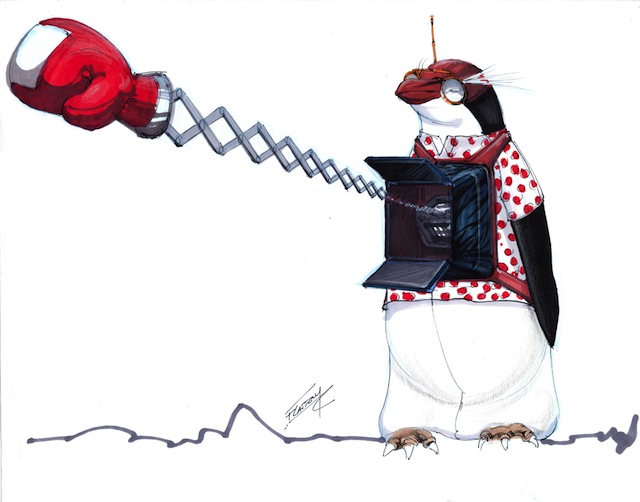
The wonderful Tim Flattery has posted up some of his concept art from a whole host of his past projects, including Real Steel and Spider-Man 2. However, his concept work for Batman Returns caught my eye. Partially because I am a Batman fan, partially because I love Batman Returns more than most and partially because… well, penguins with buzz-saws! I’m waiting for the PETA complaints to begin. There’s also some concept art for the Batmobile from Batman Forever included below. Which is not the worst thing about that movie.
The new trailer for Man of Steel has arrived and… I’m actually pretty excited about it. I’m a pretty big Superman fan, although I’ll admit that the character can be very tough to adapt. While Batman lends himself to all manner of interpretations, the Man of Steel is a lot harder to get a handle on. Batman is – despite being an orphan billionaire – much easier to relate to than an alien from another world. It’s hard to write a character who can do almost anything, and tough to emotionally invest in a hero who can shrug off bullets.
And, yet, despite that, I am cautiously optimistic about this Man of Steel, if only because it seems to grasp something about the character – something that Christopher Nolan’s Dark Knight trilogy understood about Batman. These truly iconic characters are important for what they say about us, and our culture. It’s fun to watch Superman smash alien ships and fly into the sun, but what does his appearance suggest about the world he inhabits. Can we trust him? Can he trust us? Nolan grasped that Batman was about hope in the face of despair – the notion that one man could make a difference and ascend to the status of myth. It seems, based on this trailer, that Man of Steel is about optimism and faith.
The CGI looks grand, but it’s the personal stuff that I responded to. The moment where Clark confesses that his father worries about him. He’s the strongest man in the world, impervious to bullets, and yet Jonathan Kent fears what the world will do to his son – that somehow they might “reject” him, and that would be worse than any physical harm that could befall the child he raised. That’s a fascinating (and strangely natural) hook. There’s something very human about a father’s selfish desire to put his child ahead of the greater good.
When Clark flat out asks his father if he should have allowed those kids to die, Jonathan Kent selfishly replies, “Maybe.” It’s a strangely natural moment, and it feels organic for a father to place the security of his family above the greater good. It doesn’t make Jonathan seem shallow or cynical. It just makes him seem a bit more real. And, naturally, Superman is about transcending that sort of understandable selfishness. With great power, to quote another iconic hero, comes great responsibility, and the heart of Superman suggests that if a man were to find himself gifted these incredible powers, he would use them for the betterment of mankind rather than keep them locked away for personal gain.
There’s another nice moment where Clark asks Lois if she thinks the world is ready – because Superman is a concept that can’t work without absolute trust. If the character can’t be trusted by the world at large, then he loses any moral authority. Unlike Batman who exists as an underdog and can work outside the establishment, the nigh-all-powerful Superman has to be wary of being portrayed as an alien fascist imposing his will on a less powerful mankind.
Superman Returns didn’t realise this and eroded away Superman’s moral high ground, turning the character into a spoilt and entitled teenager with the power of a god. Superman Returns was a disaster and more of a horror movie than a superhero film. It’s not about creating a world that immediately accepts Superman, but in recognising that he has to convince it of his worth. Superman’s real victory isn’t pounding Zod into a skyscraper, it’s convincing people to believe in him. After all, Superman is the very embodiment of optimism, the notion that – were a man suddenly able to fly and deflect bullets – he would use his powers to make the world a better place. If we can believe in the basic goodness of Superman, we can believe in our own capacity to do the impossible.
If Man of Steel can embrace the character without a hint of irony, I think we might be on to something.
This September marks the twentieth anniversary of Batman: The Animated Series, and the birth of the shared DC animated universe that would eventually expand to present one of the most comprehensive and thorough explorations of a comic book mythology in any medium. To celebrate, we’re going back into the past and looking at some classic episodes.
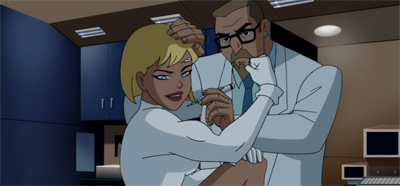
Panic in the Sky is an interesting episode, essentially serving as the climax of the conflict between the Justice League and Cadmus. Divided We Fall would focus more tightly on the League confronting Brainiac and Luthor, with an after-thought given to the question of their authority to wield such power. Panic in the Sky, as such, feels a bit torn between positioning all the players (“the big seven”) for that final confrontation, while offering the inevitable conflict between the Justice League and the United States government. As such, it’s really one big extended fight sequence, allowing McDuffie to avoid some of the more complex and compelling issues he’d raised. Still, it’s an effective episode of the show, a fun confrontation, and an illustration of just how skilled McDuffie is at structuring these gigantic arcs with so many plots and characters in the air.


















 the m0vie blog
