• Following Us

  • Categories

  • Check out the Archives


  • Awards & Nominations

Star Trek: Deep Space Nine – Season 4 (Review)

This February and March (and a little bit of April), we’re taking a look at the 1995 to 1996 season of Star Trek, including Star Trek: Deep Space Nine and Star Trek: Voyager. Check back daily for the latest review.

The fourth season of Star Trek: Deep Space Nine is one of the best seasons of Star Trek ever produced.

The first three years of Deep Space Nine were relatively rocky, although not quite to the extent that accepted fandom wisdom would contend. Each of the first three seasons had strong episodes, with the second season in particular featuring a strong selection of episodes that clearly cemented the tone and mood of the series. Nevertheless, those three seasons were also remarkably uneven. This is entirely understandable; the production team were consciously pushing the boat out and it is to be expected that it might take a little while to steady the ship.

ds9-shatteredmirror20a

With the start of the fourth season, the ship has been steadied. After three years of experimenting and tinkering, the fourth season is all about application. It is about recognising the most successful aspects of what came before and compensating for what did not work. The four season is about refining and honing the best parts of those first three seasons and building a new show around it, right down to structuring The Way of the Warrior as a second pilot and featuring a new credits sequence.

Although Deep Space Nine would change quite a bit in the final three years of its run, the fourth season marks the point at which the series seems to have a firm sense of itself. Deep Space Nine has emerged from its chrysalis.

ds9-tothedeath2a

Continue reading

Star Trek: Deep Space Nine – Broken Link (Review)

This February and March (and a little bit of April), we’re taking a look at the 1995 to 1996 season of Star Trek, including Star Trek: Deep Space Nine and Star Trek: Voyager. Check back daily for the latest review.

What is perhaps most surprising about Broken Link is how quiet and subdued it all it.

The fourth season began with a bang, with the dissolution of the alliance between the Klingons and the Federation that had been established in Heart of Glory and dramatised in Star Trek VI: The Undiscovered Country. In fact, The Way of the Warrior featured the largest and most impressive combat sequence in the history of the Star Trek franchise to that point. Even allowing for The Sacrifice of Angels and What You Leave Behind, the fourth season premiere still ranks as one of the most elaborate set pieces in the franchise’s history.

Pray... for... Odo...

Pray… for… Odo…

Broken Link consciously circles back to that. It features the first reappearance of Robert O’Reilly as Gowron since The Way of the Warrior. The episode makes it clear that the problems depicted in The Way of the Warrior are only worsening. There is no small suggestion that Gowron is hoping to turn the cold war between the Federation and the Klingon Empire into a shooting war. Broken Link is very much a show about taking the status quo that was established in The Way of the Warrior and ramping it up.

However, what is most striking about Broken Link is the manner in which it escalates the situation. Not a single weapon is discharged in Broken Link, which is the last season finalé of Star Trek: Deep Space Nine not to feature a combat sequence of some description. The actual plot of the episode is remarkably straightforward and linear, keenly focused on a single member of the ensemble rather while relegating politics into the background. Even in terms of the scripting of the episode, care is taken to slow the pace down and allow character-driven dialogue scenes.
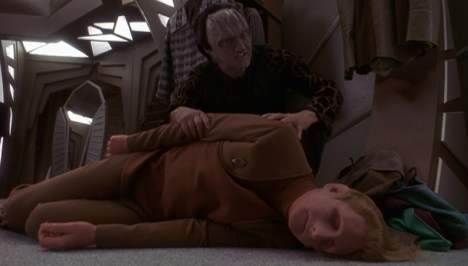
Oh no, Odo!

Oh no, Odo!

The result is a strangely intimate season finalé, one free of the bombast that comes with the season-bridging two-parters favoured by Star Trek: The Next Generation and Star Trek: Voyager. It is interesting to compare Broken Link to something like Basics, Part I, if only because the latter would never make room for Jadzia joking about being surrounded by “naked men” or Garak playing “Star Trek Cluedo” with Odo in sickbay. In fact, Broken Link is even relatively quiet by the standards of Deep Space Nine, lacking the galactic status quo shift of The Jem’Hadar or A Call to Arms.

As with a lot of the fourth season, there is a sense that the production team have made a point to learn from the third season: to improve upon what works and to fix what doesn’t. The Adversary was something of a happy accident at the end of the third season, a script thrown together at short notice when Paramount vetoed a season-ending cliffhanger that would be loosely adapted for Homefront and Paradise Lost. The slow character-centric tension of The Adversary was never intended to close the third season, but Broken Link realises that such an approach worked well.
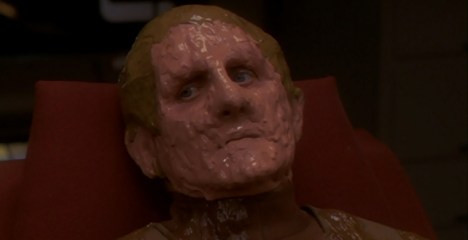
"Melting! Melting! Oh, what a world!"

“Melting! Melting! Oh, what a world!”

The result is an episode that feels incredibly comfortable in its own skin. Deep Space Nine is well aware of what it is, regardless of the direction and input that the studio offered the production team at the start of the fourth season. In fact, despite its somewhat relaxed pace and the space that it affords its character interactions, Broken Link is remarkably focused on what it wants to do. The closing line of the episode (and the season) is clever, consciously tying back the bold new direction of The Way of the Warrior back into the series’ own larger endgame.

In hindsight, Broken Link is something of a misleading title. Instead, it ties everything together.

Only a stone's throw away...

Only a stone’s throw away…

Continue reading

Star Trek: Deep Space Nine – The Quickening (Review)

This February and March (and a little bit of April), we’re taking a look at the 1995 to 1996 season of Star Trek, including Star Trek: Deep Space Nine and Star Trek: Voyager. Check back daily for the latest review.

Somehow, it happened. Star Trek: Deep Space Nine went from a show that could barely produce one good Bashir episode in a season to a series that could crank out three great Bashir episodes within the same production year.

The fourth season of Deep Space Nine is a fantastic season of television, even allowing for the episodes that don’t quite work (Sons of Mogh, Rules of Engagement) and those that fall completely apart (Shattered Mirror, The Muse). There any number of ways of measuring this success: the ease with which Worf has been integrated into the ensemble; the very high average quality of the individual episodes; the skill with which the production team navigated the introduction of the Klingon plot threads at the suggestion of the studio.

Paradise lost.

Paradise lost.

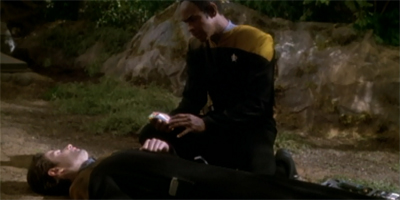
These are all perfect valid barometres of the season’s success. As is the most obvious indicator: the season is fun to watch and largely holds up on rewatch. However, the simple fact that Deep Space Nine could produce three great centring around Julian Bashir over the course of a single season speaks to how far the production team had come. After all, the studio had repeatedly asked the staff to write Bashir out of the show, convinced that fans were not responding to the station’s chief medical officer.

The Quickening is the third and final “good Bashir episode” of the fourth season, and it demonstrates just how important Bashir is to the fabric and framework of Deep Space Nine. Bashir represents Deep Space Nine‘s esoteric utopianism.

Bashir determination...

Bashir determination…

Continue reading

Star Trek: Deep Space Nine – To the Death (Review)

This February and March (and a little bit of April), we’re taking a look at the 1995 to 1996 season of Star Trek, including Star Trek: Deep Space Nine and Star Trek: Voyager. Check back daily for the latest review.

To the Death continues the late fourth season shift in focus back towards elements unique to Star Trek: Deep Space Nine.

At the end of the third season, the production team found themselves receiving notes and input from the network, who wanted Deep Space Nine to go in a different direction. The writing staff on Deep Space Nine were willing to compromise, and took some of the network input on board. As a result, The Way of the Warrior added Worf to the cast and brought the Klingons back to the fore. However, it was clear that Deep Space Nine was not particularly interested in telling a long-term story about new hostilities between the Federation and the Klingons.

The Weyoun of the Warrior...

The Weyoun of the Warrior…

Over the course of the fourth season, the writing staff’s original plans and interests began to reassert themselves in an organic and logical manner. A story similar to Homefront and Paradise Lost had originally been planned to bridge the third and fourth seasons; instead, it was pushed back to almost half-way through the fourth seasons. The Bajoran religion was still the focus of Accession. Gul Dukat received a character arc in Indiscretion and Return to Grace. The Jem’Hadar got a focus episode in Hippocratic Oath. Ferengi politics popped up in Bar Association.

However, these aspects of the show really galvanise towards the end of the fourth season, with the production team really focusing on the elements that had been important during the third season and which would become even more important during the fifth season. For the Cause marked the return of the Maquis as a political player. Body Parts focused on Ferengi culture. However, three of the season’s final four episodes focus on the Dominion, working to reestablish the Dominion as the most credible of threats and the show’s primary antagonists.

Boy, does Sisko ever break out the welcome wagon...

Boy, does Sisko ever break out the welcome wagon…

Continue reading

Star Trek: Deep Space Nine – For the Cause (Review)

This February and March (and a little bit of April), we’re taking a look at the 1995 to 1996 season of Star Trek, including Star Trek: Deep Space Nine and Star Trek: Voyager. Check back daily for the latest review.

For the Cause essentially refocuses the fourth season of Star Trek: Deep Space Nine, rallying the season’s strength as the finalé approaches.

After a bunch of lackluster episodes, from Rules of Engagement through to Shattered Mirror and The Muse, the show finds its voice once again. For the Cause is not just a great episode of television, it is an episode uniquely tailored to this particular show. For the Cause would not work on any of the other for Star Trek shows, so precisely is it calibrated to what makes Deep Space Nine unique. It is a story about trust and betrayal, but also one that chips away at the romance of Starfleet and the Federation.

Pinning his colours to the mast...

Pinning his colours to the mast…

What is particularly interesting about the stretch of episodes running from here through to Broken Link is the sense that Deep Space Nine is getting back to basics. The fourth season is somewhat overshadowed by the addition of Worf to the cast and the emphasis placed on the Klingons in The Way of the Warrior. Although the production team do a great job working within the studio mandate, this shift in focus has meant that many more traditional elements of Deep Space Nine have been shunted into the background.

The final stretch of the fourth season finds the show returning to ideas that were threaded through earlier seasons and were shifted slightly out of focus with the return of the Klingons. For the Cause brings the Maquis back to the fore. To the Death, The Quickening and Broken Link focus on the Dominion threat. Body Parts returns to Ferengi politics. To be fair, the Maquis were the only element that totally faded from view over the fourth season, so it makes sense to return to them first.

A stunning betrayal...

A stunning betrayal…

Continue reading

Star Trek: Deep Space Nine – Shattered Mirror (Review)

This February and March, we’re taking a look at the 1995 to 1996 season of Star Trek, including Star Trek: Deep Space Nine and Star Trek: Voyager. Check back daily Tuesday through Friday for the latest review.

Shattered Mirror and The Muse represent the nadir of the fourth season of Star Trek: Deep Space Nine.

To be fair, it could be worse. Neither episode is Let He Who is Without Sin or Profit and Lace or The Emperor’s New Cloak. Neither is a good episode by any measure, and they certainly rank among the weakest episodes in the show’s seven year run. However, they are more misbegotten lumps of clay than spectacular disasters. Still, as critical defenses go, that is a fairly unconvincing effort. “It could be a lot worse” is hardly the most ringing of critical endorsements.

A close shave...

A close shave…

On the other hand, the fourth season of Deep Space Nine is a fairly spectacular piece of television when taken as a whole. There is a strong argument to be made for the fourth season as the most consistently entertaining season of Deep Space Nine, which stands it in good stead when placing it in the context of the franchise as a whole. The fourth season of Deep Space Nine is one of the best seasons that the franchise ever produced, right alongside the third season of Star Trek: The Next Generation.

However, even the third season of The Next Generation had its weaker moments; The Price and Ménage à Troi come to mind. The realities and demands of television production mean that a perfect twenty-six episode season without any duds is an aspirational object rather than an achievable goal. The constant churn required to produce twenty-six forty-five minute blocks of television within nine or ten months means that not every episode is going to end up perfectly sculpted. Some will be great, some will be bland. Some will be bad.

ds9-shatteredmirror11a

Yanking his chain…

Continue reading

Star Trek: Deep Space Nine – Hard Time (Review)

This February and March, we’re taking a look at the 1995 to 1996 season of Star Trek, including Star Trek: Deep Space Nine and Star Trek: Voyager. Check back daily Tuesday through Friday for the latest review.

Hard Time is a fantastic (and vastly underrated) episode of Star Trek: Deep Space Nine.

The episode tends to get overlooked in discussions about the fourth season of Deep Space Nine, perhaps owing to the high average quality of the season or the fact that it arrives in the middle of what is admittedly the season’s weakest run of episodes. However, in spite of all that, Hard Time is an exemplary piece of Deep Space Nine. It is certainly the best of the series’ “O’Brien must suffer” episodes, and a showcase for Star Trek veteran Colm Meaney. In its exploration of trauma and recovery, and cycles of violence, it taps into the heart of the show.

Not phased in the slightest...

Not phased in the slightest…

That said, Hard Time arrives at a point where Deep Space Nine is nudging closer and closer to serialisation. The show has begun to embrace long-form storytelling, as evidenced by the ripple effect of the changes to the status quo in The Way of the Warrior and the way that little plot threads weave through the season. The show has not yet reached the point at which it can structure six- or ten-episode arcs, but it is getting close. Deep Space Nine is clearly moving towards what is (for Star Trek at least) a fairly novel style of television storytelling.

As such, Hard Time is particularly striking for the fact that it is a purely episodic adventure. The episode puts Miles O’Brien through hell, having him struggle with post-traumatic stress disorder while trying to reintegrate into society. This is the kind of plot that feels more suited to a long-running mini-arc than Worf and Dax’s arguments about the relative merits of bladed weapons or Worf’s decision to move to the Defiant. Instead, O’Brien’s trauma is dealt with over the course of a single episode. Hard Time plays as a defence of the tradition television episode structure.

Growing the beard...

Growing the beard…

Continue reading

Star Trek: Deep Space Nine – Rules of Engagement (Review)

This February and March, we’re taking a look at the 1995 to 1996 season of Star Trek, including Star Trek: Deep Space Nine and Star Trek: Voyager. Check back daily Tuesday through Friday for the latest review.

Rules of Engagement is that old Star Trek standard: the trial episode.

The franchise has never really had a lot of luck with the format over the years. The Menagerie, Part I and The Menagerie, Part II were primarily of interest for the way that they repurposed The Cage and offered viewers a glimpse of an alternate kind of Star Trek. Later in that same first season, Court Martial was a disjointed and uneven (and even illogical) story. Later series did not fare much better; neither A Matter of Perspective nor Dax nor Ex Post Facto could be considered highlights of their seasons or their shows or the wider franchise.

Worf really doesn't understand the proper way to lodge an objection...

Worf really doesn’t understand the proper way to lodge an objection…

However, The Measure of a Man remains the exception that proves the rule. Not only a strong episode of itself, it stands as one of the best episodes in the history of the franchise. More than that, it represented a turning point in the history of Star Trek: The Next Generation; it is perfectly reasonable to point to The Measure of a Man as the moment that The Next Generation finally delivered on its potential after almost two seasons of struggling to find a unique voice. It seems entirely possible that the franchise has been chasing that high ever since.

Unfortunately, Rules of Engagement is an example of the rule rather than the exception. It is a misguided and clumsy episode that has a number of interesting ideas that fail to coalesce into a satisfying whole.

Klingon lawyered up... Kl'awyered up, if you will.

Klingon lawyered up…
Kl’awyered up, if you will.

Continue reading

Star Trek: Voyager – Innocence (Review)

This February and March, we’re taking a look at the 1995 to 1996 season of Star Trek, including Star Trek: Deep Space Nine and Star Trek: Voyager. Check back daily for the latest review.

One of the remarkable things about the first two seasons of Star Trek: Voyager is the way that they seem to hark back to the aesthetic of classic Star Trek.

There is a palpable goofiness to some of the ideas in the second season that feels very much in keeping with the mood and tone of the classic sixties series. There’s a surprising amount of high-concept science-fiction allegory running through the first two seasons of the show, with the writer playing with concepts not too far removed from the space!Romans of Bread and Circuses or the half-black half-white allegories of Let That Be Your Last Battlefield. There are points where Voyager seems to drift away from literalism and wander into sci-fi wackiness.

Kids these days...

Kids these days…

There were elements of this to be found in the first season, with Caretaker awkwardly literalising the franchise’s wild west metaphor by having Janeway’s first planetfall occur on a desert world with a primitive aggressive population. The Kazon and the Vidiians seemed like they escaped from pulpy science-fiction serials, with the show even going so far as to present the Vidiians as body horror space nazis in episodes like Phage and Faces. This is to say nothing of the Cold War paranoia of Cathexis or the primary colour atomic anxiety of Time and Again.

However, this tendency really kicked into high gear during the second season, with the crews’ dreams conspiring to kill them in Persistence of Vision, Chakotay meeting his people’s space!gods (er… “sky spirits”) in Tattoo, Voyager embroiling itself in a “robotic war” in Prototype and Paris “evolving” into a salamander in Threshold. There was a sense that the show was embracing the sort of high-concept sci-fi weirdness that Star Trek: The Next Generation had spent so much of its run trying to avoid, and had only really embraced in its final years.

Bennet, we hardly knew ye.

Bennet, we hardly knew ye.

That is particularly apparent in this stretch of episodes towards the end of the second season. Innocence has a species that ages backwards, enjoying a simple allegory without getting too caught up in the internal logic of the situation. The Thaw is arguably a much greater visual tribute to the style and tone of the original Star Trek than Flashback could ever claim to be. Tuvix is a classic transporter accident story, reversing The Enemy Within. These pulpy elements of Voyager would never quite go away, but they would never be as pronounced as they were in the first two years.

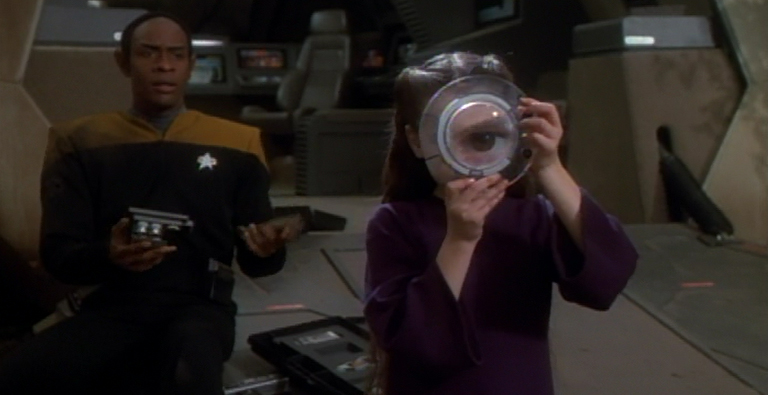
Innocence is a weird and goofy little story that works best as a modern fairy tale. It is arguably proof that the Star Trek franchise probably works better as metaphorical allegory than straight-up science-fiction.

Eye see...

Eye see…

Continue reading

Star Trek: Voyager – Investigations (Review)

This February and March, we’re taking a look at the 1995 to 1996 season of Star Trek, including Star Trek: Deep Space Nine and Star Trek: Voyager. Check back daily for the latest review.

Investigations is a misfire. It is a spectacular misfire.

Investigations is the episode that pretty much single-handedly killed any chance of Star Trek: Voyager embracing long-form storytelling once and for all. The first season had enthusiastically embraced an episodic structure, but the second season had played with the idea of playing out an arc across the majority of the season. Tying together the Kazon with the idea of a traitor on Voyager and the redemption of Tom Paris, the production team decided to attempt something relatively novel for Star Trek.

Kill me. Kill me now.

Kill me.
Kill me now.

It is worth stressing just how experimental this kind of story was. Star Trek: Deep Space Nine had played with the idea of serialisation. Threads like the Romulan and Cardassian invasion of the Gamma Quadrant were carefully seeded through episodes like Defiant and Visionary, but there was not the same tension and momentum afforded to the arcs of Michael Jonas and Tom Paris in the second season. The Romulans and the Cardassians were not discussed in every episode leading up to Improbable Cause and The Die is Cast.

At the same time, Deep Space Nine eased into serialisation in a way that allowed for failures and miscalculations that did not publicly humiliate the show. Bajoran politics could be quietly eased into the background when they weren’t quite working, characters like Primmin and T’Rul could be dropped when they weren’t what the show needed. The second season of Voyager was perhaps a bit too bold in its attempts at long-form storytelling, creating a situation where there was no way to pull back from an arc that wasn’t working.

"Well. That escalated quickly."

“Well. That escalated quickly.”

It became quite clear early on that the Paris and Jonas arc was not working. Episodes like Threshold and Dreadnought ground to a halt so that the audience could get yet another scene of Jonas selling out Voyager to the Kazon; treachery that never seemed to actually go anywhere. At the same time, Paris’ rebellious behaviour was tackled in a superficial manner in episodes like Meld and Lifesigns, with no real exploration of the interesting side of such a sting operation.

Investigations serves to bring the arc to a close, but in a manner that feels perfunctory rather than compelling. It is resolved out of a sense of tired desperation rather than any real inspiration. There is a feeling that the production team have determined this to be a failed experiment, of which they will never speak again.

See? I told you EVERYBODY's thought about it.

See? I told you EVERYBODY’s thought about it.

Continue reading