• Following Us

  • Categories

  • Check out the Archives


  • Awards & Nominations

Star Trek: Deep Space Nine – You Are Cordially Invited… (Review)

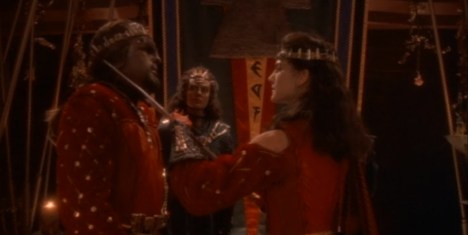
You Are Cordially Invited… is very much a breather episode.

After all, that introductory six-episode arc was exhausting. It was breathtaking in its scope and ambition, a sketch of life during wartime that spanned light-years and divided the cast for half a dozen episodes. It makes sense that You Are Cordially Invited…, the first episode to feature the crew reunited on Deep Space Nine, would attempt to strike a lighter tone. Star Trek: Deep Space Nine might be crafting a long-form war story, but that does not mean that the show is abandoning its warmth and humanity.
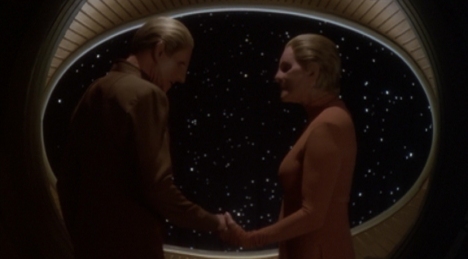
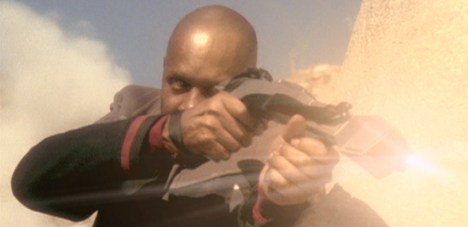
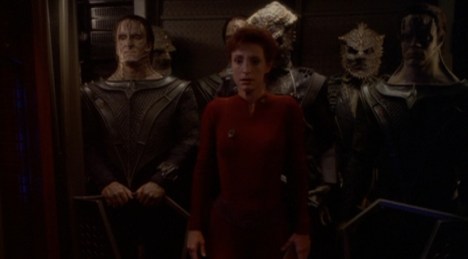
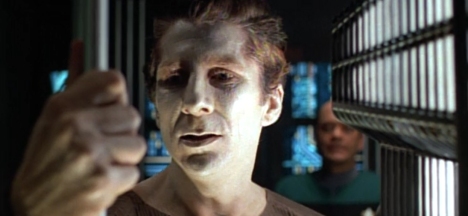
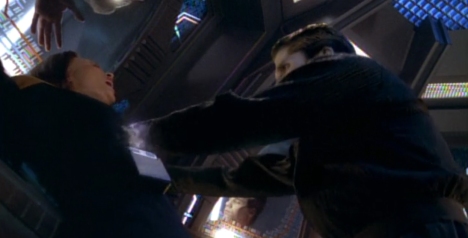
Their first argument.

Their first argument.

Indeed, You Are Cordially Invited… makes a great of sense from a structural perspective. There is an obvious impulse to contrast the show’s darker moments with lighter touches. In the Cards was an endearing comedy about the interconnected lives on the station, airing right before the show scattered those lives in Call to Arms. More than that, Call to Arms featured the wedding of Rom and Leeta as a prelude to the Dominion invasion. Following up the occupation arc with a comedy about the wedding of Worf and Dax adds a sense of symmetry to it all.

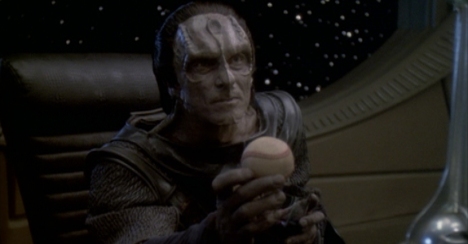
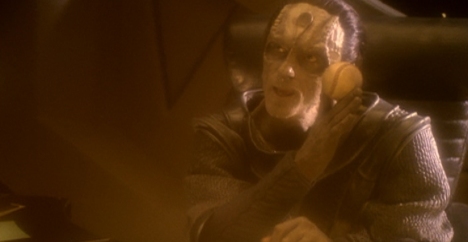
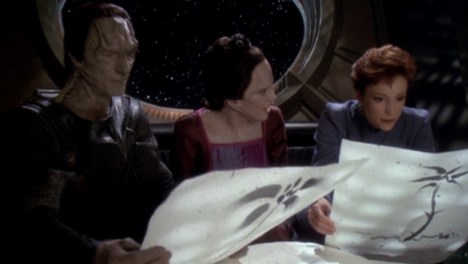
You Are Cordially Invited… might not be the strongest comedy episode in the run of Deep Space Nine, suffering a little bit from being overly conventional and entirely predictable, but it does have an infectious sense of enthusiasm that works well in contrast to the high intergalactic stakes of the previous seven episodes.

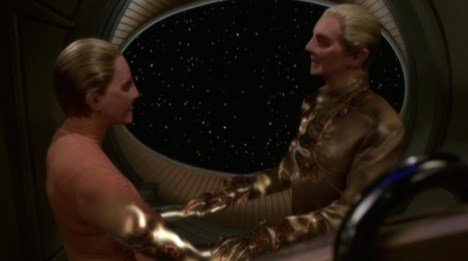
Relight my fire...

Relight my fire…

Continue reading

Star Trek: Deep Space Nine – Sacrifice of Angels (Review)

Sacrifice of Angels goes like the clappers.

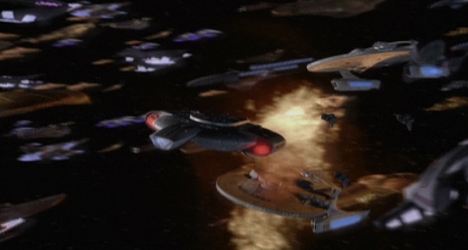
If Favour the Bold worked so well because it took its time and invested in character dynamics in the shadows this epic confrontation, then Sacrifice of Angels works so well because it just powers through to the end of the story. Sacrifice of Angels is an immaculately paced piece of science-fiction television, an episode that kicks into gear that the spectacular effects shot of the Starfleet fighters swooping down over those Galor-class destroyers in a haze of phaser fire and chaos. The episode doesn’t let up, powering through the plot to get back to the familiar status quo.

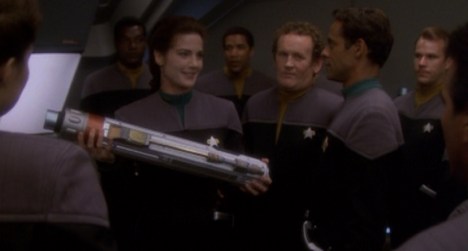
Fields of fire.

Fields of fire.

Sacrifice of Angels is also a meticulously constructed piece of television, with all of the dominoes aligned over the previous five episodes dropping at just the right point in a way that seems organic and natural, allowing for moments that are both surprising and inevitable. It is a very clean and sleek episode of television, one built to a singular purpose with a minimum of superfluous material. It really is a triumphant conclusion to an ambitious six-episode opening arc, one of the most daring narrative experiments in the entire history of the Star Trek franchise.

More striking is the sense that Sacrifice of Angels is very pointedly not the end of the larger arc. The Dominion War that began with Call to Arms does not end in Sacrifice of Angels, even though Sisko retakes the station and the characters return home. The Female Changeling even acknowledges as much in her dialogue, “Contact our forces in the Alpha Quadrant. Tell them to fall back to Cardassian territory. It appears this war is going to take longer than expected.” This is not over, despite the assurances that the writing staff gave Rick Berman on launching the arc.

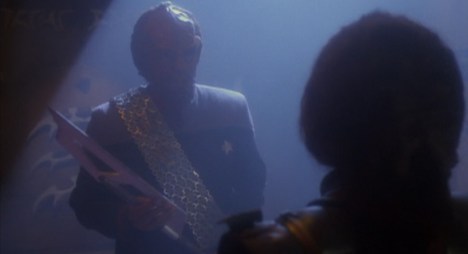
The whole damn ballgame.

The whole damn ballgame.

Then again, this makes perfect sense. Star Trek: Deep Space Nine was constantly and continuously reinventing itself over the course of its run, with several of the show’s season premieres serving as de facto pilots for a new and improved version of the show and several season-enders serving as de facto series finales bookending a particularly iteration of the series. The Way of the Warrior and Call to Arms are a great example, the fourth and fifth seasons bookended by the First and Second Battles of Deep Space Nine.

As such, it is probably more satisfying to look at Sacrifice of Angels as the end of another new beginning for the series, the end of an extended opening arc that is setting up themes and ideas that might hope to pay off over the following two seasons. In some ways, Sacrifice of Angels brings the show back to the end of Emissary. Once again, the Cardassian Occupation has come to an end. Sisko finds himself affirmed as the Emissary of the Prophets and the Commander of Deep Space Nine. This is the order of things.

Going for gold.

Going for gold.

Continue reading

Star Trek: Voyager – Scientific Method (Review)

Scientific Method is in many ways the flip side of the coin to episodes like Nemesis, Distant Origin or Remember.

Nemesis, Distant Origin and Remember were effective demonstrations of Jeri Taylor’s approach to Star Trek: Voyager, a conscious effort to downplay the unique premise of the show in favour of pitching a more generic sort of Star Trek. With that in mind, Nemesis, Distant Origin and Remember constructed powerful allegories to examine pressing contemporary issues through the lens of science-fiction, resulting in episodes that represented one of the most defining aspects of the franchise: the sci-fi-tinged morality play.

Built into Voyager's DNA.

Built into Voyager’s DNA.

Not every example of this approach worked as well as those three episodes. Voyager began leaning into this more archetypal and generic Star Trek storytelling at the start of its third season, and the results were quite hit-and-miss. There were certainly brilliant examples in the seasons ahead, like Living Witness or Blink of an Eye. But not every allegory worked as well. Sometimes, the episodes were too didactic, like Critical Care or Repentance. Sometimes, the episodes were too generic, like The Chute. Sometimes, they were just ill-judged, as with Retrospect.

Scientific Method is a very bland and forgettable episode of Star Trek. It is not necessarily bad, but it is also not particularly memorable. In some ways, it demonstrates the limitations of the “generic Star Trek” approach to scripting for Voyager. Without a set of interesting and well-developed characters with strong dynamics in a series with a unique identity, an average episode can feel rather flat.

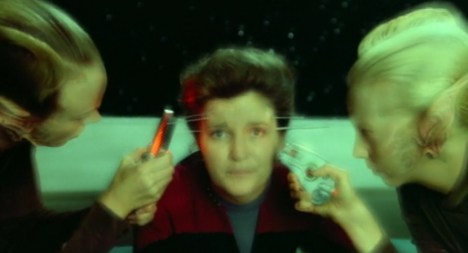
Give her head peace.

Give her head peace.

Continue reading

Star Trek: Deep Space Nine – Favour the Bold (Review)

With Favour the Bold, the writers begin winding down the ambitious six-episode arc that opens the sixth season of Star Trek: Deep Space Nine.

Indeed, Favour the Bold plays almost like the first part of a two-parter nestled at the end of the sprawling six-episode arc that opens the sixth season. At the end of the teaser, Sisko unveils his ambitious plan to Dax, boasting, “We’re going to retake Deep Space Nine.” It is the story that very clearly moves the arc that began with Call to Arms towards its conclusion, manoeuvring the series back towards the familiar status quo in which Captain Benjamin Sisko commands a lone Federation outpost near the distant planet of Bajor.

Point man.

Point man.

Favour the Bold is very much about lining up everything for the climax of the arc, moving the pieces into place so that that the dominoes can begin falling as early as possible in Sacrifice of Angels. However, the episode benefits from the fact that a lot of the heavy-lifting has already been done by this point in the arc. Behind the Lines already had Odo betray Kira, Rom get arrested and Damar figure out how best to dismantle those pesky self-replicating mines. That is already a lot of the table-setting for the arc’s epic conclusion, before Favour the Bold even begins.

As such, Favour the Bold has the luxury of beginning with a lot of its work already done and ending at the point where the action truly commences. The result is a surprisingly relaxed penultimate episode for this ambitious arc, one with the freedom to indulge in smaller character-driven scenes and the space in which to breathe.

They just need some space.

They just need some space.

Continue reading

Star Trek: Deep Space Nine – Behind the Lines (Review)

Behind the Lines is an exemplary demonstration of Star Trek: Deep Space Nine‘s embrace of serialisation.

More than any other episode in the opening arc of the sixth season, Behind the Lines is an episode that exists in relation to the other episodes around it more than a self-contained unit of narrative. A Time to Stand set the tone for the final two seasons of the show, but its also featured a daring raid on a Dominion facility. Rocks and Shoals was about a ground conflict between Sisko and a Jem’Hadar platoon. Sons and Daughters was about Worf’s long-neglected relationship to Alexander. Favour the Bold and Sacrifice of Angels are an ambitious two-part finale.

Meldmerising...

Meldmerising…

In contrast, Behind the Lines is very much about taking what has already been established and streamlining it in preparation for the bombastic conclusion to this story. Behind the Lines is the episode in which Kira uses her “new resistance” formed in Rocks and Shoals to actually do something, in which Damar finally figures out how to dismantle the minefield that went up in Call to Arms, and in which Odo betrays his friends and colleagues in pursuit of his own gratification. More than any of the episodes around it, Behind the Lines cannot really stand in isolation.

However, it is also a stunningly brilliant piece of storytelling and a reminder of just how skilfully the writing staff on Deep Space Nine had adapted to the demands of serialisation.

Terror cell.

Terror cell.

Continue reading

Star Trek: Deep Space Nine – Sons and Daughters (Review)

If A Time to Stand and Rocks and Shoals demonstrate the raw potential and ambition of the sixth season of Star Trek: Deep Space Nine, then Sons and Daughters demonstrate its shortcomings.

The fourth and fifth seasons of Deep Space Nine rank among the very best seasons of Star Trek every produced. These two seasons demonstrated a striking level of consistency. There were undoubtedly terrible episodes, like Shattered Mirror and The Muse in the fourth season or The Assignment and Let He Who Is Without Sin… However, these episodes tended to be quite concentrated. Even other episodes that didn’t quite work, like The Sword of Kahless, Sons of Mogh, A Simple Investigation or Ferengi Love Songs, were more bland than outright bad.

Let me be your father figure...

Let me be your father figure…

The sixth and seventh seasons of Deep Space Nine lack that consistency. They are even more ambitious than the two seasons directly prior, pushing harder in bolder new directions and resulting in brilliant television like Waltz, Far Beyond the Stars, In the Pale Moonlight, Treachery, Faith, and the Great River, The Siege of AR-558, It’s Only a Paper Moon, Chimera, Inter Arma Enim Silent Leges and Tacking Into the Wind. The sixth and seventh seasons of Deep Space Nine were breathtaking and highly enjoyable on their own terms.

In fact, there is a very credible argument for ranking the sixth and seventh seasons of Deep Space Nine among the best seasons of the franchise. They represent the last great narrative leap forward until the third season of Star Trek: Enterprise. These two seasons are driven by a desire to take risks and try new things, to make ambitious gambles knowing that they might not pay off. These are certainly virtues to be encouraged, even without that laundry list of spectacular television.

The lost art of parenting.

The lost art of parenting.

However, with that level of ambition, the sixth and seventh seasons were also much more variable in terms of quality. They contained a lot more misfires than the previous two seasons. This is not just the obvious high-profile failures like Profit and Lace or The Emperor’s New Cloak, but also a lot more episodes that disappoint without hitting quite that level of awfulness; One Little Ship, The Reckoning, Time’s Orphan, Prodigal Daughter, Field of Fire, Extreme Measures. There is a sense that the number of bad episodes increases noticeably.

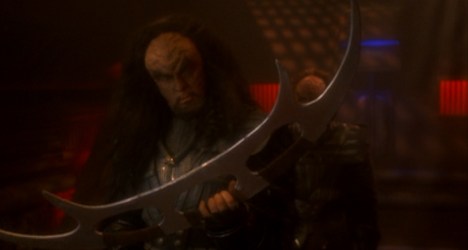
Sons and Daughters is perhaps the first example of this trend. It is an episode that is not soul-destroying terrible, but it simply does not work in the way that it is intended to work. Sons and Daughters is not only the weakest episode of the six-episode opening arc, it is also the first episode to be written by David Weddle and Bradley Thompson as members of the series’ writing staff. The two facts might not be unrelated.

All (Mar)tok tok tok.

All (Mar)tok tok tok.

Continue reading

Star Trek: Voyager – The Raven (Review)

Seven of Nine is something of a mixed blessing for Star Trek: Voyager.

In some respects, the character is a transparent ratings ploy designed to refocus media attention on and attract young male viewers to a television series facing major audience attrition. The series already has enough trouble serving the under-developed members of its ensemble like Chakotay, Tuvok and Kim. The arrival of Seven of Nine only compounds this issue, with the character serving as a focal point in five of the first six episodes of the fourth season. Seven of Nine is a very cynical addition to the cast, an awkward band aid applied to a patient with a chronic condition.

Enlightening.

Enlightening.

However, there is no denying that Seven of Nine works as a character. Even is early in the fourth season, Seven of Nine is more intriguing and compelling than most of the primary cast. As early as The Gift, Jeri Ryan demonstrated that she was one of the strongest members of the ensemble. Seven of Nine might be an awkward combination of the Spock and Data archetype with blatant fan service, but she already has a stronger character and a clearer arc than the vast majority of the regular cast. The production team know what they want from Seven, which is more than can be said of Chakotay, Tuvok or Kim.

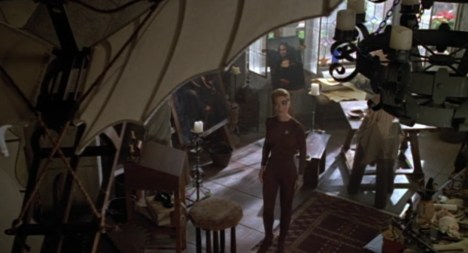
Indeed, The Raven further solidifies the character’s purpose and arc in the larger context of Voyager. Indeed, The Raven very cleverly and very literalises Seven of Nine’s character arc, doing so in a way that integrates her into the larger broader themes of Voyager. With The Raven, Seven’s journey to reclaim her lost humanity is rendered as a literal homecoming. Like everybody else on the ship, Seven is ultimately trying to find her way back home.

"I shall become a bat... er... a human."

“I shall become a bat… er… a human.”

Continue reading

Star Trek: Deep Space Nine – Rocks and Shoals (Review)

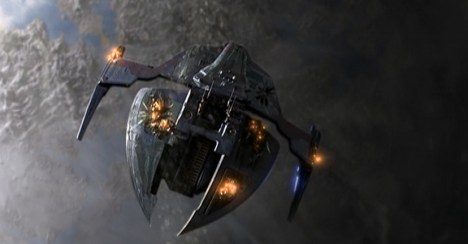
The opening arc of the sixth season of Star Trek: Deep Space Nine is one of the most ambitious storytelling experiments in the history of Star Trek.

To be fair, it is not entirely unique. In some ways, it mirrors the storytelling arc that unfolded across Star Trek II: The Wrath of Khan, Star Trek III: The Search for Spock and Star Trek IV: The Voyage Home. Both Kirk and Sisko are separated from their home and from their first officer and from their iconic command, before eventually finding their way to reunite with both. Obviously, a three-film trilogy is distinct from a six-episode arc, even before talking about the tonal, thematic and plotting differences between those three iconic films.

The Jem'Hadar warship that fell to Earth...

The Jem’Hadar warship that fell to Earth…

More than that, the success of the this arc would embolden the production team. They would attempt an even more audacious experiment to close out the seventh season of the series. The sixth season opened with six interconnected stories following the Cardassian reoccupation Terok Nor, building to Sisko’s retaking of the station. The seventh season pushes that even further, with a much more tightly integrated ten-episode arc that attempts to tell a single cohesive story. It is an even bolder creative decision than this arc, committing more strongly to the premise.

Ronald D. Moore’s departure from Star Trek: Voyager early in its sixth season would turn these experiments in serialisation into an evolutionary dead end for the franchise. It would be four years before Rick Berman and Brannon Braga would attempt to a tell a story on that scale. Indeed, faced with declining ratings and the spectre of cancellation, Star Trek: Enterprise attempted what was (on the surface at least) the even more ambitious attempt at a season-long arc across the entirety of the third season.

Winner takes it war...

Between a rock and a hard place.

Still, the six-episode arc that opens the sixth season of Deep Space Nine remains an impressive moment in the history of the franchise. Indeed, contrasted with the sprawling ten-episode arc that closes the series or the season-long arc on Enterprise, it could reasonably be argued that this six-episode stretch does a stronger job of balancing the integrity of individual episodes with the demands of the larger arc. These six episodes are all very strongly connected to one another, with a clear sense of story and character progression, but they also retain their own identities within that.

Rocks and Shoals might be the best example of this, an episode that delicately balances its own storytelling with the needs of the arc as a whole. Rocks and Shoals is at once a great episode in its own right and an essential part of a much larger story.

Express elevator to hell.

Express elevator to hell.

Continue reading

Star Trek: Voyager – Revulsion (Review)

Revulsion is a solid episode elevated by a superb guest performance.

The most notable aspect of Revulsion is the guest appearance of veteran character actor Leland Orser. Orser’s screen presence is striking, making an impression with supporting role in high-profile films from The Bone Collector to se7en to Alien Resurrection to Daredevil. He has also worked reliably in television, holding down regular roles in shows like E.R. and Berlin Station, while recurring in series like 24 and Ray Donovan. To modern audiences, he is likely recognisable got his work as a fixture of the Taken franchise.

Not just holo praise.

Not just holo praise.

Even within the Star Trek franchise, Orser is very much a recurring fixture. While never a steady player like J.G. Hertzler or Jeffrey Combs, Orser made quite an impression. He played the changeling posing as Tal Shiar operative Colonel Lovok in The Die is Cast on Star Trek: Deep Space Nine, making the most of a rather minor role in one of the series’ most memorable two-part episodes. He would also do good work as the venal Loomis in the otherwise disappointing Carpenter Street during the third season of Star Trek: Enterprise.

However, his guest appearance in Revulsion on Star Trek: Voyager remains his most distinctive turn in the franchise. Playing Dejaren, a psychotic and fragmented hologram who murdered his crew, Orser singlehandedly elevates would could easily be a tired genre exercise. Revulsion is a solid episode, but one that sticks in the memory almost entirely due to the casting.

Kali Ma!

Kali Ma!

Continue reading

Star Trek: Voyager – Nemesis (Review)

Nemesis is a great example of Star Trek: Voyager pitching itself as generic Star Trek.

This is a story that is not unique or particular to this crew. In fact, the story could easily be adapted to service characters from Star Trek: The Next Generation or Star Trek: Deep Space Nine or even Star Trek: Enterprise. In some respects, Nemesis might even work better if Robert Beltran were swapped out for Jonathan Frakes or Colm Meaney or Connor Trinneer. There is very little in the script that relies on the particularities of this show or the nuances of its characters.

The Rifleman...

The Rifleman…

While this lack of a distinct identity is a problem for Voyager as a television series, it does lead to some great episodes. Many of the best episodes of Voyager could easily be ported to or from any of the other shows. It was an approach that really came to the fore during the third season, when Jeri Taylor and Brannon Braga made a conscious choice to steer the show away from its focus on a crew stranded far from home and towards a more generic Star Trek sensibility.

At its best, this leads to very strong allegorical storytelling. Episodes like Remember and Distant Origin are very much archetypal Star Trek episodes, extended science-fiction metaphors with a strong moral core that evoke the Star Trek beloved by so many of its fans. Nemesis is very much an episode constructed in that tradition, a metaphorical exploration of the dehumanisation of soldiers through combat training and conditioning. It is a powerful and thought-provoking piece of social commentary and a superb piece of Star Trek.

A hard shoot.

A hard shoot.

Continue reading