• Following Us

  • Categories

  • Check out the Archives


  • Awards & Nominations

Star Trek: Voyager – Concerning Flight (Review)

Concerning Flight is a lovely, whimsical little episode.

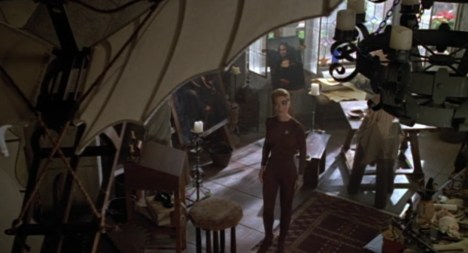
Of course, the actual plot of the episode is complete nonsense. During a raid by alien pirates, a bunch of advanced technology is stolen from Voyager. Among that advanced technology is the EMH’s mobile admitted, the holodeck database, and the primary computer core. Somehow, the pirate prince responsible for this raid has the wherewithal to download a character from the holodeck database into the mobile emitter and employ him as an inventor. Conveniently enough, the hologram is Leonardo da Vinci and the arrangement resembles medieval patronage.
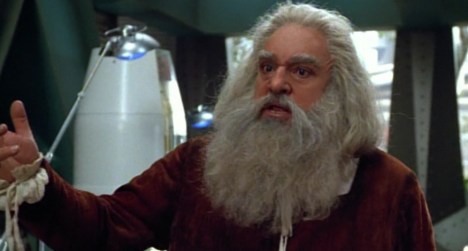
da Vinci's demons.

da Vinci’s demons.

It is all very ridiculous, relying on insane contrivance and random leaps in logic. At any given moment, the audience might be inclined to ask exactly what chain of decisions have led the characters to this exact point, right down to the sheer coincidence of having Leonardo da Vinci’s prototyple glider resting on a hilltop on the escape route that Janeway and da Vinci take in the final act. All of these criticisms are valid, and all of them are perfectly reasonable. Concerning Flight does not require suspension of disbelief, it requires a suspension bridge of disbelief.

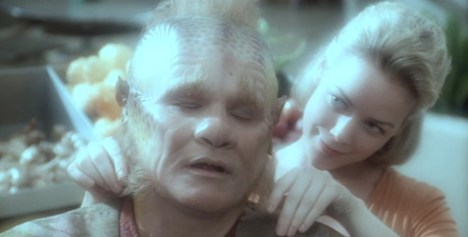
However, the episode largely earns that trust. There is an incredible charm to this very simple and straightforward (if awkwardly contrived) story, a surprising warmth and engagement to the tale of the ultimate renaissance man confronted with the ultimate new world. Concerning Flight is a fun episode that places a lot of faith in the interplay between Kate Mulgrew and John Rhys-Davies. It is a choice that pays dividends.

O brave new world, That has such people in 't!

O brave new world,
That has such people in ‘t!

Continue reading

Star Trek: Voyager – Random Thoughts (Review)

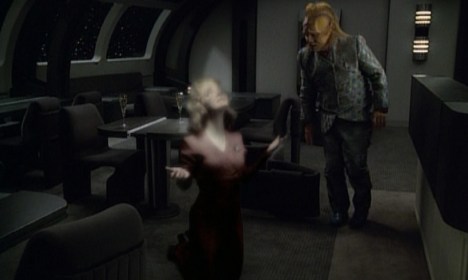
Random Thoughts is another example of Star Trek: Voyager as generic issue-driven Star Trek.

Random Thoughts is a fairly standard political-commentary-as-science-fiction-allegory plot, with the crew encountering a race of telepaths who have built a utopian society through the careful regulation of thoughts. When Torres is implicated in a very rare violent crime, the crew find themselves embroiled within mystery to determine the origin of the violent thought and the means of its transmission. Along the way, there is a hefty dose of commentary on a broad range of themes.

Scrambling the subversives.

Scrambling the subversives.

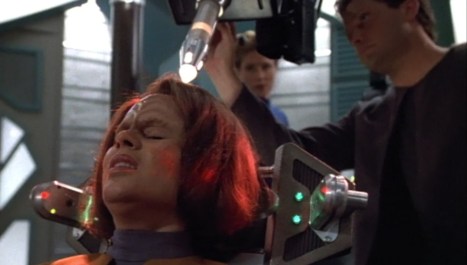
In theory, Random Thoughts is very much of a piece with Nemesis or Scientific Method, other fourth season episodes less interested in character and more driven by commentary. However, Random Thoughts is a good deal more muddled. The allegory at the centre of the story is a mess, in part because the script is so intentionally vague. Are these violent thoughts a metaphor for violence in media? Are they a commentary on heat speech? Are they an analogy for drug addiction? What about non-heteronormative sexuality?

Random Thoughts never seems to decide on one central metaphor, and so casts an exceptionally broad net. The problem is that these issues are radically different from one another, and the all-encompassing nature of the central analogy robs the episode of any nuance or sophistication. An episode advocating for the legalisation of drug use is radically different from an episode against the criminalisation of heat speech. It is very difficult to work out exactly what Random Thoughts is saying, let alone what it wants to say.

Whisked away.

Whisked away.

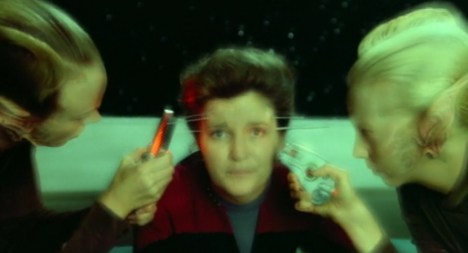
This muddled storytelling plays out in other ways. Random Thoughts is a mess episode, in terms of storytelling and structure. The plot wanders in various different directions, shifting focus from one member of the ensemble to another; for a story about Torres’ emotions, Torres is afforded very little agency. The narrative also diverts along pointless tangents, with obvious filler scenes like Paris and Chakotay discussing a rescue that never happens or Seven of Nine stopping by the Ready Room to discuss the moral of the episode.

There is something distractingly unfocused about Random Thoughts.

Secure in his convictions.

Secure in his convictions.

Continue reading

Star Trek: Voyager – Year of Hell, Part II (Review)

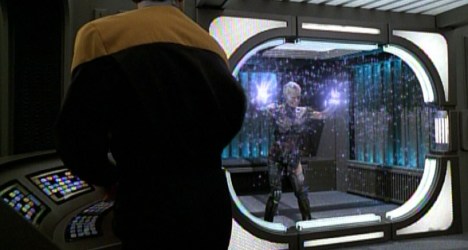
Year of Hell, Part I and Year of Hell, Part II might just be the most representative episodes of Star Trek: Voyager.

Taken together, these episodes perfectly embody the restrictions placed upon the third Star Trek spin-off. They are a boldly ambitious story of a ship that finds itself in hostile territory surrounded by a hostile force with superior firepower, all while playing into the recurring themes and fascinations of the wider series. However, they are also a two-parter that wraps up with an incredibly convenient resolution that handily resets the status quo in a manner that allows the ship (and the series) to avoid any lasting consequences from this blockbuster story.

The hole in things.

The hole in things.

The result is one of the most thrilling and engaging stories of Voyager‘s seven-season run, among the most satisfying of the series’ impressive “blockbuster” two-parters. However, its sense of scale and scope exists very much in contrast to the episodes around it, a truly epic story that leaves no lasting mark. An audience member skipping from Scientific Method to Random Thoughts would be completely oblivious of the episode. For an episode of such weight, great care is taken to ensure that its passage causes no disturbance.

Year of Hell, Part I and Year of Hell, Part II do an excellent job capturing the essence of Voyager.

Annorax-ed with guilt.

Annorax-ed with guilt.

Continue reading

Star Trek: Voyager – Scientific Method (Review)

Scientific Method is in many ways the flip side of the coin to episodes like Nemesis, Distant Origin or Remember.

Nemesis, Distant Origin and Remember were effective demonstrations of Jeri Taylor’s approach to Star Trek: Voyager, a conscious effort to downplay the unique premise of the show in favour of pitching a more generic sort of Star Trek. With that in mind, Nemesis, Distant Origin and Remember constructed powerful allegories to examine pressing contemporary issues through the lens of science-fiction, resulting in episodes that represented one of the most defining aspects of the franchise: the sci-fi-tinged morality play.

Built into Voyager's DNA.

Built into Voyager’s DNA.

Not every example of this approach worked as well as those three episodes. Voyager began leaning into this more archetypal and generic Star Trek storytelling at the start of its third season, and the results were quite hit-and-miss. There were certainly brilliant examples in the seasons ahead, like Living Witness or Blink of an Eye. But not every allegory worked as well. Sometimes, the episodes were too didactic, like Critical Care or Repentance. Sometimes, the episodes were too generic, like The Chute. Sometimes, they were just ill-judged, as with Retrospect.

Scientific Method is a very bland and forgettable episode of Star Trek. It is not necessarily bad, but it is also not particularly memorable. In some ways, it demonstrates the limitations of the “generic Star Trek” approach to scripting for Voyager. Without a set of interesting and well-developed characters with strong dynamics in a series with a unique identity, an average episode can feel rather flat.

Give her head peace.

Give her head peace.

Continue reading

Star Trek: Voyager – The Raven (Review)

Seven of Nine is something of a mixed blessing for Star Trek: Voyager.

In some respects, the character is a transparent ratings ploy designed to refocus media attention on and attract young male viewers to a television series facing major audience attrition. The series already has enough trouble serving the under-developed members of its ensemble like Chakotay, Tuvok and Kim. The arrival of Seven of Nine only compounds this issue, with the character serving as a focal point in five of the first six episodes of the fourth season. Seven of Nine is a very cynical addition to the cast, an awkward band aid applied to a patient with a chronic condition.

Enlightening.

Enlightening.

However, there is no denying that Seven of Nine works as a character. Even is early in the fourth season, Seven of Nine is more intriguing and compelling than most of the primary cast. As early as The Gift, Jeri Ryan demonstrated that she was one of the strongest members of the ensemble. Seven of Nine might be an awkward combination of the Spock and Data archetype with blatant fan service, but she already has a stronger character and a clearer arc than the vast majority of the regular cast. The production team know what they want from Seven, which is more than can be said of Chakotay, Tuvok or Kim.

Indeed, The Raven further solidifies the character’s purpose and arc in the larger context of Voyager. Indeed, The Raven very cleverly and very literalises Seven of Nine’s character arc, doing so in a way that integrates her into the larger broader themes of Voyager. With The Raven, Seven’s journey to reclaim her lost humanity is rendered as a literal homecoming. Like everybody else on the ship, Seven is ultimately trying to find her way back home.

"I shall become a bat... er... a human."

“I shall become a bat… er… a human.”

Continue reading

Star Trek: Voyager – Revulsion (Review)

Revulsion is a solid episode elevated by a superb guest performance.

The most notable aspect of Revulsion is the guest appearance of veteran character actor Leland Orser. Orser’s screen presence is striking, making an impression with supporting role in high-profile films from The Bone Collector to se7en to Alien Resurrection to Daredevil. He has also worked reliably in television, holding down regular roles in shows like E.R. and Berlin Station, while recurring in series like 24 and Ray Donovan. To modern audiences, he is likely recognisable got his work as a fixture of the Taken franchise.

Not just holo praise.

Not just holo praise.

Even within the Star Trek franchise, Orser is very much a recurring fixture. While never a steady player like J.G. Hertzler or Jeffrey Combs, Orser made quite an impression. He played the changeling posing as Tal Shiar operative Colonel Lovok in The Die is Cast on Star Trek: Deep Space Nine, making the most of a rather minor role in one of the series’ most memorable two-part episodes. He would also do good work as the venal Loomis in the otherwise disappointing Carpenter Street during the third season of Star Trek: Enterprise.

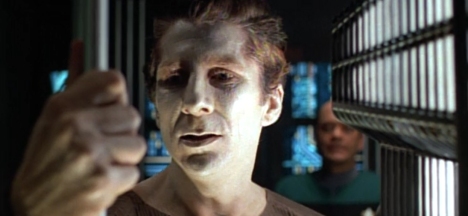
However, his guest appearance in Revulsion on Star Trek: Voyager remains his most distinctive turn in the franchise. Playing Dejaren, a psychotic and fragmented hologram who murdered his crew, Orser singlehandedly elevates would could easily be a tired genre exercise. Revulsion is a solid episode, but one that sticks in the memory almost entirely due to the casting.

Kali Ma!

Kali Ma!

Continue reading

Star Trek: Voyager – Nemesis (Review)

Nemesis is a great example of Star Trek: Voyager pitching itself as generic Star Trek.

This is a story that is not unique or particular to this crew. In fact, the story could easily be adapted to service characters from Star Trek: The Next Generation or Star Trek: Deep Space Nine or even Star Trek: Enterprise. In some respects, Nemesis might even work better if Robert Beltran were swapped out for Jonathan Frakes or Colm Meaney or Connor Trinneer. There is very little in the script that relies on the particularities of this show or the nuances of its characters.

The Rifleman...

The Rifleman…

While this lack of a distinct identity is a problem for Voyager as a television series, it does lead to some great episodes. Many of the best episodes of Voyager could easily be ported to or from any of the other shows. It was an approach that really came to the fore during the third season, when Jeri Taylor and Brannon Braga made a conscious choice to steer the show away from its focus on a crew stranded far from home and towards a more generic Star Trek sensibility.

At its best, this leads to very strong allegorical storytelling. Episodes like Remember and Distant Origin are very much archetypal Star Trek episodes, extended science-fiction metaphors with a strong moral core that evoke the Star Trek beloved by so many of its fans. Nemesis is very much an episode constructed in that tradition, a metaphorical exploration of the dehumanisation of soldiers through combat training and conditioning. It is a powerful and thought-provoking piece of social commentary and a superb piece of Star Trek.

A hard shoot.

A hard shoot.

Continue reading

Star Trek: Voyager – Day of Honour (Review)

Day of Honour is a reminder that, while Brannon Braga is clearly the heir apparent, Jeri Taylor is still the showrunner on Star Trek: Voyager.

Day of Honour is noticeably and recognisably a Jeri Taylor episode, particularly following so sharply from Scorpion, Part I, Scorpion, Part II, and The Gift. This is a script that plays very firmly to Jeri Taylor’s idea of Star Trek, including an emphasis on the development of interpersonal relationships and also a very traditional perspective on how the franchise is supposed work. Day of Honour is a very conservative episode following the bombast of the three very ambitious stories bridging the third and fourth seasons.

"Don't worry, Janeway will never miss it."

“Don’t worry, Janeway will never miss it.”

In some ways, this is undoubtedly a good thing. Jeri Taylor is clearly more interested in developing relationships between the characters than Brannon Braga. Taylor was a very old-school television writer and producer, but her best material on Voyager suggested a genuine interest in the cast and the characters. Resolutions is an episode consciously rooted in the romantic tension between Chakotay and Janeway. Coda is a very clear elaboration on Taylor’s interpretation of Janeway.

Taylor even drafted biographies for the crew in the form of Mosaic and Pathways, suggesting a deeper interest in the characters’ inner lives than any other writer on staff. In some ways, Day of Honour is an extension of this approach. It is the culmination of Taylor’s attempts to push Paris and Torres together in third season episodes like The Swarm, Blood Fever and Displaced. That relationship became one of the nicer dynamics on Voyager, and would never have happened under the oversight of either Michael Piller or Brannon Braga.

Adrift.

Adrift.

However, there are also very serious problems with Day of Honour. In keeping with the tone of Voyager during Taylor’s tenure, it is a very conservative piece of television both in terms of style and politics. After The Gift worked so hard to generate tension between Seven of Nine and the Voyager crew, Day of Honour casually brushes that aside. And it deals with an interesting story about the legacy of Seven’s relationship to the Borg in the most trite manner possible, the plot hinging on a techno-babble solution to ensure there is no actual conflict.

More than that, Day of Honour is incredibly reactionary in its portrayal of the Caatati, a refugee race who were rendered homeless by the Borg Collective. These dispossessed aliens are presented as greed and underhanded, ready to exploit the charity of our heroes and to betray them at the first opportunity. It is an extension of the xenophobic panic of Displaced, a tale about how our privileged heroes should react with paranoia and mistrust to those who arrive by accident or in distress. It is a rather uncomfortable Star Trek theme.

Means of transport.

Means of transport.

Continue reading

Star Trek: Voyager – The Gift (Review)

The Gift belongs to a very particular subgenre of Star Trek episodes.

It is an episode that fits comfortably alongside the other second stories of the other fourth seasons, alongside Family on Star Trek: The Next Generation, The Visitor on Star Trek: Deep Space Nine and Home on Star Trek: Enterprise. It is a relatively quiet and contemplative piece, more rooted in character than plot. In fact, very little of note happens during the episode, even as it is positioned at an important point in the larger run of Star Trek: Voyager following Scorpion, Part I and Scorpion, Part II.

Things come to a head.

Things come to a head.

As with FamilyThe Visitor and HomeThe Gift is a breather episode following a more epic adventure. As with Family and Home, The Gift is explicitly about working through the consequences of earlier episodes. Family allowed Jean-Luc Picard to work through the trauma of The Best of Both Worlds, Part I and The Best of Both Worlds, Part II, while Home provided an opportunity for Jonathan Archer to make sense of everything that happened between The Expanse and Zero Hour. (Let’s not worry too much about Storm Front, Part I and Storm Front, Part II.)

The Gift is an episode of contrasts, driven by the demands of the series rather than its own distinct plot. It is very heavily serialised, playing almost as the third part of Scorpion, Part I and Scorpion, Part II; much like Family played as the third part of The Best of Both Worlds, Part I and The Best of Both Worlds, Part II. However, there is something very cynical in the use of serialisation in The Gift, as the episode rather transparently exists to transition away from where the show was at the end of Scorpion, Part II towards a more sustainable status quo.

Kes of death to an established character.

Kes of death to an established character.

The Gift is also a tale of arrivals and departures. It is an episode about introducing Seven of Nine to the cast of Voyager, establishing her character arc and setting up her journey across the rest of the series building on her separation from the Borg Collective in Scorpion, Part II. At the same time, it is an episode about the departure of Jennifer Lien from Voyager, bidding farewell to Kes as a result of her exposure to “Fluidic Space” in Scorpion, Part II. There is something quite poetic in that set-up.

However, The Gift is just as much an episode of extremes in terms of quality. The story focusing on Janeway and Seven of Nine is rivetting and compelling, but the thread focusing on Kes plays almost as an afterthought. More than that, the episode’s final act plays as a gigantic cop out, another example of Voyager retreating from some of the bolder ideas in its core concept. The result is a curate’s egg of an episode, a reminder of Voyager‘s discarded potential.

Breakout character.

Breakout character.

Continue reading

Star Trek: Voyager – Scorpion, Part II (Review)

Scorpion, Part II demonstrates the real strength of the blockbuster two-part episodes scattered across the run of Star Trek: Voyager.

Generally speaking, the two-part episodes of Star Trek: The Next Generation suffered from a sense of disharmony. The two parts seldom felt integrated, often feeling quite disconnected from one another. This was most obvious in the cliffhangers bridging the seasons, when the writing staff would take time away from the office before returning to write the second part. Michael Piller famously had no idea what he was going to do with The Best of Both Worlds, Part II when he wrote The Best of Both Worlds, Part I.

Droning on.

Droning on.

Even for the two-part episodes within a given season, there tended to be a disjointedness. Chain of Command, Part I is very much set-up for Chain of Command, Part II, with the second part feeling much stronger (and more substantial) than the first. Birthright, Part I leads into Birthright, Part II, but also features an entirely unrelated subplot that is dropped completely in the second half. Arguably, The Next Generation only really figured out how to properly balance two-parters in its final season, with Gambit, Part I, Gambit, Part II and All Good Things…

In contrast, Voyager does a much better job of balancing its two-parters so that they feel like two halves of a movie rather than an extended first act followed by a compressed second and third act. Future’s End, Part I and Future’s End, Part II established that template, but Scorpion, Part I and Scorpion, Part II demonstrates that it can applied as readily to season-bridging two-parters as to mid-season sweeps episodes. Scorpion, Part I and Scorpion, Part II integrate beautifully to form an impressive Voyager television movie.

Venting frustration.

Venting frustration.

Continue reading