• Following Us

  • Categories

  • Check out the Archives


  • Awards & Nominations

Star Trek: Deep Space Nine – Blood Oath (Review)

Star Trek: Deep Space Nine is twenty years old this year. To celebrate, I’m taking a look at the first season. Check back daily for the latest review or retrospective.

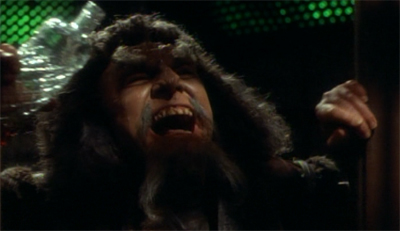
Blood Oath is a pretty fantastic piece of Star Trek: Deep Space Nine, and kicks the second season back into gear after a few mediocre (although not embarrassing) episodes. While it’s hardly the best episode of the year, and comes with its share of problems and baggage, it’s a tight and well-constructed piece of space opera. It’s a pulpy Klingon adventure, with the show’s best exploration to date of the existential problems of being Dax and a relatively simple (but potent) moral dilemma. It’s also just great fun.

Here's Kor!

Here’s Kor!

Continue reading

Star Trek: Deep Space Nine – Profit and Loss (Review)

Star Trek: Deep Space Nine is twenty years old this year. To celebrate, I’m taking a look at the first and second seasons. Check back daily for the latest review or retrospective.

It seems we’ve reached the point where Star Trek: Deep Space Nine has figured out a base level of quality, an “average” zone that it can pitch to without too much effort or breaking a sweat. We’ve had three episodes in a row now that haven’t been brilliant, but have been far from terrible. Solid, watchable stuff. That might sound like damning with faint praise, but it took Star Trek: The Next Generation longer to find that base level of quality, while Star Trek: Voyager settled into a zone where that “average” was a lot lower.

Profit and Loss is unlikely to be anybody’s favourite episode, but it remains thoroughly unobjectionable. It features the cast playing their roles reasonably well, some hints at world-building and even a guest spot for Garak. Nobody will really remember Profit and Loss as a brilliant piece of television after completing a lengthy Deep Space Nine rewatch, but they also won’t curse its name. It’ll simply be an episode in the middle-to-end section of the second season that wasn’t too bad and wasn’t too great.

Love him and leave him...

Love him and leave him…

Continue reading

Star Trek: Deep Space Nine – Playing God (Review)

Star Trek: Deep Space Nine is twenty years old this year. To celebrate, I’m taking a look at the first and second seasons. Check back daily for the latest review or retrospective.

Playing God is – structurally – quite similar to Shadowplay. The episode follows the same basic format. We have three plots running concurrently. One of these plots is a science-fiction plot while the other two are centred around character development. What’s interesting about Playing God is that the script essentially changes the priority of these plot threads. In Shadowplay, the central plot concerned the science-fiction mystery in the Gamma Quadrant, while here the ethical quandary is pushed firmly to the background. (Much to the chagrin of writer Jim Trombetta.)

Instead, Playing God brings the character plotline to the front, giving us the first Dax-centric episode firmly based around Jadzia rather than the symbiote inside of her.

Quark smells a rat... er... I mean vole...

Quark smells a rat… er… I mean vole…

Continue reading

Star Trek: Deep Space Nine – Shadowplay (Review)

Star Trek: Deep Space Nine is twenty years old this year. To celebrate, I’m taking a look at the first and second seasons. Check back daily for the latest review or retrospective.

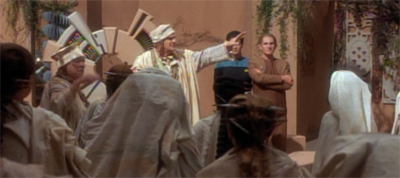
Shadowplay is a great example of the kinds of things that Star Trek: Deep Space Nine is beginning to do very well. While the main plot works very well (so well, in fact that Star Trek: Enterprise would borrow it – and Rene Auberjones – for their first season episode Oasis), it’s remarkable how much of Shadowplay is given over to the two character-development subplots unfolding back on the station. Indeed, Dax and Odo have effectively solved the mystery of the missing villagers by about two-thirds of the way into the episode.

The character-development stuff in Shadowplay is interesting because the two subplots are not written with resolutions in mind. Indeed, they don’t even kick off the respective character arcs. Kira and Bariel have been waiting to become a couple since The Siege at the latest. The last episode, Paradise hinted that Jake might not be cut out to be a Starfleet officer.

In short, what is interesting about Shadowplay is the fact that it’s really just demonstrating that the show has reached the point where it is doing the things that it does relatively well. Deep Space Nine has found its groove, that point in a show’s history when it seems like it’s relatively easy to produce an hour of television of reasonable quality.

A holo crowd...

A holo crowd…

Continue reading

Star Trek: Deep Space Nine – Whispers (Review)

Star Trek: Deep Space Nine is twenty years old this year. To celebrate, I’m taking a look at the first and second seasons. Check back daily for the latest review or retrospective.

You could make a credible argument that each of the first three Star Trek shows beautifully encapsulated their time and place. The original show was the very embodiment of the sixties zeitgeist, providing a channel for commentary and insight into counter-culture and the Vietnam War, and an outlet for various fixations and phobias. Star Trek: The Next Generation was a show that spoke to a version of America which was emerging from the Cold War, a clean and sterile morning for a new America.

Star Trek: Deep Space Nine was positioned somewhat strangely, as the idealism and enthusiasm of the early nineties gave way to paranoia and insecurity. If the hyperreal technicolour production values of the original Star Trek spoke to the energy and enthusiasm sixties, then the drab grey Orwellian design of Deep Space Nine was a reflection of the late nineties.

Whispers is really the first time that the show has pushed its sense of paranoia to the fore, and it confirms that Deep Space Nine will be a show of its time, anchored in the nineties.

It's all a bit askew...

It’s all a bit askew…

Continue reading

Star Trek: Deep Space Nine – Rivals (Review)

Star Trek: Deep Space Nine is twenty years old this year. To celebrate, I’m taking a look at the first and second seasons. Check back daily for the latest review or retrospective.

Rivals doesn’t work. However, while the second season has produced a string of noble failures, Rivals fails for a very simple reason. It’s a comedy episode without any comedy. It’s a guest-star focused episode which centres on a hopelessly miscast Chris Sarandon. Sarandon is an Oscar-nominated actor, and he should be something of a casting coup for the show. This second season has already featured Louise Fletcher, Frank Langella and John Glover – so it seems fair to acknowledge that the casting people were on a bit of a roll.

However, due to a reheated script and Sarandon’s lack of interest or engagement, Rivals winds up feeling stale. There is potential here, but it’s squandered as the writers forget the first rule of a good comedy episode. They forgot to bring the laughs.

I feel a similar way...

I feel a similar way…

Continue reading

Agents of S.H.I.E.L.D – Pilot (Review)

Agents of S.H.I.E.L.D. is a very competent production. It looks lavish. It connects the dots. It reminds the audience that it’s connected to a string of blockbuster movies without being pushy about it. It introduces a diverse ensemble. It sets up long-running mysteries and story arcs. It’s a tight and focused, and controlled piece of television.

Perhaps too controlled. There’s something oddly restrained and oddly refined about Agents of S.H.I.E.L.D., feeling a little smoother and a little more polished than a pilot really should. There’s not a hair out of place, but only because everything has been so meticulously styled. This isn’t a bad thing – the pilot plays remarkably well – but it just feels a bit limp, a bit lifeless.

It’s as if we’ve tuned into a Life Model Decoy of a Joss Whedon show.

Phil us in...

Phil us in…

Continue reading

Star Trek: Deep Space Nine – Invasive Procedures (Review)

Star Trek: Deep Space Nine is twenty years old this year. To celebrate, I’m taking a look at the first and second seasons. Check back daily for the latest review or retrospective.

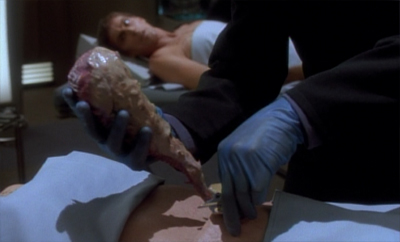
Invasive Procedures is an interesting episode. It has a great high concept, some nice character beats, and offers an inside glimpse at an astonishingly interesting alien culture. Verad is a compelling guest character and Sisko gets to be pretty badass, continuing the presentation of the character as some weird composite of James T. Kirk and Jean-Luc Picard.

There are however, a number of very sizeable flaws. The most obvious being that – despite this is nominally a “Dax” story – Dax winds up feeling more like a plot point than a character in her own right.

Slugging it out...

Slugging it out…

Continue reading

Star Trek: Deep Space Nine – Season 1 (Review)

Star Trek: Deep Space Nine is twenty years old this year. To celebrate, I’m taking a look at the first season. Check back daily for the latest review or retrospective.

Well, that was actually pretty satisfying. Star Trek: Deep Space Nine has probably the most satisfying debut season of any of the Star Trek spin-offs. While the show’s first year can’t quite measure up to the very first season of Star Trek ever produced, it can hold its head high among the spin-offs. Although I will concede that the bar isn’t exactly high when it comes to measuring the first year of the tie-in television shows.

When I began a recent re-watch of Star Trek: The Next Generation, I was glad to finish the show’s rocky first season. It was a slog, like the work one has to put in before delving into “the good stuff.” I recently picked up the blu ray of the first season of Star Trek: Enterprise. While there are a couple of nice episodes, there are quite  a few I’d forgotten entirely because they were so bland. There are more I would like to forget. Star Trek: Voyager‘s first season is the single largest missed opportunity in the history of the franchise.

So Deep Space Nine‘s first year doesn’t have to do that much beyond “not sucking” in order to earn the coveted title of “best pilot season of a Star Trek spin-off.” However, as I watched the season, I was continually impressed with the quality of work done. There are a few duds (and a few classics), but the first year demonstrates remarkable insight into what is unique about the show’s premise. It doesn’t always have the courage to follow through on that promise, but it at least acknowledges it.

ds9-season1a

Continue reading

Star Trek: Deep Space Nine – Progress (Review)

Star Trek: Deep Space Nine is twenty years old this year. To celebrate, I’m taking a look at the first season. Check back daily for the latest review or retrospective.

Progress is the best episode of Star Trek: Deep Space Nine‘s first season to date. Of course, there are better episodes ahead – two of them clustered at the end of the show’s truncated first year – but Progress still represents a considerable improvement over anything that has come before. It isn’t quite perfect, but it does have a nice character focus and takes advantage of the show’s unique perspective and position. It’s evidence that the writing staff were at least engaging with the show’s status quo and trying to work with it to tell interesting stories, with Progress offering an early pure example of what Deep Space Nine story should probably look like.

While the first season has been quite bumpy (although notably less bumpy than any of the opening seasons of the other three Star Trek spin-offs), Progress offers a demonstration that we are getting somewhere. The title might apply as much to the status of the show itself as to the themes of the episode.

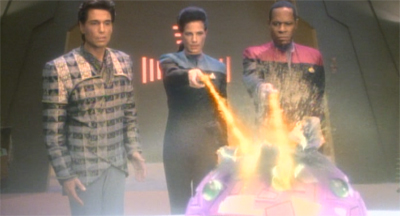
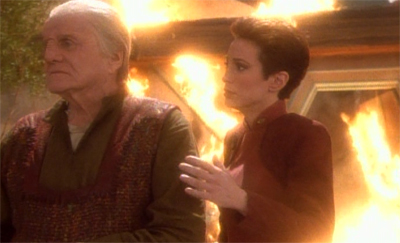
Burning down the house...

Burning down the house…

Continue reading