• Following Us

  • Categories

  • Check out the Archives


  • Awards & Nominations

Star Trek: Enterprise – Azati Prime (Review)

Next year, Star Trek is fifty years old. We have some special stuff planned for that, but – in the meantime – we’re reviewing all of Star Trek: Enterprise this year as something of a prequel to that anniversary. This August, we’re doing the third season. Check back daily for the latest review.

If you can end on a high note, the audience will forgive a lot.

The third season of Star Trek: Enterprise is one of the boldest and most ambitious seasons of Star Trek ever produced; it is certainly the most adventurous season of the franchise to air outside of Star Trek: Deep Space Nine. However, on an episode-to-episode basis, the quality is quite variable. There are great episodes (Impulse, Twilight), underrated episodes (North Star, Exile), fun episodes (Stratagem), and experimental episodes (Harbinger), but there are also a lot of episodes that are more interesting in theory than in practice.

Explosive finalé...

Explosive finalé…

It becomes increasingly obvious over the course of the season that the writing staff did not plan the year-long arc far enough in advance and that the show struggles to figure out where it wants to go after the initial burst of speed wears off. There are even a couple of outright stinkers that rank with the worst that the franchise ever produced. However, there is a lot to be said for an ending. The third season of Enterprise hits a few speed bumps along the way, but it manages to rally for an impressive and largely satisfying conclusion.

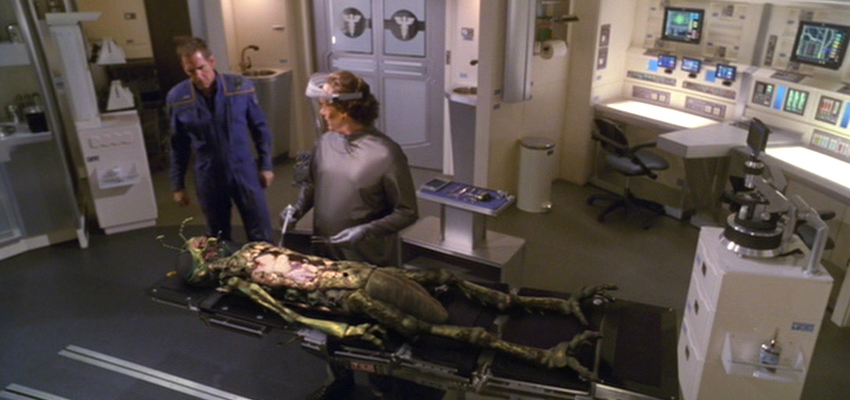
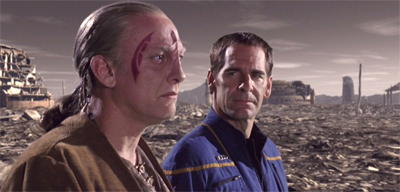
Azati Prime begins the march towards the end of the season. It was the first episode to be filmed after the Christmas break, suggesting that it was the work of a revitalised writing staff and an energised production team. More than that, it was broadcast as the last episode before a six-week break in the broadcast schedule, suggesting that everybody involved knew exactly the kind of hit that they had on their hands. It injects an incredible energy into a show that might be racing towards its own apocalypse.

Future's end...

Future’s end…

Continue reading

Star Trek: Enterprise – Hatchery (Review)

Next year, Star Trek is fifty years old. We have some special stuff planned for that, but – in the meantime – we’re reviewing all of Star Trek: Enterprise this year as something of a prequel to that anniversary. This August, we’re doing the third season. Check back daily for the latest review.

Hatchery is a very odd episode.

On the one hand, it feels like another irrelevant detour on the path to Azati Prime. It is a standalone episode about a wacky adventure that the crew have upon discovering a crashed ship on the surface of a dead world, playing with the standard Star Trek tropes about mind control and possession. This is not the first time that a Star Trek character has had their behaviour dramatically altered by an alien compound, and it does seem a bit distracting to tell this story at this point in this season, even in the aliens in this case are insect!Xindi.

Slice o' life...

Slice o’ life…

At the same time, it does feel like an important episode thematically. The third season of Star Trek: Enterprise is packed with all manner of existential explorations of what it means to be Star Trek. What are the essential ingredients of the franchise? How far can you wander off the template without breaking it? What does Star Trek even mean in a post-9/11 world? There are aspects of Hatchery that deal with these questions rather directly, as the episode explores the consequences of putting a bunch of marines on a Star Trek ship.

It just feels rather surreal that “Archer goes crazy from bug spray” should be the jumping-off point for that particular story.

"Hey there, little fella..."

“Hey there, little fella…”

Continue reading

Star Trek: Enterprise – Doctor’s Orders (Review)

Next year, Star Trek is fifty years old. We have some special stuff planned for that, but – in the meantime – we’re reviewing all of Star Trek: Enterprise this year as something of a prequel to that anniversary. This August, we’re doing the third season. Check back daily for the latest review.

If Harbinger was a surprisingly experimental piece of Star Trek, then Doctor’s Orders is something far more conventional. If Harbinger was an attempt to do something relatively novel within the framework of Star Trek: Enterprise, then Doctor’s Orders offers the viewer something they’ve seen before.

This applies in a very literal sense. There are quite a few similarities between the plot of Doctor’s Orders and One. Both are effectively one-hander bottle shows focusing on a popular member of the cast, working from the premise that an anomaly of the week requires the rest of the crew to go into stasis. From that starting point, both episodes become studies of isolation and loneliness. Both character find themselves confronting hallucinations while dealing with a perceived threat to the ship.

Yes. Doctor's Orders was a very strange choice for Sweeps.

Yes. Doctor’s Orders was a very strange choice for Sweeps.

To be fair, this is neither the first nor the last time that the Star Trek franchise will feature a plot largely recycled from existing elements. With over seven hundred episodes in the can, there will inevitably be some overlap and similarities. However, Doctor’s Orders feels familiar in another more primal sort of way. One of the big tensions of third season is a need to balance the demands of a larger story arc with a twenty-odd episode season. There is a very odd equilibrium to be struck between the long-form story and episodic standalone adventures.

Doctor’s Orders is very much an old-school episodic Star Trek adventure that could exist quite apart from the demands of the third season as a whole. It is an example of the sorts of internal tensions at work on the show.

The sleep of the just...

The sleep of the just…

Continue reading

Star Trek: Enterprise – Harbinger (Review)

Next year, Star Trek is fifty years old. We have some special stuff planned for that, but – in the meantime – we’re reviewing all of Star Trek: Enterprise this year as something of a prequel to that anniversary. This August, we’re doing the third season. Check back daily for the latest review.

It goes almost without saying that the third season of Star Trek: Enterprise was an attempt to revitalise a franchise that had already been on television for a decade and half. It was an attempt to do something quite radical and dynamic with a television property that had become rather staid and conservative. Star Trek: The Next Generation had been perfectly calibrated for the late eighties and early nineties, but its approach towards storytelling was increasingly outdated after seven seasons of Star Trek: Voyager.

One of the recurring issues in the first season of Enterprise was the conflict between the established franchise structure and something more adventurous and exciting. So many of those first season episodes seemed laboriously paced and awkwardly arch; there was a sense of dull routine rather than exciting adventure. The show would occasionally try to deviated from the established template (to varying degrees of success) with stories like Dear Doctor, Shuttlepod One, and A Night in Sickbay, but narrative conservatism won out in the sophomore season.

"So... sweeps?"

“So… sweeps?”

In many ways, Harbinger plays as a return to those earlier experiments in story structure. It is an episode that is not driven by story. Although the strange alien discovered by the crew provides a suitably dramatic climax, most of Harbinger is built around established character dynamics. Trip and T’Pol begin working through the sexual tension that has existed between them since the start of the third season; Reed and Hayes do something similar in a very different fashion. In the meantime, the ship just cruises along en route to the third season’s next big plot beat.

Harbinger is not entirely successful in this regard. There is a sense that the franchise is still figuring out how to construct episodes that don’t conform to a rigid story structure, with the mysterious alien visitor serving as an effective crutch to help get around these problems. Still, it is an interesting experiment and an example of how the show is consciously trying to reinvent itself in a manner that is more than simply cosmetic.

Expanding his Sphere of influence...

Expanding his Sphere of influence…

Continue reading

Star Trek: Enterprise – Stratagem (Review)

Next year, Star Trek is fifty years old. We have some special stuff planned for that, but – in the meantime – we’re reviewing all of Star Trek: Enterprise this year as something of a prequel to that anniversary. This August, we’re doing the third season. Check back daily for the latest review.

With Stratagem, the third season of Star Trek: Enterprise gets its head back in the game.

The recent stretch of third season episodes seemed to lose sight of what made this such an intriguing premise. Although Rick Berman had conceded that there was an escape hatch in place in case the Xindi arc could not sustain a full season of television, it was increasingly clear that the third season of Enterprise would be a single extended arc exploring Archer’s attempts to find the source of a deadly threat against mankind. It was a bold experiment for a show that had been quite rigidly episodic to this point. At least in theory.

Archer's on candid camera...

Archer’s on candid camera…

In practice, the third season of Enterprise seemed to flounder a little bit once it got past the initial burst of speed powering it into the third season. All of a sudden, the crew found themselves involved in a number of increasingly stand-alone adventures with superficial ties to the larger arc. Episodes like Extinction and Chosen Realm could easily have been produced and broadcast during the show’s first two seasons, with minor alterations. Exile and North Star were only loosely connected to the season’s plot. Carpenter Street was a time travel episode.

Proving Ground had suggested that the show was ready to re-focus its attention on the matter at hand and get back to the imminent threat posed by the Xindi. At the same time, the episode was also keen to stress its episodic nature – most notably in its role as the show’s annual check-in with the Andorians. Stratagem is very much its own self-contained story, but it is a lot more confident about how it fits in the larger scheme of things, and where it fits in the broader arc of the season.

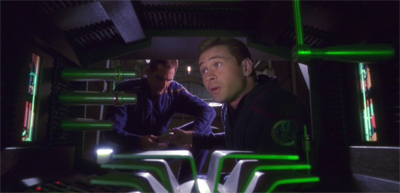
Engineering a convincing set-up...

Engineering a convincing set-up…

Continue reading

Star Trek: Enterprise – Proving Ground (Review)

Next year, Star Trek is fifty years old. We have some special stuff planned for that, but – in the meantime – we’re reviewing all of Star Trek: Enterprise this year as something of a prequel to that anniversary. This August, we’re doing the third season. Check back daily for the latest review.

Proving Ground is an odd episode to sit in the middle of the third season’s larger arc involving the Xindi and the threat against Earth.

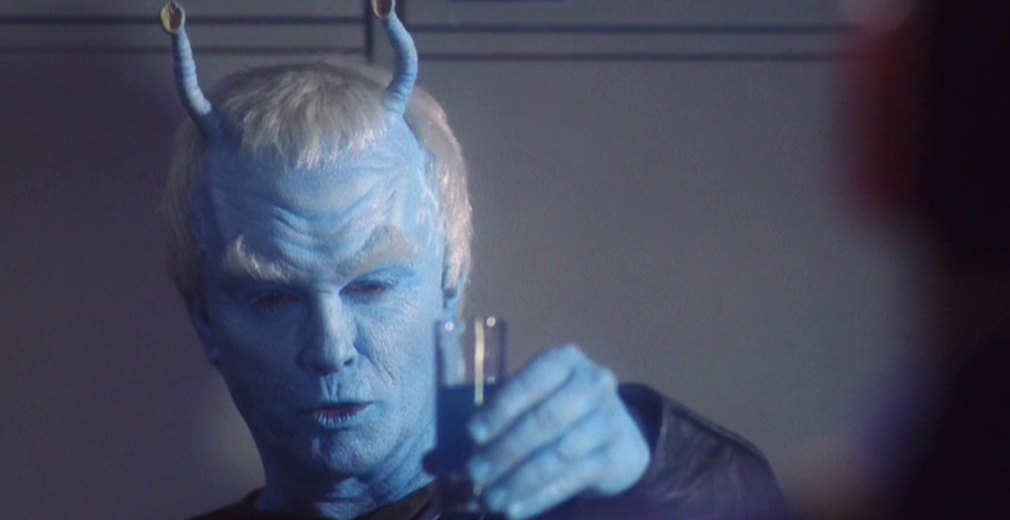
In a very real sense, it is more serialised than a lot of the episodes leading up to it. The episode even opens with a fairly sweeping “previously…” section that is sure to include a lot of nice action shots from the first half of the year. Proving Ground contributes more to the arc than anything like Carpenter Street or Chosen Realm, featuring the testing of the Xindi weapon. It also features the Andorians, suggesting that Star Trek: Enterprise has not completely divorced itself from its original place in the Star Trek canon.

Drinking away the blues...

Drinking away the blues…

At the same time, the episode is also very episodic. Shran makes a very quick cameo in Zero Hour, but this is the extent to which the Andorians are involved in the larger plot of the third season. Much like the second season, there is a sense that Shran has been slotted into “the obligatory Andorian episode” as a way to fill a production slot in a chaotic season. The sense of weight and impact of the episode is relatively minimal, like Cease Fire before it. The conclusion seems to be that Shran might be a nice guy underneath it all. It’s hardly shocking.

More than that, the structure and plot of the episode can’t help but emphasise some of the more misguided creative decisions of the third season, with Proving Ground introducing a bunch of clever (and exciting concepts) into the arc only to take them right away at the end. The fact that Proving Ground is so fun and enjoyable is almost a detriment, inviting the audience to wonder whether some of that love and affection might have been distributed across the season.

Look who just blue in...

Look who just blue in…

Continue reading

Star Trek: Enterprise – Chosen Realm (Review)

Next year, Star Trek is fifty years old. We have some special stuff planned for that, but – in the meantime – we’re reviewing all of Star Trek: Enterprise this year as something of a prequel to that anniversary. This August, we’re doing the third season. Check back daily for the latest review.

Chosen Realm is Manny Coto’s second script for Star Trek: Enterprise.

His script for Similitude marked Coto as something of an old-fashioned Star Trek writer. It was clear that Coto harboured a great deal of affection for the source material, and Similitude was structured in the style of a classic Star Trek morality play. It was a story about the circumstances in which “the needs of the many outweigh the needs of the few… or the one.” There is a reason that Star Trek fans are so very fond of Similitude, particularly given its position in the middle of a rather polarising and provocative season.

Archer encounter an enemy with faith of the heart...

Archer encounter an enemy with faith of the heart…

However, it was not entirely clear just how traditional Manny Coto was in his approach to Star Trek until the broadcast of Chosen Realm. If Similitude felt like a classic Star Trek morality play, then Chosen Realm literally was a classic Star Trek morality play. A commentary on religious fanaticism and zealotry, Chosen Realm was very much an update of the iconic Let That Be Your Last Battlefield. Coto is quite explicit about this, rather blatantly borrowing the emotive (and poignant) ending from that episode.

Although it aired in the much-maligned third season, and has no shortage of its own problems, Let That Be Your Last Battlefield is an instantly recognisable Star Trek allegory. Casual fans – and even those with a passing familiarity with the franchise – remember “the one with the aliens who are half-black and half-white who are racist against the aliens who are half-white and half-black.” It is not a subtle or nuanced allegory, but it doesn’t really need to be. It is not as if the sort of blatant racism against which the Civil Rights movement fought was a grey area.

"I think I've seen this before..."

“I think I’ve seen this before…”

Unfortunately, Chosen Realm chooses to apply this simplistic metaphor to a complicated issue. In keeping with the War on Terror metaphor running through the third season, Chosen Realm explicitly ties religion into the larger arc. Archer finds his ship hijacked by a bunch of religious suicide bombers actively intent on turning Enterprise into a weapon that can be deployed against those who believe differently than they do. This is a very classic Star Trek morality tale – the “religion is bad” theme dating back to Who Mourns For Adonais? or The Apple.

Religion is undoubtedly an element of the War on Terror, but it is not the only issue or an issue that exists in isolation. Islamic extremism (as Chosen Realm never seems particularly interested in the trope of Christian extremism) is rooted in more than simply faith. There are political and economic factors at play that are just as vital to understanding why things happen in the way that they happen. Chosen Realm is uninterested in any of this, structuring itself as Richard Dawkins rant in science-fiction form.

What was that about politics or religion?

What was that about politics or religion?

Continue reading

Star Trek: Enterprise – Carpenter Street (Review)

Next year, Star Trek is fifty years old. We have some special stuff planned for that, but – in the meantime – we’re reviewing all of Star Trek: Enterprise this year as something of a prequel to that anniversary. This August, we’re doing the third season. Check back daily for the latest review.

This is the point at which it becomes all but impossible to argue that the production team knew what they were doing this season.

The third season of Star Trek: Enterprise holds together reasonably well, if the viewer pulls back to a big enough distance. The broad arcs are discernible and logical – there is a clear start point and a reasonable trajectory, even if the first half of the season tends to get a bit lost. It really pulls itself together during the second half of the season, with one or two exceptions, building towards a finalé that satisfies both the demands of a year-long arc and the franchise surrounding it. It is not perfect, but it is not bad for a first attempt.

Hey kids! It's Leland Orser!

Hey kids! It’s Leland Orser!

Of course, it is also quite clear that the production team really had no idea what they were doing – or even what they were trying to do. The fact that it comes together in the second half of the season all but concedes that it doesn’t hold together in the first half. The first half of the third season is populated with standalone episodes that tend to either fit thematically (North Star, Similitude) or tonally (Impulse, Exile) with the general direction of the show, but a rather limited sense of progress or advancement.

Carpenter Street is the point at which any real sense of trust between the audience and the production team snaps like a twig. It is a story that features the characters time travelling to modern-day Earth in the middle of a gigantic story arc about how they are more isolated than they ever have been before. It throws away any sense of internal logic or consistency, never really exploring how an alien species that can travel back to Detroit in 2004 should have a problem with Earth in 2153. And, crucially, it is not fun enough to excuse those issues.

Hey kid! It's Jeffrey Dean Morgan! (Really!)

Hey kid! It’s Jeffrey Dean Morgan!
(Really!)

Continue reading

Star Trek: Enterprise – Similitude (Review)

Next year, Star Trek is fifty years old. We have some special stuff planned for that, but – in the meantime – we’re reviewing all of Star Trek: Enterprise this year as something of a prequel to that anniversary. This August, we’re doing the third season. Check back daily for the latest review.

It is hard to talk about Similitude without talking about Manny Coto.

It is quite easy to get distracted from the episode itself, which is a sublimely moving piece of working with skilled direction from LeVar Burton and a beautiful central performance from Connor Trinneer. More than that, Similitude is very much pure Star Trek. It is a metaphor about the human condition, wrapped up in a morality play fashioned from some admittedly questionable science-fiction. This good old-fashioned allegorical science-fiction in a style that really works, capitalising on the status quo of the third season of Star Trek: Enterprise to tell a moving story.

Send in the clones...

Send in the clones…

And, yet, despite all that, this is the point at which Manny Coto arrives. Much like it is impossible to talk about The Bonding without talking about Ronald D. Moore, it is impossible to talk about Similitude without talking about Manny Coto. Coto arrived on the show fresh from Odyssey 5, and quickly made himself invaluable and essential. While his scripts were quite hit-and-miss on an episode-by-episode basis, Coto demonstrated an aptitude for producing television in general and Star Trek in particular.

Indeed, Coto managed to climb the franchise rungs faster than any producer and writer since Michael Piller in the third season of Star Trek: The Next Generation. Piller had found himself running the show after Michael Wagner suddenly decided to step down only a few episodes into the season. Coto had a bit longer to get the lay of the land; he would have half of the third season to establish himself before being placed in charge of the writers’ room for the start of the show’s fourth year when Brannon Braga stepped back into a more supervisory role.

Genetically engineered engineer...

Genetically engineered engineer…

A number of factors helped to establish Coto as an almost mythical figure in Star Trek lore. The dramatic change in tone and style into the fourth year, which catered to a core group of Star Trek fans – including Coto himself – surely helped. The fact that Coto was succeeding Brannon Braga probably helped establish his credibility as well – a vocal section of fandom has complete disdain for Braga’s style. Despite the fact that Coto was only in charge for twenty-four episode, he made a surprisingly enduring contribution to the franchise as a whole.

Hindsight seems to suggest that Similitude was almost prophetic; it is the story of incredible growth and development over an incredibly short amount of time, making a deep and lasting impression.

Designer baby...

Designer baby…

Continue reading

Star Trek: Enterprise – North Star (Review)

Next year, Star Trek is fifty years old. We have some special stuff planned for that, but – in the meantime – we’re reviewing all of Star Trek: Enterprise this year as something of a prequel to that anniversary. This August, we’re doing the third season. Check back daily for the latest review.

It is surprising just how hasty some sections of Star Trek fandom are to dismiss North Star as absurd or ham-fisted or ridiculous.

It is precisely those qualities the make North Star quintessential Star Trek.

Spectre of gun...

Spectre of gun…

Continue reading