• Following Us

  • Categories

  • Check out the Archives


  • Awards & Nominations

Star Trek: Deep Space Nine – In the Cards (Review)

In the Cards is the perfect penultimate episode to a sensational season of television.

One of the more common observations about Star Trek: Deep Space Nine is that it is the most dour and serious of the Star Trek series. It is the grim and cynical series of the bunch, with many commentators insisting that the series rejects the franchise’s humanist utopia in favour of brutality and nihilism. This criticism is entirely understandable. The series is literally and thematically darker than Star Trek: The Next Generation or Star Trek: Voyager. Even at this point, it is about to embark upon a two-year-long war arc, the longest in the franchise.
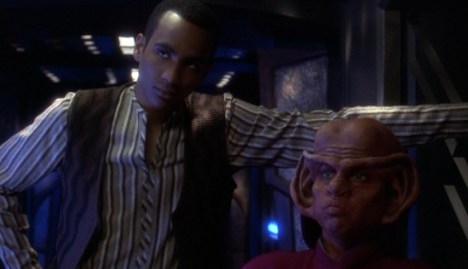
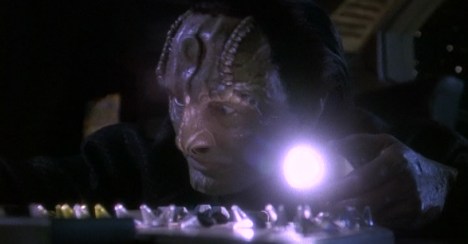
Jake and the Ferengi Man.

Jake and the Ferengi Man.

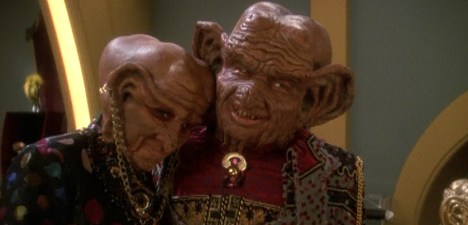
However, this is also a very reductive reading of Deep Space Nine. The series is more willing to criticise and interrogate the foundations of the Star Trek universe than any of its siblings, but it remains generally positive about the human condition. Governments and power structures should be treated with suspicion, but individuals are generally decent. Positioned right before the beginning of an epic franchise-shattering war, In the Cards is the perfect example of this philosophy. In the Cards elegantly captures the warmth and optimism of Deep Space Nine.

Deep Space Nine is fundamentally the story of a diverse and multicultural community formed of countless disparate people drawn together by fate or chance. In the Cards is a story about how happiness functions in that community, how the bonds between people can make all the difference even as the universe falls into chaos around them. It is also very funny.

Pod person.

Pod person.

Continue reading

Star Trek: Deep Space Nine – Empok Nor (Review)

Empok Nor is effectively a slasher movie.

It is Bryan Fuller’s second story credit for Star Trek: Deep Space Nine, and it shares a number of tonal and thematic similarities with his story for The Darkness and the Light. Both episodes are essentially pitched as serial killer horror movies, in which monsters from the past stalk our lead characters. These are fascinating tonal departures for the Rick Berman era of the Star Trek franchise, even if they feel like the logical extension of early horror-tinged episodes like The Man Trap or Charlie X or The Enemy Within.

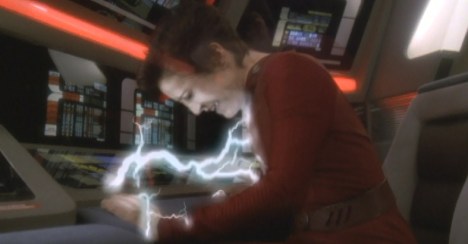
The great game.

The great game.

Empok Nor is not as well developed or as effective as The Darkness and the Light. It lacks the thematic and character-driven punch of that earlier episode, even suffering as a little derivative. While Kira’s efforts to reconcile her past as a terrorist with her current status quo was the driving force of The Darkness and the Light, the contrast between O’Brien as a soldier and O’Brien as an engineer feels a little underdeveloped in Empok Nor. More than that, Empok Nor suffers from casually transforming Garak into a gloating nineties serial killer.

At the same time, there is a cheeky thrill to watching the Deep Space Nine production team try their hand at a particularly trashy and visceral genre, offering jump scares and atmosphere on familiar sets with the lighting turned way down low. Empok Nor is not a standout of this most spectacular of television seasons, but it had its charms.

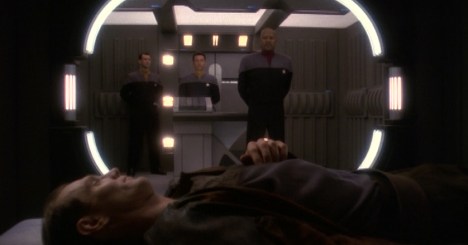
Sleeping beauties.

Sleeping beauties.

Continue reading

Star Trek: Deep Space Nine – Blaze of Glory (Review)

Blaze of Glory is a spectacular piece of television.

It is an episode that serves a very clear plot function in the larger context of Star Trek: Deep Space Nine. It is clearly designed to tidy away some of the dangling loose ends before the show transitions into the Dominion War. Much like Children of Time was really the last “strange Gamma Quadrant phenomenon” episode, Blaze of Glory is the last Maquis episode. It also marks the last appearance of Michael Eddington, a character who has come a long way since his first appearance as the station’s new security officer in The Search, Part I.

Michael Eddington, Noted Brigand.

Michael Eddington, Noted Brigand.

However, even ignoring the fact that Blaze of Glory fulfils these larger obligations in terms of the show’s long-running plot threads, the episode is an engaging and exciting buddy action film that finds Benjamin Sisko paired with one of his most hated adversaries on a dangerous mission into the heart of enemy territory. Ira Steven Behr and Robert Hewitt Wolfe prepare a script laced with wry banter for unlikely action heroes Avery Brooks and Ken Marshall, while Kim Friedman directs the episode as if it were a lost Reagan era Shane Black script.

However, Blaze of Glory also feels very much like Deep Space Nine at its best. It is an episode that celebrates how much these characters can grow and change, while also revelling in the diversity of perspectives that make Deep Space Nine such a compelling show. It is an episode that understands Sisko and Eddington are perhaps more alike than either would concede, but which explores those parallels in a way that never obscures their key differences or their mutual mistrust.

Disarming conversation.

Disarming conversation.

Continue reading

Star Trek: Deep Space Nine – Children of Time (Review)

Time is the fire in which we burn.

Children of Time comes towards the end of the franchise’s thirtieth anniversary season. By all accounts, the thirtieth anniversary season had been a resounding success. Star Trek: First Contact managed to please audiences and critics with a journey back to the beginning of the Star Trek universe. Star Trek: Deep Space Nine offered a crowd-pleasing homage to The Trouble With Tribbles in Trials and Tribble-ations. Even Star Trek: Voyager got in on the act with Flashback, Future’s End, Part I and Future’s End, Part II.

More than that, the franchise was thriving by just about any measure. Three casts were active simultaneously; two casts on television and one in cinemas. The thirtieth anniversary had garnered incredible media attention and had helped to remind audiences that the franchise was still chugging along a decade after its resurrection. To many observers, it appeared that the Star Trek had been resurrected. Against all odds, the television show that had been cancelled by NBC after only three seasons seemed to have been granted a form of immortality.

Walking into the sunset.

Walking into the sunset.

However, things were not as rosy behind the scenes. In fact, the franchise had been underperforming since the end of Star Trek: The Next Generation. The ratings would not become a real problem until the launch of Star Trek: Enterprise, but there were early signs that the franchise was in decline. Both Deep Space Nine and Voyager underwent cast revisions in their fourth seasons to try to solidify the ratings. Deep Space Nine got to keep its existing cast and add one new face, while Voyager had to fire one cast member to make room for the newest player.

Children of Time feels very much like a meditation and contemplation upon the theme of legacy, asking the characters on Deep Space Nine to wonder what they might leave behind.

Shocking.

Shocking.

Continue reading

Star Trek: Deep Space Nine – Soldiers of the Empire (Review)

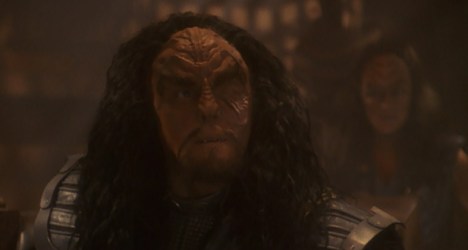
Soldiers of the Empire is a very effective illustration of just how far Star Trek: Deep Space Nine was willing to push the Star Trek franchise.

It is an episode that unfolds primarily on a Klingon Bird of Prey. This is nothing new. After all, Star Trek: The Next Generation produced A Matter of Honour in its second season, assigning Riker to serve on a Klingon ship as part of an exchange programme. However, that episode was told primary from a human perspective, the story centring on Riker adjusting and adapting to an alien culture before saving the day. When Worf joined the Klingon fleet in Redemption, Part II, the story kept cutting back to life on the Enterprise in his absence.

"Mahk-cha!"

“Mahk-cha!”

In contrast, Soldiers of the Empire is primarily focused upon the Klingon cast and the Klingon crew. Worf and Dax join the IKS Rotarran to support General Martok in his first command since escaping the Dominion prison camp at the end of By Inferno’s Light, but they are very much bystanders. Although Worf and Dax provide vital narrative functions in introducing the audience to Klingon customs and cultures, the narrative arc of the show belongs to Martok and the crew of the Rotarran. This is not a story about Worf and Dax, this is a story about Martok.

The result is an episode that really pushes the limits of the storytelling possibilities on Deep Space Nine, a reminder that the production team remain as ambitious as ever in the show’s fifth season. Soldiers of the Empire suffers from a few minor plotting issues, but it is exciting and compelling in a way that captures the very best of Deep Space Nine.

A sharp stabbing pain.

A sharp stabbing pain.

Continue reading

Star Trek: Deep Space Nine – Ferengi Love Songs (Review)

Ferengi Love Songs has one really good joke. In the episode’s defence, it might just be a great joke.

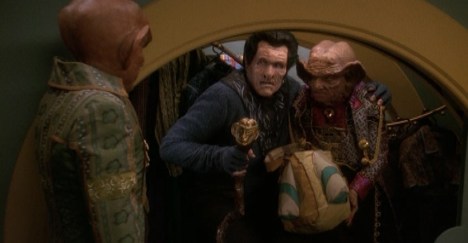
The most striking moment in Ferengi Love Songs comes eight minutes into the episode. In fact, the teaser rushes along so fast that it feels like the production team were pushing for that moment to serve as the sting that would segue into the opening credits. Instead, it arrives during an otherwise short and indistinct first act, providing an effective ad break on syndication. Still, the image is strong enough that it lingers. The image is the sequence in Quark discovers that the Grand Nagus, the most powerful of Ferengi, is hiding in his closet.

Imagine me and you, I do, I think about you day and night, it's only right...

Imagine me and you, I do,
I think about you day and night, it’s only right…

It is a great comedy moment, in both concept and execution. The idea of the leader of a vast interstellar empire hiding in somebody’s bedroom is ridiculous in a way that Star Trek is very rarely ridiculous, at least during the Rick Berman era. It is very much a stock sit-com trope, except it has been dressed up in the trappings of a franchise that has a long record of taking itself incredibly seriously. There is an endearing absurdity to the gag that feels almost like the Star Trek: Deep Space Nine writers are affectionately poking fun at the franchise’s self-seriousness.

Even the execution of the joke works very well. Quark absent-mindedly opens his closet and puts his travel bag inside. The Grand Negus is waiting inside and accepts the bag that is offered. Quark closes the closet, and then does a double-take. He reopens the closet, at which point the Grand Nagus points out that Quark shouldn’t even be here. In a panic, Quark immediately grabs his bag and prepares to leave his house (and the planet) before he properly processes what has happened. “What’s the Nagus doing in my closet?”

He comes with a lot of baggage.

He comes with a lot of baggage.

It is a scene that might have been lifted from some forgotten thirties screwball comedy, which makes sense considering the interests of the Deep Space Nine production team. Rene Auberjonois directs the sequence in which to play into that absurdity, and Armin Shimerman proves quite game at delivering double-takes and exaggerated moments of realisation. It is a great gag, skilfully executed, that is brilliantly silly in the way that Deep Space Nine is not afraid to be.

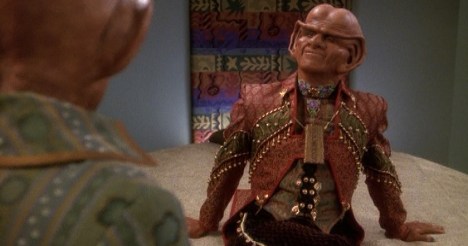
The biggest problem with Ferengi Love Songs is the challenge of where it needs to go from that brilliant little gag. There is an interesting kernel of a story idea here, the writers’ obvious affection for these Ferengi characters shining through. Unfortunately, none of that fits with the tone of the episode’s central gag, which leads a plot that feels strangely dissonant as it tries to wring drama and conflict from the image of the Grand Nagus crouched over in Quark’s closet.

Strange bedfellows...

Strange bedfellows…

Continue reading

Star Trek: Deep Space Nine – Ties of Blood and Water (Review)

Ties of Blood and Water is a phenomenal piece of television, and a great example of the strengths of Star Trek: Deep Space Nine.

It is an episode that is tied to the personal and the political, a thriller about great powers squaring off against one another set against the more intimate story of a woman nursing her surrogate father in the final hours of his life. Ties of Blood and Water is both intimate and epic, never sacrificing one for the other. Its larger political story beats feel entirely in keeping with the demands of the larger shared universe, but it never loses sight of the story’s emotional centre. There is a very personal aspect to this tale, one firmly grounded in the characters and their relationships.

The ties that bind.

The ties that bind.

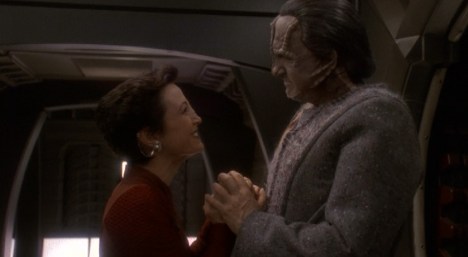
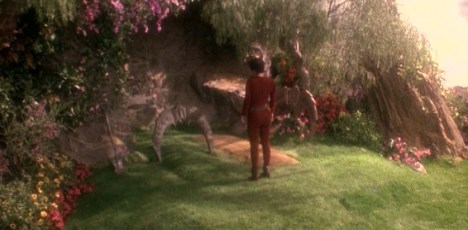
Ties of Blood and Water focuses on Tekeny Ghemor, the Cardassian Legate featured in Second Skin. There, he was convinced that Kira was his daughter who had been sent to infiltrate the Shakaar Resistance. In Ties of Blood and Water, Ghemor returns to the station as the relationship turns a full circle. In Second Skin, Kira Nerys had been a surrogate daughter to Ghemor, standing in for the lost Iliana. In Ties of Blood and Water, Ghemor finds himself cast as a surrogate father to Kira, providing her with a means to work through the loss of her biological father.

Ties of Blood and Water has a certain poetry to it, extending beyond the memorable title.

Greener pastures.

Greener pastures.

Continue reading

Star Trek: Deep Space Nine – Business as Usual (Review)

Business as Usual is, appropriately enough, a very typical Star Trek morality play.

It is a relatively rare example of Star Trek: Deep Space Nine engaging in the sort of pointed social commentary that many fans expect of the genre, the rather straightforward moral lesson couched in science-fiction trappings; The Devil in the Dark as a commentary on “the other”, A Taste of Armageddon as a condemnation of the Vietnam War, Let That Be Your Last Battlefield as a critique of racism in general. There are all but expected in a Star Trek show, but Deep Space Nine rarely plays them particularly straight.

Disarming conversationalists...

Disarming conversationalists…

Deep Space Nine has told issue-driven stories before, with In the Hands of the Prophets serving to explore the gap between creationists and those who believe in evolution or Past Tense, Part I and Past Tense, Part II constructed as a direct commentary on Los Angeles’ plans to lock up their homeless population. However, the series tend to favour broader commentaries about grander themes. The show arguably as a timeless quality because it tends not to dwell too heavily upon specific ideas, instead meditating on particular themes like authority and conflict.

Indeed, Star Trek: Voyager is a lot more traditional in this respect. That writing staff has a clear fondness for the archetypal Star Trek morality play, constructing episodes as metaphors for contemporary issues; Remember explores Holocaust denial, Distant Origin deals with creationism, Displaced offers a reactionary take on immigration. Even non-issue-driven episodes like Darkling and Fair Trade make a point to stress the franchise’s utopian values in a manner much more overt than Deep Space Nine.

The hard sell.

The hard sell.

With that in mind, Business as Usual feels strangely old-fashioned. It is very much an episode of Deep Space Nine in terms of setting and character, in that no other Star Trek show would have a lead character knowingly and willingly become an arms dealer. However, it feels very much like an archetypal Star Trek show in that it is an episode about how the arms trade is implicitly immoral and horrific. It is a very worthwhile message, and in no way diminished by its obviousness, but it does feel surprisingly clear cut when compared to episodes like The Ship or Rapture.

Business as Usual is essentially a very conventional Star Trek story that is elevated by one of the best guest casts in the history of the franchise.

"No, Mister Quark, I expect you to buy!"

“No, Mister Quark, I expect you to buy!”

Continue reading

Star Trek: Deep Space Nine – A Simple Investigation (Review)

A Simple Investigation is a quiet little episode.

This is particularly true in the context of the crowded second half to the fifth season of Star Trek: Deep Space Nine. In Purgatory’s Shadow and By Inferno’s Light radically upended the status quo and set the fifth season on a march towards A Call to Arms. The threat of war looms large over the second half of the season, following the admission of Cardassia into the Dominion. There is a creeping sense of inevitability to episodes like Blaze of Glory and Soldiers of the Empire.

Strange bedfellows...

Strange bedfellows…

At the same time, Deep Space Nine takes a little while to adjust to that dramatic shift. The Dominion and Cardassia only come back into focus with Ties of Blood and Water, the episode that reintroduces Weyoun to the series. Still, episodes like Doctor Bashir, I Presume and Business as Usual have a sense of weight to them as they offer up high-stakes family drama and arms-dealing morality plays. In contrast, A Simple Investigation feels relatively low key. It is not an episode with profound consequences or shocking revelations.

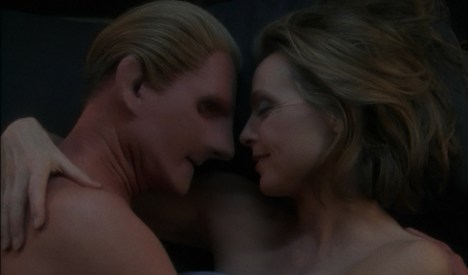
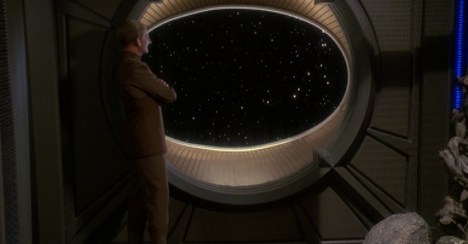
Instead, A Simple Investigation plays as a small-scale cyberpunk noir romance in which Odo falls head-over-heels in love with a guest star whom he will never see again. With all the chaos unfolding across the length and breadth of the fifth season, A Simple Investigation feels surprisingly… simple. The problems of these little people don’t amount to a hill of beans in this crazy world, but A Simple Investigation still takes the time to fixate upon them.

Star struck.

Star struck.

Continue reading

Star Trek: Deep Space Nine – Doctor Bashir, I Presume (Review)

Doctor Bashir, I Presume is a strange little episode.

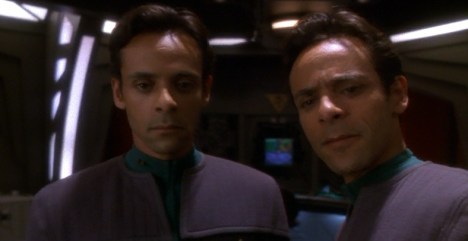
It directly follows In Purgatory’s Shadow and By Inferno’s Light, a two-part story in which it was revealed that Doctor Julian Bashir had been abducted by the Dominion at some point during the fifth season and replaced with a changeling infiltrator. Although the maths can be a little difficult to work out, it is suggested that Bashir was replaced by a changeling at some point before Rapture. With that in mind, it seems strange that the very next episode of Star Trek: Deep Space Nine should reveal that the recently returned Julian Bashir is himself an imposter.

"Oh, shiny."

“Oh, shiny.”

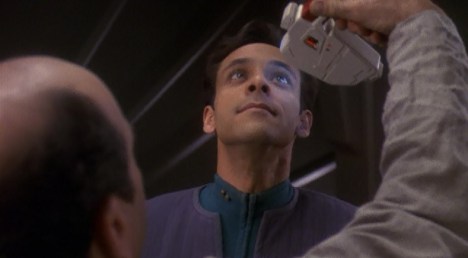
However, even on its own terms, Doctor Bashir, I Presume is a very odd piece of television. The hook of the episode is a guest appearance from Robert Picardo as Lewis Zimmerman. Picardo is making a crossover appearance from Star Trek: Voyager where he played the EMH, who had also made an appearance in Star Trek: First Contact. Picardo is a fine dramatic actor, but the character is notable for being comic relief. Doctor Bashir, I Presume begins as a light-hearted quirky piece, turning sharply at the half-way point to become a gritty science-fiction family drama.

All of this is quite jarring. However, Doctor Bashir, I Presume works surprising well. A large part of that is down to how strange the episode is, often feeling like an intimate family drama about recrimination and disappointment set against the backdrop of a massive science-fiction franchise.

A selfie with himself.

A selfie with himself.

Continue reading