• Following Us

  • Categories

  • Check out the Archives


  • Awards & Nominations

Millennium – Loin Like a Hunting Flame (Review)

This February and March, we’re taking a trip back in time to review the fourth season of The X-Files and the first season of Millennium.

Loin Like a Hunting Flame represents the peak of a particular type of Millennium story.

It is an episode towards which the season seems to have been building. It is an episode that rather explicitly and candidly ties together two of the show’s favourite subjects: sex and violence, in harmony together. Loin Like a Hunting Flame is something of a stalking horse for the rest of the season; it is the first season episode that most obviously embodies the excesses of any show like Millennium. Fetishised violence has been baked into Millennium since The Pilot opened with a stripper dancing in her own blood; here, it reaches a logical end point.
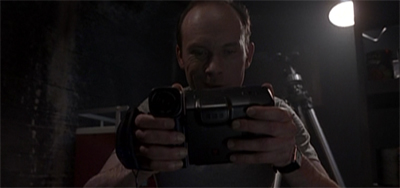
Candid camera!

Candid camera!

Loin Like a Hunting Flame is an episode that is guilty of just about any criticism that might be thrown at it. It is gratuitous; it is sensationalist; it is excessive. It tries to have things both ways, titillating the viewer with glimpse of “exotic” sexual liberation while warning them that those sexually liberated individuals will be punished for their perceived transgressions. Yes, Loin Like a Hunting Flame tries to say something a bit more nuance, but it flails around for most of its forty-five minute runtime like a dying fish.

In many respects, this could be treated as a catharsis for the series. After this point, Millennium turns a corner. The rest of the first season is a lot more ambitious in tone and scope. As much as Loin Like a Hunting Flame closes off a particularly evolutionary line of Millennium, Force Majeure and The Thin White Line push forwards towards a more adventurous show. Loin Like a Hunting Flame just has to work these issues out, once and for all, to their logical (and unsatisfying) conclusion.
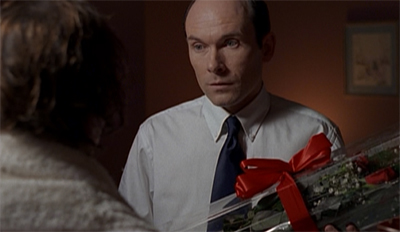
Wholesome family fun...

Wholesome family fun…

Continue reading

Star Trek: Enterprise – Unexpected (Review)

Next year, Star Trek is fifty years old. We have some special stuff planned for that, but – in the meantime – we’re reviewing all of Star Trek: Enterprise this year as something of a prequel to that anniversary. This January, we’re doing the first season. Check back daily for the latest review.

So, male pregnancy, eh?

Talk about a nipple slip...

Talk about a nipple slip…

Continue reading

Star Trek – A Private Little War (Review)

The first Star Trek pilot, The Cage, was produced in 1964. To celebrate its fiftieth anniversary, this December we are reviewing the second season of the original Star Trek show. You can check out our first season reviews here. Check back daily for the latest review.

Star Trek is a pop culture relic of the sixties. It’s possible to see the decade reflected in just about every facet of the production. The show’s costume and set design speak to the decade, as do the series’ sexual politics. The Cold War colours a significant portion of the series, reflected in the Klingons and elsewhere. The Second World War is treated as the beginning of the future, while much emphasis is put on mankind’s expansion to the stars.

Even outside of these general parallels, there are episodes that speak to particular facets of the sixties. The Naked Time, This Side of Paradise and The Way to Eden all play with the idea of social liberation. The Ultimate Computer, Return of the Archons, The Apple and The Changeling all speak to concerns and insecurities about the rapid advance of technology and the people left behind. Journey to Babel touches on the gap felt between conservative parents and liberal children ready to embrace life’s possibilities.

Make war, not love...

Make war, not love…

And then there’s the Vietnam episodes. Shows like Errand of Mercy and A Taste of Armageddon reflect the conflict in a number of ways that were not possible in the scripted dramas of the time. However, A Private Little War is perhaps the definitive Vietnam episode. Part of this is due to the script and the production, which makes explicit reference to “the twentieth century brush wars on the Asian continent.” With the Klingons and the Federation meddling directly in the conflict on a small backwater planet, comparisons invite themselves.

However, there were factors at play outside the control of the production team. A Private Little War was produced in late 1967. It aired on February 2, 1968. However, North Vietnamese forces had launched the Tet Offensive only a few days earlier – the campaign would land through the end of March. The Tet Offensive would end with the North Vietnamese suffering heavier losses than the American or South Vietnamese forces, but the attacks would have a devastating affect on public opinion.

"Got your nose! And, soon, your planet!"

“Got your nose! And, soon, your planet!”

A Private Little War is placed terribly. It is a reluctant justification of the Vietnam War, presenting interference in a foreign war as a terrible (but necessary) burden weighing on Kirk’s conscience. The episode closes with Kirk committing to arm the natives, even if the show doesn’t have the courage of its conviction to follow the idea to its logical consequences. For all that Star Trek is described as a liberal and pacifistic vision of the future, A Private Little War endorses American interference in Vietnam.

The broadcast of A Private Little War only a couple of days following the turning point of the public perception of the war is an absolutely fascinating pop cultural synergy – a demonstration of how Star Trek was inevitably and inexorably of its time in a way that even a few months delay between filming and broadcast could change the context of the episode so dramatically.

I wouldn't look so happy with myself...

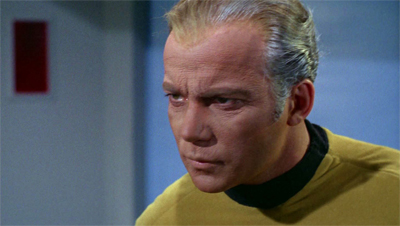
I wouldn’t look so happy with myself…

Continue reading

Star Trek – The Deadly Years (Review)

The first Star Trek pilot, The Cage, was produced in 1964. To celebrate its fiftieth anniversary, this December we are reviewing the second season of the original Star Trek show. You can check out our first season reviews here. Check back daily for the latest review.

“Accelerated ageing” is one of those classic science-fiction tropes. It’s one of those stock element that can be easily baked into an episode – like “evil duplicate” or “body theft.” It instantly adds drama, gives the actors something to do, and offers a chance for the make-up team to work on something that might be considered a bit more prestigious than aliens. It pops up on shows as diverse as Stargate SG-1 and The X-Files.

Within the Star Trek franchise, the trope shows up a couple of times. The Deadly Years is the most obvious example, but it also shows up during the first two years of Star Trek: The Next Generation, when that show was trying hardest to channel its direct predecessor. Too Short a Season inverted the trope to give us “accelerated de-ageing”, while Unnatural Selection played it entirely straight.

A wrinkle in the timeline...

A wrinkle in the timeline…

The Deadly Years is an episode that doesn’t quite work as a cohesive whole, although if its populated with some intriguing moving parts. There is a sense that the writing staff are trying to plug perceived gaps in the story by throwing everything they have into the mix. Some of these are good ideas, some of these are already so familiar that they feel like Star Trek clichés at what marks the halfway point of the original production run.

There are several elements here that would arguably support their own episodes. On top of the idea of the crew ageing rapidly, we get the wonderful dramatic hook of Spock trying to prove Kirk unfit for command – a plot point that never feels like it gets enough focus. However, we also get another “incompetent/crazy/stupid senior official” plot heaped on top to provide a suitably dramatic climax to the episode. And the Romulans return, albeit as generic heavies. The Deadly Years is a mixed bag at best.

"She's... well, you get the idea..."

“She’s… well, you get the idea…”

Continue reading

Star Trek – Who Mourns For Adonais? (Review)

The first Star Trek pilot, The Cage, was produced in 1964. To celebrate its fiftieth anniversary, this December we are reviewing the second season of the original Star Trek show. You can check out our first season reviews here. Check back daily for the latest review.

In many respects, Who Mourns for Adonais? is a formative episode for Star Trek as a franchise. It’s a show that really informs a lot of the franchise that would follow, even beyond the confines of the original television show. It’s an episode that represents the first clear articulation of a strand of thought that has been bubbling away through the first season of Star Trek and into the second, exploring the religious side of the Star Trek universe and mankind’s place in the cosmos.

The episode is iconic and memorable. It is packed with images that are familiar to even the most casual of fans. “Kirk confronts a Greek god in deep space!” is a catchy premise. “A giant hand grabs the Enterprise and threatens to crush the ship!” is the type of delightfully insane visual that ranks with “Captain Kirk as a Nazi!” or “space Lincoln!” when it comes to Star Trek visuals that stick with people outside the context of the show itself. Coupled with the distillation of those themes, this is a “big” episode.

"Jack, I'm flying!"

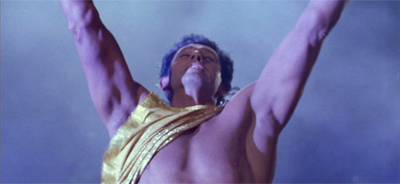
“Jack, I’m flying!”

Unfortunately, Who Mourns for Adonais? is also a deeply troubling episode. It has problems heaped upon problems. Some of those problems are inherited from the general aesthetic of the show, and are not specific to this episode. However, some of those problems are explicitly articulated here. Who Mourns for Adonais? is an episode that embodies quite a few of the very serious problems that run through the original Star Trek and haunt the franchise for quite some time.

The fact that these problems come baked into an iconic and memorable episode is disappointing.

"Oh, your gods..."

“Oh, your gods…”

Continue reading

The X-Files – 2Shy (Review)

This November (and a little of December), we’re taking a trip back in time to review the third season of The X-Files and the first (and only) season of Space: Above and Beyond.

A lot of the success of the third season of The X-Files came for learning what had worked earlier, and trying to hone that.

So, for example, the epic mythology of Colony and End Game enabled episodes like Nisei and 731 along with Piper Maru and Apocrypha. Shows like Die Hand Die Verletzt and Humbug had proven that the show could do comedy, so it wasn’t as big a risk to commit to stories like Clyde Bruckman’s Final Repose or Jose Chung’s “From Outer Space.” Even episodes like Fresh Bones had helped to define what a standard “monster of the week” should look like.

Freak like me...

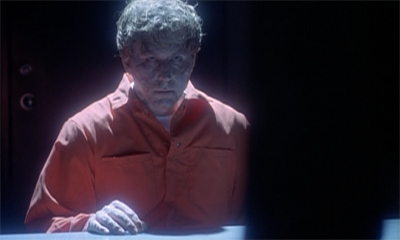
Freak like me…

This approach to the third season had its drawbacks. It seemed like the first chunk of the first season was stuffed with supernatural revenge stories, to the point where it is surprisingly easy to confuse The List and The Walk on the basis of title and theme alone. However, it was a very effective way of producing television. It is very hard to fault any approach towards television production that could turn “fat-sucking vampire” into a premise that works.

The genealogy of 2Shy is quite easy to trace. It is the obvious synthesis of Tooms and Irresistible, two of the more memorable and effective monster stories of the first two seasons. 2Shy may have some very serious problems, but it does what it says on the tin.

Fresh bones...

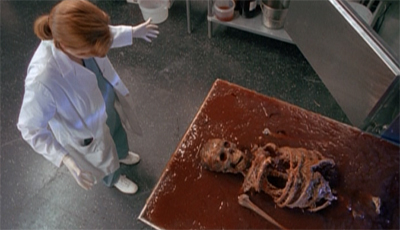
Fresh bones…

Continue reading

Star Trek: Voyager – Cathexis (Review)

This September and October, we’re taking a look at the jam-packed 1994 to 1995 season of Star Trek, including Star Trek: Deep Space Nine and Star Trek: Voyager. Check back daily for the latest review.

Cathexis has a vaguely interesting premise, but it gets a little bit too caught up in science-fiction high concepts and New Age mysticism.

Once again, there’s a sense that the wrong writer has been assigned the wrong brief. The New Age spirituality elements of Chakotay’s character were largely championed by Michael Piller; the “romantic period mystery” story for Janeway clearly comes from Jeri Taylor. The only part of Cathexis that clearly comes from credited writer Brannon Braga is the somewhat generic Invasion of the Body Snatchers plot line – and, as such, it seems to be the only thread in which Braga is particularly interested.

So we get a bunch of half-hearted New Age stuff unfolding, with Chakotay’s wandering spirit represented by a camera with a blurry filter swooping through familiar sets. Once again, Chakotay’s Native American heritage becomes a launching pad for some ill-advised mysticism and exoticism, which Cathexis never even bothers trying to explain.

Frankly, I'm surprised Tuvok put up with this for so long...

Frankly, I’m surprised Tuvok put up with this for so long…

Continue reading

Star Trek: Deep Space Nine – Through the Looking Glass (Review)

This September and October, we’re taking a look at the jam-packed 1994 to 1995 season of Star Trek, including Star Trek: Deep Space Nine and Star Trek: Voyager. Check back daily for the latest review.

It’s very tempting to write off the problems with the mirror universe episodes of Star Trek: Deep Space Nine as diminishing returns – the idea that repeated exposure to what was once novel robs that item of its novelty. It is possible to become immune to the charms of camp, dulled to absurd space opera, and just worn out by watching the cast play “space pirates meet Star Wars.”

However, this does a bit of a disservice to the mirror universe as a concept. As iconic as it has become, Mirror, Mirror worked very well as a piece of introspection for the original Star Trek. Crossover stands out as one of the strongest episodes in the first two years of Deep Space Nine, because it manages to capture the thoughtful-yet-campy self-criticism of Mirror, Mirror.

Let's face it, after what O'Brien's been through, nobody would be surprised if he snapped...

Let’s face it, after what O’Brien’s been through, nobody would be surprised if he snapped…

In contrast, Through the Looking Glass marks the point at which the mirror universe really ceases to be a clever concept, and becomes something that is simply kept around because it’s old and because the production team like the idea of playing “roguish rebels and evil empires” in a way that’s impossible in the mainstream Star Trek universe.

While the episode does have an interesting central premise and is nowhere near as weak as some of the mirror universe episodes ahead, Through the Looking Glass is the moment where the mirror universe seems to get away from Deep Space Nine.

They really nailed Rom to the wall...

They really nailed Rom to the wall…

Continue reading

Star Trek: Deep Space Nine – Meridian (Review)

The September and October, we’re taking a look at the jam-packed 1994 to 1995 season of Star Trek, including Star Trek: Deep Space Nine and Star Trek: Voyager. Check back daily for the latest review.

Meridian is, to be frank, an absolutely abominable episode of Star Trek: Deep Space Nine. As a series, Deep Space Nine never really had a concentrated run of bad episodes, like the first and second seasons of Star Trek: The Next Generation or the second season of Star Trek: Enterprise or the third season of the original Star Trek. The first two seasons of Deep Space Nine might not be spectacular, but they are competently produced television – while there are a few scattered stinkers to be found, the bulk of the show comprises of mediocre and solid stories.

Instead, Deep Space Nine tended to pepper its weakest episodes throughout its run, perhaps a firm reminder that the show was never an entirely serialised experience. This wasn’t one story pushing forward, despite the presence of arcs and character development; Deep Space Nine was still prone to the pratfalls of episodic television. In this case, the pratfall was the necessity of churning out filler on a tight schedule and hoping to meet a deadline while pumping out two dozen episodes a year.

So we get unforgivably shoddy episodes like The Emperor’s New Cloak or Profit and Loss or Let He Who Is Without Sin mixed in with Deep Space Nine at the height of its form. The third season of Deep Space Nine lacks the highs of the later seasons, but that doesn’t mean it lacks the lows. Meridian stands out as the weakest episode of the season, and a serious competitor for one of the worst episodes of the show.

It appears that the toxic smell of the script is suffocating Terry Farrell...

It appears that the toxic smell of the script is suffocating Terry Farrell…

Continue reading

Non-Review Review: Maleficent

As portrayed in the classic 1959 version of Sleeping Beauty, Maleficent is an absolutely fascinating character. Like so much in that film, she is woefully under-developed, but brilliant character design by Marc Davis and sterling voice work from Eleanor Audley helped to fashion an iconic characters. In spite (or perhaps because) of the fact that Sleeping Beauty establishes so little about her, Maleficent endures one of the most recognisable and memorable characters in the Disney animated canon.

So, if a live-action villain-centric feature film was going to tackle one of the classic villains from the studio’s rich history, it makes sense that Maleficent would be chosen. Angelina Jolie seems almost born to play the role, carrying herself with a regal grace, an icy detachment, an impeccable sense of comic timing and spot-on vocal impersonation of Eleanor Audley. The production design on Maleficent is absolutely stunning, with the movie occasionally seeming like an animated classic brought to life.

If only the same amount of enthusiasm had been invested in the script.

All fired up...

All fired up…

Continue reading