• Following Us

  • Categories

  • Check out the Archives


  • Awards & Nominations

Star Trek: Voyager – Favourite Son (Review)

Favourite Son feels like the culmination of something that has been festering across the third season of Star Trek: Voyager.

The Star Trek franchise is generally regarded as progressive and forward-thinking. There is some debate to be had about whether this is an accurate summary of the franchise, given some of the creative decisions made over the course of its half-century run. However, there are times at which the franchise feels particularly liberal and points at which it feels particularly reactionary. A product of the mid-nineties, running through to the turn of the millennium, Voyager tends to feel very conservative in places.
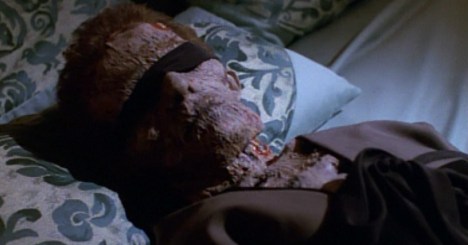
This is a little bit what watching the episode feels like.

This is a little bit what watching the episode feels like.

In the second season, this reactionary tendency played out through the treatment of the Kazon in episodes like Initiations and Alliances. In the third season, with the Kazon long gone, it seems that Voyager has turned its reactionary gaze upon its female cast members. To be fair, the show’s first two seasons had any number of unfortunate creative decisions when it came to various female characters. Most notably, the decision to turn Seska into a baby-crazed maniac in Manoeuvres did not bode for the first female-led Star Trek series.

Nevertheless, a misogynist streak has manifested itself across the third season as a whole. In some cases, this has been relatively subtle; like the awkward insistence upon sexualising three-year-old Kes in the eyes of her two mentor figures in Warlord and Darkling. In other cases, this has been the entire point of the plot; like the decision to have Q try to sleep with the franchise’s first female lead and introduce his shrewish wife in The Q and the Grey or to introduce a psycho stalker in Alter Ego.
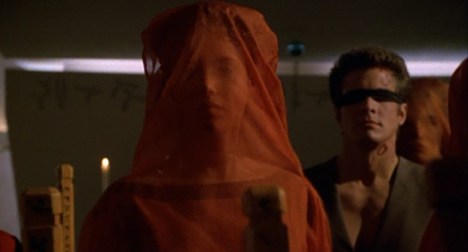
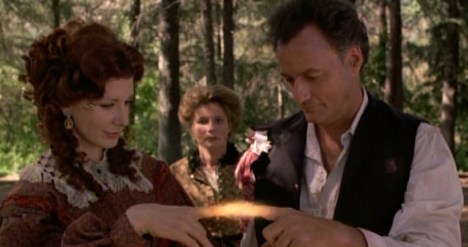
The original red wedding.

The original red wedding.

Other times, this sexist attitude has bubbled through the background of various episodes to the point that it builds to critical mass. Torres is victimised by her male colleagues over the course of three straight episodes, and none of them are held accountable; she is sexually assaulted by Vorik in Blood Fever, stunned by Chakotay in Unity, and tortured by the evil!EMH in Darkling. In each of those cases, the show seems to shrug off the violence committed by male characters against one of the show’s female leads.

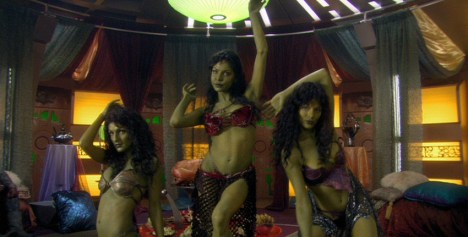
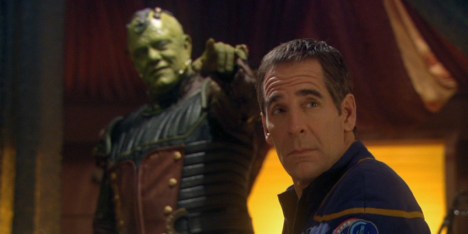
All of these elements come to the fore in Favourite Son, an episode that would have been painfully retrograde had it aired as part of the original series during the sixties. Favourite Son is that most uncomfortable myth dressed up in science-fiction drag, the tale of an island of beautiful women using their sexual prowess to lure men into their clutches to emasculate them. It is terrifying to think that this episode made it to air in the late nineties.
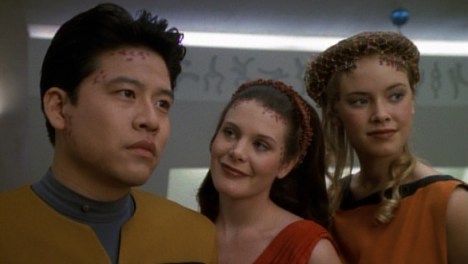
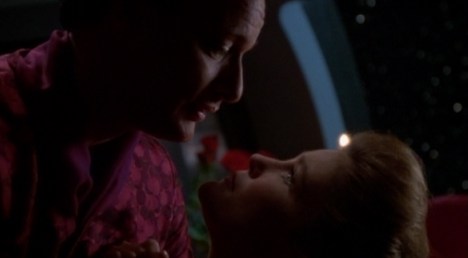
A beautiful dream.

A beautiful dream.

Continue reading

Star Trek: Voyager – The Q and the Grey (Review)

The Q and the Grey is an extraordinary cynical piece of work.

What better way to mark the release of Star Trek: First Contact into cinemas than to ensure that the very next episode of Star Trek: Voyager to broadcast features a guest appearance from one of the most beloved recurring characters to have appeared on Star Trek: The Next Generation? After all, the series had just led into the release of the movie with Future’s End, Part I and Future’s End, Part II providing a mid-nineties reimagining of the beloved Star Trek IV: The Voyage Home.

Pitching Q.

Pitching Q.

More than that, with Michael Piller gone from the writers’ room, the production staff had laid out a vision for the future of Voyager. The series effectively jettisoned any number of ideas that Piller had fostered over the first two seasons, from tension between Starfleet and the Maquis to the Kazon to Lon Suder to the idea of long-form storytelling to the relationship between Neelix and Kes. Instead, Voyager had decided to pitch itself as the most generic Star Trek ever, with little reference to the central premise of the series from here on out.

Indeed, The Q and the Grey is the second story in a very short space of time to make light of the crew’s journey home by refusing to press a more powerful guest star for assistance. In Future’s End, Part I and Future’s End, Part II, the ship’s temporally displaced return to Earth was shrugged with only a few lines of dialogue used to explain why this trip halfway across the galaxy could not be exploited to shorten their journey home. In The Q and the Grey, Janeway declines Q’s offer of assistance to get the crew home.

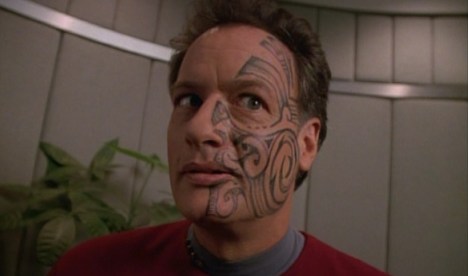
Bold-faced liar.

Bold-faced liar.

“My crew and I will get home,” Janeway informs Q. “We’re committed to that. But we’re going to do it through hard work and determination. We are not looking for a quick fix.” It is effectively the “building character” excuse for why Janeway doesn’t simply ask Q to return the ship home at the end of the story when the dust settles; nobody actually knows why that is, but it is probably best to offer some moral argument. The fact the Q could easily return the ship home, saving the lives of those who will die in the years ahead, is glossed over.

However, that does not matter, because Voyager has largely rejected its central premise. This no longer a series about a crew desperately longing to get home, except when it provides a convenient motivation. This is a Star Trek spin-off that is content to offer reheated leftovers inherited from The Next Generation. In this case, The Q and the Grey feels like a retread of Q Pid, a particularly uninspiring Next Generation episode. Next, Macrocosm will offer its own take on Genesis, another less than iconic Next Generation story.

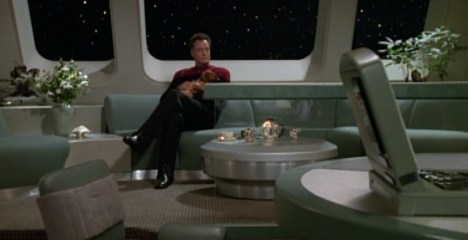
And your little dog, too.

And your little dog, too.

All of this is building, to Voyager‘s most blatant and obvious inheritance from The Next Generation. The Borg are coming to Voyager, in greater numbers and higher concentration than they ever appeared on The Next Generation, as the show continues awkwardly trying on its older sibling’s clothes. It is disappointing and uninspiring by equal measure, watching Voyager abandon any pretence of its own identity in favour of something safer and more familiar. Then again, this was always a Star Trek show about longing for the comforts of home.

However, The Q and the Grey is not merely unoriginal and uninspired, it is also unfortunate. Kenneth Biller’s script is cringe-inducing and embarrassing, illogical and misogynistic. The biggest issue with The Q and the Grey is not that Voyager has settled for offering a pale imitation of The Next Generation. The problem is that that the imitation is downright terrible in its own right.

It fingers.

It fingers.

Continue reading

Star Trek – Turnabout Intruder (Review)

This July and August, we’re celebrating the release of Star Trek Beyond by taking a look back at the third season of the original Star Trek. Check back every Monday, Wednesday and Friday for the latest update.

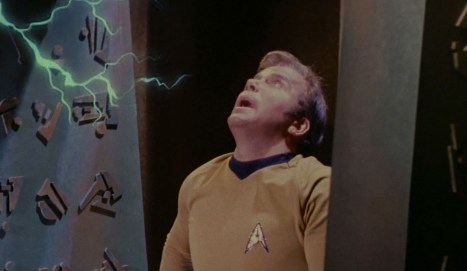
This is the end.

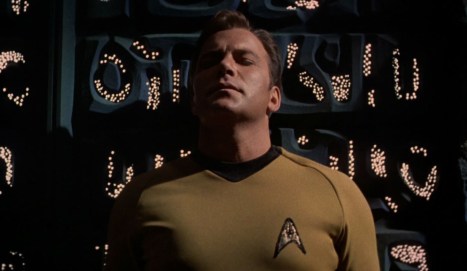
And what an ignominious ending it is. Turnabout Intruder is the last episode of the original Star Trek run, bringing down the curtain on three years of boldly going and bidding farewell to this cast… at least for the moment. It is also an infamously terrible episode of television, in which Captain Kirk finds himself swapping bodies with the psychotic scientist Janice Lester. Lester is repeatedly categorised as insane, but her primary motivation seems to be rebellion against Starfleet’s institutional sexism.

It's full of stars.

It’s full of stars.

Seen as this is a Gene Roddenberry story, Turnabout Intruder sides entirely with Starfleet on the matter. This was the same writer and producer who would later balk at The Measure of a Man because he thought that Data should willingly surrender himself to Starfleet experimentation. So, instead of becoming an exploration of sexism and discrimination, Turnabout Intruder instead becomes a vigorous defense of institutionalised misogyny. Of course Starfleet doesn’t allow women captains, the episode suggests, they could never handle the strain!

It is an episode that really puts paid to the show’s claims of liberal progressivism, credited to a writer who would in later years cultivate a mythology of himself as the architect of that liberal progressivism. Turnabout Intruder is just about the most damning argument against the franchise’s utopian idealism imaginable, which makes it particularly insulting as a series finale.

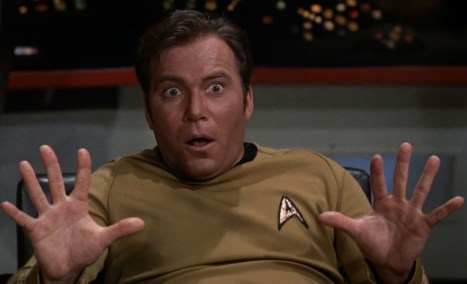
William Shatner did not react well to news of cancelation.

William Shatner did not react well to news of cancellation.

Continue reading

Star Trek – The Paradise Syndrome (Review)

This July and August, we’re celebrating the release of Star Trek Beyond by taking a look back at the third season of the original Star Trek. Check back every Monday, Wednesday and Friday for the latest update.

As with Elaan of Troyius, it feels like The Paradise Syndrome casts an awfully long shadow for such a simply awful episode.

Much like Elaan of Troyius before it, The Paradise Syndrome marks out what will become a particular subgenre of Star Trek episode. To be fair, Elaan of Troyius had a much greater influence; it demonstrated that the basic “Enterprise ferries diplomats” plot from Journey to Babel was something that could be repeated, throwing a healthy helping of “our hero falls for an alien princess” into the mix. In contrast, the basic template defined by The Paradise Syndrome is a lot more specific.

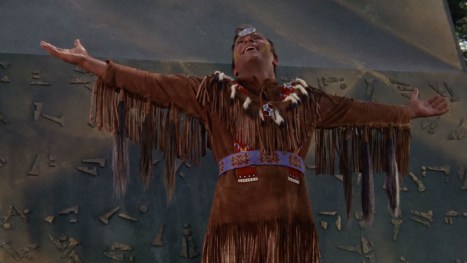
Going Native American.

Going Native American.

The Paradise Syndrome effectively posits a “what if…?”, wondering what might happen if Kirk gave up adventuring to settle down into a more mundane existence. It is an idea that Star Trek: The Next Generation would revisit to much greater effect in The Inner Light. It is also the basic template employed by Workforce, Part I and Workforce, Part II during the final season of Star Trek: Voyager. It is very rare to point to Voyager and argue that it executed an idea much better than the original Star Trek, but this is perhaps the exception that proves the rule.

The Paradise Syndrome is also (and unavoidably) a clumsy racist misfire of an episode.

"That'll teach me to hope that the next episode will be better."

“That’ll teach me to hope that the next episode will be better.”

Continue reading

Star Trek: Enterprise – Bound (Review)

This May, we’re taking a look at the fourth (and final) season of Star Trek: Enterprise. Check back daily for the latest review.

Bound is, for all intents and purposes, the last standalone episode of Star Trek of the Rick Berman era.

There are five more episodes following Bound, but they consist of two two-parters and the official series finale. Bound is very much the last “regular” episode of Star Trek: Enterprise to be produced, the last episodic adventure in the series. In fact, given the trends in contemporary television that are nudging the format towards serialisation and long-form storytelling, it seems entirely plausible that Bound could be the last standalone episode of Star Trek ever produced.

Strike a pose.

Strike a pose.

As such, it is a shame that Bound is a complete and utter disaster. It is an embarrassment to the series and to the franchise. More than that, it is an embarrassment that was written by the fourth season showrunner and which feels very much like the big ideas of the fourth season carried to their logical conclusion. Bound recalls the horrible sexism of episodes like Precious Cargo and Bounty, cloaking its objectionable sexual politics in the guise of nostalgia. Arguably the best things about Bound is that it makes Rajiin seem well-constructed in comparison.

Bound is easily the worst episode of the season and a strong contender for one of the worst episodes of the series. What better way to remember Enterprise?

Nostalgic sexism, hoy!

Nostalgic sexism, hoy!

Continue reading

Star Trek: Voyager – Persistence of Vision (Review)

This February and March, we’re taking a look at the 1995 to 1996 season of Star Trek, including Star Trek: Deep Space Nine and Star Trek: Voyager. Check back daily Tuesday through Friday for the latest review.

In some respects, the second season of Star Trek: Voyager can be seen as a conflict over the future of the show.

On the one hand, Michael Piller had returned to the franchise following the failure of the television show Legend. With Ira Steven Behr overseeing Star Trek: Deep Space Nine, Piller returned to focus his attention on the second season of the younger Star Trek show. After all, the second season was a disorganised mess, with the production team struggling to get the necessary scripts together on time. Having a safe pair of hands on board to help guide the show might come in handy.

"It's a bridge AND a tanning salon, simultaneously..."

“It’s a bridge AND a tanning salon, simultaneously…”

On the other hand, Jeri Taylor had been around the show since Caretaker. She had taken over the reins after Piller’s departure and had supervised the tail end of the first season. Taylor had arrived on the Star Trek franchise just a year after Piller, and had been a vital part giving Star Trek: The Next Generation its unique voice and mood. Over the course of the second season, it became increasingly clear that Michael Piller and Jeri Taylor had very different visions for the future of Star Trek: Voyager, and those visions were coming into conflict.

History ultimately vindicated Jeri Taylor. The second season of Voyager was the last television season of Star Trek to be directly overseen by Piller, while Jeri Taylor become the guiding light of the third and fourth seasons of the show. Whatever problems might exist with those two seasons television, they are at least more stable and consistent than the first and second years of the show. It is, of course, arguable that Piller never got his own change to exercise his own vision of the show unimpeded – and so that is not a fair measure.

Cutting the Doctor down to size...

Cutting the Doctor down to size…

In a way, the conflict between Piller and Taylor’s versions of Voyager is quite clearly typified in this early run of episodes. The show had breezed through the four episodes left over from the first season production block, and desperately needed ideas to keep afloat. The senior producers rolled up their sleeves and got involved. Piller was largely responsible for Parturition and Tattoo, while Taylor oversaw Persistence of Vision. None of these episodes are perfect, but it is quite clear that Taylor is increasingly the show’s safest bet going forward.

Persistence of Vision is a very flawed episode of television, playing to some of Taylor’s more uncomfortable recurring motifs. However, it is much more interested in actually moving Voyager along than either of Piller’s contributions.

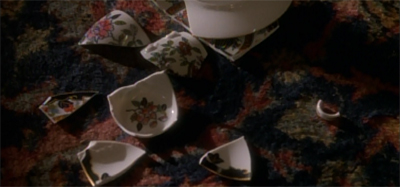
"The teacup that I shattered did come together."

“The teacup that I shattered did come together.”

Continue reading

The Lone Gunmen – Three Men and a Smoking Diaper (Review)

This October/November, we’re taking a trip back in time to review the eighth season of The X-Files and the first (and only) season of The Lone Gunmen.

Three Men and a Smoking Diaper might just be the worst episode of The Lone Gunmen.

It is also the only episode to be written solely by Chris Carter, who had also contributed to The Pilot.

Good advice...

Good advice…

Continue reading

Star Trek: Enterprise – Exile (Review)

Next year, Star Trek is fifty years old. We have some special stuff planned for that, but – in the meantime – we’re reviewing all of Star Trek: Enterprise this year as something of a prequel to that anniversary. This August, we’re doing the third season. Check back daily for the latest review.

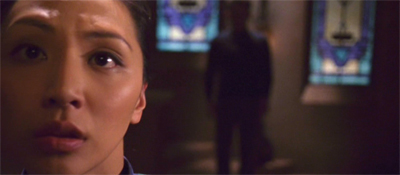
If Impulse was Star Trek doing contemporary horror, then Exile is Star Trek doing gothic horror.

It is quite impressive how committed Exile is to its gothic horror trappings. Tarquin doesn’t just live alone in exile and project flattering images of himself; he lives in an honest-to-goodness gothic mansion lit by candles, where he dabbles in the occult while wearing what is a highly stylised dressing gown and between tending to the graves of his beloved(s). Exile does not skimp on its pulpy trappings. Like a lot of the early third season episodes, Exile would make for a satisfying dime-store paperback sci-fi novel; several images from the story would make a suitable cover.

It was a dark and stormy night...

It was a dark and stormy night…

That said, it is quite difficult to pull off gothic science-fiction. The original Star Trek pulled it off on a number of occasions – most obviously with The Squire of Gothos. The later spin-offs have struggled getting the right balance of po-faced seriousness with heightened absurdity. Star Trek: The Next Generation attempted Sub Rosa in its final season, while Star Trek: Voyager had some early experiments with Janeway’s gothic horror fantasy. Neither could be deemed a resounding success, and Exile stumbles a bit in the execution.

There are a number of leaps that the plot doesn’t quite articulate as well as it might. It is hard to believe that Archer would leave Hoshi alone with Tarquin, even with a phase pistol tucked under her pillow. The revelation of Tarquin’s powers should terrify the crew; having the ability to alter another person’s perception across lightyears is utterly unlike anything these explorers have seen before. However, everybody seems to accept it at face value so that the plot can move along at a reasonable rate.

Somebody has a fixation...

Somebody has a fixation…

The way that Exile ties back into the larger arc is somewhat clumsy, right down to the convenient segue into The Shipment that comes in the final scene. In many ways, the structure of Exile recalls that of Extinction, an effectively stand-alone story that contains a very trite nods to the larger Xindi arc without any substantive connection. Despite the vital exposition that Tarquin provides in his final scene (and the subplot involving the spheres), Exile feels rather unnecessary in the larger scheme of things.

And yet, despite all that, Exile has something quite interesting to say. Written by Phyllis Strong, directed by Roxann Dawson and starring Linda Park, Exile is a very rare episode of Enterprise. It is a story with a very clear (and somewhat prescient) feminist subtext that has some very astute observations to make about certain facets of what might be deemed “nerd culture.” Specifically, male nerd culture.

He sees you when you're sleeping...

He sees you when you’re sleeping…

Continue reading

Star Trek: Enterprise – Bounty (Review)

Next year, Star Trek is fifty years old. We have some special stuff planned for that, but – in the meantime – we’re reviewing all of Star Trek: Enterprise this year as something of a prequel to that anniversary. This April, we’re doing the second season. Check back daily for the latest review.

Just when it seemed like Star Trek: Enterprise was on a roll, it produces Bounty.

To be fair to writers Mike Sussman and Phyllis Strong, and showrunners Rick Berman and Brannon Braga, Bounty has all the makings of a network-mandated episodes. It is easy to see the stock plot elements manufactured from a checklist provided by the network. T’Pol in her underwear! Space battles! Klingons! The script also demonstrates a clear reluctance about some of these elements, as uncomfortable to be making Bounty as the viewers are to be watching it.

An enlightening experience?

An enlightening experience?

It is perhaps telling that Bounty was buried as the second half of a “double feature” with First Flight on initial broadcast. Not a feature-length adventure or a two-part episode, the scheduling of Bounty seems a little conspicuous, as if everyone involved is trying to get it out of the way as quickly and quietly as possible. Viewers watching UPN on 14th May 2003 would have tuned in for First Flight as usual. If they were lucky, they simply tuned out afterwards and returned to watch The Expanse a week later.

It is a much smoother transition from First Flight to The Expanse, but that does little to justify Bounty. The last stretch of the second season has generally done a good job of bidding farewell to a particular style of Star Trek. However, Bounty is an episode the embodies the worst tendencies of Enterprise. Sadly, those tendencies that may not actually be going anywhere.

"You're gonna sit there, and like it."

“You’re gonna sit there, and like it.”

Continue reading

The X-Files – Small Potatoes (Review)

This February and March, we’re taking a trip back in time to review the fourth season of The X-Files and the first season of Millennium.

Darin Morgan’s absence haunts the fourth season of The X-Files.

According to Frank Spotnitz, Darin Morgan had originally hoped to contribute a script in the middle of the season. Unfortunately, that idea fell through. The scramble to fill that gap in the schedule led to Memento Mori, which ultimately became the centre of the fourth season’s mythology arc, for better or worse. Scully’s cancer arc was just one result of the Darin-Morgan-shaped hole in the fourth season. Small Potatoes is another, the show’s first real “comedy” episode since Morgan departed the staff at the end of the third season.

A sting in the tale...

A sting in the tail…

Darin Morgan often gets credit for introducing the concept of comedy to The X-Files. That is not entirely fair; Glen Morgan and James Wong wrote Die Hand Die Verletzt shortly before Darin Morgan wrote Humbug. However, Morgan did refine the idea of comedy on The X-Files. Darin Morgan won an Emmy for writing Clyde Bruckman’s Final Repose, and he still considers Jose Chung’s “From Outer Space” to be among the best things that he has ever written.

Despite Morgan’s departure, it was clear that The X-Files could not completely avoid comedy. Once a show has demonstrated that it can do something particularly well, it becomes very difficult to stop doing that thing. Comedy episodes became something of a staple on The X-Files, with the show regularly churning out light-hearted and funny episodes (with varying degrees of success) until the show was finally cancelled after its ninth season. However, there was a long stretch after Morgan departed where the series seemed quite grim. Somebody would have to go first.

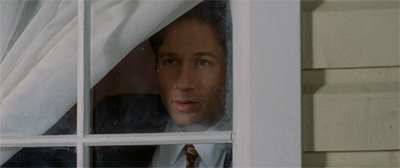
The inside, looking out...

The inside, looking out…

So Vince Gilligan stepped up to bat. Gilligan had been on staff for a bout a year at this point. He had quickly established himself as one of the most promising young writers in the room. While his first script for the show – Soft Light – was arguably more interesting than successful, Gilligan enjoyed an incredible hot streak when he joined the staff. Pusher, Unruhe and Paper Hearts are among the best scripts of the third and fourth seasons. With Small Potatoes, he seemed to position himself as the logical successor to Darin Morgan.

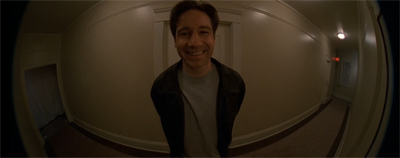
Darin Morgan even appears in Small Potatoes to pass the metaphorical baton.

"Here's Mulder!"

“Here’s Mulder!”

Continue reading