• Following Us

  • Categories

  • Check out the Archives


  • Awards & Nominations

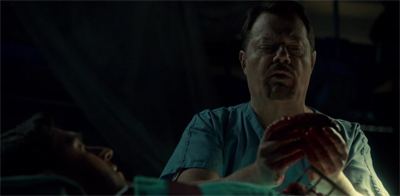
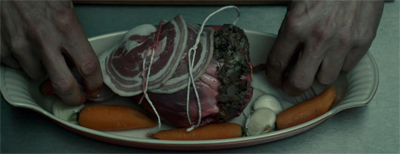
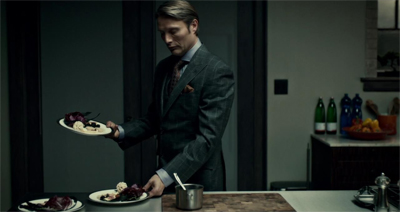
Hannibal – Relevés (Review)

For a show about a serial killer and the FBI’s Behavioural Analysis Unit, Hannibal is often surprisingly deep. That’s not much of a surprise, given the quality of the staff working on it, but the show is absolutely stunning meditation on identity and personality. In a way, that’s one of the smartest things about Fuller’s first thirteen episode season, building on the foundations set by Thomas Harris to construct something that fits quite elegantly while remaining its own distinct entity.

Relevés is the penultimate episode of the first season, and the point where – having used Roti to clear away some of the clutter – the show starts tying up a lot of those loose ends. Perhaps one of the most impressive things about the episode is the amount of suspense that Bryan Fuller and his staff can wring from the set-up – despite the fact that we know how this story ends, Hannibal manages to engage us so completely in the telling that what we already know seems almost irrelevant.
Things are heating up...

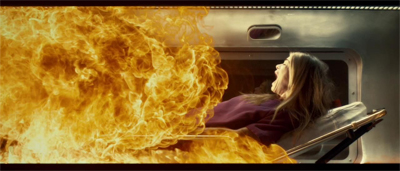
Things are heating up…

Continue reading

Hannibal – Roti (Review)

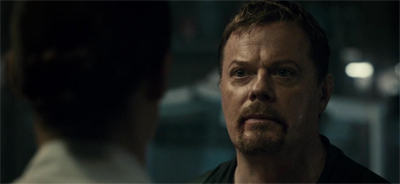
Roti is the point where Hannibal really starts to gear up for its finalé. The decision to thematically name each of the first season’s episodes after a part of a meal seems oddly appropriate, as the whole season can be seen as a banquet, each of the courses painstakingly prepared to ensure a rich bouquet of flavour and a pleasing array of tastes. Each course is individual, and yet it remains part of the whole. It’s all one gigantic and enjoyable experience, just broken down into sweet digestible chunks. Each serves a clear purpose, like a chapter in a book, or a course in a meal.

Roti features the return of Abel Gideon, the show’s obvious homage to Anthony Hopkins’ portrayal of Doctor Hannibal Lecter. It also positions Will precisely where he needs to be for the first season’s rapidly-approaching climax.

A piece of the action...

A piece of the action…

Continue reading

Hannibal – Buffet Froid (Review)

Buffet Froid is the most strikingly horrific episode of Hannibal to date. Of course, the show is very much a horror story and enjoys its fair share of grotesque imagery. This is the series, after all, that gave us the makeshift angels, the do-it-yourself cello and the human totem poll. However, Buffet Froid plays most obviously on the imagery and iconography of horror. This is the episode where people have no faces and skin comes off at the slightest touch and the serial killer is waiting for you under your bed.

As you might imagine for a show with such complete control of its own atmosphere, Buffet Froid works very well indeed – providing what might be the most horrific episode of the show to date.

The doctor will see you now...

The doctor will see you now…

Continue reading

Hannibal – Sorbet (Review)

Hannibal took its time building up Hannibal Lecter as a serial killer. According to creator Bryan Fuller, there would have been a joke in Aperitif about Lecter’s culinary habits, but holding off on the sight of Lecter as a serial killer until the end of Entrée feels like it was a shrewd move. Not because it could ever fool the audience into forgetting that Hannibal Lecter is a murdering cannibal or anything like that. Instead, it builds up a certain amount of tension and suspense around the character, allowing us to see how those around him could have been blinded by his persona.

With a few obvious exceptions – knocking out Doctor Bloom in Potage or phoning the Hobbs household in Aperitif – we’ve mostly seen Lecter through the eyes of others. While the very premise of the show counts on the audience knowing who or what Lecter is, keeping him at a distance allowed the show a bit of breathing room in its first year. However, now that we’ve caught a glimpse of Lecter in action, Sorbet feels like its willing to pull back the layers on our eponymous epicurean.

Best served warm...

Best served warm…

Continue reading

Hannibal – Entrée (Review)

It’s nice that we got this far into the season before Entrée was necessary. It’s the kind of episode that a show like Hannibal was always going to have to produce relatively early on, allowing it to air the laundry, so to speak, and to overtly and clearly distinguish itself from a popular predecessor. In this case, it’s The Silence of the Lambs.

Although we haven’t met Clarice Starling yet, although the credit at the start of each episode cites Red Dragon as the show’s inspiration, it’s hard to escape the shadow of one of the most popular horror films ever made. Many argue that The Silence of the Lambs was the first film to win the Best Picture Oscar. Even today, it remains a cultural touchstone, and there’s an incredibly large number of people who are only familiar with the character of Hannibal Lecter through that story and – in particular – through the film adaptation.

Hannibal hasn’t been shy about referencing The Silence of the Lambs, nor should it be. Crawford’s office from the start of Aperitif seems arranged in homage to the film, while the arrangement of two of the victims in Coquilles couldn’t help but evoke Hannibal’s dramatic escape from his cell at the film’s climax. Still, that doesn’t change the fact that Entrée exists mainly to allow the show to indulge and engage in the imagery and iconography of the film, so that Hannibal can truly distinguish itself.

"Oh, goodie..."

“Oh, goodie…”

Continue reading

Hannibal: Coquilles (Review)

I feel a little bad now. I spent a lot of time in Amuse-Boche and Ceuf complaining about the possibility that Hannibal might turn into a serial-killer-of-the-week procedural, at a time when the networks are over-saturated with that sort of forensic drama. However, Coquilles manages to be a pretty superlative hour of television despite feeling like a pretty conventional “catch the serial killer” story. The key is in the execution, with Coquilles serving as a rich character-driven drama that just happens to involve the hunt for a gruesome serial killer.

It also helps that the “angel maker” feels like a refugee from an early draft of a Thomas Harris novel rather than a bland psychopath of the week.

Served...

Served…

Continue reading

Hannibal – Ceuf (Review)

Ceuf is somewhat overshadowed by the controversy it generated, an episode of Hannibal pulled from broadcast following several national tragedies (including the Boston bombings and the Newtown tragedy). In the wake of these two high-profile incidents, it was felt that broadcasting the full episode so close to the events would have been a bit much. This move naturally generated a host on on-line commentary with various people adopting various positions on the topic of whether or not Bryan Fuller was right to pull the show from the air. In a way, Ceuf is far more interesting for what it ended up being than as a chapter of Hannibal.

Something to chew over...

Something to chew over…

Continue reading

Hannibal – Potage (Review)

Hannibal continues to move apace. Serialisation can often be a tricky beast, because it relies heavily on pacing. Reveal too much too fast and none of the plot beats carry enough weight. Drag out your revelations and your game-changing twists, and things feel too slow. The sense of progression is lost. On top of that, and something which is easily overlooked when it comes to serialisation, the key is to ensure that each episode exists as its own entity, while remaining a part of the whole. As often as one might use the “chapters of a book” analogy for episodes of The Sopranos or The Wire, this tends to ignore that each episode generally tended to be structured as its own entity. While a part of a larger story, each episode was its own self-contained unit of story.

Potage seems to suggest that Hannibal is finding its feet in the area, and carefully pacing itself. We are peeling back the layers on the eponymous psychiatrist at a pace that is neither too fast nor too slow. The evidence is mounting and his moves are becoming more brazen, but he retains his air of mystery. Since Lecter is a character who only really works with that sense of mystery, it’s a shrewd balance between progressing the plot and retaining the character’s appeal. Potage demonstrates the show has quite a knack for it.

The good doctor?

The good doctor?

Continue reading

Hannibal – Amuse-Bouche (Review)

Second episodes can be tough. Pilots tend to establish the core themes and characters of a show, offering a very clear blueprint going forward and perhaps hinting at the direction that you want to take things. They are grand mission statements, couched in broad terms and delivered with a sense of novelty. Second episodes are a bit less exciting. They are about putting that plan into action, defining the edges a bit, expanding outwards where necessary and refining as needed. It’s with the second episode that you really get a sense of what a show is going to be like in a more practical week-to-week sense.

By that measure, Amuse-Bouche works quite well at giving us a sense of putting the show’s feet on the ground and helping prepare us for what lies ahead for the rest of the season.

It's growing on me...

It’s growing on me…

Continue reading

Non-Review Review: The Frozen Ground

Despite strong central performances and a firm directorial hand, The Frozen Ground never quite manages to find its footing. Part se7en, part secondary school civics lesson, The Frozen Ground suffers from a ham-fisted script which feels the need to constantly remind the audience about how terrible the whole situation is. Characters don’t deliver dialogue so much as thematic statements, with the script playing out as an over-extended advertisement for a women-in-trouble charity.

The issues raised by The Frozen Ground about how society treats the abused and the dispossessed are definitely worth talking about. The film makes a lot of poignant criticisms about how the opinions and experiences of a certain class of women are conveniently dismissed and overlooked by those in positions of authority. The problem is that the script is far too earnest about such matters, as if afraid that the audience might be unable to grasp the exploitation of these women unless it is pointed out repeatedly and awkwardly.

It’s less of a film, and more of a blunt mission statement. Less of a story and more of a bleak public service announcement. Which is a shame, because John Cusack is legitimately great here, and Nicolas Cage and Vanessa Hudgens do the best they can with the material afforded to them.

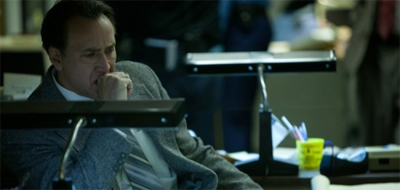
Feeling quite Cage-y on the subject...

Feeling quite Cage-y on the subject…

Continue reading